


Glycerin is a sugar alcohol used mainly as a humectant and preservative that keeps soft dog treats moist, pliable, and shelf-stable. Manufacturers often add about 10% to 15% during production, and it can make up roughly 20% to 30% of the finished treat after drying and shrinkage, while adding little nutritional value beyond its functional role.
So why do so many conversations about glycerin stop at “Is it safe?” A better question is, what is glycerin in dog treats doing, where did it come from, and how much of it is your dog consuming across the day? The answer helps you read a soft chew as a formulation, not just as a list of scary-sounding or reassuring words.
Table of Contents
- What Glycerin Actually Is in a Dog Treat
- The Four Jobs Glycerin Does Inside a Soft Chew
- Where Glycerin Comes From and Why the Source Matters
- How Much Glycerin Is in a Typical Treat
- Safety, Side Effects, and the Cumulative Exposure Question
- Reading the Label Like Someone Who Knows the Trade-Offs
- When Glycerin Is Acceptable in Your Dog's Treats
What Glycerin Actually Is in a Dog Treat
What is glycerin in dog treats doing? Glycerin, also called glycerol, is a clear, odorless sugar alcohol used in foods, supplements, and pet products. Its name can sound like sugar, but it is not table sugar or a dietary fat. In a soft chew, its main purpose is to manage moisture and texture rather than provide meaningful protein, vitamins, or other nutrients. WATT Global Media's glycerin analysis likewise describes glycerin as a functional ingredient with little to no nutritional value.
A simple comparison helps. A dry sponge feels stiff and brittle, while a damp sponge bends and keeps its shape. Glycerin works somewhat like a moisture-holding sponge inside a treat. It binds water and helps keep that moisture distributed through the chew instead of letting the product dry into a hard biscuit.
That physical effect shapes the product your dog receives. Soft treats contain enough moisture to create storage and texture challenges. Without an ingredient that helps hold moisture, a chew may crack, crumble, or become unpleasantly hard. Glycerin helps the manufacturer produce a bite that stays pliable and easy to chew while remaining suitable for storage without refrigeration.
Plain-English rule: Glycerin is usually there to control the treat's physical condition, not to improve its dietary value.
The ingredient's source deserves a separate look. Vegetable, animal, and synthetic glycerin can carry different implications for certification, sourcing preferences, and label transparency, even though the finished chemical is very similar. The amount used matters as well. A modest amount in one treat presents a different formulation question from a moisture-heavy recipe offered repeatedly.
Your dog's total intake matters more than one isolated ingredient listing. Glycerin can appear in soft chews, supplements, and other pet products, so check the full feeding pattern. The practical question is whether that pattern suits your dog's digestion and health needs, not solely whether one bite appears acceptable.
The Four Jobs Glycerin Does Inside a Soft Chew
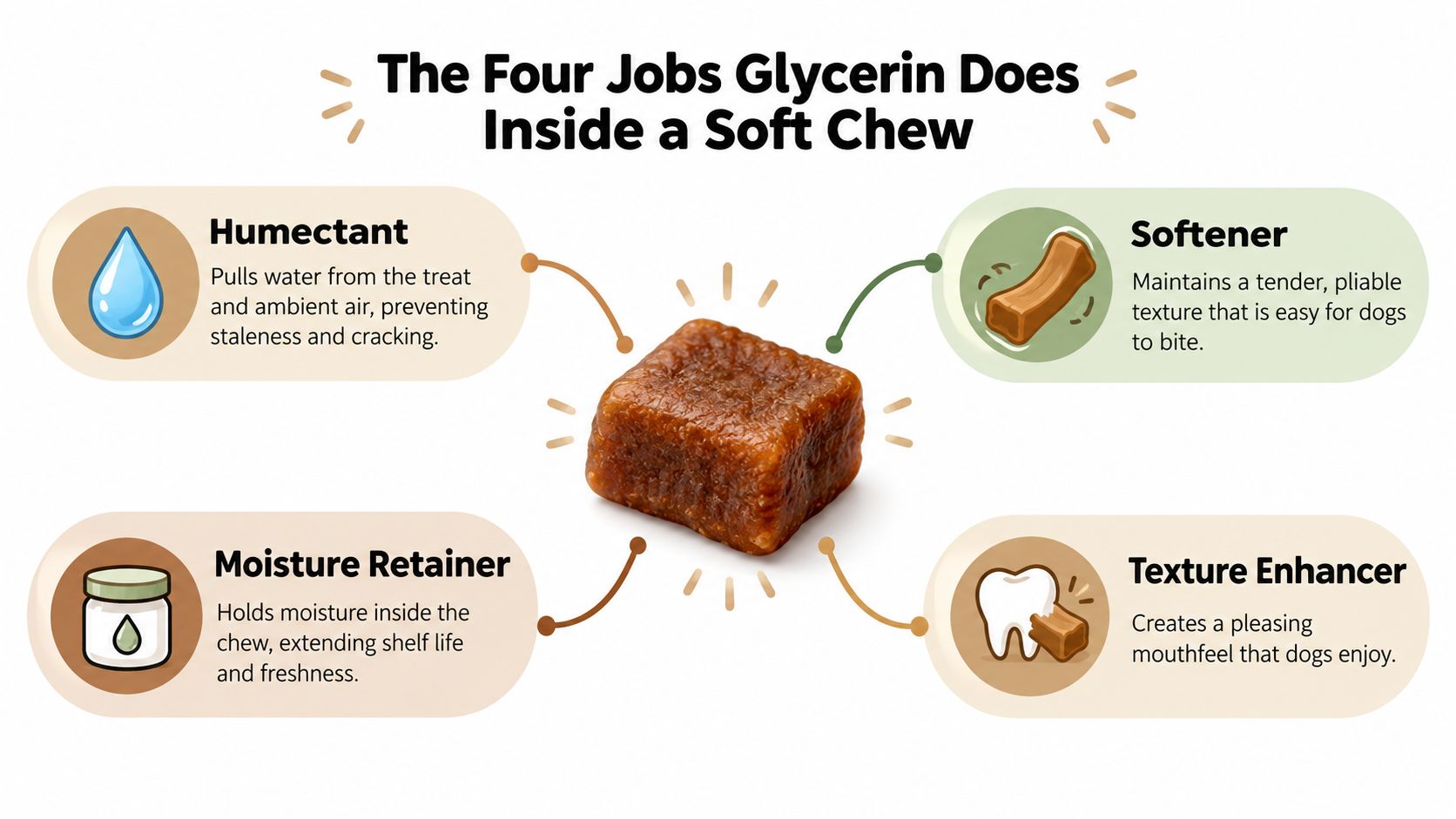
Glycerin does more than one job, although moisture control is usually the central one. A manufacturer may use it to shape how a treat feels, tastes, and stores.
Humectant
As a humectant, glycerin binds water. It can help keep moisture within a soft chew and interact with moisture in the surrounding air. That reduces the chance that the treat will quickly become dry, cracked, or hard after the package is opened.
A soft training reward needs to survive repeated opening and closing without turning into crumbs. Glycerin helps maintain that flexible feel.
Texture agent
Glycerin also works as a texture agent. It helps ingredients bind into a cohesive mass that can be pressed, extruded, shaped, and sliced during production. Without enough binding and moisture management, a soft product may crumble while it's being made or handled.
That's why the same ingredient can influence both factory performance and the dog's experience. The chew needs to hold together before it reaches the bowl, then remain tender enough to bite.
Mild sweetener
Glycerin has a mild sweetness. That can make a formulation more appealing and may help soften the taste of bitter botanical extracts, active ingredients, glucosamine, or some medications. It isn't the same as adding table sugar, but it still contributes to the overall flavor profile.
Shelf-life support
Finally, glycerin supports shelf stability by helping manage available water. A less favorable moisture environment can reduce the likelihood of rapid mold or yeast growth, although glycerin isn't a complete antimicrobial preservation system by itself. Manufacturers still need an appropriate overall formulation, packaging, and handling process.
A soft treat such as Prebiotic Chicken Squeeze Treats for Dogs, 24 Packets illustrates why texture and palatability are separate from glycerin itself. This product is described as a real cage-free chicken squeeze treat with prebiotics, and it's free of artificial colors, preservatives, and flavors. For a broader explanation of how soft products are designed for bite and convenience, see the Joyfull guide to soft chews.
Where Glycerin Comes From and Why the Source Matters
The word “glycerin” tells you what the ingredient is called, but it may not tell you enough about its origin. Manufacturers can obtain glycerin from different feedstocks, and owners may care about those distinctions because of dietary preferences, allergen management, certification, or supply-chain transparency.
Three common source categories
Vegetable glycerin comes from plant oils. Commonly discussed sources include palm, coconut, and soy oil. A label may identify it as vegetable glycerin, coconut glycerin, or palm-derived glycerin.
Animal glycerin can come from fats such as tallow or lard. It may be produced as a byproduct of soap or biodiesel manufacturing. Owners who avoid animal-derived ingredients for ethical, religious, or dietary reasons may want the source confirmed rather than assumed.
Synthetic glycerin is manufactured through chemical processes, including routes involving petroleum-derived propylene. The source can matter to buyers seeking plant-based or specific certification standards.
Chemically, purified glycerin from these routes is very similar. The practical difference is the information available about the supply chain and the standards applied to the finished ingredient. A vague label doesn't automatically prove poor quality, but it gives you less information to evaluate.
| Source | Typical Origin | Common Label Wording | Owner Considerations |
|---|---|---|---|
| Vegetable | Palm, coconut, or soy oil | Vegetable glycerin, coconut glycerin, palm-derived glycerin | Useful for plant-based preferences and clearer source identification |
| Animal | Tallow or lard byproducts | Animal glycerin, glycerin, glycerol | Relevant for animal-source exclusions and dietary preferences |
| Synthetic | Chemically manufactured feedstocks | Glycerin, glycerol, E422 | Ask the manufacturer if origin or certification matters to you |
How to read the wording
You may see glycerin, glycerol, glycerine, vegetable glycerin, or E422. A label that says “glycerin” doesn't give you the same source detail as one that identifies a plant origin. Some pet-food discussions describe a bare glycerin listing as commonly associated with a vegetable source, but you shouldn't treat that wording as proof of origin or quality.
Contact the manufacturer if source, food-grade status, or allergen control matters for your dog. Clear answers about the ingredient's origin and specifications are more useful than broad claims such as “natural” or “clean.”
How Much Glycerin Is in a Typical Treat
How much glycerin sits inside a soft chew, and what does that amount tell you about the recipe? The answer changes with the treat's moisture level, texture, and production method. An industry white paper describes minimum use around 10%, with 15% or more in wetter products. After drying and shrinkage, glycerin may represent roughly 20% to 30% of a finished treat. These figures describe formulation and finished-product context, not a universal amount in every product.
Ingredient lists usually appear in descending order by weight. The list cannot reveal an exact percentage, but it offers a useful clue about glycerin's role.
| Treat Format | Typical Glycerin % | Typical Label Position | Functional Implication |
|---|---|---|---|
| Moist soft chew | About 10% to 15% or more in wetter formulations | Often prominent | Moisture retention and pliable texture are central to the product |
| Functional chew | Varies by recipe | May appear near other major ingredients | Helps hold a shaped product together and maintain softness |
| Squeeze-style treat | Must be checked on the individual label | Depends on formulation | Texture and flow require careful moisture management |
| Crunchy baked treat | Usually less relevant to texture | Often absent or less prominent | The product relies more on baking and low moisture than on a soft-chew system |
A simple calculation shows why the label percentage matters. A 5-gram soft chew containing 10% glycerin would contain 0.5 grams of glycerin per chew. That result comes directly from the stated percentage, but it still depends on whether the figure describes the production mixture or the finished product.
The treat's position on the ingredient list adds another clue. Glycerin listed third or fourth may have a substantial formulation role in a soft, pliable product. Listed near position ten, it may support texture without driving it. The ingredient name stays the same, while its practical effect can change with the recipe. For that reason, read the percentage, product format, and surrounding ingredients together rather than judging the word alone.
Safety, Side Effects, and the Cumulative Exposure Question
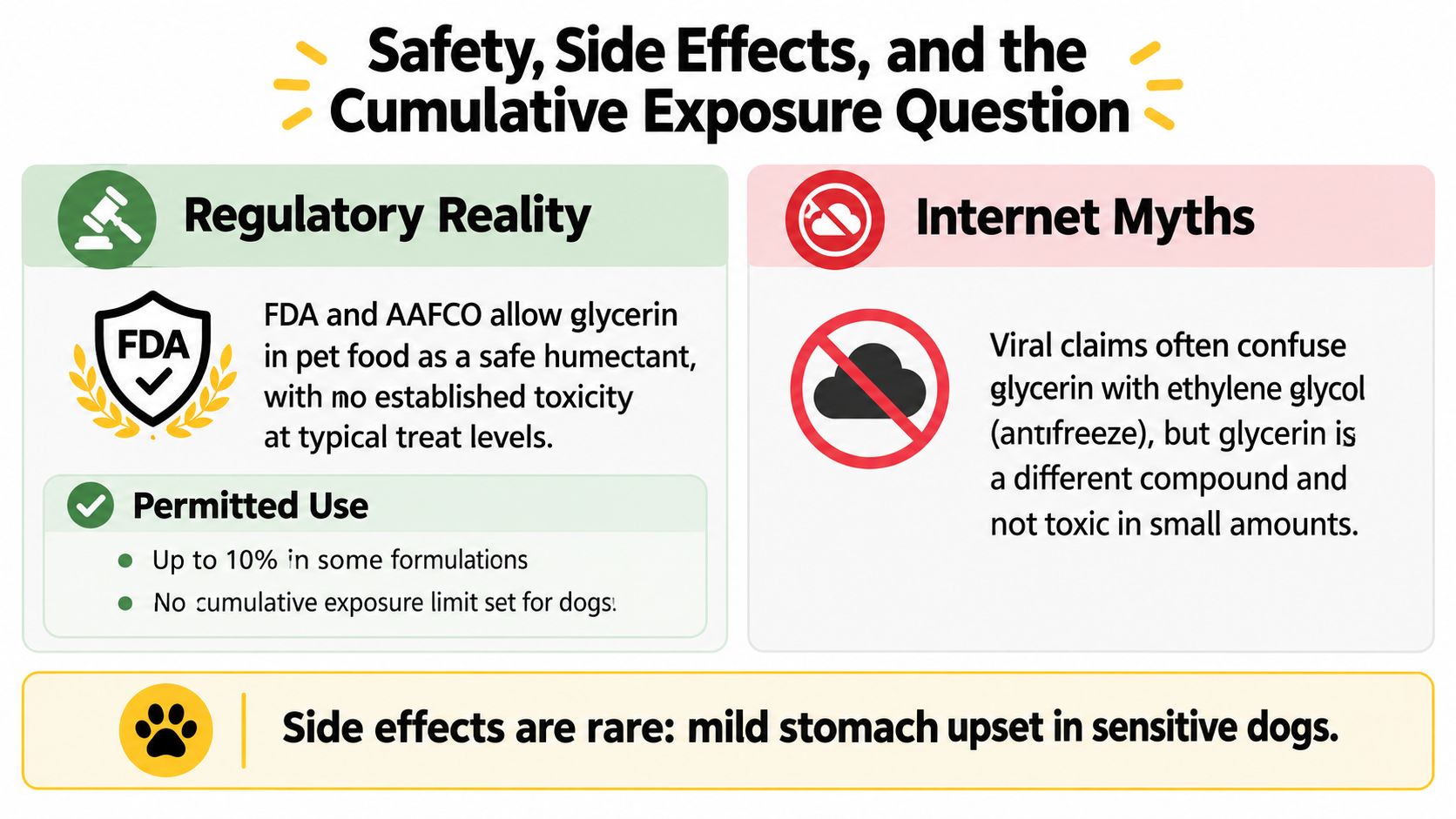
A glycerin listing does not, by itself, show that a treat is toxic. The more useful questions are whether the ingredient is food-grade, whether the recipe is properly formulated, and whether the manufacturer can explain its source and quality. Glycerin functions mainly as a texture and moisture ingredient, so its presence should be judged alongside the rest of the formula.
A past U.S. FDA jerky pet treat investigation also shows why accurate labeling matters. 58 samples were documented, and 17 contained glycerin that wasn't declared on the label, as summarized in WATT's ingredient analysis. The issue was not just the ingredient's name. It involved knowing what was in the product and recognizing that a functional ingredient is not the same as a major nutrient.
What reactions should you watch for
Digestive tolerance is the practical concern to monitor. Clear Conscience Pet's formulation white paper notes that excessive intake may contribute to cramping, gas, or diarrhea in sensitive dogs. Dog Food Advisor's glycerin discussion also describes possible gastrointestinal upset, including diarrhea, vomiting, gas, and cramping.
If loose stool or vomiting starts after a new treat, stop offering that product and observe your dog. Persistent or severe symptoms, or symptoms in a dog with an existing medical condition, call for veterinary advice.
Why the daily pattern matters
One treat rarely provides the whole picture. A dog might receive several soft rewards, a chew, a supplement, or another glycerin-containing product during the same day. Repeated exposure deserves closer attention when the dog already has a sensitive digestive system.
Track the pattern without pretending that an unlabeled percentage can provide an exact intake:
- List every product your dog receives in a day.
- Record glycerin's position on each ingredient panel.
- Note the serving size and how often you offer it.
- Watch stool, gas, appetite, and vomiting after changes.
- Ask your veterinarian about the pattern if your dog has diabetes, chronic gastrointestinal disease, or another condition affected by diet.
The available evidence does not establish one universal threshold for cumulative exposure. Repeated use, prominent placement on several labels, and digestive symptoms are reasons to review the full routine with a veterinarian rather than guess at a safe limit.
Reading the Label Like Someone Who Knows the Trade-Offs
A label can answer more than “Does this contain glycerin?” Read it as a set of clues about what the manufacturer needed the ingredient to do.
Start with the ingredient name
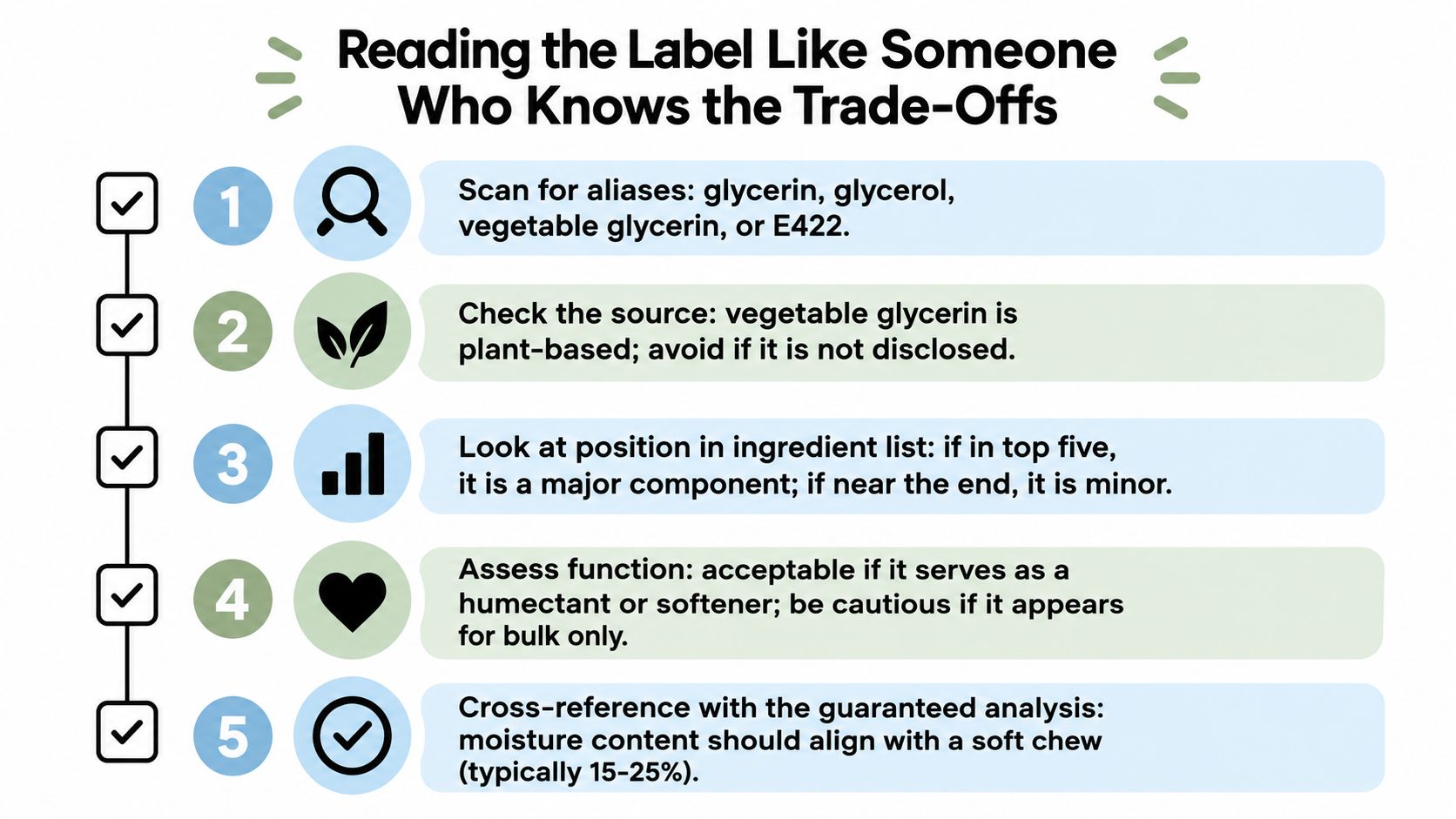
Look for glycerin, glycerol, glycerine, vegetable glycerin, or E422. Don't assume that a different spelling means a different function. These terms can identify the same general ingredient, while the added word “vegetable” provides more source information.
Next, inspect what appears around it. If the panel begins with identifiable animal proteins or whole-food ingredients and glycerin appears later, the product may be using it as a supporting texture ingredient. If glycerin appears near the top, the formula likely depends more heavily on moisture retention and soft texture.
Ask what the ingredient is doing
Use this quick checklist while shopping:
- Check the source wording. “Vegetable glycerin” gives more information than a bare “glycerin” listing. If the source matters to your household, contact the manufacturer.
- Check the ingredient position. A high position suggests a larger role by weight, but it doesn't provide an exact percentage unless the company discloses one.
- Check the treat format. A soft chew has a logical reason to use a humectant. A crunchy biscuit may rely on a very different production method.
- Check the feeding pattern. Consider whether your dog receives glycerin from several products instead of judging one package alone.
- Check your dog's response. Digestive changes are practical evidence that the current product or serving pattern may not suit your dog.
For more help with the surrounding ingredients, Joyfull's guide to reading pet food ingredient lists can help you evaluate the whole panel rather than isolating one word.
A useful aisle rule: Source transparency plus a sensible ingredient position is more reassuring than a vague “natural” claim.
Be cautious with labels that make broad quality promises but don't identify the glycerin source. Also avoid treating a “vegetable” label as a guarantee that the whole recipe meets your nutritional goals. Glycerin can be food-grade and functional while the rest of the treat still deserves scrutiny.
When Glycerin Is Acceptable in Your Dog's Treats
Glycerin can be acceptable when it has a clear job, the manufacturer gives you enough information to evaluate it, and the treat fits your dog's broader diet. A soft chew needs moisture control. That alone isn't evidence of a bad recipe.
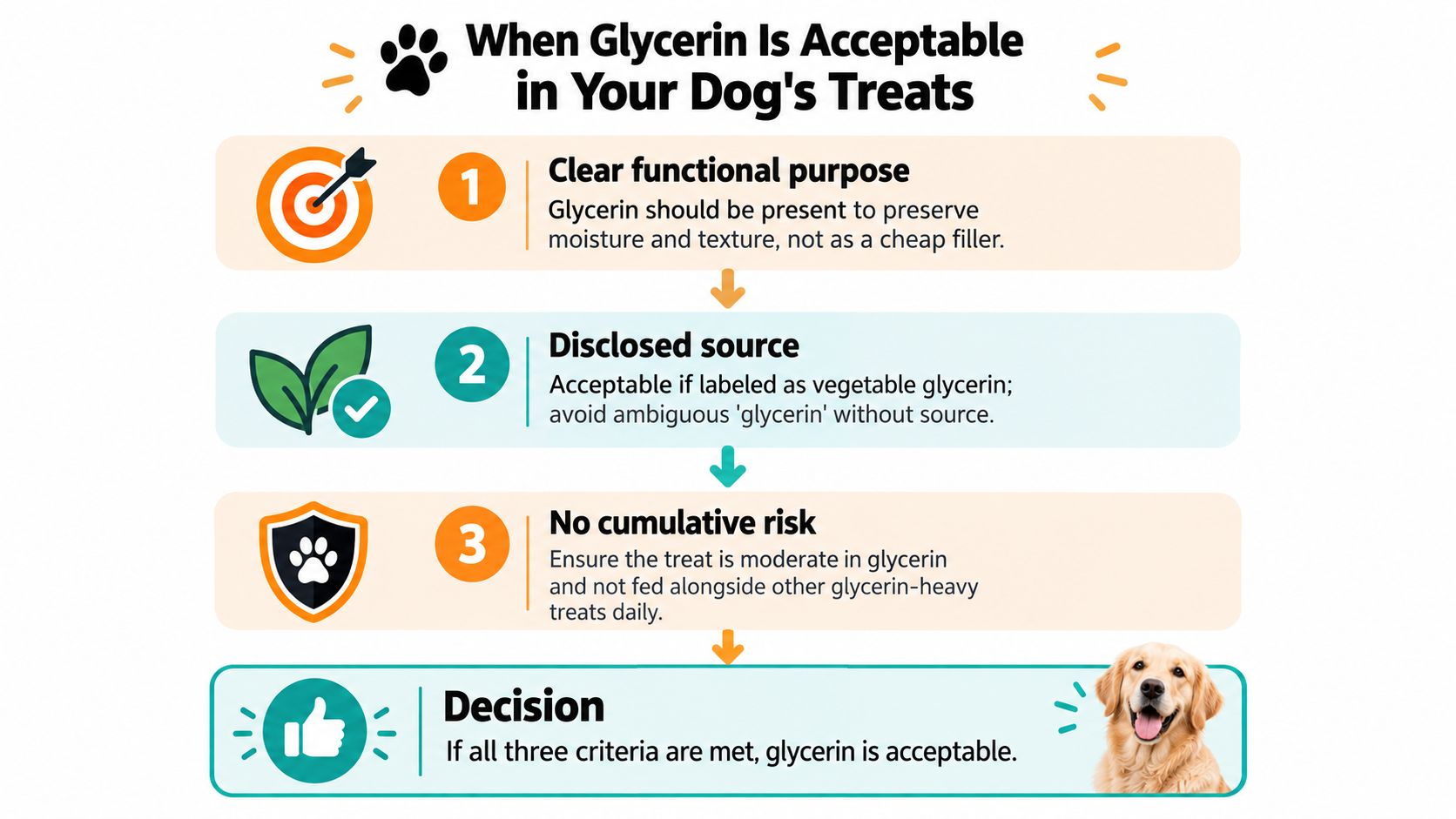
A practical decision rule has three parts:
- Clear function. The product is soft, moist, pliable, or designed to hold a shaped texture, so glycerin has an understandable formulation purpose.
- Disclosed source. The label identifies vegetable glycerin or the manufacturer can explain the ingredient's food-grade origin.
- Manageable exposure. You aren't stacking several glycerin-heavy products throughout the day, and your dog tolerates the treat without digestive upset.
Situations that deserve caution
Glycerin appearing among the first few ingredients doesn't automatically disqualify a treat, but it tells you to examine the formula more closely. Ask whether the primary ingredients still provide the qualities you want, or whether the product's identity depends mostly on moisture and texture.
Be more careful when:
- Your dog has diabetes or a condition requiring dietary control. Discuss regular use with your veterinarian.
- Your dog has a sensitive stomach. Introduce the product gradually and monitor stool, gas, appetite, and vomiting.
- The source isn't disclosed. Request clarification before making the treat a routine part of the diet.
- Your dog receives multiple soft products. Review chews, supplements, toothpaste, and other items together.
- Glycerin appears high on several panels. Variety can still create a repeated pattern of exposure.
For owners who also value small-batch pet care from local makers, the same principle applies. Ask what each ingredient does, where it comes from, and how the product fits into your dog's routine. Ingredient transparency is useful whether you're choosing a packaged chew or a locally made care product.
A lickable format can also change how you deliver rewards. Joyfull's dog squeeze treats are described as made with real cage-free chicken, containing prebiotics, and free of artificial colors, preservatives, and flavors. Whatever product you choose, read its own label rather than assuming that every soft or squeeze-style treat uses glycerin in the same way.
Glycerin is best understood as a functional tool, not a fear word. Choose products where its purpose makes sense, its source is reasonably clear, and your dog's total routine remains balanced.
Joyfull makes convenient pet treats built around clean ingredients and high-quality proteins, including options designed for lickable enrichment and prebiotic support. Review the product details and ingredient information at Joyfull before choosing a treat that fits your dog's label-reading priorities.
0 comments