


Your puppy ignores the crunchy biscuit the moment a training session starts, or your older dog takes a reward eagerly but struggles to break it apart. In both cases, the issue may not be stubbornness. Texture changes how easily a dog can eat, smell, carry, and enjoy a treat.
Soft chew dog treats can be especially useful when you need a reward that tears into small pieces, feels gentler on sensitive mouths, or keeps a dog engaged without a long chewing break. But “soft” describes texture, not automatically quality, digestibility, or safety. A pliable treat can still contain unnecessary ingredients, provide too many calories, or be unsuitable for a dog with allergies.
This guide will help you understand what makes soft chews different, how moisture affects their texture and shelf life, how to scan an ingredient list, and how to decide whether a functional claim has meaningful support. You'll also learn how to portion them for training, compare homemade and commercial options, and build a simple safety routine.
Table of Contents
- Introduction to Soft Chew Dog Treats and Why Texture Matters
- What Makes Soft Chew Dog Treats Different
- How to Read Ingredients and Judge Protein Quality
- Best Use Cases for Training Senior Dogs and Everyday Rewards
- Portion Control Calories and Fitting Treats Into a Balanced Diet
- Homemade Versus Commercial Soft Chews What to Consider
- Choosing Vet Friendly Options and Staying Safe With Allergens
Introduction to Soft Chew Dog Treats and Why Texture Matters
A young dog learning “sit” may need several rewards in a short session. A hard biscuit can take too long to chew, crumble across the floor, or distract the dog from the next cue. A soft treat, by contrast, can often be broken into a tiny bite and swallowed quickly, keeping the lesson moving.
An older dog may have a different reason for preferring a soft texture. Dental discomfort, missing teeth, or reduced chewing strength can make a rigid snack less appealing. Softness can improve acceptance, but it shouldn't replace a veterinary check when a dog suddenly avoids hard food or treats. A change in chewing behavior can signal oral pain.

The broader market helps explain why this format appears everywhere. One industry estimate placed soft and chewy or training treats at 17.0% of the global pet treat products market, equivalent to USD 5.81 billion, with a projected 8.7% CAGR for that segment, as reported by Strategic Market Research's pet treat products market analysis. The same report estimated soft and chewy treats at 35.6% of global treats-and-chews demand, showing that this isn't a fringe product style.
Practical rule: Choose texture for the dog and the job first. Then judge ingredients, calories, storage, and serving safety.
You can use dog treats as training rewards, occasional enrichment, or a small part of a daily routine. The responsible choice usually comes down to a few simple checks: your dog's mouth and chewing ability, the treat's ingredient transparency, its calorie information, and whether each piece is served at an appropriate size. Soft chews can be both enjoyable and sensible when those details work together.
What Makes Soft Chew Dog Treats Different
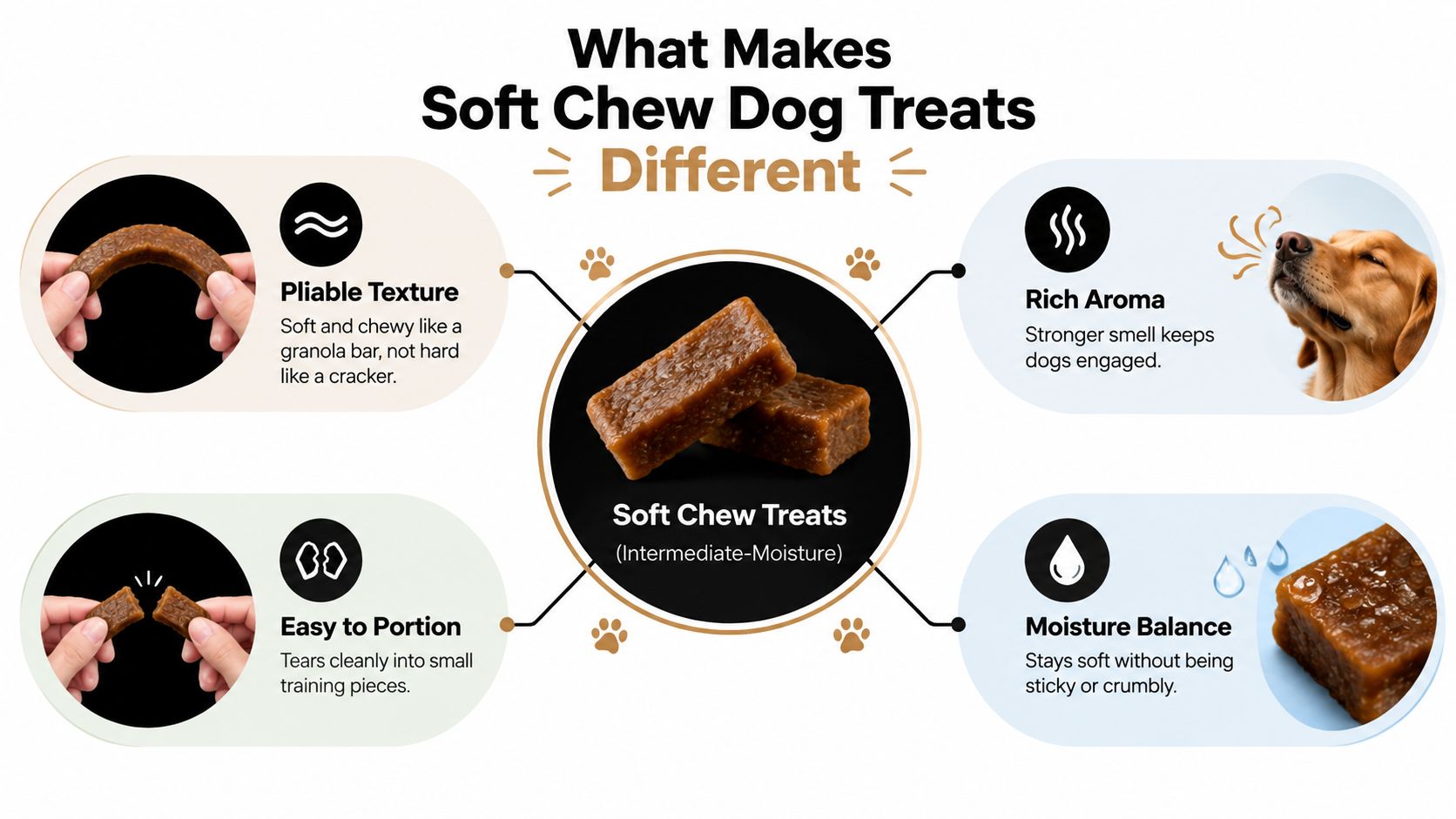
A soft chew sits between a biscuit and wet food on the moisture spectrum. That middle position gives it a pliable texture while supporting shelf stability when the recipe, processing, packaging, and storage conditions are properly controlled. Ingredients hold onto some water, so the treat bends or tears instead of snapping like a dry cracker. Its exact firmness still depends on the formula and manufacturing method.
Moisture controls more than softness
Technical descriptions commonly place soft dog treats around 20% to 30% moisture, while some references use a broader range of 15% to 40%. Shelf stability depends on water activity, usually written as aw, not on moisture percentage alone. Neutral technical information describes shelf-stable intermediate-moisture products as commonly maintaining aw in roughly the 0.65 to 0.85 range, as discussed in Frontiers in Animal Science's veterinary and consumer-preference study.
Water activity measures how available water is for chemical reactions and microbial growth. As aw rises, spoilage organisms have more opportunity to grow. During storage, a treat that loses moisture can become hard, brittle, or less appealing. Packaging helps maintain the intended balance by limiting drying and humidity absorption.
Texture changes how the treat functions
Soft chews often release more aroma than dry biscuits because moisture and fats can carry scent. That stronger smell may help during training outdoors or around distractions. Pliable pieces are also easier to tear into small portions, allowing frequent rewards without giving a whole treat each time.
Different formats fit different jobs:
- Crunchy biscuits provide a firm bite and may suit dogs that enjoy chewing, but they can be slower to divide during rapid-fire training.
- Jerky-style treats may be flexible yet fibrous. Check whether they tear cleanly and whether the texture suits your dog.
- Semi-moist treats overlap with soft chews, although recipes differ in moisture, binding ingredients, and firmness.
- Dog squeeze treats provide a lickable format that can help with medication routines, enrichment, or controlled rewards, but the serving amount still matters.
Softness describes a physical feature. It does not guarantee that a product is complete, balanced, low calorie, or suitable for every dog. Read the label, follow the serving guidance, and watch how your dog handles each treat. A texture tool works best when it matches the dog, the task, and the amount being offered.
How to Read Ingredients and Judge Protein Quality
A treat label can look complicated, but you don't need to memorize every ingredient to make a better choice. Start at the beginning of the list, identify the main protein, then scan for ingredients that may matter to your dog's health or sensitivities.
Use the first scan for the main protein
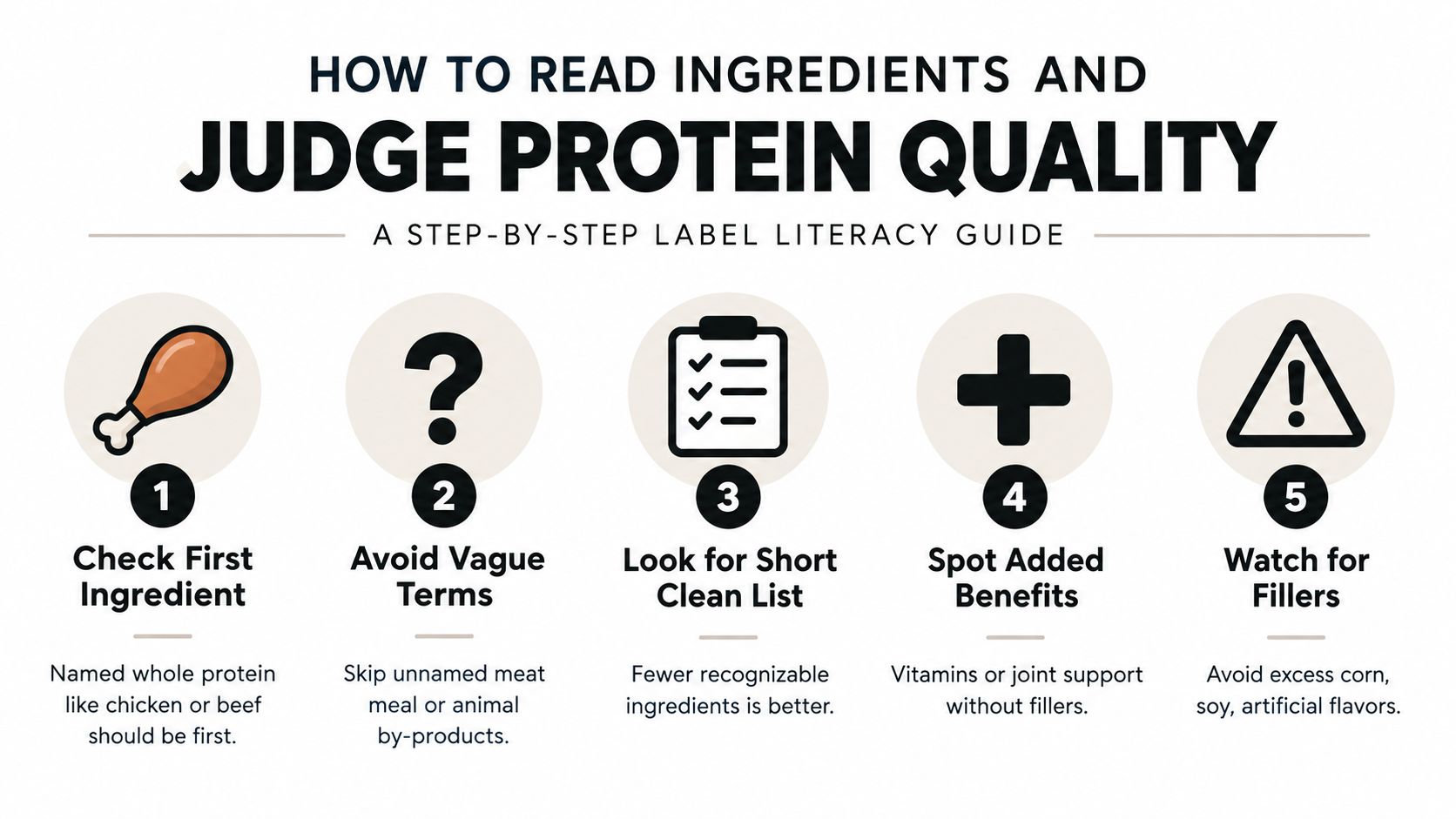
Ingredients are listed by weight before processing. A named protein near the beginning, such as chicken, beef, turkey, or salmon, tells you more than a vague phrase such as “meat” or “animal protein.” A named ingredient also makes it easier to avoid a known trigger if your dog has reacted to a particular protein before.
Look for clarity rather than a magical ingredient order. A short list of recognizable ingredients can be easier to evaluate, but a longer list isn't automatically poor quality. Vitamins, minerals, stabilizers, and functional ingredients may have legitimate technical purposes. The question is whether you understand why they're included and whether they fit your dog.
Scan for unnecessary additions
After identifying the protein, check the rest of the list for added sugars, artificial flavors, and filler-heavy ingredients. Ingredients such as corn syrup deserve particular attention because they add sweetness without making the treat a more meaningful source of nutrition. “Natural flavor” can also cover many different preparations, so a transparent label is easier to judge than a vague one.
Common proteins and grains can cause problems for individual dogs, even when they're safe for most dogs. If your dog has recurring itching, ear problems, vomiting, diarrhea, or poor stool quality, don't keep switching treats randomly. Ask your veterinarian whether an elimination diet or other structured evaluation makes sense.
A useful thirty-second label routine looks like this:
- Name the protein. Write down every animal protein in the formula, not just the one pictured on the front.
- Check the opening ingredients. Ask whether they make sense for a treat your dog will eat regularly.
- Look for hidden complexity. Watch for several sweeteners, multiple vague flavor terms, or ingredients you can't identify.
- Match the recipe to the dog. Avoid known allergens and consider whether the texture works for the dog's mouth.
- Separate treats from supplements. A treat with a functional ingredient isn't automatically dosed like a veterinary supplement.
For comparison, Probiotic Supplement for Cats - 30 Single-Serving Packets is described as containing real beef bone broth, veterinarian-formulated clinically tested probiotic strains, two complementary prebiotics, and third-party testing for potency and purity. It's a cat supplement, not a dog treat, but the label lesson is useful: evaluate the stated purpose, ingredients, testing, and serving format separately rather than treating a broad wellness phrase as proof.
You can also use this guide to red flags in pet food ingredients when a label uses unfamiliar terms. If your dog needs a restricted diet, bring the package to your veterinarian instead of relying on front-of-bag language.
Best Use Cases for Training Senior Dogs and Everyday Rewards
Soft chew dog treats shine when the reward needs to be quick, portionable, and easy to accept. They aren't automatically superior to crunchy treats. The right format depends on the dog's mouth, the environment, and what you're asking the dog to do.
Training rewards
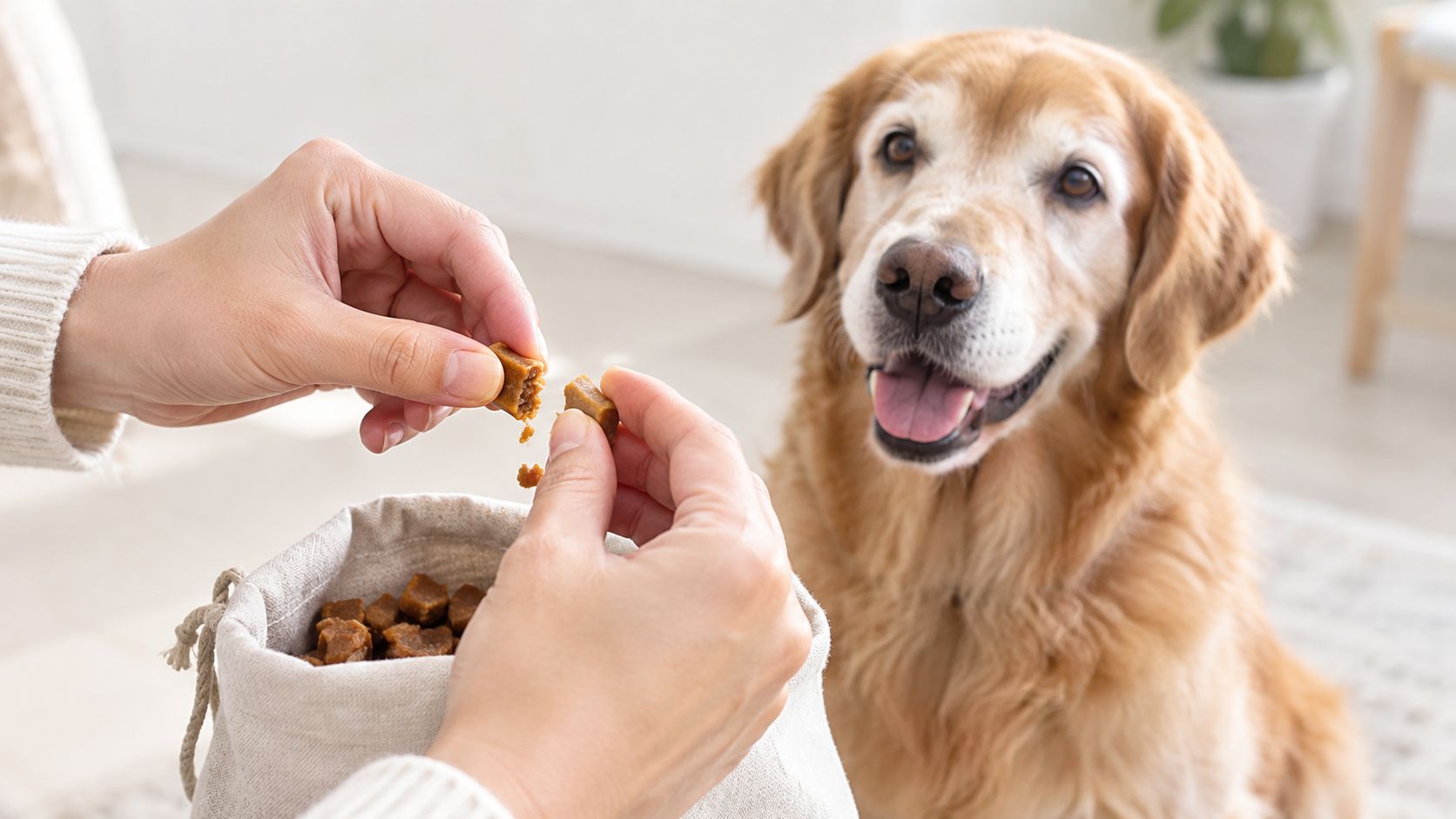
For leash work, recall practice, puppy classes, or cooperative grooming, a soft chew can be torn into very small pieces. The dog gets the taste and reinforcement without spending as long chewing. That helps you deliver the next reward quickly and keeps the behavior sequence clear.
A high-value smell can also help when the surroundings compete with you. But palatability is individual. One dog may work enthusiastically for a moist beef treat, while another prefers a crunchy biscuit or a piece of its regular food. Test the response, then use the least exciting reward that still motivates the behavior.
Senior and dental considerations
A soft texture may be more comfortable for dogs with reduced chewing ability, but it doesn't treat dental disease. If your dog drops food, chews on one side, paws at the mouth, develops bad breath, or resists eating, schedule a veterinary examination. Don't use a soft treat to work around ongoing oral pain.
For a dog with a history of swallowing food whole, softness can create a different concern. Tear pieces small enough for the dog's size and eating style, and supervise the reward instead of tossing large pieces from a distance.
The video below shows a practical treating context and can help you observe how a dog waits, takes, and consumes a reward.
Everyday rewards
Use soft chews for calm reinforcement, handling practice, puzzle toys, or a small evening reward. A firmer chew may be more satisfying for a dog that enjoys prolonged chewing, while a dry treat may be easier to carry without sticking to a pocket. Texture should match the activity, not just the marketing category.
A treat is successful when it supports the behavior and the dog can eat it comfortably. Bigger and softer isn't always better.
Portion Control Calories and Fitting Treats Into a Balanced Diet
The easiest way to overfeed soft chews is to count pieces instead of calories. A large treat broken in half may still provide more energy than several tiny training pieces, while a small-looking treat can add up during a long session.
Start with the calorie information on the package. If the label gives calories per treat, divide that number by the number of pieces you create. For example, if one treat contains 10 calories and you tear it into five equal rewards, each piece provides about 2 calories. Use the actual label value rather than guessing from size.
Apply the daily allowance
A common veterinary feeding guideline is to keep treats to about 10% of a dog's daily calorie intake, but the exact allowance depends on body size, activity, age, health, and the calories in the main diet. Because that numerical rule is widely used but individualized, confirm the target with your veterinarian, especially if your dog is overweight or has a medical condition.
Your routine can stay simple:
- Set the day's treat budget. Decide before training begins how many calories you can use.
- Pre-break the chews. Make small pieces in advance so your hand doesn't keep returning to the bag.
- Adjust the meal when needed. On a training-heavy day, slightly reduce the regular food only with guidance from the diet plan your veterinarian has set.
- Track patterns, not perfection. Note unusually generous days and return to the planned portion at the next meal.
Make the math practical
Small dogs often need much smaller reward pieces than owners expect. Large dogs may handle a larger bite, but large size doesn't remove the need to count. A treat pouch filled with pre-portioned pieces makes the difference visible and helps everyone in the household follow the same plan.
Don't confuse “soft” with “light.” Moisture affects texture, while calories come from the ingredients and their amounts. The guaranteed analysis can help you understand nutrient categories, but the calorie statement is the more useful number for daily portion decisions.
If the bag doesn't provide clear calorie information, contact the manufacturer or choose a product with more transparent feeding guidance. When a dog is on a weight-loss, diabetic, gastrointestinal, or prescription diet, ask the veterinary team before adding a regular soft chew routine.
Homemade Versus Commercial Soft Chews What to Consider
Homemade soft chews offer control. You choose the protein, decide whether to include ingredients such as cooked pumpkin or sweet potato, and can avoid a known trigger. They also let you make pieces in the exact size your dog needs.
Commercial treats offer consistency. A manufacturer can control the recipe, processing conditions, packaging, and batch handling in ways that are difficult to reproduce in a home kitchen. That matters particularly for intermediate-moisture treats because texture and shelf stability depend on controlling available water, not just following a baking time.
Homemade advantages and limits
A homemade batch can work well as a short-lived training reward when you have time to prepare, cool, portion, and store it correctly. Keep the recipe plain. Avoid onions, garlic, chocolate, grapes, raisins, xylitol, heavily seasoned foods, and fatty table scraps.
The main challenge is preservation. Home cooks usually don't measure water activity, so they can't confirm that a soft product has reached a stable moisture balance. Treats may spoil before visible mold appears, especially if they're sealed while warm or stored at room temperature.
For broader pet-care guidance, maxijournal.com expert pet tips can provide additional context on everyday feeding and care decisions, but a homemade recipe still needs to fit your dog's individual veterinary plan.
Commercial advantages and limits
A commercial soft chew is convenient when you want repeatable texture, printed calorie information, a defined ingredient list, and packaging instructions. You'll still need to assess the product rather than assuming every packaged treat is suitable. Check the seal, expiration or best-by information, storage directions, and whether the pieces are easy to break.
Commercial preparation also doesn't guarantee that a treat is nutritionally complete. Most treats are meant to complement a complete diet, not replace it. If your dog has allergies, chronic digestive signs, or a condition requiring strict nutrition, ask your veterinarian to review the exact product.
Choose homemade when ingredient control and fresh preparation are your priorities. Choose commercial when consistency, convenience, and clearer handling information matter more. Either way, discard anything with an unusual odor, visible mold, swollen packaging, or a texture that has changed unexpectedly.
Choosing Vet Friendly Options and Staying Safe With Allergens
A vet-friendly treat choice is less about a trendy badge and more about transparent information. You should be able to identify the main protein, understand the serving guidance, see how the product is stored, and explain why the texture suits your dog.
Use this final buying and serving checklist:
- Match the protein to your dog. Avoid ingredients your veterinarian has identified as triggers, and remember that a flavor name may not reveal every protein in the recipe.
- Inspect the texture. Soft should mean pliable, not sticky, wet, stringy, or difficult to tear.
- Consider eating style. Dogs that gulp need closer supervision and smaller pieces.
- Question functional promises. “Calming,” “joint support,” and “dental health” are broad categories. Ask what ingredient provides the proposed benefit, whether the amount is disclosed, and whether your veterinarian thinks the product fits your dog.
- Treat supplements as measured products. A chew-shaped supplement may be convenient, but its active ingredients still need appropriate dosing.
Softness can improve acceptance, but it doesn't automatically eliminate choking or obstruction risk. Independent discussion of commercial chews in IVC Journal's veterinary guidance on how much a dog can bite off and chew highlights why size, chewing behavior, and supervision matter. A soft piece that is too large can still be swallowed poorly, and some dogs will gulp anything appealing.
Digestibility deserves the same attention. Stop serving a treat if your dog develops vomiting, diarrhea, marked gas, itching, facial swelling, weakness, or a sudden refusal to eat. Facial swelling, breathing difficulty, collapse, or repeated vomiting requires urgent veterinary attention rather than home observation.
If dental support is your goal, discuss an appropriate plan with your veterinary team and use resources such as supplements for your dog's teeth as a starting point for questions, not as a substitute for an oral examination.
Store soft chews exactly as the package directs. Keep the container sealed, use clean hands, avoid leaving treats in a hot car, and check for changes in smell, color, stickiness, or visible growth. Introduce a new treat in a small amount, watch stool and skin responses, and keep the package available if your veterinarian needs to investigate a reaction.
When you're choosing between two products, select the one whose ingredients, calories, function, and handling instructions you can explain clearly. That small habit turns soft chews from an impulse purchase into a predictable part of your dog's care.
Joyfull offers dog products made with clean ingredients, high-quality proteins, and scientific review from an in-house veterinary advisor, including options designed for convenient everyday wellness routines. Review the formulas and serving details at Joyfull, then choose a soft chew or treat format that fits your dog's texture preference, diet, and training needs.
0 comments