


Most advice about cat treats chicken gets the first answer right and the important answer wrong. Plain, fully cooked chicken can be safe, but safety alone doesn't tell you whether the portion is appropriate, whether the label is honest, or whether the treat is replacing balanced cat food. Chicken dominates the category, with 35.8% of the global cat treats market, while the overall market was valued at $7.8 billion in 2025 and is projected to reach $12.3 billion by 2034, according to MarketIntelo's cat treats market analysis.
The useful question isn't, “Can my cat eat chicken?” It's, “Which chicken format belongs in my cat's calorie budget, and how much can I serve without compromising the main diet?” Use three filters every time: ingredient quality, label transparency, and portion math.
Table of Contents
- Why Chicken Treats Deserve a Closer Look
- What Chicken Brings to Your Cat's Bowl
- The Chicken Format Decision Tree Most Articles Skip
- How to Read a Chicken Treat Label Like a Pro
- Comparing the Most Common Chicken Treat Formats
- Portion Math That Keeps Treats Under 10% of Calories
- A Simple Checklist for Choosing Better Chicken Treats
Why Chicken Treats Deserve a Closer Look
Chicken treats belong in your cat's daily food budget, not outside it. Kibble, wet food, dental treats, lickable pastes, toppers, and chicken rewards all contribute calories. A small training bite seems harmless, but repeated extras can crowd out the complete nutrition supplied by the main diet.
Chicken remains a major commercial flavor because it suits many treat formats. The chicken segment is projected to grow at a 4.9% CAGR, confirming that it remains a core product profile rather than a fading shelf option, according to the cat treats market data.
Apply the same three filters
Ingredient quality comes first. Plain chicken breast, a single-ingredient freeze-dried product, and a seasoned deli slice may all use the word “chicken,” yet their safety profiles differ. Preparation controls exposure to salt, oils, aromatics, bones, and processing additives. That distinction should guide your format choice before your cat ever tastes the treat.
Label transparency comes next. A roasted chicken image on the front proves little. Check whether the ingredient list names chicken clearly or relies on vague animal terms, flavoring, starch, or added fat. The back panel identifies the actual recipe.
Portion math controls the outcome. A clean, protein-rich treat can still become a poor choice if it replaces too much complete food. Keep treats at no more than 10% of daily calories, following PetMD's guidance on cats eating chicken.
Practical rule: Rank the format first, inspect the ingredients second, and measure the dose third. Your cat's enthusiasm does not make a questionable recipe suitable.
Use this standard for packaged snacks and chicken prepared at home. Chicken does not need a ban. It needs appropriate preparation, honest label review, and measured servings.
What Chicken Brings to Your Cat's Bowl
Chicken deserves a place in the treat rotation because it delivers high-quality animal protein and essential amino acids. Cats rely on nutrients from animal sources, so a meat-based reward is generally more useful than one built mainly on starch or vague flavoring. The ingredient list still matters. “Chicken” alone does not guarantee a sound recipe.
A commercial chicken treat shows why. One product reports more than 70% meat content and names chicken, poultry by-products, chicken liver, pork liver, and gelatin among its first ingredients. Its guaranteed analysis lists 33% minimum crude protein, 15% minimum crude fat, 4% maximum crude fiber, and 30% maximum moisture. The recipe also includes taurine, according to the Vitakraft PurrSticks chicken recipe product information.
The useful nutrients
Chicken supplies protein for tissue maintenance and amino acids cats must obtain through food. It can also contribute B vitamins and taurine when the recipe uses suitable animal tissues. Taurine supports normal heart and vision function, but a chicken treat is not a complete nutritional system.
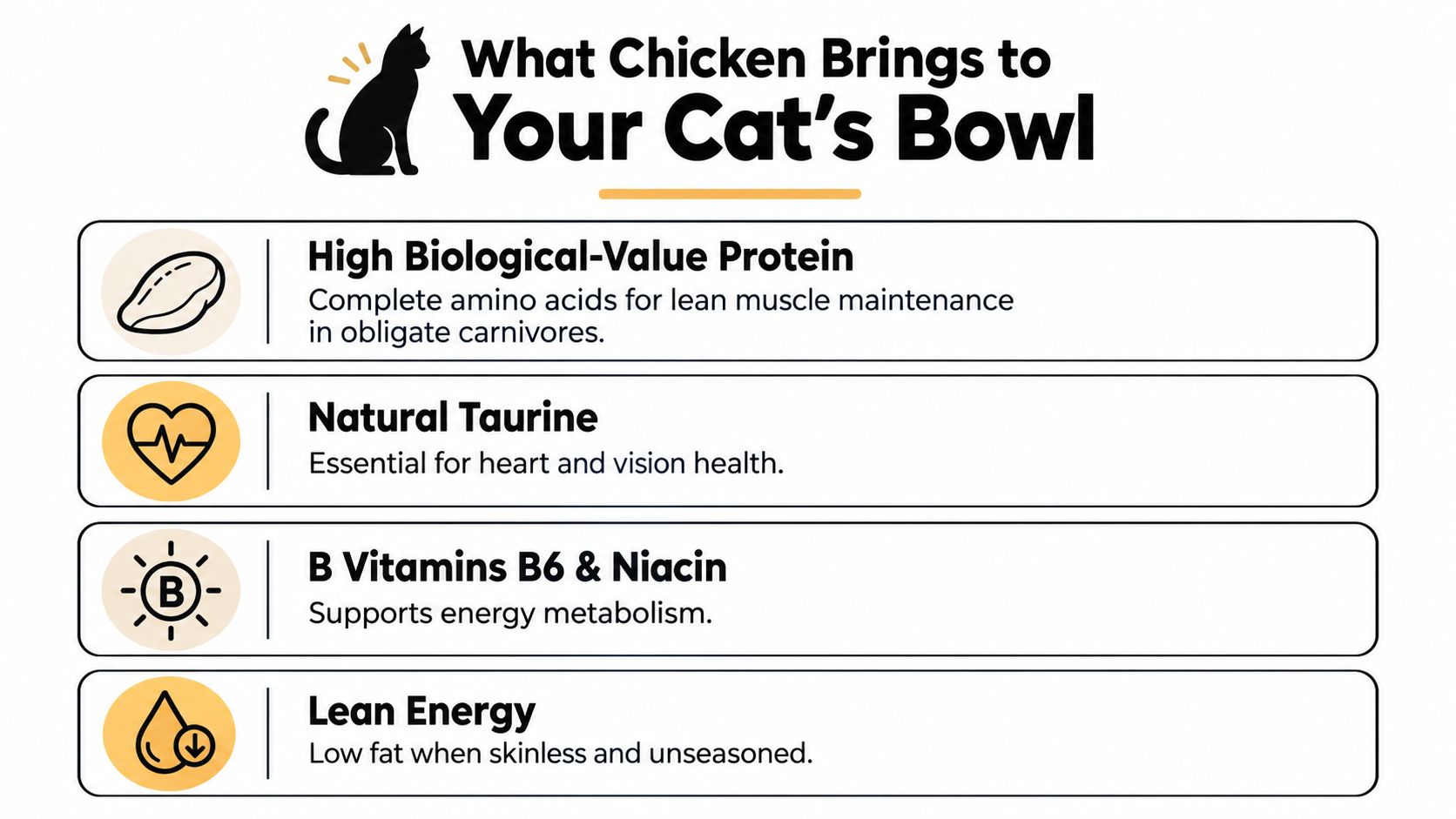
The cut changes the reward's calorie and fat load. Plain, skinless breast is usually the leaner kitchen choice, while dark meat and skin add more fat. Portion a small piece of skinless breast differently from a greasy piece of skin-on thigh.
Why chicken can't replace dinner
Chicken by itself lacks the complete vitamin and mineral profile found in complete cat food. It does not reliably provide the balanced mineral levels or formulated amounts of nutrients such as vitamin E, iodine, and omega-3 DHA.
Serve chicken as a topper, reward, or occasional snack, never as a meal replacement. For a non-chicken functional option, Prebiotic Tuna Squeeze Treats for Cats contain real wild-caught tuna and prebiotics, while excluding artificial and “natural” flavors, colors, and preservatives.
The Chicken Format Decision Tree Most Articles Skip
The chicken on your counter is not automatically suitable for your cat. Use this decision tree before serving it.
Start with the kitchen formats
Plain boiled or baked chicken: Make this your default. Serve it fully cooked, boneless, skinless, and unseasoned. Remove visible fat, then shred it into small pieces your cat can manage.
Rotisserie chicken: Reserve it for occasional use. Skin increases the fat load, and the meat may contain salt, brine, garlic, onion, or spices. Removing the skin does not prove the meat escaped seasoning contact, so plain home-cooked chicken remains the safer routine choice.
Deli lunch meat: Skip it. Processing commonly adds sodium, preservatives, and flavoring. A front label that says “chicken” does not make a cured slice equivalent to plain poultry.
Fried chicken: Avoid it. Batter, oil, skin, and seasoning make the snack fatty and difficult to assess. Removing the coating still leaves meat that may have absorbed salt and grease.
Seasoned leftovers: Do not share them. Garlic, onion, sauces, butter, spice blends, and pan drippings add avoidable hazards. Cat-Care's cooked-versus-raw chicken guidance also recommends plain, fully cooked, boneless, skinless chicken and warns against raw meat and cooked bones.
Freeze-dried chicken: Choose this for a shelf-stable option when the ingredient panel names a single chicken ingredient. It avoids kitchen seasoning and breaks easily into measured training pieces. Because drying concentrates the food, portion control still applies.
For enrichment or digestive routines, keep categories separate. cat squeeze treats may serve a different purpose from a plain chicken reward, so do not treat a supplement-style product as interchangeable with single-ingredient meat.
Ask two questions before serving
- Is the protein named plainly? “Chicken” or “chicken breast” identifies the source more clearly than “meat,” “animal protein,” or “poultry flavor.”
- Are additions minimal? No additions is the cleanest choice. A simple stabilizer, such as rosemary extract, may be acceptable when the complete formula suits your cat.
Raw chicken brings pathogen exposure for cats and people. Bones can choke a cat or injure the gastrointestinal tract. Cook the meat fully and remove every bone before serving.
How to Read a Chicken Treat Label Like a Pro
The front of the bag sells the image. The ingredient panel decides whether the treat deserves a place in your cat's routine. Ingredients appear by weight, so the opening entries show whether chicken leads the recipe or merely supplies the flavor story.
Read the first five ingredients
Look for a named protein in the first position, such as chicken, chicken breast, or chicken liver. A short list of recognizable ingredients gives you a clearer basis for judging the treat and measuring portions.
Reject labels built around vague terms:
- Unnamed by-products: “Meat by-products” does not identify the animal source clearly.
- Animal digest: This describes a flavoring ingredient, not a specific protein.
- Chicken flavor: Flavor wording does not establish meaningful chicken content.
- Seed oils: Sunflower or canola oil can add fat without making the treat more useful.
- Color additives: Caramel color changes appearance, not nutritional value.
- Chicken listed late: Chicken appearing after preservatives, starches, or flavoring ingredients may indicate a small amount.
Read the guaranteed analysis beside the ingredient list. Protein, fat, fiber, and moisture help you judge how the recipe fits your cat's daily calories. A meat-forward label still requires portion control, especially when drying or added fat concentrates calories.
Compare two hypothetical labels
Label A, a clean freeze-dried recipe: Chicken breast, chicken liver. The short list identifies the animal sources and makes the product easy to portion.
Label B, a bargain jerky recipe: Poultry by-product, animal digest, vegetable oil, glycerin, salt, caramel color, chicken flavor. Your cat may enjoy the smell, but the label gives you less control over protein identity, sodium, fat, and processing.
A short ingredient list does not make a treat a complete diet. Use it as a snack or reward, not as a replacement for nutritionally balanced main food.
Use the 30-second rule
If you cannot identify three consecutive ingredients, put the bag back. For more guidance on understanding clean labels for pets, prioritize named ingredients, a clear purpose for each addition, and minimal flavoring architecture.
Then check calories per piece or serving. An attractive ingredient list can still produce too many calories when you offer repeated handfuls. Choose a treat you can break into small pieces, record the amount served, and keep the total within the daily treat allowance covered later.
Comparing the Most Common Chicken Treat Formats
Chicken treats are not interchangeable. Plain cooked chicken gives you the clearest ingredient control, while freeze-dried chicken travels well and stores easily. Squeeze purées add moisture, baked treats provide crunch, and jerky may be convenient while also carrying more sodium or additives.
Use the table to choose a format for a specific job, then verify the package. Protein, moisture, calories, and ingredients change by recipe, so never treat a format label as a fixed nutrition profile.
| Format | Protein per 100 kcal | Moisture % | Typical piece kcal | Primary risk |
|---|---|---|---|---|
| Freeze-dried chicken | Often concentrated | Usually low after drying | Varies by nugget size | Overfeeding concentrated pieces |
| Baked crunchy treat | Varies by recipe | Usually low to moderate | Varies by piece size | Added starch and fat |
| Squeeze puree | Varies by recipe | Usually high | Varies by serving | Starch, sugar, or flavoring additives |
| Jerky | Often protein-forward | Usually low | Varies by strip size | Sodium, preservatives, and chewing difficulty |
| Plain cooked chicken | Depends on cut and preparation | Naturally present | Varies by piece size | Inconsistent portions and incomplete nutrition |
Match the format to the job
For training, use a treat that breaks into tiny, countable pieces. Crumble a freeze-dried nugget instead of handing over the whole piece. That gives you more rewards from the same serving and keeps portion control practical.
For hydration support, choose a moist product rather than a dry, concentrated snack. A lickable treat can fit this role, but check for thickeners, flavorings, and stated calories before serving.
For a low-calorie snack, plain skinless chicken offers the most control over what reaches the bowl. Measure it anyway. Lean meat still contains calories, and inconsistent chunks make daily intake difficult to judge.
For hairball routines, chicken treats do not address every cause of hairballs. Grooming, hydration, hairball products, and veterinary assessment may all have a role depending on the cat. Probiotics are a separate category. Probiotic Supplement for Cats - 30 Single-Serving Packets is described as containing real beef bone broth, veterinarian-formulated probiotic strains, prebiotics, and third-party potency and purity testing. Use that product information to assess whether it fits your cat's needs, rather than treating it as a chicken treat substitute.
Portion Math That Keeps Treats Under 10% of Calories
The 10% rule sets the daily ceiling: treats contribute no more than 10% of a cat's calories, while the complete main diet provides the remainder. For chicken, keep servings small and plain, especially when the meat is offered alongside a nutritionally complete food. Fat content, preparation, and the product's calorie density all affect the final portion.
Use a 10-pound cat needing roughly 200 calories daily as a working example. That leaves about 20 calories for treats, or approximately one teaspoon of cooked shredded chicken in the supplied example. This is a calculation aid, not a universal prescription. Age, body condition, activity, health status, and the main diet's calorie density can change the appropriate limit.
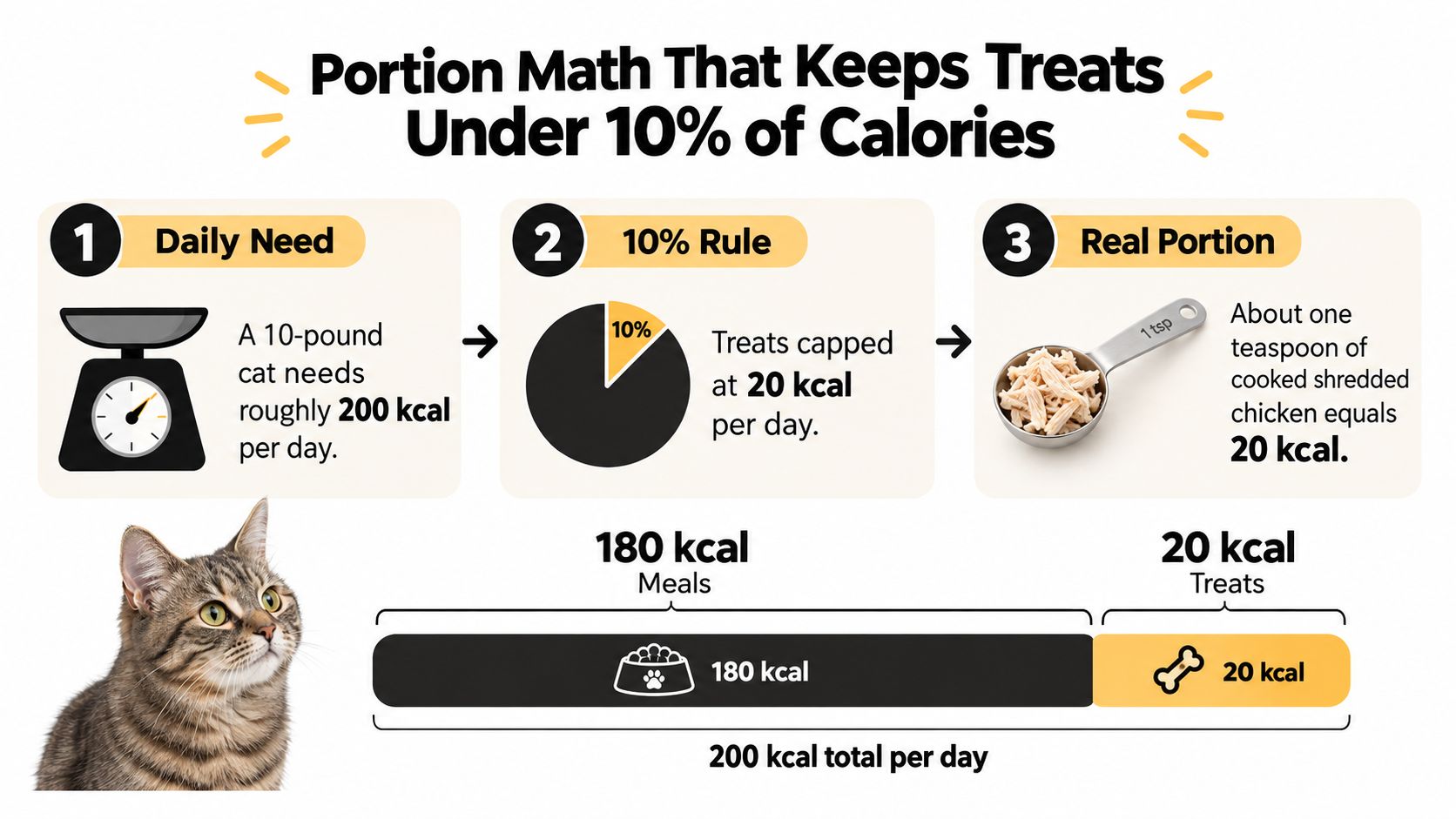
Calculate the daily cap
For a 5-pound kitten consuming 250 calories daily, the treat ceiling is 25 calories. The supplied portion example describes roughly one freeze-dried nugget, but nugget sizes vary. Use the package's calorie information, not the shape of the piece, to set the serving.
A practical daily split looks like this:
- Main meals: 90% of daily calories.
- Training rewards: 5% of daily calories.
- Affection or enrichment treat: 5% of daily calories.
This schedule stops scattered rewards from turning into an untracked extra meal. If the treat label provides enough information, remove an equivalent amount of regular food so total daily calories stay on target.
Avoid the common counting errors
Free-feeding hides treat calories because the bowl remains available throughout the day. Liquid calorie pastes count too, and dental treats still contribute calories even when they serve an oral-care purpose.
For accurate portions, use a kitchen scale. Weigh the day's chicken, find the listed calories per gram, multiply the weight by that figure, and keep the result within the daily treat cap. If the label lacks enough information for a confident calculation, choose a product with clearer calorie disclosure.
Review this 10% treat rule explained for practical serving guidance. Happy Guts Duo for Pups is a dog product, not a cat-treat substitute, even though its product snapshot describes high-quality protein, veterinarian formulation, third-party testing, and a prebiotic chicken squeeze treat paired with a probiotic supplement.
A Simple Checklist for Choosing Better Chicken Treats
Use this shelf test before buying. A clear ingredient list, usable calorie information, and a format your cat can safely eat matter more than attractive packaging.
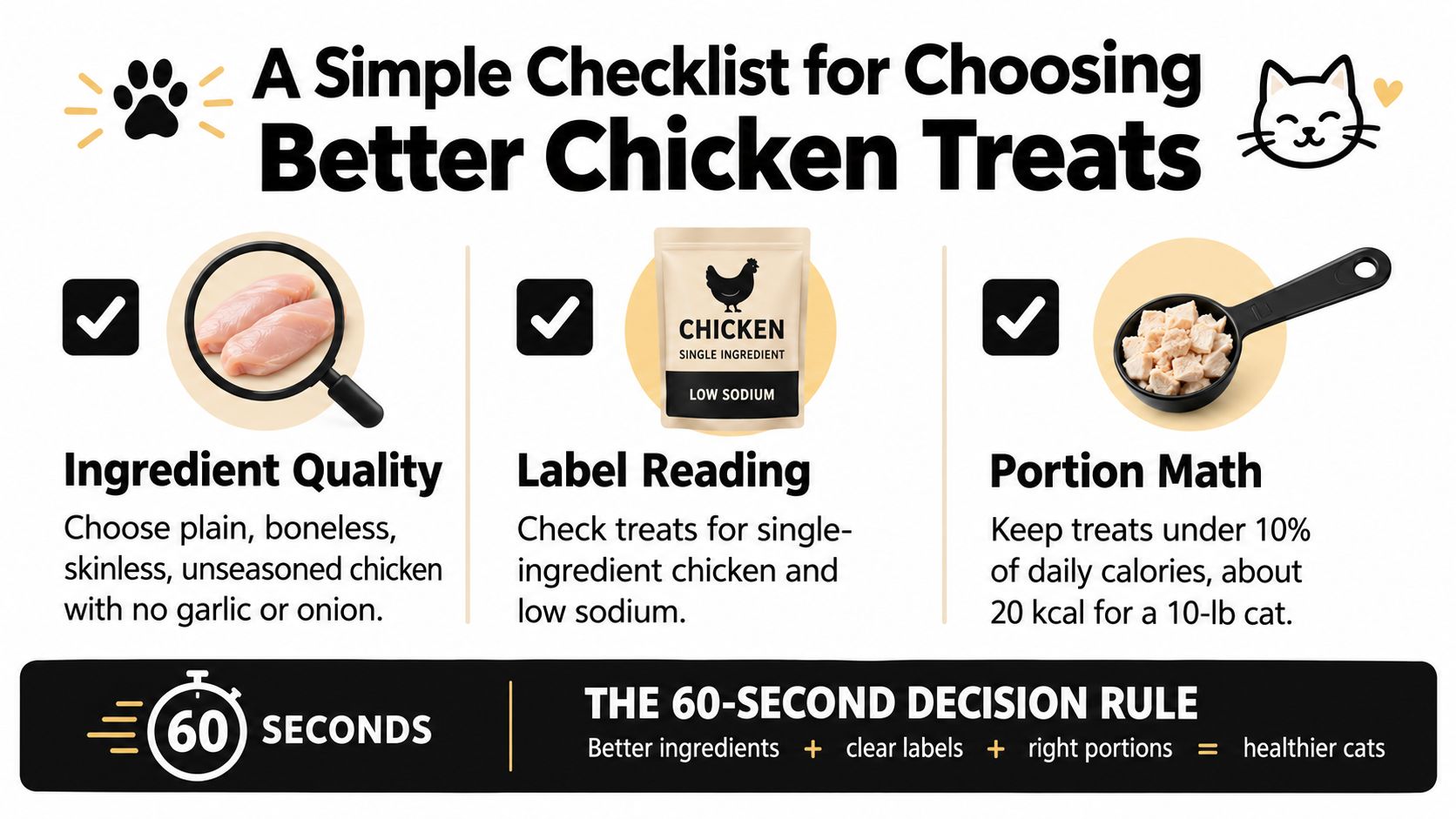
The 60-second store test
Identify the protein first. Choose a named chicken source near the beginning of the ingredient list. “Chicken” or “chicken breast” gives you more useful information than a generic meat label.
Count recognizable ingredients. A short list is easier to check. Five or fewer recognizable ingredients is a sensible preference, but it does not prove the treat is nutritionally complete.
Reject avoidable hazards. Do not buy products containing onion or garlic. Treat seed oils, unnamed animal fat, heavy seasoning, and unclear sodium information as reasons to keep looking.
Read the life-stage statement. Treats do not need to replace a complete diet. The statement still tells you whether the product is intended as a complete food or an occasional snack.
Match texture to the cat and the setting. Moist treats can add fluid to the routine. Dry, concentrated treats travel well, but their calories add up quickly. Break larger pieces only after checking the package calories, because size alone does not set a safe serving.
Measure the portion. Keep treats below 10% of daily calories. Cats with obesity, kidney disease, heart disease, food allergies, or other medical conditions need a treat budget set with a veterinarian.
For senior-pet celebrations, apply the same rules described in Halloween treats for aging pets, plain ingredients, manageable texture, and a portion that does not displace the main diet.
The final ranking
Safest default: Plain, fully cooked, boneless, skinless chicken breast without seasoning.
Best shelf-stable upgrade: Single-ingredient freeze-dried chicken, measured rather than left available for free feeding.
Occasional option: Rotisserie chicken with the skin and obvious seasoning removed. Hidden salt and aromatics still make it unsuitable as a routine treat.
Skip: Deli chicken, fried chicken, seasoned leftovers, raw chicken, bones, garlic, onion, and products with unexplained flavoring.
Choose the shortest ingredient list you can verify, confirm the calorie information, and weigh the serving before offering it. Joyfull makes pet wellness products that include wild-caught tuna squeeze treats with prebiotics and a veterinarian-formulated probiotic supplement for cats. Visit Joyfull to compare those products with your cat's current treat routine.
0 comments