


Most advice about senior dog joint supplements starts with the wrong premise: that every product on the shelf offers roughly the same benefit. It doesn't. A label covered in pictures of active dogs can hide a formula with uncertain doses, weak evidence, or ingredients that have never been tested together in a meaningful way.
The clearest evidence currently favors omega-3 fatty acids, specifically EPA and DHA, used at a clinically relevant dose. Glucosamine and chondroitin remain popular and may help some dogs, but the research is inconsistent, and they shouldn't be presented as interchangeable with omega-3 support or prescription pain control. This guide gives you a practical way to spend wisely, read labels, and recognize when your dog needs a veterinarian rather than another chew.
Table of Contents
- Why Most Joint Supplement Advice Fails Senior Dogs
- What Happens to Joints as Dogs Age
- Evidence Behind the Most Common Joint Supplement Ingredients
- Dosing Guidelines and Safety Considerations
- How to Evaluate Supplement Quality and Avoid Bad Products
- Complementary Care That Amplifies Joint Supplement Results
- When to Start Supplements and When to See Your Vet
Why Most Joint Supplement Advice Fails Senior Dogs
The supplement aisle encourages a simple conclusion: if a product says “hip and joint,” it must support mobility. That conclusion is convenient, but it ignores the difference between an ingredient's presence and evidence that the ingredient works at a useful dose.
Veterinary research doesn't support treating all joint supplements as equal. One canine osteoarthritis trial found that glucosamine hydrochloride combined with chondroitin sulfate improved pain, weight-bearing, and disease severity by day 70, but broader reviews have reached conflicting conclusions. An AVMA review found insufficient evidence to recommend glucosamine-chondroitin as an alternative to NSAIDs, while a later meta-analysis reported no analgesic effect from chondroitin-glucosamine nutraceuticals in dogs and cats with osteoarthritis. You can review the trial details in the published canine osteoarthritis study.
The label can look stronger than the formula
Many products combine glucosamine, chondroitin, MSM, collagen, turmeric, herbs, vitamins, and oils in one attractive chew. That may sound complete, but a long ingredient list doesn't tell you whether each component appears in an effective amount, whether the product has been tested independently, or whether the combination has clinical support.
The practical problem is that owners often spend money on a blend without knowing what they're testing. If the dog improves, you can't identify the useful ingredient. If nothing changes, you may not know whether the dose was inadequate or the formula didn't help.
Practical rule: Choose a product because its active ingredient, dose, quality controls, and intended use are clear, not because the front label promises total joint care.
Joint supplements also shouldn't replace diagnosis. A slower walk may reflect osteoarthritis, but it can also indicate a soft-tissue injury, spinal disease, muscle loss, or another medical problem. Senior dogs deserve a plan based on the cause of their discomfort, not a guess based on packaging.
What Happens to Joints as Dogs Age
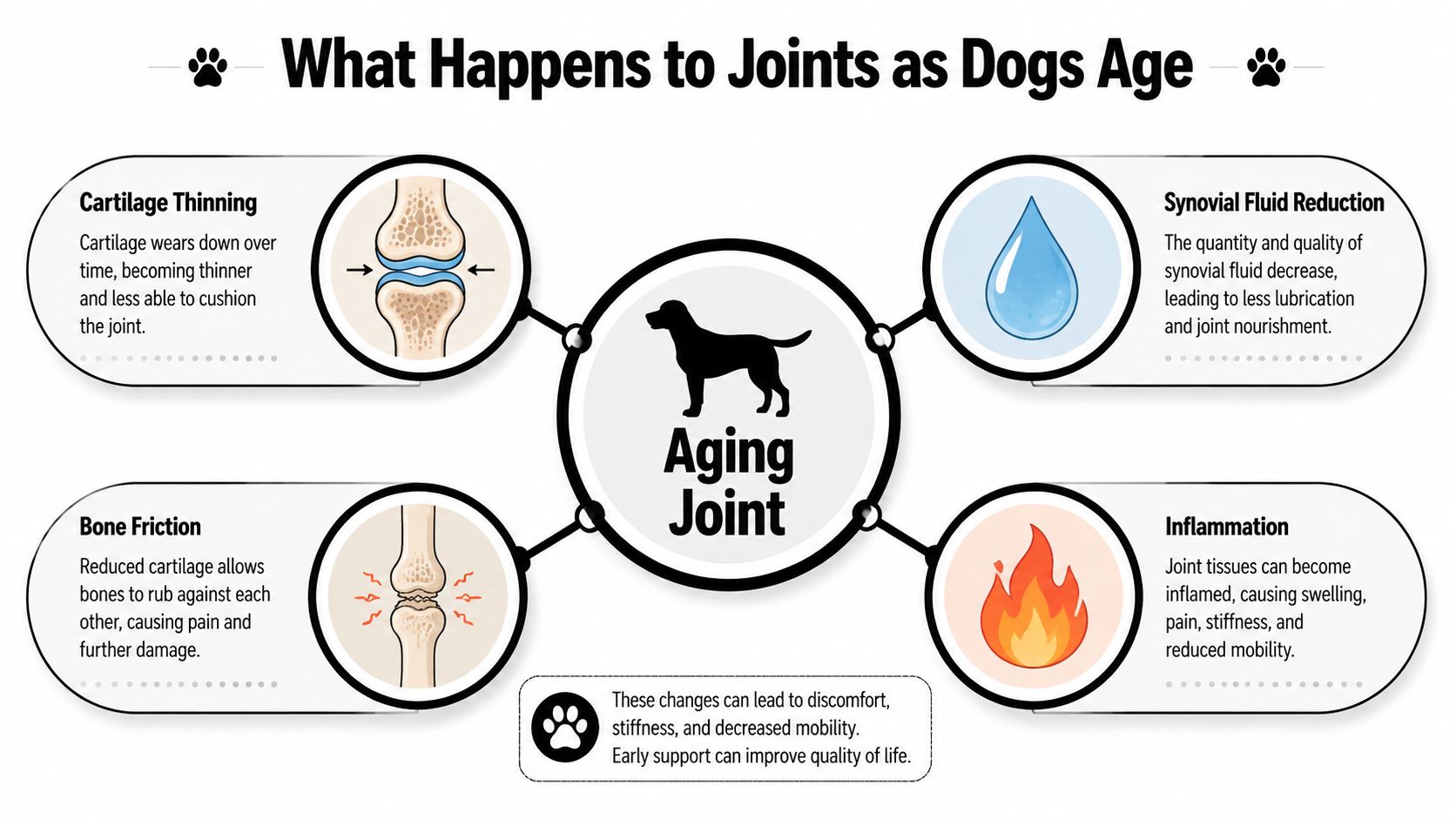
Age changes how a dog's joints absorb movement, but age alone does not explain every mobility problem. Smooth cartilage normally covers the meeting surfaces of bones, synovial fluid limits friction, and surrounding muscles stabilize the limb. Injury, inherited joint disease, and excess body weight can strain that system long before a dog appears visibly stiff.
Cartilage can thin and lose its cushioning function. Changes in joint fluid and the surrounding capsule may restrict motion, while inflammation sends chemical signals that contribute to pain. As the protective surface deteriorates, movement becomes less efficient and the joint handles everyday loading with less reserve.
Why size and history matter
A senior dog's risk depends on more than the birthday on its record. In the Dog Aging Project analysis, 40% of adult dogs received some type of joint supplement, and among dogs with osteoarthritis, 70% received at least one joint supplement. Older, larger, and previously overweight dogs were more likely to receive these products, according to the Dog Aging Project analysis.
These findings show how common supplement use is, not that supplements prevent joint disease. Larger bodies place more mechanical demand on joints. Earlier periods of excess weight can add to that load, while orthopedic injuries and inherited problems involving the hips, elbows, knees, or spine can make age-related changes more obvious.
Early signs are behavioral
Dogs often compensate for discomfort instead of displaying obvious pain. Watch for a pattern of small changes:
- Rising slowly: Your dog takes longer to stand after sleeping or resting.
- Avoiding height: They hesitate before stairs, the car, furniture, or a favorite sleeping spot.
- Changing pace: Familiar walks become shorter, slower, or interrupted by more frequent pauses.
- Protecting a limb: Licking, guarding, or reacting to touch around a joint deserves attention.
- Losing rear-leg muscle: Thinner hindquarters can signal reduced use of painful limbs.
Joint support should protect comfortable movement and muscle, not chase puppy-like behavior. Omega-3s with a clearly stated EPA and DHA amount offer a more evidence-based starting point than treating every joint chew as interchangeable. Glucosamine and chondroitin remain marketing-heavy choices with inconsistent data, so the label should not substitute for diagnosis.
A sudden change, visible pain, or difficulty bearing weight requires a veterinary examination before relying on a supplement. The cause may involve a joint, soft tissue, spine, muscle loss, or another medical problem.
For households with multiple pets, keep products species-specific. The Probiotic Supplement for Cats - 30 Single-Serving Packets is formulated for feline digestive support, not canine joint care.
Evidence Behind the Most Common Joint Supplement Ingredients
The ingredient list is not the evidence. For a senior dog with suspected osteoarthritis, rank products by the active compound, the amount provided, and the quality of support behind it.
Omega-3s deserve first consideration
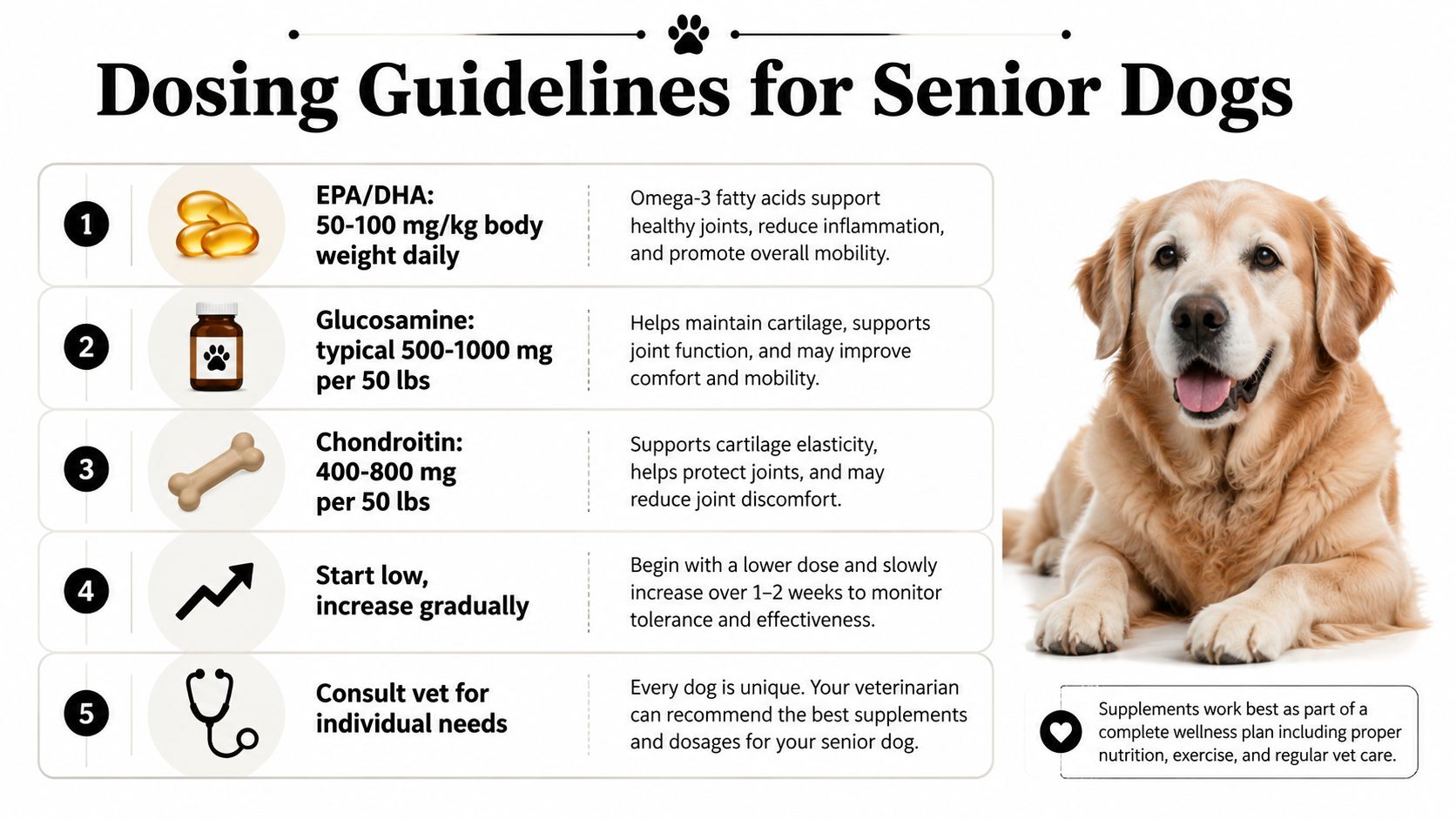
EPA and DHA are the strongest evidence-backed ingredients among common canine joint supplements. Canine osteoarthritis consensus guidance recommends either an omega-3-enriched joint diet or an omega-3 supplement. It identifies a minimum combined EPA and DHA dose of 100 mg per kilogram of body weight per day and a maximum safe limit of 370 × body weight^0.75 of combined EPA and DHA. Older dogs with osteoarthritis may need gradual dose increases to reach therapeutic levels. The canine osteoarthritis consensus guidance provides the dosing framework.
The label must show EPA and DHA separately. Total fish-oil weight does not tell you whether the product supplies enough of these active omega-3s for a therapeutic approach. A capsule can contain fish oil and still provide an inadequate dose.
Glucosamine and chondroitin remain uncertain
Glucosamine and chondroitin are popular because they are associated with cartilage support. One controlled trial reported meaningful improvement by day 70, but systematic reviews could neither confirm nor deny their benefits in osteoarthritic dogs. A 2022 meta-analysis also found a marked lack of analgesic effect.
Use these ingredients as an optional trial, not as guaranteed treatment. They should not replace an NSAID when your dog is painful. For a plain-language explanation of glucosamine, read this Joyfull pet owner guide on glucosamine.
Other popular ingredients need a lower ranking
MSM, collagen, turmeric, curcumin, green-lipped mussel, and botanical blends appear frequently in joint formulas. The available evidence here does not establish them as equivalent to targeted EPA and DHA dosing. That does not show that every one is useless. It means these ingredients should not distract you from the active dose, product testing, veterinary diagnosis, and the stronger omega-3 evidence.
| Ingredient | Evidence Strength | Veterinary Consensus | Key Consideration |
|---|---|---|---|
| EPA and DHA | Strongest among common supplement options | Recommended in canine osteoarthritis guidance | Confirm the combined EPA and DHA dose |
| Glucosamine and chondroitin | Mixed and inconsistent | Not a dependable alternative to NSAIDs | Any benefit may be modest, delayed, or absent |
| MSM | Limited in the supplied evidence | No clear conclusion here | Do not use it to justify a vague proprietary blend |
| Collagen | Emerging or condition-dependent | Not established as equivalent to omega-3s | Check the exact form and dose |
| Turmeric or curcumin | Limited in the supplied evidence | No clear conclusion here | Dog-specific safety and formulation matter |
| Mixed formulas | Difficult to evaluate | Depends on each active ingredient | Hidden doses prevent a fair trial |
Dosing Guidelines and Safety Considerations
A supplement can fail because the ingredient is weak, but it can also fail because the owner never reaches a relevant dose. This is especially common with fish oil. Labels may list total oil while giving little prominence to the actual EPA and DHA content.
Start with the active amount
Use this process:
- Find EPA and DHA separately. Add the two amounts together to calculate combined EPA plus DHA per serving.
- Convert your dog's weight to kilograms. Divide the body weight in pounds by 2.2.
- Multiply kilograms by 100 mg. That gives the minimum combined EPA and DHA target identified in canine osteoarthritis guidance.
- Compare the result with the label. If the serving falls short, the product may not match the intended therapeutic approach.
- Ask your veterinarian before increasing the dose. The guidance also identifies a maximum safe limit based on body weight, written as 370 × BW^0.75 of combined EPA and DHA in the consensus document.
Don't copy generic glucosamine or chondroitin numbers from a random chart. The supplied evidence doesn't establish a universally reliable dosing schedule for those ingredients, and products vary substantially.
Introduce one change at a time
Give a new product with food if the label permits, and introduce it gradually. Watch for vomiting, diarrhea, appetite changes, unusual bruising, or worsening discomfort. If symptoms appear, stop and contact your veterinarian rather than assuming the reaction is harmless.
Extra caution is necessary when your dog takes an NSAID, an anticoagulant, or medication for kidney, liver, heart, or digestive disease. Omega-3s may be appropriate, but the correct plan depends on the whole patient. A supplement can complement prescribed treatment, but you shouldn't reduce or discontinue medication without veterinary direction.
Use this video as a visual reminder to check dosing and discuss individual needs with your veterinarian:
How to Evaluate Supplement Quality and Avoid Bad Products
A transparent label is more valuable than a dramatic promise. Start by asking whether the manufacturer tells you exactly how much of each active ingredient appears in every serving. If the answer is hidden behind “proprietary blend,” you can't compare the product with clinical guidance or judge whether the formula deserves a trial.
Use a label checklist
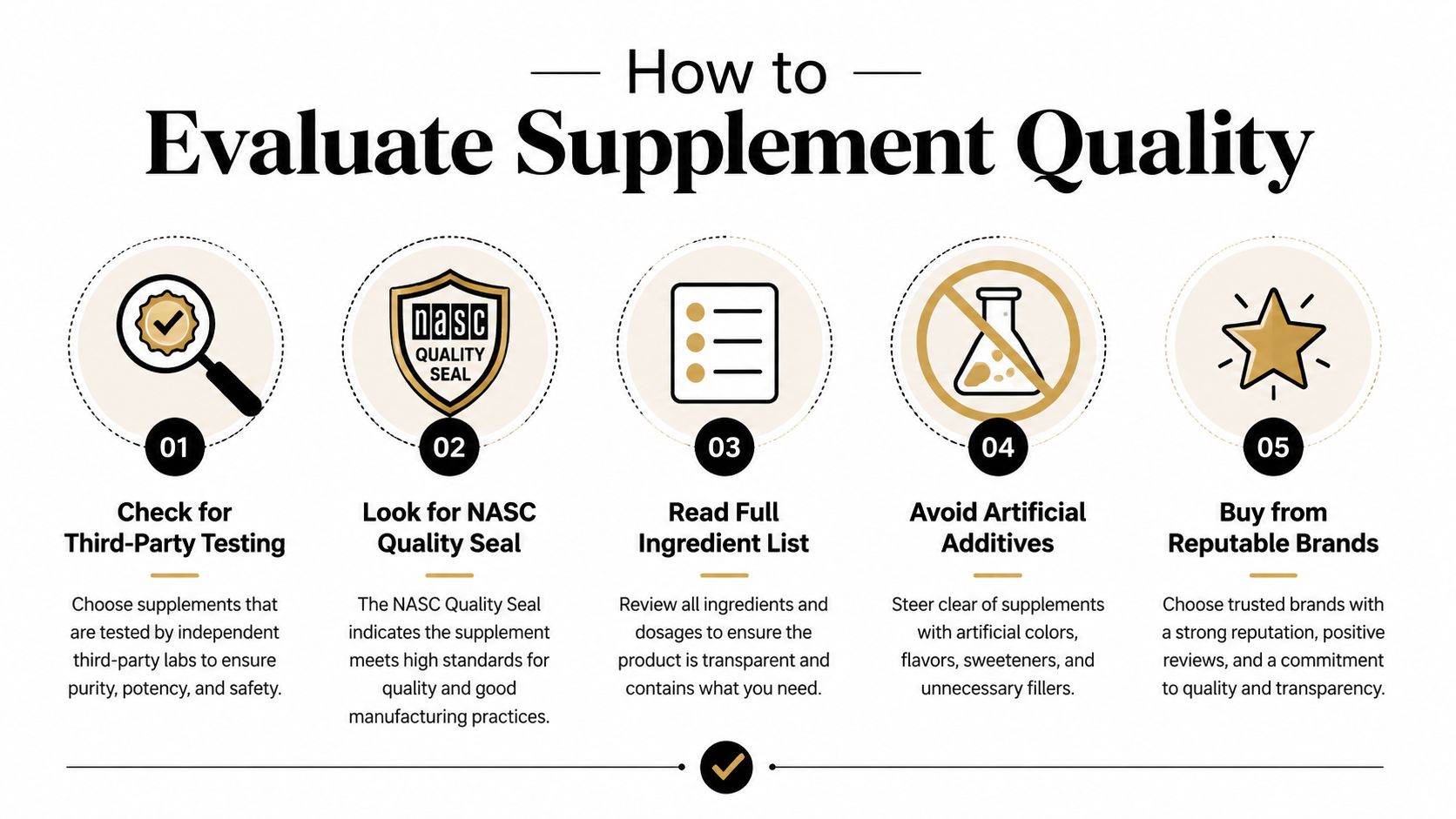
- Identify active doses: Look for EPA and DHA amounts, not only “fish oil,” and exact quantities for other ingredients.
- Check independent testing: Look for batch-level testing or a certificate of analysis that addresses identity, potency, and contaminants.
- Look for quality programs: A credible quality seal, such as the NASC seal, can be one part of your screening process.
- Read every ingredient: Avoid products that rely on vague flavor systems or unnecessary additives, and check for ingredients unsafe for dogs.
- Confirm the intended species: Human products may contain ingredients or dosing formats that don't suit dogs.
Third-party testing doesn't prove that a supplement improves arthritis. It answers a different question, whether the contents match the label and meet specified quality standards. You still need clinical evidence for the active ingredient and a dose that makes sense.
Reject marketing shortcuts
Be wary of claims that promise to rebuild damaged joints, eliminate arthritis, or work instantly. Osteoarthritis is a progressive condition, and a supplement shouldn't be marketed as though it can reverse established structural changes.
A good formula also needs a delivery method your dog will accept consistently. A perfectly dosed product that stays in a cupboard has no practical value. Before buying, compare the serving size, storage instructions, expiration date, palatability, and whether the active dose remains clear after the product is divided across multiple chews.
For broader product-selection principles, this guide to the best supplements for dogs can provide another label-reading reference.
Complementary Care That Amplifies Joint Supplement Results
A supplement can't compensate for excess weight, weak supporting muscles, untreated pain, or slippery floors. The most sensible mobility plan uses nutrition as one layer in a broader routine.
Weight deserves immediate attention because it changes the mechanical load on every step. Feed measured portions, account for treats, and monitor body condition rather than relying only on the number on the scale. A dog that carries less unnecessary weight may move more comfortably even before a supplement has had time to show an effect.

Build movement without provoking pain
Short, controlled walks usually make more sense than occasional bursts of intense activity. Choose level, stable surfaces and stop before your dog becomes visibly tired or stiff. Gentle movement helps preserve muscle, while forcing a painful dog through strenuous exercise can worsen the experience and reduce willingness to move next time.
Home adjustments matter too:
- Improve traction: Place non-slip runners on smooth floors where your dog turns or rises.
- Reduce jumping: Use ramps or steps for cars and favorite resting areas.
- Support rest: An orthopedic bed can make getting comfortable easier.
- Protect routines: Keep food, water, and sleeping areas easy to reach.
Prescription pain treatment has an important place when discomfort is moderate, severe, or worsening. NSAIDs and other veterinary therapies can address pain more directly than supplements, while omega-3 support, weight control, exercise, and environmental changes help create a sustainable plan. For general context on non-drug approaches to inflammation, you can also review MedEq Fitness on natural recovery strategies, while remembering that human wellness advice isn't a substitute for canine veterinary care.
When to Start Supplements and When to See Your Vet
There isn't controlled evidence proving that joint nutraceuticals prevent osteoarthritis before it develops. That point matters because many owners start supplements solely because a dog has reached a certain age. Age and size can justify a conversation with your veterinarian, but they don't establish a universal start date.
Start with an examination if your dog has a sudden mobility change, visible pain, reluctance to walk, repeated limping, difficulty bearing weight, or a new reaction to touch. A veterinarian may need to distinguish arthritis from an injury, spinal problem, or another illness before you choose a product.
Use a simple decision process
- Comfortable dog with risk factors: Discuss weight, activity, diet, and whether targeted omega-3 support is appropriate.
- Gradual stiffness or reduced activity: Book an examination, then consider a monitored supplement trial alongside the recommended care plan.
- Diagnosed osteoarthritis: Prioritize the veterinary pain and mobility plan. A supplement can be complementary, not a replacement.
- No meaningful improvement during the agreed trial: Reassess the diagnosis, dose, product quality, and treatment plan with your veterinarian.
Track specific behaviors rather than writing “seems better.” Record how readily your dog rises, whether they finish their usual walk, how they manage stairs, and whether they initiate play. A planned review after a sustained trial gives you better information than changing several products at once.
If medication becomes necessary, ask your veterinarian about effective NSAIDs for dogs with arthritis and how they fit with supplements.
Joyfull offers pet wellness products built around clearly identified ingredients and veterinary review, which fits the label-first approach recommended here. Visit Joyfull to explore its formulas, then bring the product details to your veterinarian before adding anything to your senior dog's routine.
0 comments