


You're standing in the treat aisle with two bags in your hands. Both promise high protein, both feature appealing pictures of meat, and neither makes it obvious whether the protein is easy for your pet to digest or balanced with the amino acids their body needs. The larger number on the front may look persuasive, but it doesn't tell the whole story.
That's the challenge with high quality protein snacks. Protein quantity and protein quality aren't the same thing. Once you know how digestibility, amino-acid completeness, ingredient order, and processing affect a snack, you can make a much more informed choice in under a minute. You'll also know how to adjust your approach for dogs and cats, portion treats sensibly, and recognize when a veterinarian should guide the decision.
Table of Contents
- Why Protein Quality Confuses So Many Pet Parents
- What High Quality Protein Actually Means
- Why Not All Protein Snacks Are Equal
- How to Read a Protein Snack Label Like a Pro
- Animal Versus Plant Proteins and Cats Versus Dogs
- Serving Sizes and Homemade Snack Ideas
- Vet-Safety Notes and Your Quality Checklist
Why Protein Quality Confuses So Many Pet Parents
A pet parent named Elena recently faced a familiar choice. Her dog enjoyed training treats, but Elena wanted something more nourishing than a biscuit made mostly from starch. One packet listed a prominent crude protein number. Another listed chicken near the top of the ingredients, but the front of the package used fewer nutrition claims.
The first packet looked more impressive at a glance. The second gave Elena more useful information about where the protein came from. Without understanding the difference, she would have been comparing marketing language rather than nutrition.
The high protein trap
“High protein” usually describes how much nitrogen-containing material a product contains, not how much usable protein reaches the body. A snack can contain a substantial crude protein figure and still provide less nutritional value if its protein is difficult to digest, lacks an essential amino acid, or has been damaged during processing.
That doesn't make every plant ingredient or every processed snack a poor choice. It means the label needs to be read as a set of clues. Ingredient identity, formulation, processing, and your pet's individual needs all matter.
A useful mindset: Treat “high protein” as an invitation to investigate, not as a complete quality assessment.
The commercial market is also becoming noisier. A 2026 industry estimate values the global high-protein dog treats market at USD 0.9 billion in 2025 and projects it to reach USD 2.2 billion by 2036, with an implied 8.2% compound annual growth rate. The same forecast projects adult dog owners will account for 52.8% of demand in 2026, while poultry-based proteins will represent 41.9% of the category. These figures describe a growing commercial category, not a guarantee that every product within it has superior nutrition. (Market forecast for high-protein dog treats)
What you'll learn to notice
The most useful questions are straightforward:
- Is the main protein source clearly named?
- Does the protein offer a strong essential amino-acid profile?
- Is it likely to be digestible after processing?
- Does the snack suit a dog or a cat?
- Can you serve it in a sensible amount?
You may also encounter products that combine protein with a specific functional purpose. For example, Prebiotic Chicken Squeeze Treats for Dogs, 24 Packets are described as containing real cage-free chicken and prebiotics, with no artificial colors, preservatives, or flavors. A lickable treat can be useful for enrichment or as a topper, but it still belongs within the pet's overall diet.
For a broader explanation of how shoppers can think about protein quality across nutrition products, this clean protein powder guide offers useful label-reading context, even though human and pet nutrition shouldn't be treated as interchangeable.
What High Quality Protein Actually Means
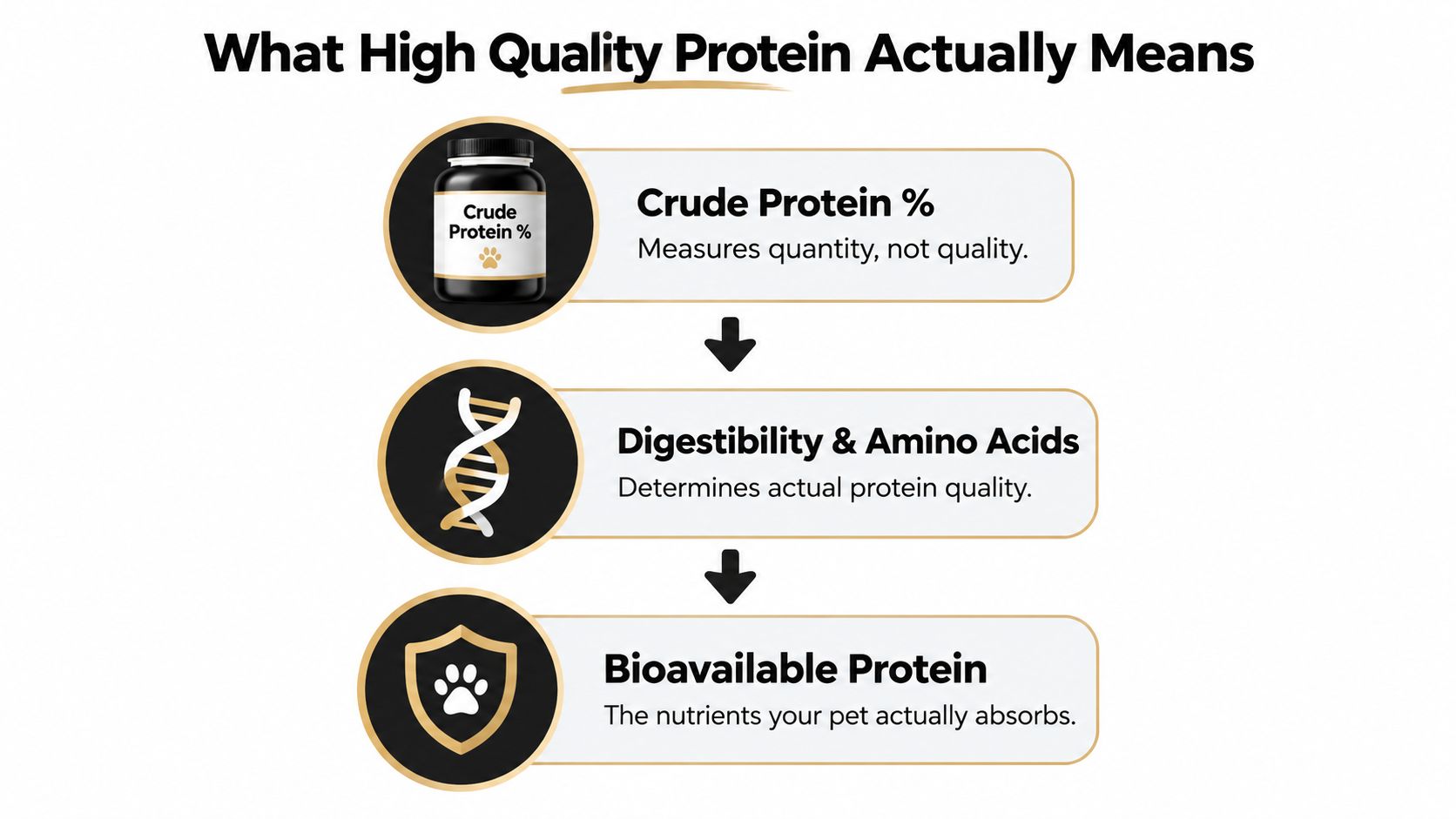
Protein quantity tells you how much protein a snack contains. Protein quality tells you how effectively your pet can digest and use it.
Think of crude protein as fuel in a tank. A label may tell you how full the tank is, but it doesn't tell you whether the engine can burn that fuel efficiently. Digestibility is part of that answer. Amino-acid completeness is another. A snack with a lower crude protein figure may offer more useful nutrition if your pet can digest it well and obtain the essential amino acids their body can't make on its own.
Start with digestibility
The Merck Veterinary Manual's nutrition guidance classifies protein digestibility above 93% as very high, 86% to 93% as high, 80% to 85% as average, and below 80% as low. These ranges give you a helpful framework, but they aren't usually printed directly on a treat packet.
Digestibility describes the proportion of a nutrient that can be broken down and absorbed. If a protein is poorly digested, more of what your pet eats passes through unused. If it's highly digestible, the body has a better opportunity to access its amino acids.
Digestibility also depends on the whole formulation. The same ingredient can behave differently when combined with other ingredients or exposed to different processing conditions. That's why a named protein source is a useful starting point, not a complete verdict.
Then consider amino acids
Proteins are built from amino acids. Some are essential, meaning your pet must obtain them through food. A protein's biologic value rises when it supplies those essential amino acids in useful proportions and can be digested efficiently.
Amino-acid completeness works like a set of building materials. If your pet has plenty of bricks but not enough mortar, the total pile of materials doesn't translate into a complete wall. One limiting amino acid can restrict how effectively the body uses the others.
A DIAAS-like benchmark used in dog and cat nutrition treats scores of 100% or higher as high-quality protein, scores above 50% but below 100% as moderate, and scores below 50% as insufficient as a primary source for the limiting amino acid. Applied research on pulse ingredients found that essential amino acids other than methionine were highly digestible at roughly 80% to 90% on a dry-matter basis, while methionine was the limiting nutrient. (Technical bulletin on plant protein and pet nutrition)
That example explains why a protein-rich ingredient can still need a complementary ingredient. The goal isn't to reject every plant protein. It's to assess whether the complete formulation supplies the amino acids your pet needs after processing.
Use the label as a starting point
A crude protein value remains useful. It helps you compare products within a similar snack category and can reveal when a product's front-of-pack promise doesn't match its guaranteed analysis. It just shouldn't be treated as a direct measure of usable protein.
Look for a named animal protein, a transparent ingredient list, and information about formulation or testing where available. The strongest choice is the one that combines an appropriate protein source with digestibility, amino-acid balance, sensible processing, and a serving size you can manage.
Why Not All Protein Snacks Are Equal
A treat is a format, not a nutritional category. A crunchy biscuit, a tender strip, a rawhide-style chew, and a freeze-dried piece may all sit in the same aisle, but they can perform very different nutritional roles.
A 2025 review of dog snack formulations found protein levels ranging from 0 to 84.0 grams per 100 grams across sampled products. Several freeze-dried and meat-based products reached 60.0 grams per 100 grams or more. The same review makes the practical point clear: the word “snack” doesn't tell you whether a product is primarily meat, starch, a long-lasting chew, or a functional treat. (Review of commercial dog snack formulations)
A quick comparison by format
| Snack Format | Typical Protein Level | Best Use Case |
|---|---|---|
| Biscuits | Highly variable across formulations, from low to high | Routine rewards when the ingredient list and portion fit your pet |
| Tender treats | Variable, depending on meat, starch, moisture, and binders | Training or frequent small rewards |
| Meat-based strips | Often protein-focused, but still formulation-dependent | A chewy reward when the named protein suits your pet |
| Freeze-dried meat treats | Some reviewed products reached 60.0 g per 100 g or more | Small, concentrated rewards, with careful portion control |
| Rawhides and chew sticks | Nutrient value varies by material and processing | Chewing activity, not automatically a high-quality protein source |
| Dental sticks | Formulated for a specific texture and purpose | Dental routines, where safety and veterinary guidance matter |
The table is a comparison tool, not a substitute for a product label. Moisture changes the way protein percentages appear, and a high number on a dry product may not translate directly to the same number on a moist treat. Two products with similar crude protein figures can still differ in digestibility and amino-acid balance.
Why the aisle feels crowded
Premium snack language has expanded because pet parents want more than an occasional indulgence. They're looking for treats that support training, enrichment, digestion, dental care, or a meat-forward feeding style. That creates useful innovation, but it also gives brands more opportunities to place broad health language in front of precise nutrition information.
A comparison of human snack labels, such as this guide to comparing 100-calorie bars, can reinforce a general lesson: serving context matters. For pets, the same principle applies, but the relevant question is whether the snack fits the animal's complete diet and daily energy needs.
Cats deserve particular attention in this category. Prebiotic Tuna Squeeze Treats for Cats are described as using fish broth, real wild-caught tuna, and prebiotics, while excluding artificial and natural flavors, colors, and preservatives. That kind of short, named ingredient list gives a cat owner more to evaluate than a broad “premium” claim alone.
How to Read a Protein Snack Label Like a Pro
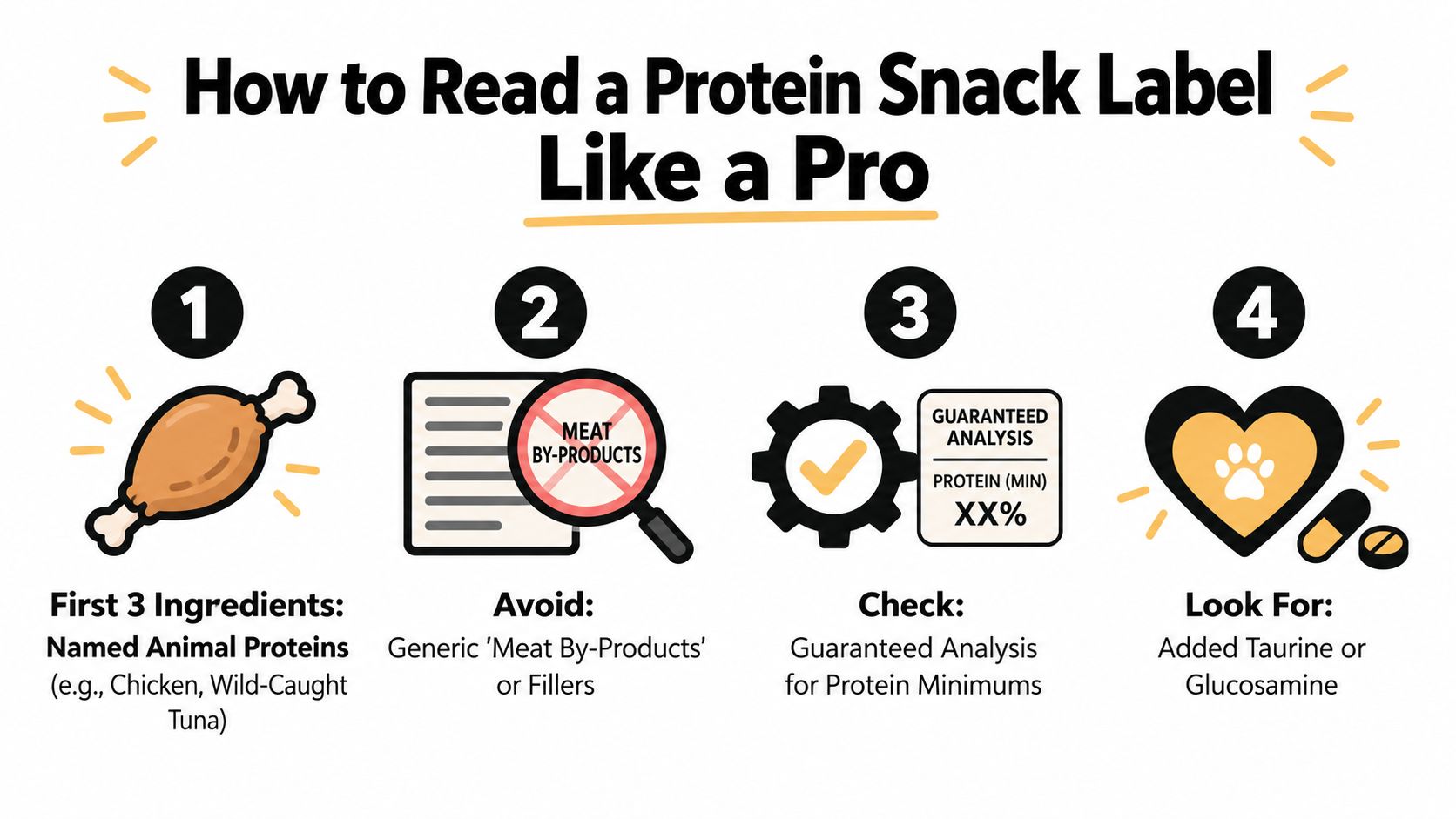
Read the label in an order that protects you from front-of-package marketing. Start with the ingredient list, then check the guaranteed analysis, then consider processing and the product's intended use.
Begin with the first ingredients
Ingredients generally appear in descending order by weight. The first few ingredients therefore give you a useful picture of the formula's foundation, although moisture and preparation can affect how that order should be interpreted.
Look for named sources such as chicken, turkey, beef, salmon, or wild-caught tuna. A named ingredient doesn't automatically prove superior quality, but it tells you what species or food the manufacturer is using. Vague terms such as “meat byproducts” or “animal digest” give you less detail to work with.
The word “byproduct” also needs nuance. Organ tissues can provide valuable nutrients, and the term alone doesn't tell you that an ingredient is unsafe. The practical concern is transparency. A label that identifies the animal source and gives you a clearer formulation story is easier to assess.
Treat crude protein as a minimum
The guaranteed analysis usually lists crude protein as a minimum rather than a promise that every piece contains precisely that amount. Use it to compare similar products, but don't let it override the ingredient list or the snack's purpose.
Research on commercial treats found animal-based treats averaged 30.50 grams per 100 grams of protein, compared with 6.93 grams per 100 grams for plant-based treats. The same research explains that heat processing can damage essential amino acids and trigger Maillard reactions, which means processing can affect protein quality after ingredients have already been selected. (Research on protein content and processing in pet treats)
That's why “made with meat” isn't the end of the investigation. Ask whether the product provides useful information about formulation, testing, or processing. A product can have a sensible ingredient list while still requiring portion awareness.
For more practical help, use this guide to decoding ingredient lists for cats and dogs.
Apply a one-minute checklist
- Name the protein: Identify the species and the main protein ingredients.
- Check the analysis: Compare crude protein with similar snack formats.
- Scan for vague wording: Note generic meat terms, fillers, and unclear flavor sources.
- Look for unnecessary extras: Artificial colors, preservatives, and flavorings may not suit every pet.
- Match the purpose: A training reward, chew, topper, and dental product shouldn't be judged by identical standards.
A company may also provide third-party testing or veterinary formulation review. Those signals don't replace your judgment, but they can add accountability. JoyFull applies this style of checklist through clean ingredient lists, named high-quality proteins, and in-house veterinary review, giving pet parents a concrete example of how formulation principles can appear in a commercial snack.
Animal Versus Plant Proteins and Cats Versus Dogs
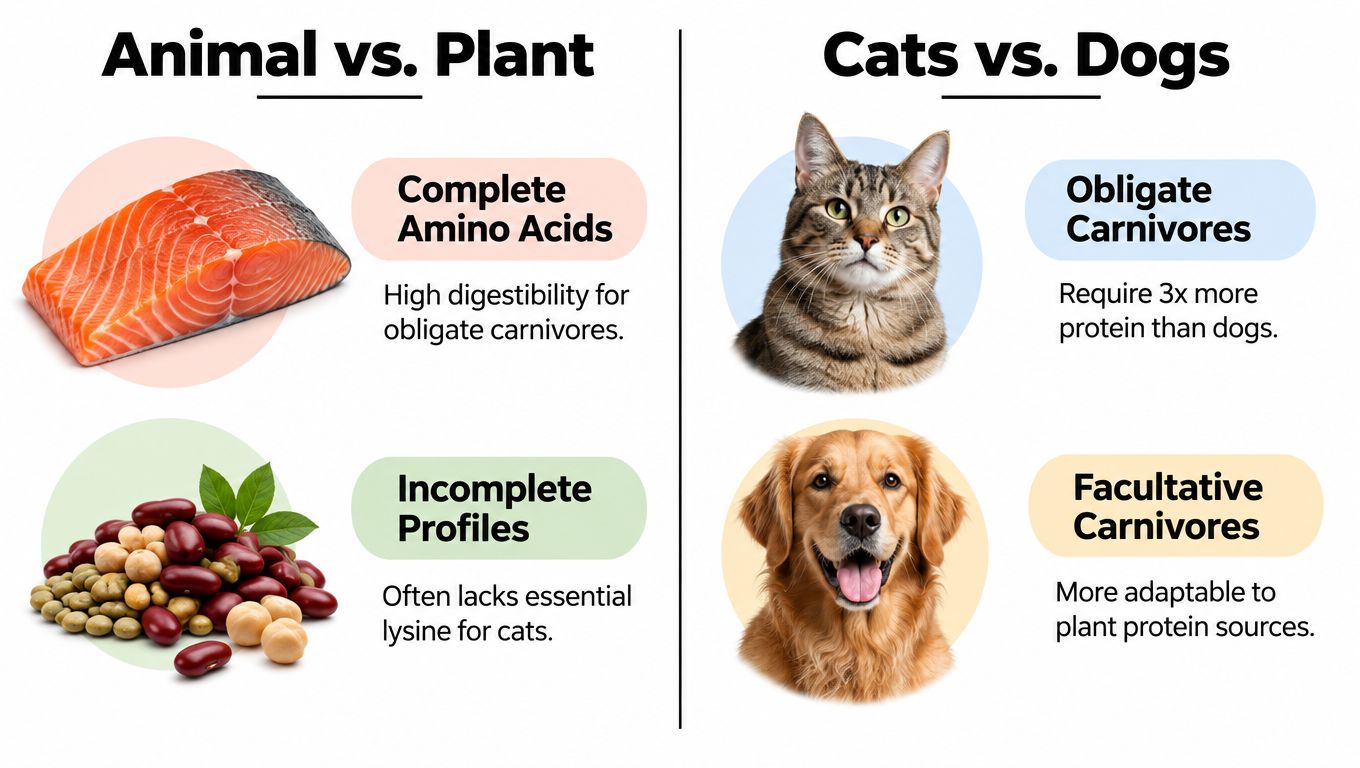
A protein snack can look impressive on its label and still suit a dog better than a cat. Animal and plant proteins differ in amino-acid patterns, digestibility, and how processing affects the final product. Animal proteins often offer a more complete profile for carnivorous species, while plant proteins can contribute useful nutrition when a formula combines them carefully.
The species difference matters. Dogs are adaptable omnivorous carnivores, so their snacks can draw from a wider range of balanced ingredients. Cats are obligate carnivores, with nutritional requirements that make meat-based formulation especially important. A dog treat should not become a cat treat just because both pets enjoy its flavor.
Animal and plant sources side by side
| Consideration | Animal-based protein | Plant-based protein |
|---|---|---|
| Amino-acid profile | Often more complete for dogs and cats | May need complementary ingredients |
| Digestibility | Can be high, depending on source and processing | Varies by ingredient and processing |
| Formulation role | Often serves as the central protein source | Can contribute protein, fiber, or complementary nutrition |
| Label question | Which species and tissue are identified? | Which plant ingredients balance limiting amino acids? |
Methionine is the usual limiting amino acid in plant-heavy formulas. A cat snack built around one plant protein can therefore fall short even when its guaranteed analysis shows substantial crude protein. Look for a named animal protein or an explicit methionine supplement in the ingredient list. A carefully balanced blend can address the gap, but protein quantity alone cannot confirm that the amino-acid supply fits the animal's needs.
For plain-language background, complete vs incomplete protein explained describes how complementary ingredients can improve an overall amino-acid profile. Human nutrition terms still require care when applied to pets, yet the basic idea remains useful: the strongest-looking fuel grade is not always the fuel your particular engine can use best.
Dogs and cats need different standards
Dog snacks and treats accounted for 25,590 launches from 2016 to 2025, including 2,901 launches in 2025 alone, while cat-specific products represented a smaller share. Cats nevertheless held the second-largest pet snack market share and needed formulations that reflected their obligate carnivore biology. (Research on pet snack launches and species categories)
That difference can leave cat owners with fewer practical examples. For a dog, assess ingredient clarity, digestibility, palatability, and the snack's role in the diet. For a cat, examine the primary protein source and whether the formulation clearly suits feline nutrition. For a deeper look at feline protein requirements, see the Joyfull protein guide for cats.
Use these sourcing questions for either species:
- Is the animal source named?
- Does the formula emphasize an appropriate protein?
- Has processing been considered?
- Are the ingredients easy to understand?
- Does the snack complement, rather than displace, a complete diet?
Cats may also respond strongly to texture and aroma. A short ingredient list beginning with fish broth and wild-caught tuna, as used in a cat-focused lickable treat, gives an owner a clearer starting point than a vague meat-flavor claim. The goal is not to chase the highest protein number. It is to choose a protein source and formulation that match the pet eating the snack.
Serving Sizes and Homemade Snack Ideas
Even an excellent protein snack can become unsuitable if portions are too generous. Treats should remain a modest part of the daily diet, with the amount adjusted for your pet's size, life stage, activity, body condition, and health status.
High-protein snacks can be concentrated, especially when they're dried or freeze-dried. A small piece may contain more nutrition than its size suggests, so break larger treats into training-sized portions and keep a daily count. If your pet receives several kinds of rewards, include all of them in the same overall treat allowance.
Simple homemade options
Plain chicken or turkey bites are a straightforward choice. Cook the meat thoroughly, remove bones and skin, avoid seasoning, and cut it into small pieces. The animal protein provides a familiar amino-acid source, while minimal preparation keeps the ingredient list short.
Baked egg treats can be made with plain cooked egg and a simple pet-safe base. Avoid salt, butter, onion, garlic, and seasoning blends. Egg contributes a complete animal protein, but the finished bites should still be served as a complementary snack rather than a replacement for balanced food.
Dehydrated fish pieces can work for pets that tolerate fish. Use a species appropriate for your pet, cook or dehydrate it safely, remove bones, and avoid oils, marinades, and salty seasonings. Fish can be aromatic and appealing, which makes small pieces useful for training.
Small liver pieces should be occasional rather than a daily staple. Organ meats contain valuable nutrients, but excessive amounts can unbalance a diet. Follow your veterinarian's guidance if you're using organ meat regularly.
Make the portion easy to manage
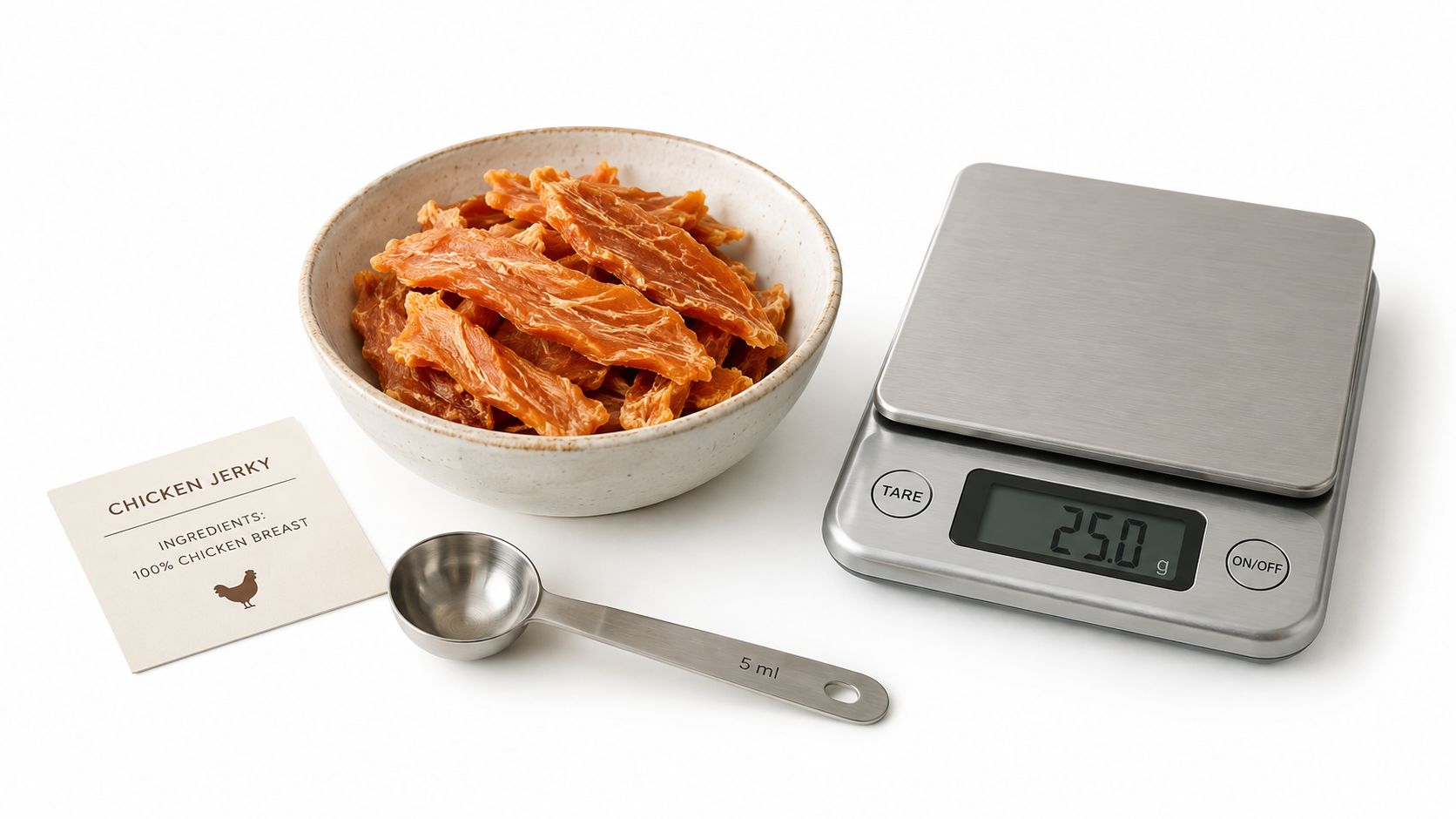
A digital kitchen scale can help when you're preparing dried treats, while a measuring spoon or small container can keep daily portions visible. For enrichment, a lickable snack can be spread thinly on a lick mat or placed inside a suitable food toy, slowing consumption without requiring a large amount.
You can also browse Joyfull's treat recipes for additional ideas, then adapt the general principles to your pet's needs. Homemade treats should complement a complete and balanced diet. They shouldn't replace meals unless a veterinary nutrition professional has formulated the entire diet.
Vet-Safety Notes and Your Quality Checklist
Introduce a new snack gradually and watch for vomiting, diarrhea, itching, constipation, or a clear change in appetite. Stop the new item and contact your veterinarian if symptoms persist or seem significant.
Never season homemade treats with onion, garlic, or spice blends. Use organ meats sparingly, and ask your veterinarian before adding high-protein snacks if your pet has kidney, liver, or pancreatic disease. Those conditions can change how protein and fat should be managed.
Call your veterinarian about sudden pickiness, ongoing digestive changes, weight changes, or a new reaction to food. A snack should never delay investigation of a health problem.
Before buying, run this short checklist:
- Named protein: The main animal source is clear.
- Useful formulation: The ingredients support an appropriate amino-acid profile.
- Processing awareness: The product gives you enough information to judge how it was made.
- Clean label: Unnecessary artificial colors, preservatives, or flavorings aren't doing the marketing work.
- Sensible portions: You can serve the snack without displacing balanced food.
High quality is a checkable standard, not a mysterious premium label. With a little practice, you can hold every snack to the same questions and choose more confidently for the individual dog or cat in front of you.
Joyfull makes pet snacks with clean ingredients and high-quality proteins, including options designed for dogs and cats. Visit Joyfull to explore convenient treats that fit a more thoughtful approach to protein quality, ingredient clarity, and everyday enrichment.
0 comments