


You're standing in the pet-food aisle comparing two bags. Both list 32% crude protein, yet one costs twice as much. The label makes the choice look simple, but that percentage can't tell you how much protein your dog or cat can digest, which amino acids it provides, or whether processing has changed its nutritional value.
High quality animal protein is better understood as a digestion-and-absorption question. A useful ingredient should supply the indispensable amino acids a pet can't make fast enough, in a form the body can use efficiently. A food with a lower-looking protein number may therefore deliver more practical nutritional value than one with the same or higher number.
The most useful filters are amino acid completeness, digestibility, and suitability for the species. Once you read labels through those filters, phrases such as “meat-rich,” “premium protein,” and “high protein” become starting points for questions, not final answers.
Table of Contents
- Why the Protein Percentage on the Bag Is Not the Whole Story
- Indispensable Amino Acids and the Building-Block Analogy
- PDCAAS and DIAAS Explained Without the Jargon
- Comparing Common Animal Protein Sources for Dogs and Cats
- How Processing and Form Change Real Digestibility
- Reading Labels and Evaluating Sourcing Like a Formulator
- Where Pet Protein Is Heading and What Owners Should Watch
Why the Protein Percentage on the Bag Is Not the Whole Story
A bag may display a high crude protein percentage, yet your pet may receive less usable nutrition than the number suggests. Guaranteed analysis estimates crude protein mainly through nitrogen content. It does not directly show how many complete amino acids survive digestion, enter circulation, and reach the tissues.
That difference explains why two foods with the same protein percentage can perform differently. One may use a highly digestible animal protein with a balanced amino acid pattern. Another may reach the label target with ingredients that supply less of a limiting amino acid, or with protein made less available by processing.
The three questions behind the percentage
First, check amino acid completeness. Dogs and cats require specific indispensable amino acids from food. A recipe can contain plenty of total protein while providing too little of one needed building block. The total is like the weight of a toolbox. It does not show whether the particular tools required for the job are inside.
Second, ask how much protein the pet can digest. A pet-nutrition reference classifies digestibility above 93% as very high, 86% to 93% as high, and below 80% as low. Its DIAAS-like framework treats a score of 100% or above as high protein quality, 50% to 100% as moderate, and below 50% as insufficient as a primary source for a limiting amino acid. These thresholds are described in the Pet Nutrition Institute reference on protein and pulses in pet food.
Finally, consider species and processing. Cats and dogs do not have identical nutrient requirements, so the same ingredient may not suit both in the same way. Cooking, rendering, hydrolysis, and other processing methods can also change how easily protein is broken down and used.
Practical rule: Treat crude protein as a quantity signal, not a quality verdict.
A formulator therefore reads beyond the front-of-bag claim. They review named ingredients, amino acid data when available, digestibility testing, the nutritional adequacy statement, and the ingredient's processing history. Chicken, meat, egg, and dairy proteins are often formulation benchmarks, while carefully evaluated novel proteins can also have a useful place.
Indispensable Amino Acids and the Building-Block Analogy
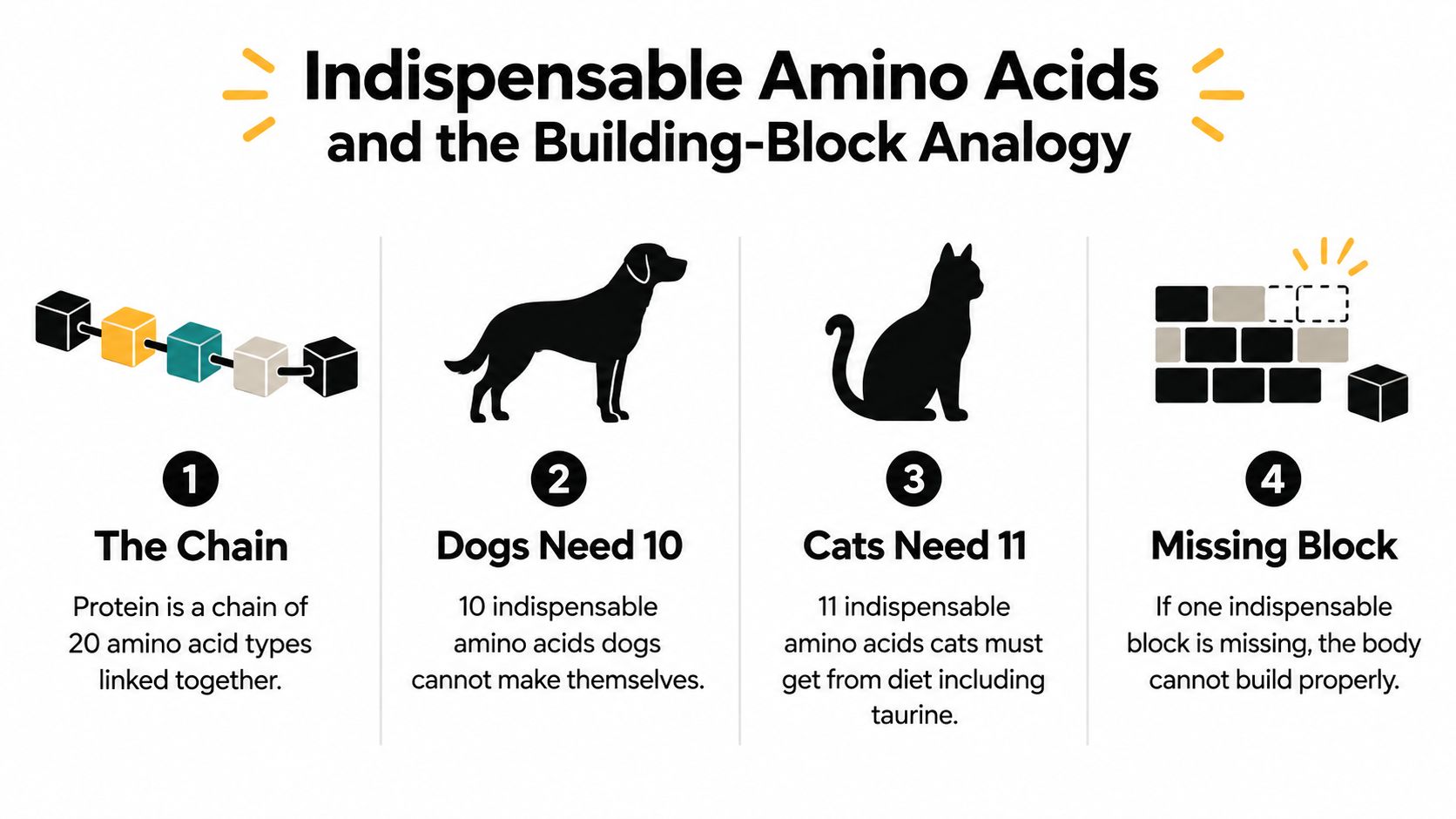
Think of a protein as a wall built from linked blocks. The body can recycle and rearrange some blocks, but it can't manufacture every block quickly enough to meet daily demand. Those required dietary blocks are the indispensable amino acids.
Dogs need 10 indispensable amino acids, while cats need 11, including taurine. The exact dietary requirement differs by species because cats have a more specialized metabolism. A protein can contain plenty of total amino acids and still be inadequate if one indispensable block is missing or supplied in too small an amount.
Why the limiting block controls the result
Formulators pay close attention to amino acids such as arginine, lysine, methionine, taurine, and tryptophan because each supports different physiological functions. Lysine and methionine can become limiting in an otherwise protein-rich recipe. Tryptophan contributes to normal biological processes, while arginine is particularly important in nitrogen metabolism.
The building-block analogy helps explain why a crude-protein percentage can mislead. If a construction crew has plenty of bricks but lacks a critical connector, it can't complete the wall. Similarly, the body can't use an abundant supply of some amino acids to fully compensate for a shortage of another indispensable amino acid.
Cats make the distinction especially important. They need preformed taurine and arachidonic acid in their diets, so a cat food must be formulated around feline requirements rather than assuming that a dog-oriented protein pattern will work. Muscle meat and appropriate organ inclusions can contribute to a species-appropriate formulation, but the finished diet still needs to meet established nutrient profiles.
Dogs have greater metabolic flexibility, but they still benefit from complete, highly digestible animal proteins. Quality isn't determined by whether an ingredient sounds meaty. It depends on the amino acids delivered after digestion and whether the complete food meets the animal's nutritional requirements.
If you're choosing a protein-containing treat rather than a complete diet, evaluate it in context. For example, Prebiotic Chicken Squeeze Treats for Dogs - 24 Packets is described as made with real cage-free chicken and includes prebiotics, but a treat shouldn't be treated as a replacement for a nutritionally complete meal.
PDCAAS and DIAAS Explained Without the Jargon
Suppose two pet foods list the same crude-protein percentage. One may still deliver more usable amino acids because its protein is digested more completely and absorbed in a form the animal can use. PDCAAS and DIAAS help describe that difference, although neither score replaces evaluation of the finished diet.
PDCAAS, or Protein Digestibility Corrected Amino Acid Score, compares a protein's limiting amino acid with a reference pattern, then adjusts the result for overall digestibility. It was developed mainly for human nutrition. The score is capped at 1.0, so proteins performing above that point can appear equal.
DIAAS, or Digestible Indispensable Amino Acid Score, examines each indispensable amino acid separately and uses digestibility measured at the end of the small intestine. It is not capped, so it can show when a protein exceeds a reference requirement by a substantial margin. A comparative review of animal and plant proteins described pork meat, casein, egg, and potato proteins as excellent-quality proteins, with average DIAAS values above 100. Whey and soy reached high-quality values of 75 or higher. Pea, rice, oat, canola, and corn proteins fell below the no-claim threshold of 75 in that comparison.
A useful reading guide
These bands provide a rough way to read a score when a manufacturer supplies one. They describe protein performance, not whether a complete food meets a dog's or cat's requirements.
| Protein source | PDCAAS | Typical DIAAS | Limiting amino acid | Notes |
|---|---|---|---|---|
| Egg | Up to 1.0 | Excellent in comparative human nutrition data | Usually none prominent | Reference protein |
| Whey | High | 75 or higher | Varies by reference pattern | Highly digestible dairy protein |
| Pork | High | Above 100 | Usually none prominent | Excellent in the comparison |
| Casein | High | Above 100 | Usually none prominent | Excellent in the comparison |
| Potato protein | Variable | Above 100 | Varies by pattern | Plant-derived exception |
| Pea, rice, oat, canola, or corn protein | Variable | Below 75 | Varies by source | May need blending or supplementation |
Pet-food interpretation requires the right species reference pattern. A canine and feline study found a meat-protein ingredient with indispensable amino acid digestibility above 85% and DIAAS-like values above 100 across all adult dog and cat reference patterns tested. Under those study conditions, the ingredient could serve as the sole protein source in adult diets.
The practical lesson is simple: use a score as evidence, not as a marketing shortcut. A high value can indicate good digestibility and amino acid availability, but the complete food still needs to provide every required nutrient in suitable amounts.
Comparing Common Animal Protein Sources for Dogs and Cats
Commercial diets commonly use chicken, beef, lamb, turkey, salmon, whitefish, egg, and liver. Each can contribute valuable amino acids, but the best choice depends on the whole formulation, the pet's tolerance, and the ingredient's processing history.
The table below uses qualitative digestibility bands rather than assigning unsupported values to individual ingredients. The broader evidence shows that many high-quality animal proteins can exceed about 90% apparent digestibility, while lower-quality proteins may perform much less well, as summarized in the pet protein digestibility reference.
| Protein source | Amino acid completeness | Typical digestibility | Best use case |
|---|---|---|---|
| Chicken | Generally complete in a balanced formulation | High when appropriately processed | Familiar primary protein for dogs and cats |
| Beef | Complete, with useful mineral contributions in meat-based formulas | High when well processed | Dense red-meat option and rotation protein |
| Lamb | Complete when properly formulated | High, though form matters | Alternative protein for selected diets |
| Turkey | Generally complete | High when appropriately processed | Poultry rotation or palatability support |
| Salmon | Complete, with marine nutrient value | High when well processed | Fish-based formulas and protein rotation |
| Whitefish | Complete when included in a balanced recipe | High when appropriately processed | Alternative fish protein |
| Egg | Highly balanced amino acid profile | Very high in suitable forms | Reference-quality protein or formulation support |
| Liver | Nutrient-dense but not a sole protein foundation | Variable by form and inclusion | Organ inclusion for micronutrient contribution |
Dogs and cats also require different formulation decisions. Cats need preformed taurine and arachidonic acid, so feline diets must account for more than a generic “animal protein” claim. Dogs can synthesize some compounds from precursor nutrients, but a complete animal-source protein can still simplify formulation and support predictable nutrient delivery.
Novel proteins may help when a veterinarian is investigating food sensitivity, although changing foods shouldn't be confused with diagnosing an allergy. Hydrolyzed proteins take the concept further by breaking proteins into smaller peptides for specialized diets. Organ meals can provide concentrated micronutrients, but their inclusion needs careful control because a complete diet depends on balance, not just adding more organs.
For a species-focused explanation of feline protein choices, see Joyfull's protein guide for cats. It's useful to keep the cat-specific requirements separate from general dog-food label advice.
How Processing and Form Change Real Digestibility
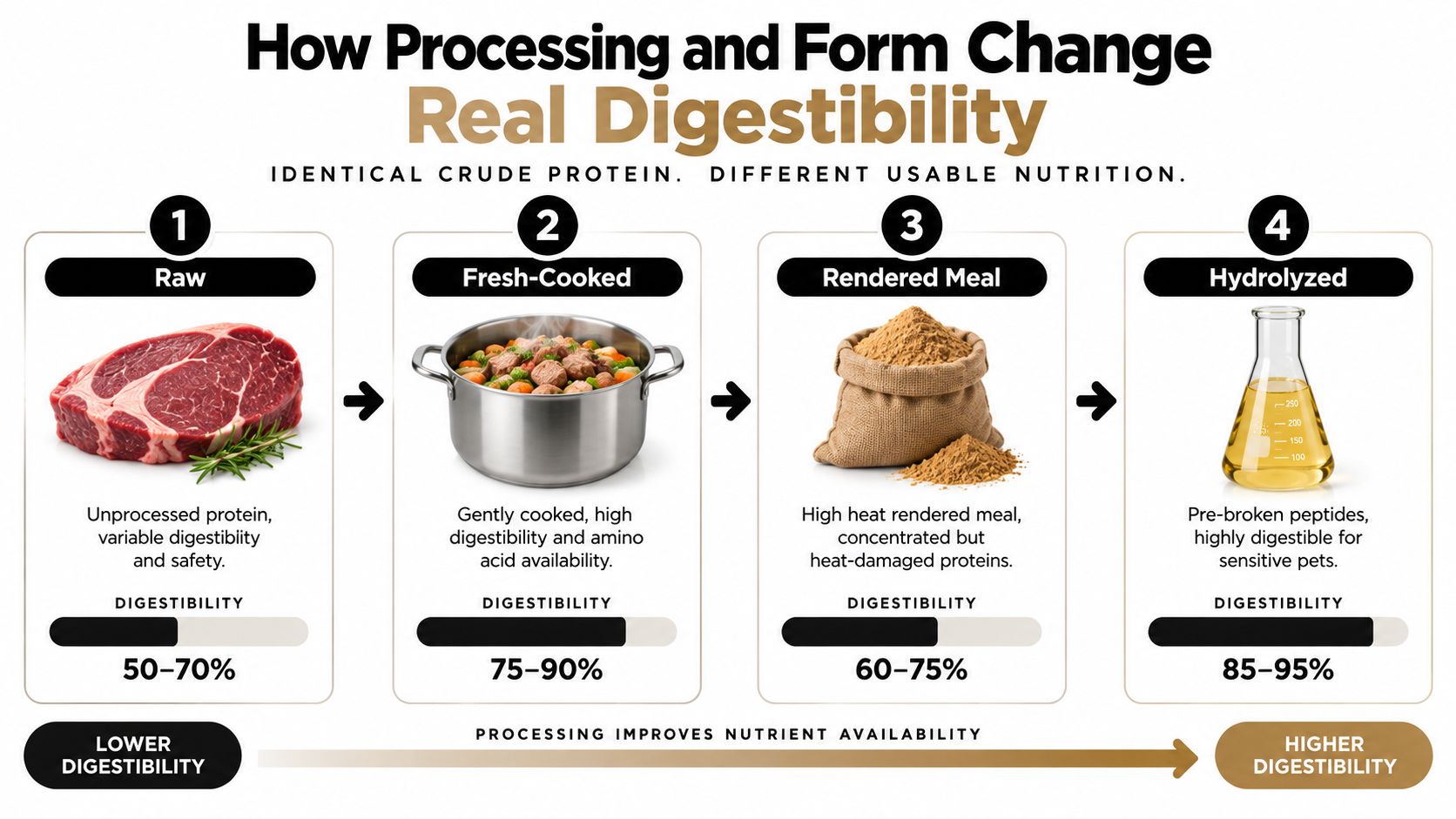
An ingredient's name doesn't tell you everything about its nutritional performance. Raw meat, fresh-cooked meat, rendered meal, and hydrolyzed protein may begin with similar crude-protein readings, yet digestion can differ because heat, pressure, water removal, and enzymatic treatment change the protein structure.
Raw ingredients retain their original structure but bring greater handling and safety considerations. Fresh cooking can denature proteins, which often makes them easier for digestive enzymes to access, while also improving safety and shelf stability when controlled properly. Rendering removes water and concentrates nutrients, but excessive heat can damage heat-sensitive amino acids.
The ingredient form changes the species response
Hydrolysis breaks proteins into smaller peptides before the pet consumes them. That can support diets designed for sensitive animals, but it doesn't automatically make every hydrolyzed ingredient nutritionally complete. The amino acid profile still matters.
Collagen provides a useful example. Recent research found that canine digestibility and absorption were higher for collagen and collagen peptide products, while feline digestibility and absorption were higher for gelatin and collagen peptides. The result, reported in a 2025 in vitro study of protein digestibility in dogs and cats, shows why “animal protein” isn't a species-neutral quality label.
Processing also affects amino acids such as lysine and threonine. Heat can cause chemical reactions that reduce availability, while moderate cooking may improve access to the protein without creating the same degree of damage. A formulator must balance three competing goals:
- Safety: Reduce pathogen risks through controlled processing.
- Stability: Create a product that remains consistent during storage.
- Bioavailability: Preserve or improve the amino acids the animal can absorb.
The question isn't whether rendered meal or fresh meat is universally superior. It's whether the finished ingredient has been processed in a way that delivers dependable amino acid nutrition for the intended species.
For owners dealing with digestive concerns, improve pet digestion with Joyfull offers a plain-language explanation of hydrolyzed protein. A veterinarian should guide therapeutic diet decisions, especially when vomiting, diarrhea, weight loss, or suspected allergy is involved.
Reading Labels and Evaluating Sourcing Like a Formulator
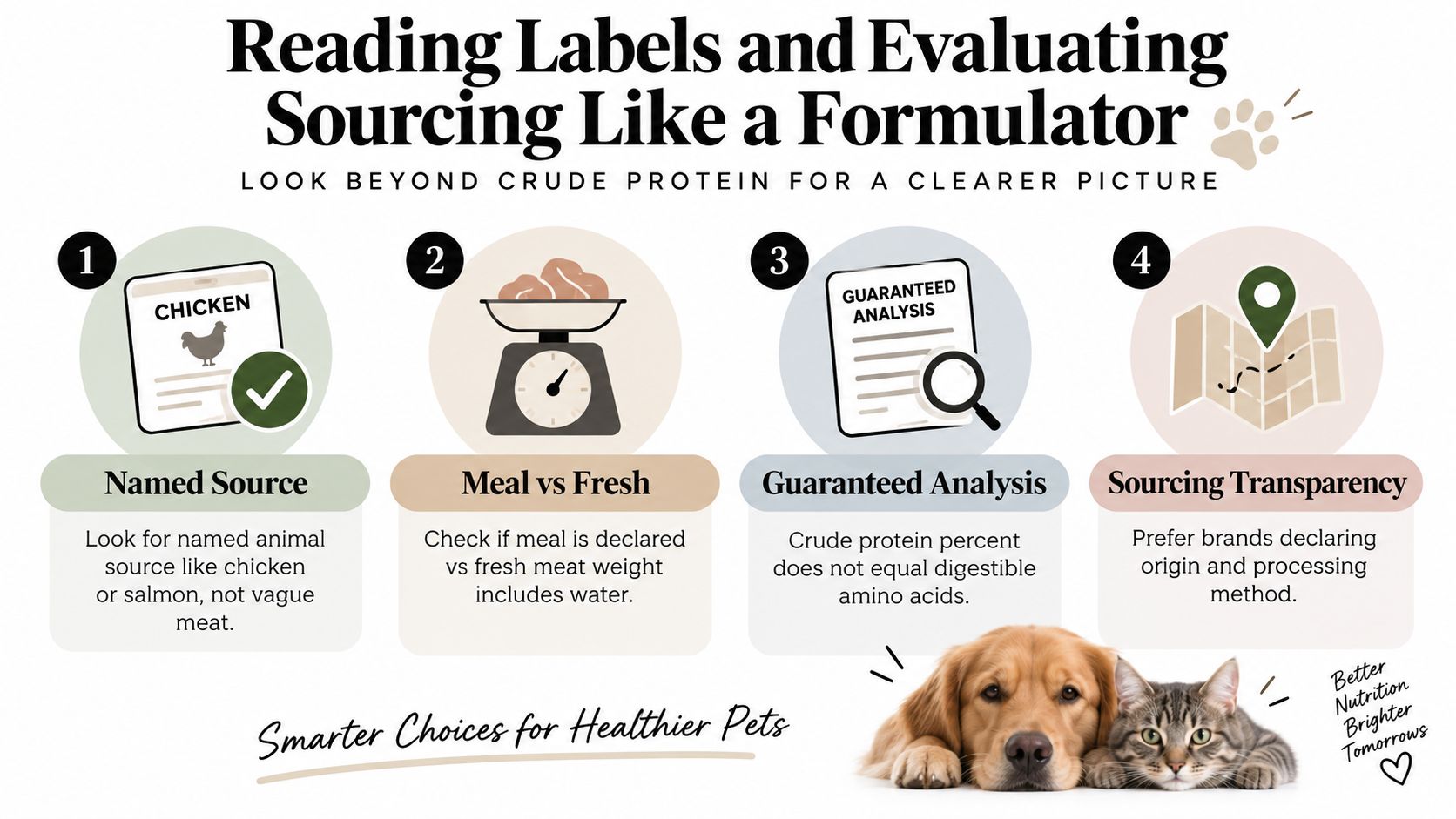
Start with the ingredient list, but don't stop at the first ingredient. Look for a named animal source, such as chicken, turkey, salmon, or beef, rather than a vague term that doesn't identify the species. A named meal can be nutritionally useful because it has already had much of its water removed, while fresh meat appears heavier before cooking because it contains substantial moisture.
Four label checks that reveal more
Guaranteed analysis reports minimum or maximum declared nutrient values, not the full amino acid picture. A crude-protein percentage is useful for basic comparison, but it can't reveal digestibility or whether a limiting amino acid is adequately supplied.
Meal versus fresh meat requires context. Meal is concentrated, while fresh meat includes water that leaves during cooking. Neither label term, by itself, proves superior quality.
The adequacy statement matters because it tells you whether the product is intended to provide complete and balanced nutrition for a stated life stage. Treats and toppers serve a different role from complete diets, even if they contain a recognizable animal ingredient.
The sourcing story should answer practical questions. Does the company identify the species, country of origin, processing method, and facility controls? Can it explain how ingredients move from farm or fishery to finished food?
Ingredient splitting can also distort a quick visual impression. A recipe may list chicken meal, rice, and chicken fat separately, making the meat-related ingredients appear scattered through the list. Read the entire panel and ask how the named proteins function together in the finished formula.
Owners comparing grain-free or corn-free choices may find Bandana Rx corn free advice helpful for understanding why ingredient exclusions should be based on the individual pet and the complete recipe, not on a single ingredient fear. A food can be free of one ingredient and still fail to provide a well-balanced diet.
Joyfull's stated quality approach centers on named proteins, controlled processing, and scientific review with an in-house veterinary advisor. Those principles are useful evaluation criteria for any brand, including Joyfull dog food tips, rather than reasons to accept a label without asking questions.
Where Pet Protein Is Heading and What Owners Should Watch
Pet nutrition is moving beyond a simple meat-versus-plant argument. Insect proteins, fermented and single-cell proteins, upcycled organ ingredients, and new precision-fermented proteins are expanding the available choices. A 2025 safety study of FeedKind Pet protein reported protein and energy digestibility above 80% and fat digestibility above 90% in adult dogs, according to the reported peer-reviewed study summary. Those findings don't establish that every alternative protein is equivalent, but they show why source category alone is no longer enough to judge quality.
A separate 2026 FDA no-objection milestone for a precision-fermented lamb protein ingredient signals that protein development is moving beyond conventional meat, bones, and meals. That milestone is a regulatory development, not proof that every future ingredient will suit every dog or cat.
What owners should prioritize
- Choose named proteins. A specific species gives you more information than an undefined meat meal claim.
- Ask for digestible data. The most useful questions concern standardized indispensable amino acid digestibility, safety testing, and the finished diet's adequacy, not just crude protein.
- Watch the processing method. The same source can perform differently after cooking, rendering, or hydrolysis, and dogs and cats may respond differently to the resulting form.
- Treat sustainability claims carefully. Farm-to-bowl traceability and transparent sourcing are more meaningful than broad environmental language without supporting detail.
The category is likely to become more evidence-driven as regulators and consumers challenge greenwashing and demand clearer sourcing records. The practical shift is already clear: owners need to compare usable protein quality, not chase the largest percentage printed on the front of a bag.
For readers interested in how packaging and distribution may evolve alongside ingredient innovation, the future of refillable pet supplies provides useful context. Packaging choices don't determine amino acid quality, but they're part of the broader move toward more transparent pet-product systems.
Joyfull offers pet foods and treats built around clearly identified proteins, with formulas subjected to scientific review by an in-house veterinary advisor. Visit Joyfull to explore options and compare the ingredient details with the digestibility, amino acid, species, and processing questions covered here.
0 comments