


Forget the flashy marketing on the front of the bag for a second. When you're trying to figure out what’s really in your dog's food, you need to zero in on four specific things: the product name, the ingredient list, the guaranteed analysis, and something called the AAFCO statement.
It sounds like a lot, but it’s simpler than you think. The product name itself is a huge clue about the actual protein content, and the ingredient list shows you what the food is mostly made of, since everything is listed by weight. Getting a handle on these key areas is the single fastest way to see past the hype and pick a food that's genuinely good for your dog.
What Product Names on the Front of the Bag Really Mean
Believe it or not, the name on the front of the bag tells a crucial story long before you flip it over to read the ingredients. It’s not just clever branding. The words used are actually regulated by the Association of American Feed Control Officials (AAFCO), and they give you a surprisingly accurate snapshot of the food's main protein content.
Learning these simple rules is like having a secret decoder ring for the pet food aisle.
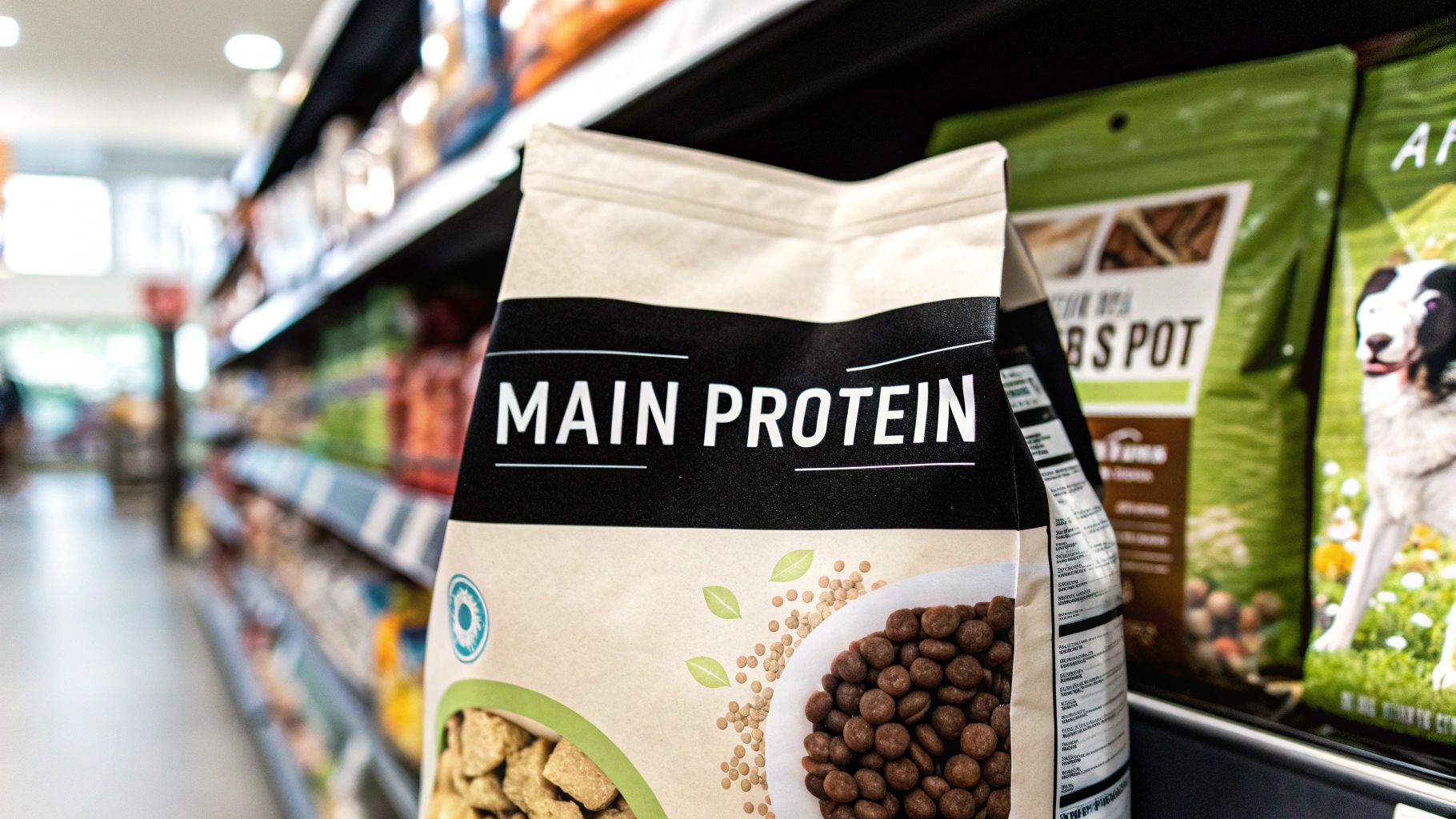
This is exactly why "Chicken Dog Food" and "Chicken Dinner for Dogs" are worlds apart. Each name signals a completely different recipe, and once you know the rules, you can spot the high-protein options in seconds.
The 95 Percent Rule Uncovered
The best, most straightforward naming rule from AAFCO is the "95% Rule."
If you see a simple name like ‘Beef for Dogs’ or ‘Salmon Dog Food,’ it means that the named meat makes up at least 95% of the entire product, not including the water needed for processing. Even when you add the water back into the equation, that named ingredient has to make up a whopping 70% of the total food.
This long-standing rule is a powerful, immediate sign that you're looking at a meat-first formula. It’s also why learning to spot and avoid dog food without fillers is so important for your dog's long-term health.
Spotting Lower Protein Formulas
The moment you see descriptive words like "dinner," "platter," "entrée," or "formula," you need to know a different set of rules is in play.
-
The 25% Rule: A name like "Beef Dinner" or "Chicken Formula" tells you the named meat makes up at least 25% of the food, but less than 95%. These foods will almost always contain a much higher proportion of grains, starches, and vegetables.
-
The 3% Rule: This one is a bit sneaky. If the bag says "Dog Food with Salmon," the game completely changes. The word "with" means the food is only required to contain a minimum of 3% salmon. The actual primary protein is probably something else entirely, like chicken meal or corn gluten meal.
Key Takeaway: Those trigger words are everything. "Chicken Dog Food" is a protein-heavy meal. "Dog Food with Chicken" is a totally different product where chicken is just a minor player.
Finally, there’s the "flavor" rule, which is the least reassuring of all. A product called "Beef Flavor Dog Food" only has to contain enough beef for the taste to be detectable. There is no minimum percentage at all. For any pet owner looking for quality, meat-based nutrition, this is a massive red flag.
Going Deeper Than the First Five Ingredients
The ingredient panel is where you get the real dirt on what's in your dog's food. By law, ingredients have to be listed by their weight before they’re cooked. This is why you always want to see a solid, named protein—think 'deboned chicken' or 'lamb meal'—right at the top of the list. It tells you the food is built on a foundation of quality protein, not cheap fillers.
But don't just stop there. I've learned that looking past those first five ingredients tells you a whole lot more. It reveals the brand's true nutritional philosophy. Are they just meeting the bare minimum, or are they genuinely trying to help your dog thrive?
Watch Out for "Ingredient Splitting"
One of the oldest tricks in the book is a little something called ingredient splitting. It’s a sneaky way to make a cheap ingredient seem less prominent than it actually is. A manufacturer will take one ingredient, say, corn, and list it as several different things like 'ground corn,' 'corn gluten meal,' and 'corn bran.'
Let's look at a common example with peas:
- Pea Protein
- Pea Fiber
- Split Peas
Each of those might be pretty far down the list on its own. But if you added up their total weight, you might find that peas are actually the main ingredient, even more than the "deboned chicken" listed first. It's a classic red flag that the food might be leaning heavily on plant-based fillers to cut costs.
Use the "Salt Divider" Trick
Here's a pro tip I share with everyone: scan the list and find the salt. It's a game-changer. Why? Because pretty much everything listed after salt makes up less than 1% of the entire recipe.
This is your dividing line. You’ll often see a long parade of trendy "superfoods" like blueberries, kale, or kelp listed after the salt. They look great on the bag, but in reality, they're included in such minuscule amounts that it's more about marketing appeal than providing any real health benefit for your dog.
My Take: When you see a bunch of fancy fruits and botanicals way down at the bottom of the list, take it with a grain of salt (pun intended). The real nutritional muscle comes from the ingredients that appear before it.
Finding the Good Stuff That Really Counts
Beyond the core proteins and carbs, I always look for functional ingredients that show a real commitment to your dog's total well-being. When I see these on a label, I know the formulator was thinking about more than just filling a bowl.
Here are some of the valuable extras that catch my eye:
- Omega Fatty Acids: You want to see sources like fish oil (especially salmon oil) or flaxseed. These are crucial for healthy skin, a glossy coat, and keeping joints happy.
- Probiotics and Prebiotics: Look for things like "dried lactobacillus acidophilus fermentation product" or chicory root. A healthy gut is the cornerstone of good digestion and a strong immune system.
- Antioxidants: Natural preservatives like Vitamin E (often listed as mixed tocopherols) and Vitamin C are great because they help protect your dog's cells from damage.
- Chelated Minerals: This is a huge sign of a quality formula. When you see minerals listed as "zinc proteinate" or "iron proteinate," it means they are bound to amino acids. This makes them way easier for your dog’s body to absorb and actually use.
Understanding what makes for truly good ingredients in dog food helps you cut through the marketing fluff and focus on what will genuinely nourish your pet. A formula that includes these beneficial additions shows the company didn't cut corners and invested in a higher standard of nutrition.
Making Sense of the Guaranteed Analysis Panel
That little chart of percentages on the side of the bag, the Guaranteed Analysis, can feel a bit like reading a science textbook. But don't let the technical terms throw you off. Once you know what you’re looking at, it becomes one of the best tools for comparing different dog foods, especially when you're weighing wet vs. dry options.
First off, the word "crude" doesn't mean the ingredients are low-quality. It’s just a scientific term for the method used to estimate the total amount of protein, fat, and fiber. This panel guarantees the minimum percentage of crude protein and crude fat and the maximum percentage of crude fiber and moisture.
The visual below breaks down how to think about the ingredients list, which directly feeds into the final numbers you see in the guaranteed analysis.
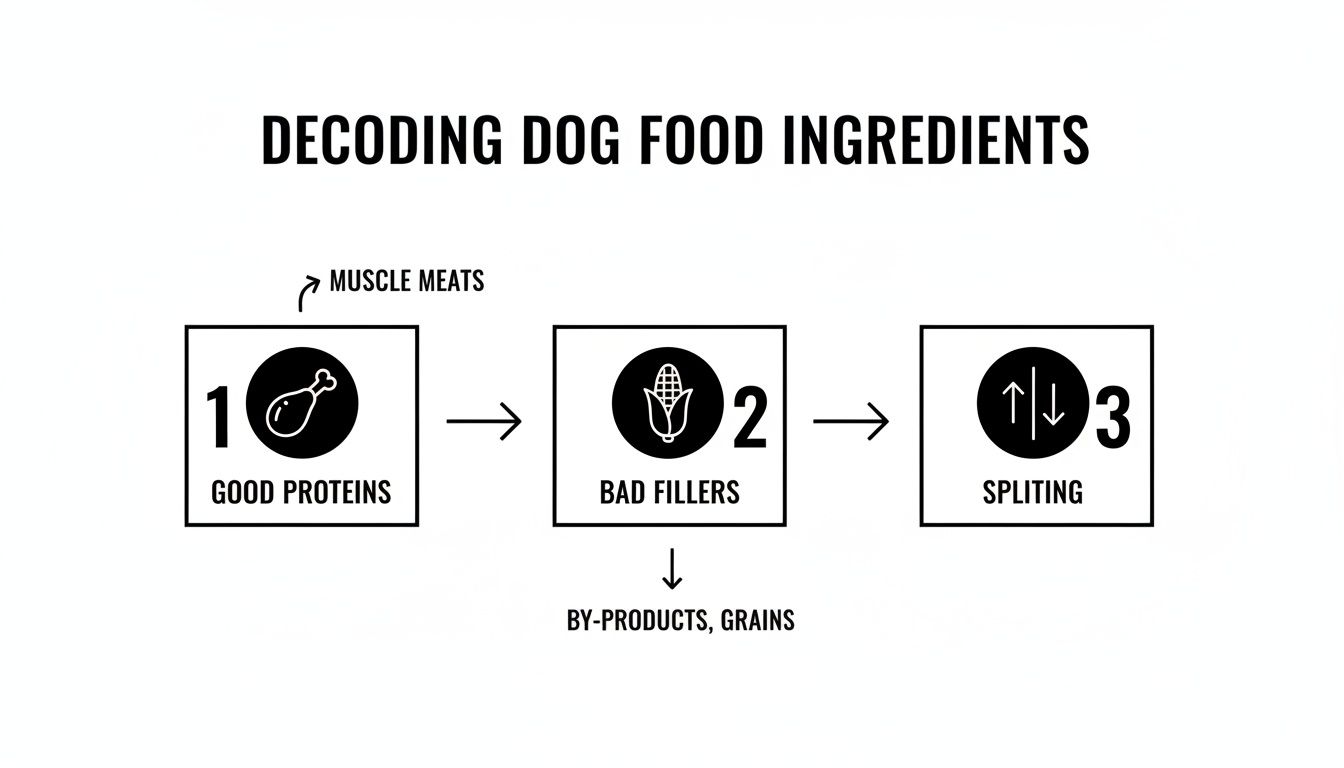
As you can see, zeroing in on high-quality proteins and spotting sneaky filler tactics is the first step to ensuring those guaranteed percentages actually mean something for your dog's health.
Why Moisture Content Is the Key
Have you ever looked at a kibble label next to a canned food label and thought the numbers seemed completely mismatched? That’s all because of water.
A dry kibble boasting 28% protein and 9% moisture looks way better than a canned food with only 7% protein and a whopping 78% moisture. It’s a classic apples-to-oranges comparison, and it's totally misleading. To get a true sense of the nutrition, you have to mentally remove the water from the equation. The AAFCO made moisture reporting mandatory back in the 1970s, and you can read the full research about these labeling requirements to see why.
This is where calculating the dry matter basis comes in. It’s a simple conversion that levels the playing field, allowing you to see the real nutrient percentages of any food, wet or dry.
Pro Tip: Calculating nutrients on a dry matter basis is a non-negotiable step if your dog has specific health needs like kidney support or weight management. For these dogs, precise protein and fat levels are absolutely critical.
How to Calculate Dry Matter Basis
The math here is way simpler than it sounds and only takes a moment.
- Find the Dry Matter: Just subtract the moisture percentage from 100%. A dry food with 12% moisture has 88% dry matter. A wet food with 78% moisture? It only has 22% dry matter.
- Calculate the Nutrient Percentage: Take the protein percentage right off the label (the "as-fed" value) and divide it by the dry matter percentage you just found.
To see how this works, let's look at that example again.
A dry kibble lists 26% protein and 10% moisture.
- Dry Matter: 100% - 10% = 90%
- Dry Matter Protein: 26 ÷ 90 = 28.9%
Now, what about that canned food with 8% protein and 78% moisture?
- Dry Matter: 100% - 78% = 22%
- Dry Matter Protein: 8 ÷ 22 = 36.4%
All of a sudden, that canned food is revealed to be much more protein-dense than the kibble. This quick calculation changes everything.
To make this crystal clear, here’s a table comparing typical 'as-fed' values from the label to their true 'dry matter' values.
Dry Matter Nutrient Comparison Wet vs Dry Food
| Nutrient | Canned Food (As-Fed) | Dry Food (As-Fed) | Canned Food (Dry Matter Basis) | Dry Food (Dry Matter Basis) |
|---|---|---|---|---|
| Protein | 8% | 26% | 36.4% | 28.9% |
| Moisture | 78% | 10% | 0% | 0% |
| Dry Matter | 22% | 90% | 100% | 100% |
As you can see, once the water is removed from the picture, the nutritional profile looks completely different. The canned food, which initially seemed lower in protein, is actually significantly higher.
Estimating the Carb Content
One of the most important nutrients—carbohydrates—is almost never listed on the Guaranteed Analysis. But you can get a pretty good estimate yourself.
Start by adding up the percentages for crude protein, crude fat, moisture, and crude fiber. You'll also need a number for ash, which is the mineral content. It's not always listed, but a safe estimate is around 8% for dry food and 2% for wet food.
Subtract that total from 100%. What's left over is your approximate carbohydrate percentage. For dogs with diabetes or those on a specific low-carb diet, figuring this number out is an absolute must.
What the AAFCO Statement Actually Guarantees
If there's one thing you absolutely must find on a dog food label, it's the Nutritional Adequacy Statement. This little block of text is the official nod from the Association of American Feed Control Officials (AAFCO), and it confirms the food is "complete and balanced" for a specific life stage.
Think of it as the ultimate quality check. It's the brand's guarantee that the bag contains a properly formulated diet, not just a random assortment of ingredients. Without it, you’re flying blind and have no real assurance that the food can support your dog’s health over the long haul.
AAFCO requires this statement on virtually all pet foods sold in the U.S., a standard that has been a game-changer for improving pet nutrition.
Formulated vs. Feeding Trials
When you look closely at the statement, you'll notice it says how the food was validated. There are two primary methods, and knowing the difference can help you make a more informed choice.
-
"Formulated to meet the nutritional levels...": This means the manufacturer designed the recipe—usually on a computer—to meet the specific nutrient profiles established by AAFCO. They run a lab analysis on the finished product to confirm it hits the targets for protein, fat, vitamins, and minerals. It's a perfectly valid, science-based approach.
-
"Animal feeding tests using AAFCO procedures...": This is what many consider the gold standard. It goes a step further by feeding the food to real dogs for an extended period (usually six months) under strict, controlled conditions. Researchers monitor their health to ensure they not only survive but thrive. This proves the nutrients are bioavailable—meaning the dog's body can actually absorb and use them—and that the food performs well in the real world.
While a "formulated" food is perfectly fine, a successful feeding trial offers an extra layer of confidence.
My Personal Insight: I always feel a bit more secure choosing a food that has passed feeding trials, especially for puppies or dogs with specific health concerns. It’s like the difference between a car that looks perfect in a computer simulation and one that has actually been put through its paces on the road.
Matching the Food to Your Dog's Life Stage
The AAFCO statement is also crystal clear about which life stage the food is for. This part isn’t just a suggestion—it’s critical. A growing puppy's nutritional needs are worlds away from those of a senior dog who spends most of the day napping.
You’ll typically see three main life stage designations:
- Growth: Specifically for puppies. These formulas are packed with more calories, protein, and key minerals like calcium and phosphorus to build strong bones and muscles.
- Maintenance: Designed for healthy adult dogs who have finished growing and have normal activity levels.
- All Life Stages: This is a bit of a catch-all. To meet this standard, the food must meet the more demanding nutritional requirements of a growing puppy. That means it's also suitable for most adult dogs. However, it can sometimes be too rich or calorie-dense for less active, overweight, or senior dogs.
That ‘Nutritional Adequacy Statement’ is your dog's ticket to balanced meals. It confirms if a food is 'complete and balanced' for critical life stages, like puppy growth which requires a minimum of 22.5% protein, versus adult maintenance at 18%. With over 90% of U.S. dog foods now carrying this statement, it has become a benchmark of reliability in an industry where 40 million U.S. households own dogs. You can find more insights about these label requirements on PetMD.com.
Using Calories and Feeding Guidelines Correctly
Alright, so you’ve dissected the ingredients and crunched the numbers on the analysis. Now comes the most important part: turning that information into the right amount of food in your dog’s bowl. This is where the rubber meets the road, and getting it right is the key to avoiding accidental overfeeding—a huge factor in pet obesity today.
First, hunt down the calorie content. Every bag is legally required to list it, usually as "kilocalories per cup" (kcal/cup). This little number is your best friend for accurate portioning. For instance, a high-octane "performance" food might be packed with 450 kcal/cup, while a "healthy weight" formula could be a leaner 320 kcal/cup. If you just scoop a cup of each, you're looking at a massive difference in your dog's daily calorie intake.
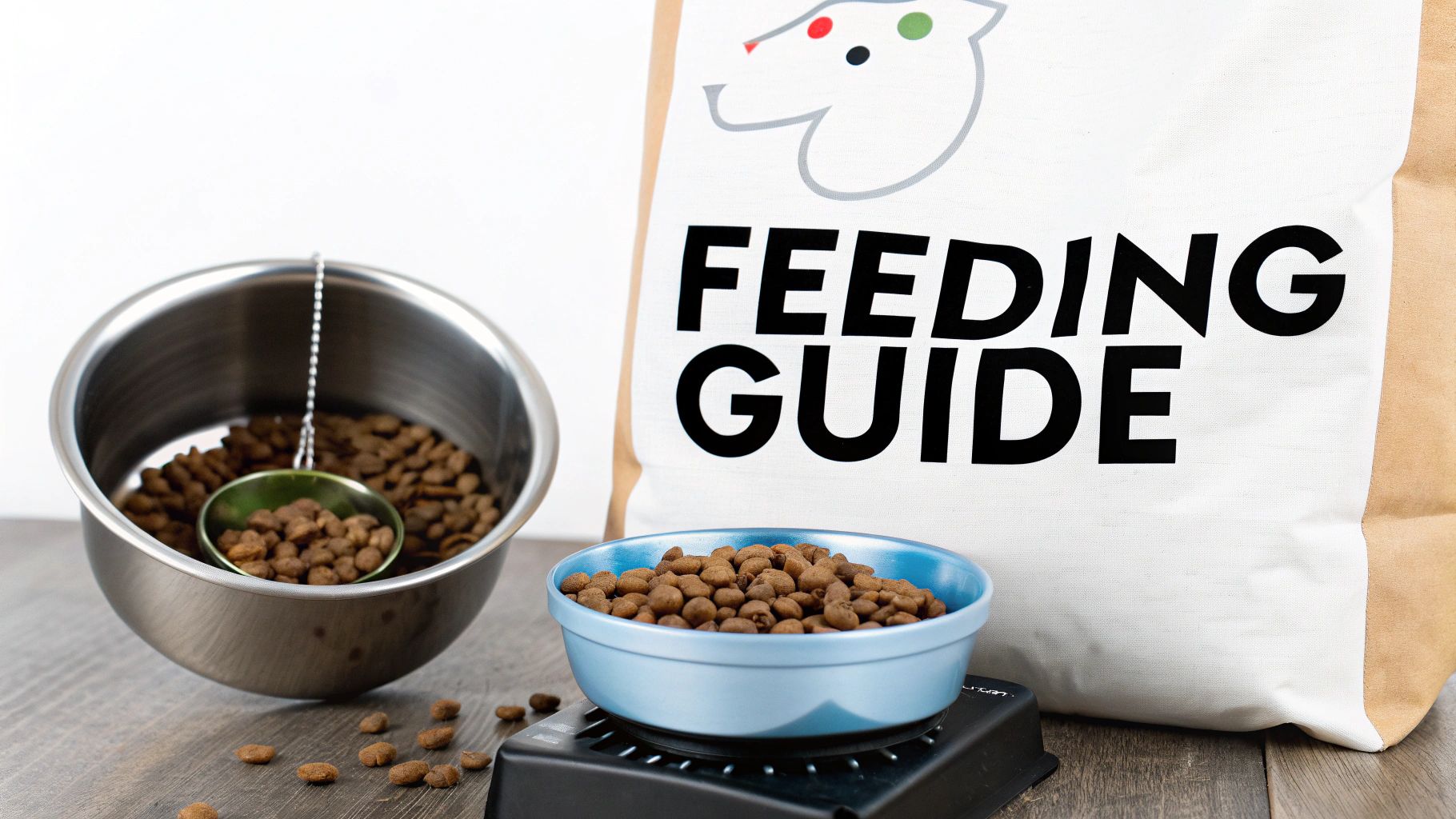
Understanding this caloric density is what separates a good guess from a precise meal plan. It empowers you to make smart adjustments.
Why the Feeding Chart Is Only a Starting Point
Think of the feeding chart on the bag as a rough draft, not a final prescription. These guides are based on a generic, "average" dog—a creature that doesn't actually exist. In the real world, two dogs of the exact same weight can have completely different needs.
A 50-pound couch-potato Basset Hound and a 50-pound agility-training Border Collie are living in different universes, metabolically speaking.
The chart on the bag simply can't account for crucial variables like:
- Activity Level: Is your dog a professional napper or a marathon runner?
- Breed & Metabolism: Some breeds, like Labs and Beagles, seem to gain weight just by looking at food.
- Age: A senior dog’s metabolism has slowed way down compared to a young adult’s.
- Spay/Neuter Status: This is a big one. Dogs that are spayed or neutered often need 20-30% fewer calories.
My Personal Tip: I always tell people to use the feeding chart as their guide for day one, and then watch the dog. The best tool you have is your own two hands. You should be able to easily feel their ribs under a thin layer of fat, but not see them jutting out. Adjust the food up or down by about 10% at a time until you hit that sweet spot. If you want a more scientific starting point, a dog food portion calculator can give you a more personalized recommendation.
Don't Forget the Fine Print
Before you walk away from the bag, do a final quick scan for two last, but very important, details.
First, find the 'best by' date. This isn't just a suggestion; it ensures the food is fresh and that the vitamins and fats haven't started to degrade. Second, look for the manufacturer's contact information. A company that stands by its product will make it easy to find their phone number or email. It’s a great sign of transparency and a commitment to their customers.
Your Dog Food Label Questions Answered
Even when you feel like you've got the basics down, a few tricky questions always seem to pop up when you're standing in the pet food aisle. Let's tackle some of the most common points of confusion so you can feel 100% confident in what you're bringing home for your dog.
What Is the Difference Between 'Chicken' and 'Chicken Meal'?
This is one of the most frequent questions I get, and it's a great one. When you see 'chicken' listed, it refers to the clean flesh and skin from parts of whole chickens. The key thing to know is that it’s weighed before cooking, when it's still full of water—typically around 70%.
'Chicken meal', on the other hand, is chicken that has gone through a process called rendering. Think of it as a cooking process that removes the water, leaving behind a highly concentrated protein powder.
So, while "fresh chicken" sounds more appetizing, chicken meal actually provides more protein per ounce because all that water weight is gone. You'll often see high-quality foods using both to get the benefits of fresh ingredients and the protein punch of the meal.
Are 'Grain-Free' Dog Foods Always a Better Choice?
Not necessarily. The "grain-free" trend exploded in popularity, but it’s more of a marketing term than a guarantee of a healthier food. These recipes simply swap out common grains like corn or wheat for other carbohydrate sources—think potatoes, peas, or lentils.
For a dog with a true, diagnosed grain allergy, these foods are a great solution. But the reality is that most dogs digest high-quality grains just fine.
It's also worth noting that the FDA has investigated a potential link between some grain-free diets (especially those heavy on legumes) and a heart condition called dilated cardiomyopathy (DCM). Your best bet is always to choose a complete and balanced diet that suits your individual dog's needs, ideally with guidance from your vet.
And remember, your dog's health isn't just about what's in their bowl. Creating a safe and comfortable environment is just as crucial. For instance, an ultimate guide to artificial turf for dogs can help you build a better outdoor space for them to play in.
How Important Is the 'Best By' Date on the Bag?
It's critical—don't ignore it. The 'best by' or 'best before' date isn't just a suggestion; it’s about safety and nutritional integrity.
Over time, the fats in kibble can go rancid. This not only tastes bad but can cause some serious stomach upset for your dog. Beyond that, the vitamins and antioxidants in the food lose their potency, meaning that bag of food might not be providing the 'complete and balanced' nutrition you're paying for.
Always check the date before you buy a bag, and try to finish it well before it expires.
At Joyfull, we believe your pet’s health comes first, and that starts with total transparency. Our formulas are built on clean, high-quality proteins and are meticulously reviewed to deliver genuinely beneficial, no-BS nutrition. Explore our better-for-you snacks at https://joyfullpet.com.
0 comments