


“Give your dog an allergy chew and the itching will stop.” That's among the most popular advice pet parents encounter, and it's also one of the least useful ways to evaluate a product. Dog supplements for allergies aren't interchangeable, and their value depends on the ingredient, the dose, the dog's diagnosis, and whether the formula is being used as supportive care rather than as a substitute for treatment.
Canine atopic dermatitis, a chronic allergic skin condition, is estimated to affect 3% to 15% of dogs globally. In a large U.S. field study, atopic or allergic dermatitis was identified in 4.7% of 31,484 dogs examined across 52 veterinary practices (veterinary review and field-study summary). That makes allergy management a common, recurring need, but common doesn't mean simple.
The practical question isn't just whether supplements “work.” It's which ingredient has evidence for which problem, and when does it become an expensive add-on with little chance of changing your dog's comfort?
Table of Contents
- The Truth About Canine Allergy Supplements
- Understanding the Root Causes of Dog Allergies
- Evaluating the Evidence for Popular Allergy Ingredients
- How to Read Supplement Labels Like a Veterinary Pro
- Integrating Supplements with Prescription Allergy Treatments
- Tracking Progress and Recognizing Signs of Improvement
- Frequently Asked Questions About Canine Allergy Support
The Truth About Canine Allergy Supplements
A supplement can support an allergy plan, but it rarely replaces diagnosis, parasite control, infection treatment, prescription medication, or dietary investigation. The 2023 AAHA guidelines describe veterinary-formulated essential fatty acids, nutraceuticals, palmitoylethanolamide, probiotics, and epidermal-barrier products as adjunctive options, which means they're intended to complement core management rather than function as stand-alone cures (AAHA allergic skin disease guidelines).
That distinction matters because allergic skin disease behaves more like a chronic management problem than a one-time irritation. A dog may need help controlling inflammation, restoring a damaged skin barrier, reducing exposure to triggers, and treating secondary infections. A capsule or chew might contribute to one of those jobs, but it can't address every cause of itching at once.
Practical rule: Choose a supplement for a defined purpose, not because its label contains the longest ingredient list.
The commercial category is expanding alongside pet healthcare spending and interest in ongoing wellness. One market report projects the pet allergy immune supplement category from a sub-$1 billion global market in 2025 to $1.62 billion by 2035, with a projected 5.1% CAGR, while another estimate places the broader category at $2.67 billion in 2024 and $6.08 billion by 2035. The same reports identify dogs as a major part of demand, with one assigning dogs about 70.0% of pet-type share in 2025 and another estimating the dog segment at 49.0% of the pet allergy treatment market in 2025 (market category analysis). These are market projections, not proof that any individual product improves symptoms.
A sensible plan also includes basic pet supplement safety tips, especially around dosing, overlapping ingredients, medical conditions, and interactions. If your dog has open sores, repeated ear problems, severe discomfort, or rapidly worsening skin, a veterinary examination should come before experimentation with another chew.
Understanding the Root Causes of Dog Allergies
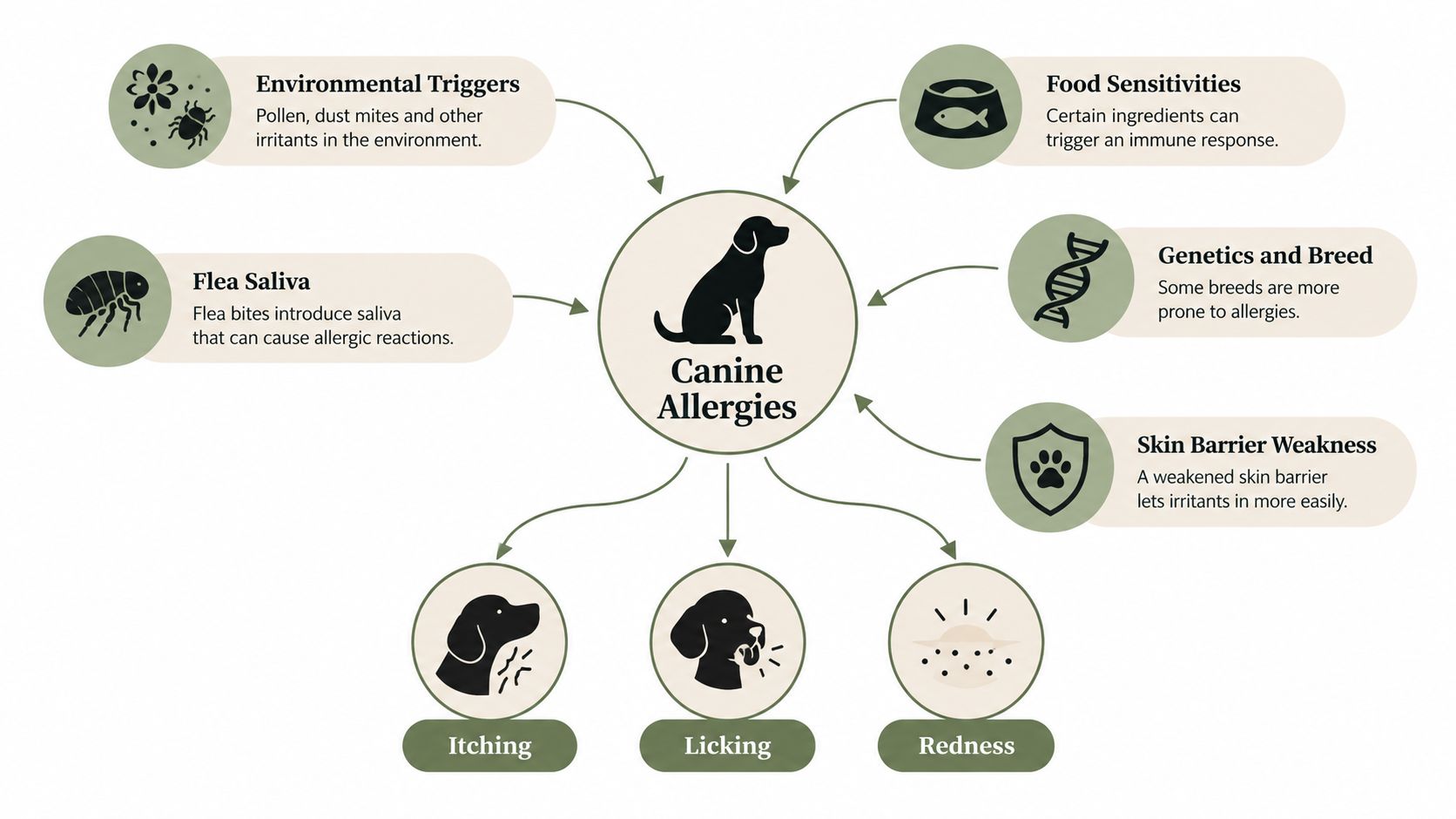
Itching is an outward symptom, not a diagnosis. Dogs can react to environmental allergens such as pollen, grasses, and dust mites, to particular food components, or to flea saliva. Some dogs also inherit a greater tendency toward allergic skin disease, and several triggers can operate together.
The itch threshold
Think of discomfort as a cup that gradually fills. Flea exposure may add one amount, pollen another, dry skin another, and a bacterial or yeast overgrowth another. Once the cup overflows, the dog scratches, licks, chews, or rubs, even if no single trigger seems dramatic.
The skin barrier is part of that picture. A healthy epidermis helps keep irritants out and moisture in. When the barrier is impaired, allergens can interact more readily with the skin and immune system. Scratching then causes additional physical damage, which can increase inflammation and create an environment where secondary problems develop.
This is why a product aimed at the skin's lipid layer isn't addressing the same biological target as a prebiotic or probiotic. One may be selected to support barrier function, while the other is intended to influence the intestinal microbial environment. Neither proves that the dog's primary trigger originates in that system.
Food, fleas, and the gut-skin connection
Food reactions require careful investigation rather than casual ingredient swapping. A dog with food-related itching may need a structured veterinary elimination diet, while a dog with flea allergy dermatitis needs reliable flea control. Adding a supplement without addressing the trigger can leave the main inflammatory signal untouched.
The gut-skin axis is biologically plausible, but plausibility isn't the same as a guaranteed clinical result. Prebiotic fibers can serve as food for existing beneficial gut bacteria, and a product such as Prebiotic Chicken Squeeze Treats for Dogs - 24 Packets combines real cage-free chicken with prebiotics in a lickable format, without artificial colors, preservatives, or flavors. That makes it a treat with a gut-health feature, not proof of an allergy treatment effect.
Environmental management can also reduce exposure for some dogs. If airborne particles are part of your household concern, you can compare air purifiers for pet owners, while remembering that air cleaning doesn't replace veterinary evaluation, flea prevention, or treatment of inflamed and infected skin.
Evaluating the Evidence for Popular Allergy Ingredients
Ingredient categories often sound more precise than they are. “Immune support,” “skin defense,” and “gut balance” can describe very different formulas, doses, and evidence levels. The useful question is whether a specific ingredient has clinical data for a specific symptom or diagnosis.
A practical comparison
| Ingredient | Primary Target | Evidence Strength | Best Used For |
|---|---|---|---|
| EPA and DHA omega-3 fatty acids | Inflammatory pathways and skin support | Supportive evidence, ingredient and dose dependent | Adjunctive care for allergic skin disease |
| Probiotics | Intestinal microbial environment | Mixed for canine atopic dermatitis | Carefully selected gut support, not an assumed itch cure |
| Vitamin E | Antioxidant and skin support | Limited adjunctive evidence | A targeted formula recommended by a veterinarian |
| Vitamin D | Immune and skin-related pathways | Limited, with some positive trial findings | Individualized nutritional support |
| Zinc | Skin and barrier-related nutrition | Limited, with some positive trial findings | Dogs with a relevant nutritional or clinical indication |
| Quercetin | Commonly marketed for immune and histamine support | Insufficient basis for broad promises | Only when a veterinarian has a specific rationale |
Omega-3 products deserve careful label scrutiny because “fish oil,” “salmon oil,” and “omega-3” don't tell you the same thing. EPA and DHA are the relevant named fatty acids, so a product that doesn't disclose their amounts makes it difficult to compare with clinical use or avoid underdosing. Fatty-acid supplementation by itself also isn't a universal solution, and veterinary reviews describe its evidence as limited when treated as a lone intervention (evidence review of canine atopic dermatitis therapies).
Probiotics are especially easy to oversell. A 2025 systematic review and meta-analysis found no significant improvement compared with placebo or baseline for CADESI-4 severity, with an SMD of -2.73, a 95% confidence interval of -5.02 to 0.36, and P=0.08. It also found no significant improvement for pruritus PVAS, with an SMD of -0.20, a 95% confidence interval of -1.85 to 2.25, and P=0.85 (2025 probiotic systematic review and meta-analysis). Earlier guidelines likewise concluded that evidence was insufficient to support oral probiotics for preventing or treating spontaneous canine atopic dermatitis.
Vitamins, minerals, cannabinoids, and quercetin shouldn't be grouped together as though they have identical support. A veterinary review describes only limited adjunctive evidence for vitamin E, vitamin D, zinc, and cannabinoids, while another evidence assessment found some positive trials involving vitamin D and zinc methionine (canine allergy evidence review). “Some positive trials” still doesn't mean every dog needs supplementation, or that a multi-ingredient chew contains a studied amount.
For additional product education, best allergy chews for dogs should be judged by transparent ingredients and amounts rather than by the promise on the front of the package. A cat product such as Prebiotic Tuna Squeeze Treats for Cats belongs to a different species and isn't an option for treating canine allergies, though its listed formulation illustrates how clearly a product can identify real wild-caught tuna, prebiotics, and excluded artificial flavors, colors, and preservatives.
How to Read Supplement Labels Like a Veterinary Pro
A polished package can still leave out the information you need. Start with the active ingredient panel, not the marketing headline. If the product claims to contain omega-3s, look for separate EPA and DHA amounts. If it contains probiotics, look for strain names, viable counts, storage instructions, and whether the count applies through the expiration date.
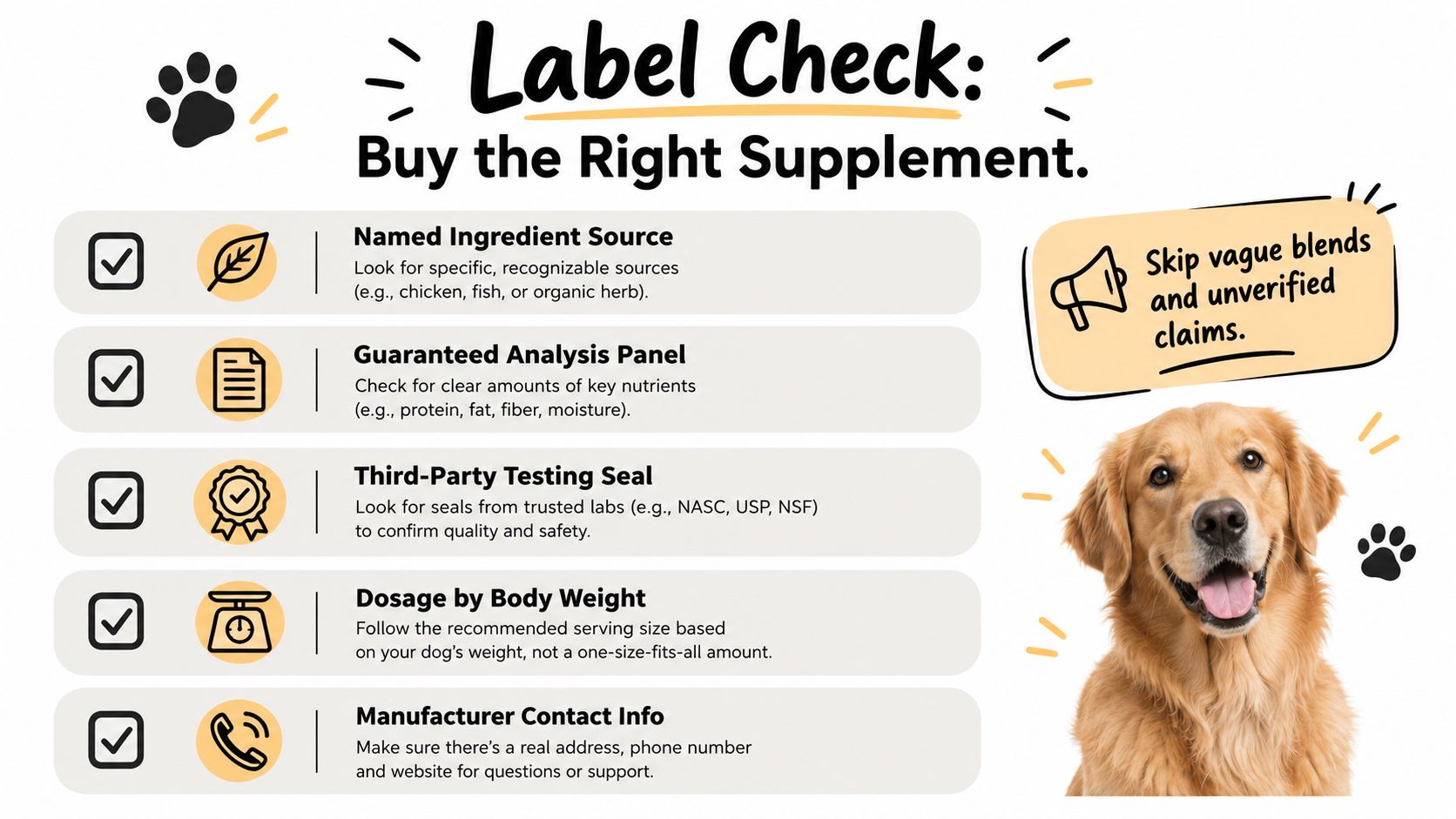
Five label checks
- Named ingredient source. “Fish oil” is less useful than a declaration of the oil source and its EPA and DHA content. For botanicals, vitamins, and minerals, the chemical form can matter.
- Guaranteed analysis. Confirm that the panel identifies what the product guarantees, not just what the formula contains in theory. A long list without quantities prevents meaningful comparison.
- Third-party testing. Look for evidence that an independent organization or laboratory checks identity, potency, and contaminants. This doesn't prove clinical effectiveness, but it can make the label more trustworthy.
- Dosage by body weight. A serving recommendation should explain how it changes with the dog's size. Don't assume that one chew provides an appropriate amount for every dog.
- Manufacturer contact information. A responsible company should make it possible to ask about testing, sourcing, shelf stability, and adverse reactions. If those answers aren't available, choose cautiously.
Red flags hiding in plain sight
“Proprietary blend” is a major limitation because it may conceal the amount of each active ingredient. “Immune boosting” is also too broad to guide a purchase. A dog with allergic inflammation doesn't necessarily need generalized immune stimulation, and the phrase doesn't identify a mechanism, dose, or expected outcome.
Soft chews, powders, oils, and capsules each have practical differences. A picky dog may accept a powder mixed into food but reject a chew, while a liquid may be easier to measure but more vulnerable to oxidation after opening. Follow storage directions, check expiration dates, and ask your veterinarian whether the format suits the ingredient and your dog's diet.
A transparent label can't guarantee a result. An opaque label makes it harder to know what you're buying at all.
Integrating Supplements with Prescription Allergy Treatments
The safest way to combine a supplement with allergy medication is to treat it as one part of a coordinated plan. Veterinary guidelines place nutraceuticals, essential fatty acids, palmitoylethanolamide, probiotics, and epidermal-barrier products in the adjunctive category (AAHA allergic skin disease guidelines). That means your veterinarian may use them alongside treatment that controls active inflammation, itch, infection, or a confirmed trigger.
Pet parents often ask whether a supplement can replace medication such as Apoquel or Cytopoint. The honest answer is that outcome data usually doesn't justify promising that result for every dog. A recent Ohio State veterinary study describes oral supplementation in terms of reducing the severity of moderate-to-severe environmental allergy signs and measuring how often anti-itch medication remains necessary. That framing is important because it treats medication use as something to measure, not something to assume a supplement will eliminate (Ohio State veterinary study information).
Build the plan around the diagnosis
If a dog has an active bacterial or yeast infection, nutritional support won't replace appropriate treatment. If fleas are driving the flare, flea control is central. If a food reaction is suspected, adding several new ingredients can make a dietary investigation harder to interpret.
Ask your veterinarian to review:
- The target symptom. Is the supplement intended for itch, barrier support, recurrent ear disease, or digestive tolerance?
- The full ingredient list. Check for duplicate vitamins, oils, minerals, or botanicals already present in the diet or another product.
- The monitoring plan. Decide what would count as improvement and when the plan should be reassessed.
- Medical risks. Discuss pancreatitis history, bleeding concerns, endocrine disease, pregnancy, surgery, and current medications before starting an oil, herb, or concentrated nutrient.
A product marketed among the top omega 3 for pets still needs to disclose enough information for your veterinarian to evaluate it. Don't stop a prescribed treatment because a supplement appears to help for a few days. If symptoms improve consistently, your veterinarian can decide whether medication changes are appropriate and how to make them safely.
Tracking Progress and Recognizing Signs of Improvement
Supplements usually require patience, but patience shouldn't mean guessing. Before starting, write down your dog's current pattern: nighttime scratching, paw licking, redness on the belly, coat changes, ear odor, skin lesions, and the number of days anti-itch medication is needed. A simple calendar or phone note can reveal trends that memory misses.

What meaningful change looks like
A useful early sign may be less frantic scratching during rest, rather than a suddenly perfect coat. You might notice fewer interrupted nights, less chewing between the toes, or a calmer response after outdoor exposure. Coat shine can improve as overall skin health improves, but appearance alone shouldn't outweigh persistent itch or recurrent infections.
Track one change at a time where possible. If you begin a new supplement, switch food, change shampoo, and start a new medication in the same week, you won't know which intervention made a difference. Record the product name, serving amount, start date, stool changes, vomiting, itching, and any treatment days.
Keep a medication-day log. The useful question isn't whether your dog had one good day. It's whether flare-ups become less disruptive over time under veterinary supervision.
There isn't a universal timetable that proves a supplement is working. If your dog worsens, develops open wounds, shows painful ears, or has digestive side effects, contact your veterinarian rather than waiting for nutritional support to catch up. If there's no meaningful trend after the evaluation period your veterinarian recommends, reassess the diagnosis, ingredient, dose, and product quality.
This short video can help reinforce the broader idea that allergy management depends on observation and consistent care:
Frequently Asked Questions About Canine Allergy Support
Can I give my dog human fish oil capsules?
Sometimes a veterinarian may approve a human product, but don't choose one by capsule size alone. Check the actual EPA and DHA amounts, additional ingredients, freshness, storage requirements, and whether the product contains flavorings or other components unsuitable for dogs. Your dog's weight, diet, medical history, and current medication determine whether a particular oil is appropriate.
How can I introduce a supplement to a picky eater?
Start with the serving approach your veterinarian recommends, and introduce only one new product at a time. Mix a powder into a small amount of a familiar, highly palatable food rather than hiding it in the entire meal. For dogs that resist capsules or chews, a lickable format may be easier, but palatability doesn't make an ingredient clinically necessary.
Can prebiotics cure an allergy?
No. Prebiotics provide fermentable fiber that can support beneficial organisms already living in the gut, but they don't identify or remove pollen, fleas, or a food trigger. They may be a reasonable digestive-support feature in a treat, but they shouldn't be presented as a replacement for allergy diagnosis or treatment.
Should dogs with sensitive stomachs avoid allergy supplements?
Not automatically, but sensitive dogs need a slower introduction and closer monitoring. Watch for loose stool, vomiting, reduced appetite, or worsening discomfort. A simple formula can make it easier to identify the cause of a reaction, while a multi-ingredient blend makes troubleshooting more difficult.
Are “immune-boosting” ingredients safe for every breed?
Breed alone rarely answers that question. Individual health status matters more, including organ disease, medication use, pregnancy, previous reactions, and nutritional deficiencies. Vitamins and minerals can be useful when a veterinarian identifies a reason for them, but unnecessary concentration can create risk rather than benefit.
When should I stop trying supplements at home?
Stop and seek veterinary advice when itching is severe, skin is broken, ears are painful or repeatedly infected, or your dog's quality of life is declining. Supplements can support a medical plan, but they shouldn't delay diagnosis when a dog is suffering.
Joyfull offers convenient pet wellness products, including prebiotic options designed to support everyday gut health with clearly described ingredients. Visit Joyfull to review the formulas and choose a practical option to discuss with your veterinarian as part of your dog's broader allergy-support plan.
0 comments