


The most popular advice about dental dog treats is also the most misleading: give your dog a chew and skip the toothbrush. Dental treats can help reduce plaque and calculus, but they aren't a substitute for brushing, veterinary examinations, or professional cleaning. Their value comes from a narrower, more useful role. A well-designed chew adds physical contact with accessible tooth surfaces, supports maintenance between other forms of care, and can make oral hygiene easier to fit into daily life.
That distinction matters because not every chew performs the same way. Shape, texture, composition, chewing behavior, and evidence all influence the result. The right question isn't just whether a treat is labeled "dental." It's whether the product has a credible mechanism, appropriate safety profile, and realistic place in your dog's routine.
Table of Contents
- Why Dental Dog Treats Are Not a Brushing Replacement
- How Dental Chews Clean Your Dog's Teeth
- Understanding the VOHC Seal and What It Proves
- Ingredients to Look For and What to Avoid
- Feeding Frequency and Safety Guidelines for Daily Use
- When to See Your Vet About Dental Health
- Building a Realistic Dental Care Routine for Your Dog
Why Dental Dog Treats Are Not a Brushing Replacement
Brushing remains the gold standard for removing plaque because it lets you deliberately reach tooth surfaces and the gumline. A dental chew can't make that same promise. It only cleans where the dog chews and where the treat makes meaningful contact.
Clinical research supports a benefit from properly designed dental chews, particularly for plaque accumulation and calculus, but the effect isn't uniform across every part of the mouth. In a blinded randomized study, daily chew use reduced plaque and calculus compared with giving no chew. The effect was stronger for those deposits than for gingivitis or volatile sulfur compounds, which points toward a primarily mechanical action rather than a broad treatment for gum inflammation. The clinical trial reported through PubMed provides the relevant evidence.
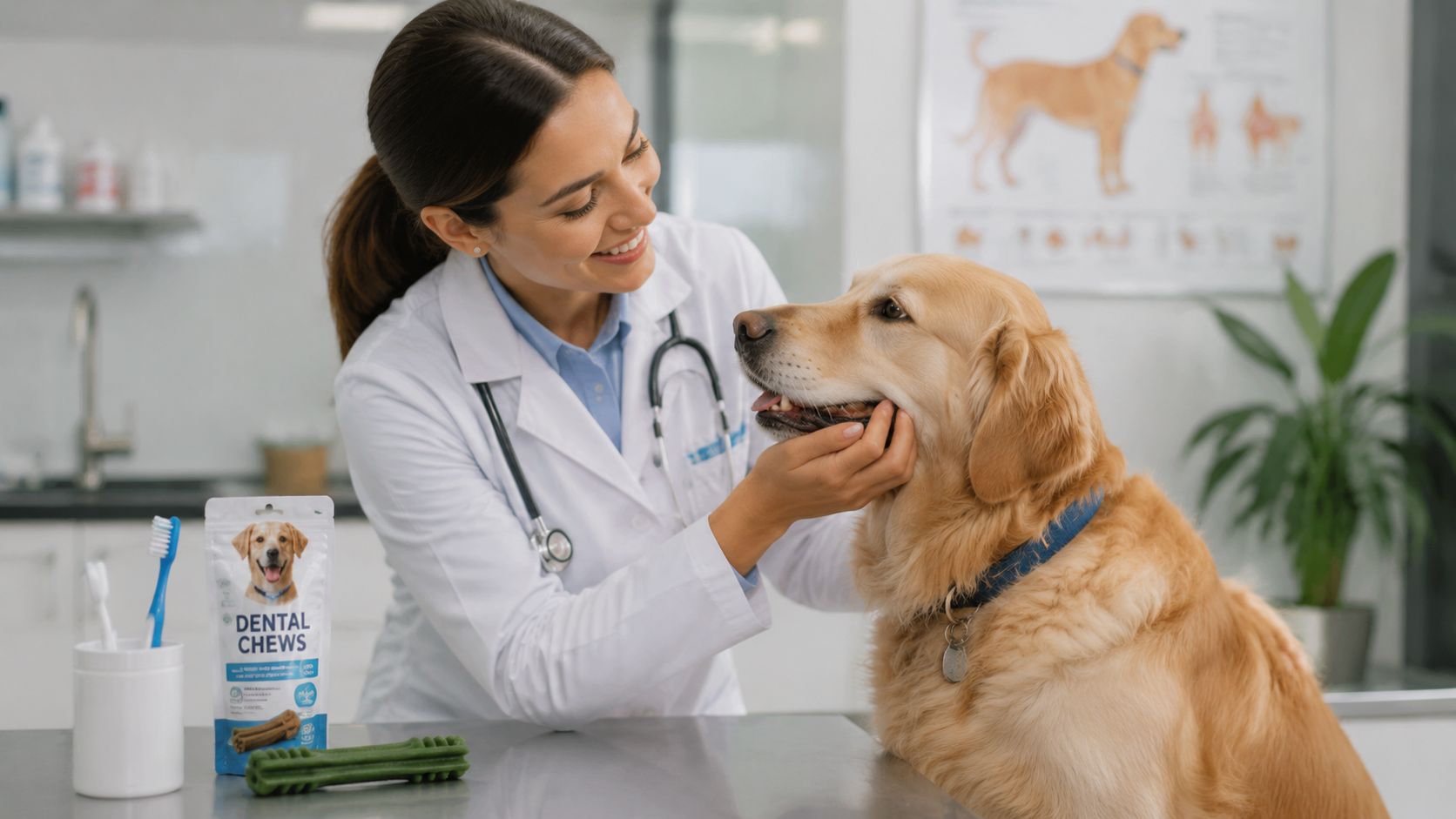
What a chew can and cannot do
A dental dog treat may help interrupt soft plaque before it mineralizes, especially on surfaces the chew reaches repeatedly. It may also support fresher breath when odor is connected to surface buildup. Those are useful maintenance benefits, but they don't amount to treatment for established dental disease.
A chew generally can't:
- Reach every surface: Posterior teeth may receive more contact than canines or incisors, depending on the product and the dog's chewing style.
- Clean below the gumline: Subgingival disease requires veterinary assessment and, where appropriate, professional treatment.
- Reverse existing damage: A chew won't repair a painful tooth, remove advanced disease, or resolve persistent gum inflammation.
- Replace deliberate brushing: Brushing gives owners control over location, duration, and the gumline area.
The honest promise: A dental chew is a maintenance tool, not a permission slip to abandon brushing.
Think of the routine as layered care. Brushing handles targeted plaque removal. A validated chew adds mechanical action during an activity many dogs already enjoy. Veterinary care identifies problems that home routines can't see or safely manage. Keeping those roles separate helps you avoid both extremes, dismissing dental treats entirely or expecting one snack to solve every oral-health problem.
How Dental Chews Clean Your Dog's Teeth
Dental chews work through contact mechanics, not magic ingredients. As a dog bites, bends, and compresses a chew, the treat presses against tooth surfaces. That pressure and movement can disturb plaque biofilm and loosen some mineralized deposits. Results depend on whether the chew repeatedly reaches useful surfaces, rather than on a label such as “hard.”
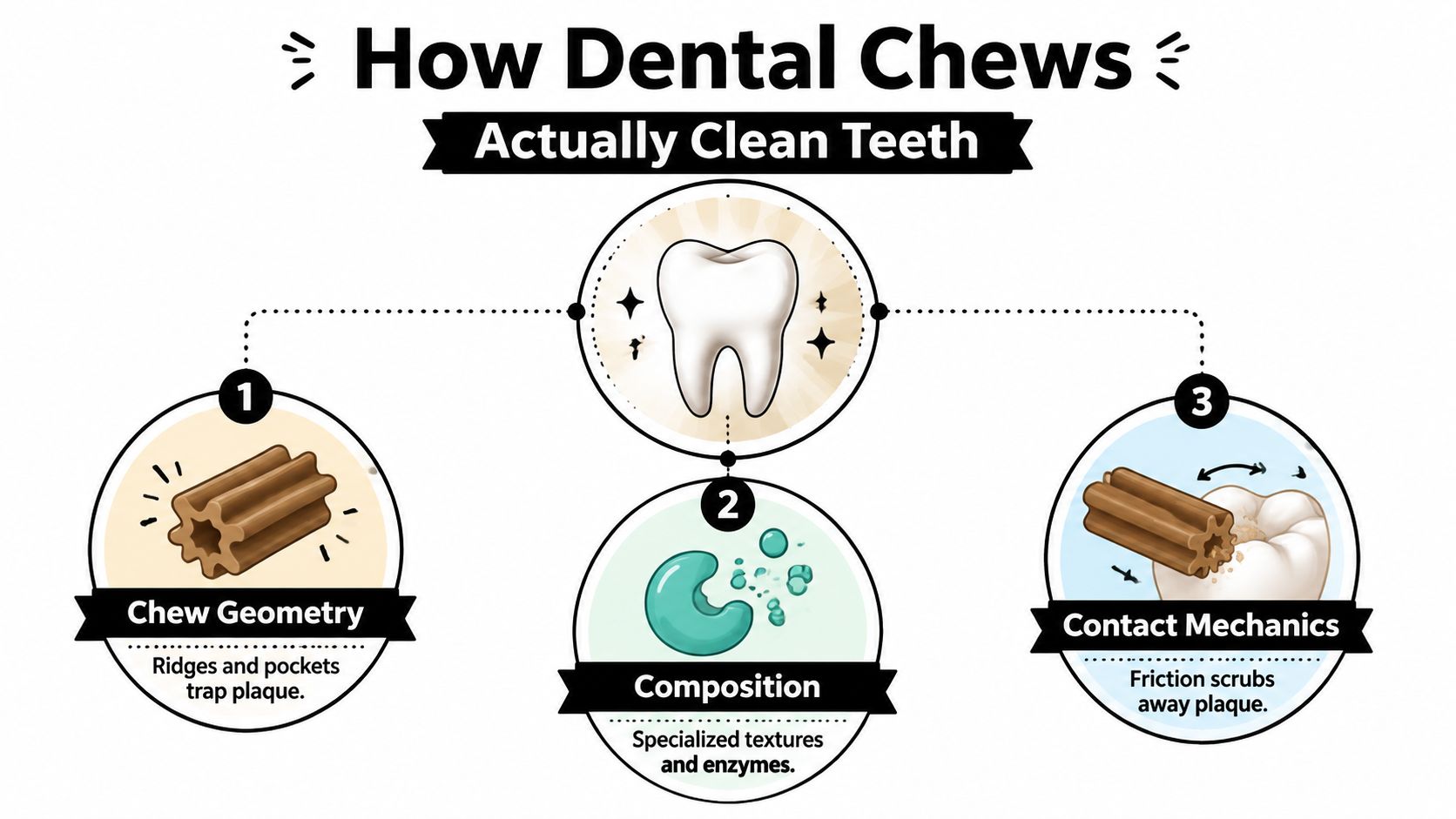
Geometry creates contact
Grooves, ridges, folds, and textured edges change how a chew moves across a tooth. A smooth snack may pass through the mouth with little scraping. A shaped chew creates repeated points of pressure as the dog works through it. Its shape also affects whether it reaches posterior chewing surfaces, including the carnassial teeth and the maxillary first molar.
Cleaning is not necessarily even across the mouth. One veterinary study found that a chew reduced plaque and calculus overall, with the strongest effects on the carnassial teeth and maxillary first molar. Canines and incisors did not show a significant effect. The VOHC trial protocol materials explain why controlled conditions and tooth-specific results matter when evaluating a product.
Composition changes how the chew behaves
Composition affects flexibility, abrasiveness, breakdown, and texture. A chew that fractures quickly may provide less sustained tooth contact. One that is excessively rigid can create safety concerns, especially for dogs that bite forcefully instead of gradually working through the treat.
Ingredients may support a product's broader oral-care purpose, but they cannot replace mechanical contact. A chew cannot clean a surface meaningfully if its design lets the treat break apart or pass through the mouth without engaging the teeth.
Design determines the clinical result
Dental chews are not interchangeable. One controlled study reported a 12.3% reduction in plaque coverage and a 17.4% reduction in plaque thickness for one chew compared with a control, as recorded in the PubMed study record. Another chew matched a leading brand on plaque and calculus outcomes.
The practical lesson is clear: Hardness alone isn't a quality test. Shape, texture, and composition should create sustained, appropriate contact with the surfaces a dog uses while chewing. Used this way, a chew can supplement brushing by adding mechanical action to a realistic oral-care routine, while leaving brushing responsible for more deliberate plaque removal.
Understanding the VOHC Seal and What It Proves
A dental claim describes an intended benefit. The Veterinary Oral Health Council, or VOHC, seal adds evidence that a product achieved a defined dental result under specified testing conditions. That result may involve plaque or tartar reduction. The seal indicates tested performance for that benefit, while questions about existing disease, suitability, and daily care still require separate judgment.
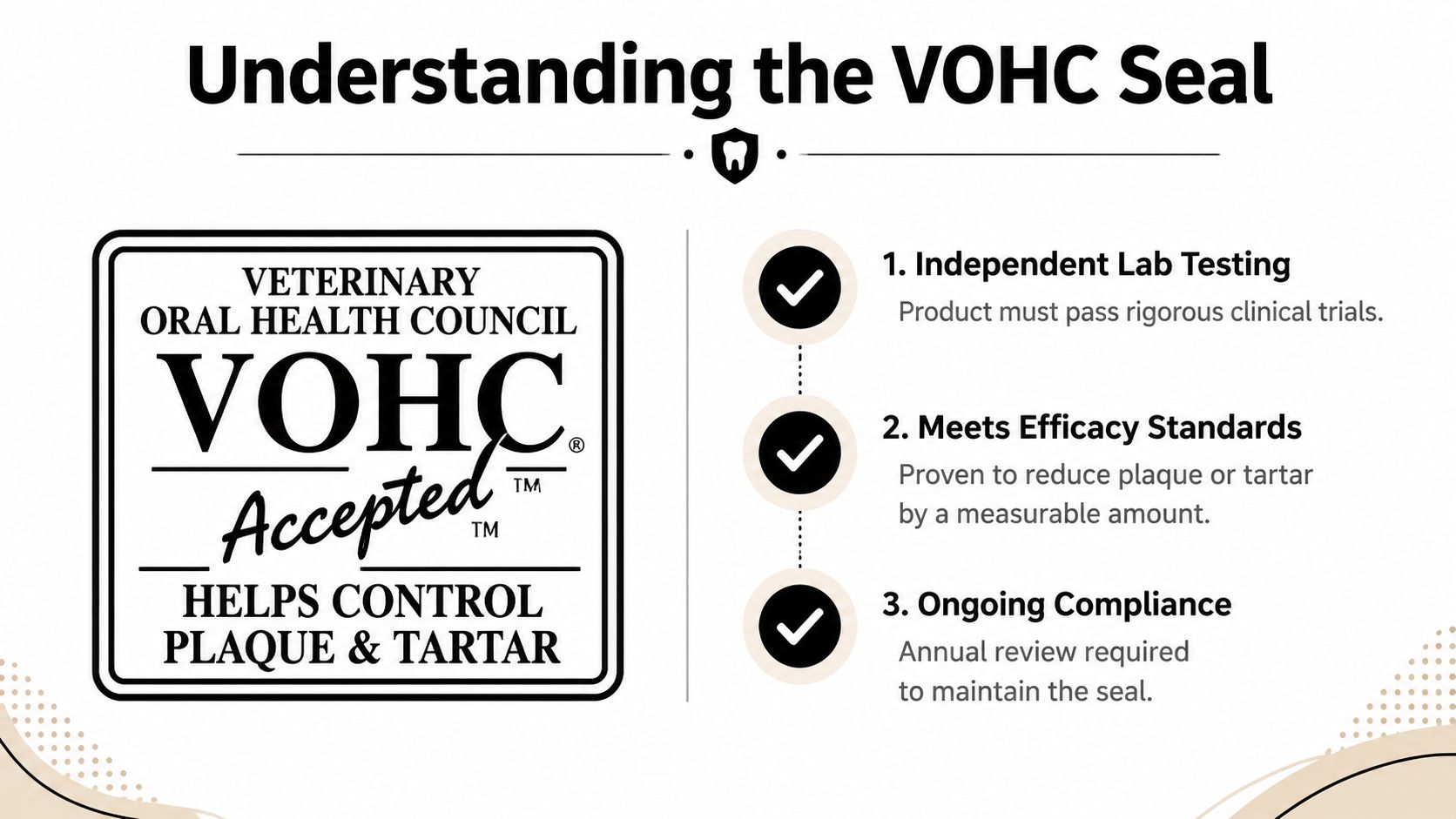
Read the benchmark, not just the badge
For chews or treats that depend on mechanical action, the VOHC framework uses a negative-control trial. Researchers compare dogs receiving the product with a group that does not receive the tested chew. That comparison helps separate the product's effect from ordinary changes over time.
The framework also includes these requirements:
- A measurable efficacy threshold: The product must show at least a 20% reduction in plaque in one trial, or a mean 30% reduction across two trials, for the relevant outcome. These thresholds are part of the VOHC trial protocol requirements.
- A meaningful trial period: Testing lasts a minimum of 28 days, as specified in the same protocol requirements.
- Defined testing conditions: The product is assessed with a protocol designed to measure plaque or tartar reduction, rather than simple chewing enjoyment. The full requirements explain how those outcomes are evaluated.
A dog may spend plenty of time chewing a treat without producing validated cleaning. The VOHC process helps distinguish engagement from demonstrated dental performance.
Why location matters
A product can perform differently across the mouth. Posterior chewing surfaces often receive more force and contact, so a design that encourages sustained engagement in those areas may produce a more useful practical effect than a generic treat shape.
The VOHC seal answers a focused question: has this product demonstrated a qualifying dental benefit under the council's framework? It does not establish that the chew suits every dog, replaces brushing, or manages existing oral disease. Owners still need to consider size, texture, ingredients, calories, and veterinary advice.
Evidence should also match the health claim. For example, a cat supplement such as Probiotic Supplement for Cats - 30 Single-Serving Packets is presented for digestive support and testing details, not as a dental chew. A VOHC-accepted chew can add tested mechanical support to a routine, while brushing remains the more deliberate method for removing plaque.
Ingredients to Look For and What to Avoid
An ingredient list can't prove that a dental chew works, but it can reveal whether the product fits your dog's needs. Start by separating functional design from attractive packaging. A clean label is useful, yet the treat still needs a texture and shape that create appropriate contact with teeth.
Look for a purposeful formulation
Some dental products use antimicrobial agents, natural abrasive materials, or probiotic ingredients as part of their oral-care approach. Examples may include chlorhexidine or zinc compounds, calcareous algae or cellulose, and beneficial bacteria intended to support mouth health. These ingredients should be considered alongside the full formulation and your veterinarian's advice, especially if your dog has sensitivities or an existing condition.
High-quality proteins can make a chew more appealing, which may improve routine consistency. That doesn't automatically make a product dental-effective, though. Palatability helps a dog finish the chew, while geometry and contact mechanics determine how much useful tooth interaction occurs.
Treat vague claims carefully
The word “natural” doesn't tell you how a product cleans teeth. Nor does a long list of added ingredients guarantee better performance. Watch for formulations dominated by fillers, added sugars, or excessive fats when those ingredients don't serve a clear purpose for your dog.
A practical label check looks like this:
| Look for | Question to ask |
|---|---|
| Named proteins | Can you identify the primary protein sources? |
| Functional texture | Does the product describe a chew structure that supports contact? |
| Clear ingredient language | Are components identified rather than hidden behind vague descriptions? |
| Calorie information | Can you account for the treat in the daily diet? |
| Evidence of efficacy | Does the product carry relevant acceptance or provide credible trial information? |
For a broader label review, use this guide to dog treat ingredients to avoid in 2025. It can help you identify formulations that don't align with your preferences, but ingredient screening shouldn't replace checking the product's dental evidence.
Joyfull describes its approach as using clean ingredients, high-quality proteins, and scientific review by an in-house veterinary advisor. That philosophy gives owners a useful standard for transparency, but the dental claim still needs to be judged on dental-specific design and evidence.
Feeding Frequency and Safety Guidelines for Daily Use
Most dogs can start with one dental chew per day, then adjust that routine to the product directions, the dog's size, chewing style, diet, and health history. Frequency is only one part of the decision. The chew must also fit the mouth, provide manageable resistance, and fit within the daily calorie budget. The veterinary homecare review notes that home protocols can improve deposit control while professional cleaning remains part of oral care.
Match the chew to the dog
A small dog may struggle with a product made for a much larger mouth. A powerful or fast chewer can break off pieces quickly, while another dog may work slowly through the same texture. Size labels help narrow the choice, but watching the dog use the chew provides better safety information.
Before making a chew part of the routine:
- Choose the intended size range: A larger chew does not automatically provide better cleaning.
- Observe the first sessions: Watch how your dog bites, holds, and breaks down the product.
- Supervise active chewing: Remove fragments that become small enough to swallow whole.
- Stop for discomfort: Hesitation, pawing at the mouth, bleeding, or sudden refusal can signal a problem.
- Consider sensitivities: Review proteins, grains, fats, and additives if your dog has dietary reactions.
Safety rule: Choose a chew that yields under normal chewing pressure. Very hard, rigid items can place teeth at fracture risk, especially for forceful chewers.
Budget the calories
A daily chew counts as food. Account for its calories by adjusting meals when needed, and monitor body condition rather than treating the product as nutritionally invisible. A chew can support surface oral care while still contributing to weight gain if the rest of the diet remains unchanged.
For broader feeding guidance, review how many dog treats per day, then follow the product's feeding directions and your veterinarian's recommendations. Dogs with sensitive digestion, food allergies, previous dental problems, or special diets may need a more individual plan. The goal is a repeatable routine that your dog can chew safely and that the household can maintain.
When to See Your Vet About Dental Health
Dental chews support maintenance; they do not diagnose oral disease. Arrange a veterinary examination when warning signs appear, because continuing to offer treats without checking the cause can delay necessary treatment.
Contact your veterinarian if you notice:
- Persistent bad breath: Ongoing odor can reflect gum disease, infection, or another oral problem rather than ordinary food residue.
- Visible tartar: Hard, attached deposits may require professional removal.
- Red, swollen, or bleeding gums: These signs need assessment instead of home care alone.
- Changes in eating: Dropping food, chewing on one side, reluctance to eat, or difficulty picking up food may indicate pain.
- Excessive drooling or mouth sensitivity: These changes can accompany dental or oral problems.
- Loose, broken, or discolored teeth: A chew cannot repair structural damage.
Know what professional care adds
A veterinary examination can identify disease below the gumline and inspect areas a chew cannot reach. Professional cleaning removes deposits from difficult locations, while the veterinarian assesses whether a damaged tooth needs further treatment.
Dental treats can help manage surface buildup between visits, but they do not remove every deposit or replace professional care. Established gingivitis and disease below the gumline require veterinary evaluation. This matters when owners are considering whether postponing care is affordable. The dental disease in dogs cost guide from The Vet Price Comparison Site outlines the financial implications of delayed attention.
Use chews after assessment
Once your veterinarian confirms a healthy mouth or completes necessary treatment, ask which home-care tools suit your dog. A VOHC-accepted chew may help maintain plaque or tartar control, while brushing allows more deliberate coverage. Your veterinarian can also recommend a suitable texture if your dog has fragile teeth, a history of fractures, or trouble chewing.
Persistent bad breath deserves attention even if a chew makes the smell temporarily fresher. The change may cover the odor for a short time, but it does not identify its cause or show whether disease remains. A timely examination gives the chew a proper role, as one part of ongoing oral care rather than a response to unexplained symptoms.
Building a Realistic Dental Care Routine for Your Dog
The best oral-care routine is the one you can maintain without overstating what any single tool does. Start with your actual schedule, your dog's tolerance, and the condition of the mouth. Then add layers gradually.
The minimum workable routine
For a busy owner, begin with three habits:
- Inspect the mouth regularly: Look for tartar, gum redness, broken teeth, and changes in comfort.
- Use an appropriately sized dental chew: Choose evidence-backed options where possible, supervise chewing, and account for calories.
- Keep veterinary examinations on the calendar: Ask for an oral assessment instead of waiting for obvious pain.
This approach is better than buying a chew and ignoring the mouth entirely. It gives you a maintenance tool and a way to notice when the situation changes.
The enhanced routine
If your dog accepts handling, add brushing with pet-safe toothpaste. Introduce it slowly, beginning with calm contact around the lips and gums before expecting a full brushing session. The chew can remain a separate positive activity, but it shouldn't be used to excuse missed brushing.
Ingredient transparency matters here, too. Owners who want a convenient reward or topper can consider appropriate dog treats, while remembering that a general treat isn't automatically a dental product. Match the tool to the job.
A plan for dental concerns
Dogs with visible deposits, painful chewing, or persistent odor need veterinary guidance before you build a home routine. After assessment or treatment, your plan might combine brushing, a suitable dental chew, monitoring, and follow-up care.
Keep this checklist visible:
- Evidence: Look for VOHC acceptance or credible dental trial information.
- Mechanics: Favor designs that encourage sustained tooth contact.
- Fit: Match size and texture to your dog's mouth and chewing style.
- Nutrition: Include the chew in the daily calorie budget.
- Expectations: Treat it as a supplement, never as a replacement for brushing or veterinary care.
Dental dog treats can earn their place in a sensible routine when you judge them by evidence and use them consistently. They work best as one practical layer in care, alongside brushing, observation, and professional attention when needed.
Joyfull offers clean-ingredient pet wellness products developed with high-quality proteins and reviewed by an in-house veterinary advisor. Visit Joyfull to explore options that can fit a thoughtful routine, while choosing dental products based on their specific oral-health evidence and design.
0 comments