


You're standing in the pet food aisle with your dog's favorite bag in one hand and a newer “natural,” “premium,” or “grain-free” option in the other. The front of each package shows fresh ingredients, smiling pets, and reassuring promises. Then you turn the bags around and find a dense ingredient list, a Guaranteed Analysis panel, feeding directions, and wording that seems designed for a lawyer rather than a pet parent.
That moment is common because a label tells you several different things at once. Some details describe the recipe. Others identify the food's intended use, show nutrient guarantees, or support a marketing message without proving that the food is right for your pet. Decoding food labels turns that clutter into a practical shopping skill. You don't need to memorize every regulation. You need to know where to look, what each statement means, and which claims deserve a second glance.
Table of Contents
- Why Learning to Read Pet Food Labels Matters
- How Pet Food Labels Are Organized
- What the Ingredient List Really Tells You
- Understanding Guaranteed Analysis and Calorie Content
- How to See Through Common Marketing Claims
- What AAFCO Statements and New Front of Pack Wording Mean
- Your Practical Checklist for Choosing Healthier Options
Why Learning to Read Pet Food Labels Matters
Maya had already decided on a bag for her young dog. The front promised real meat, wholesome ingredients, and complete nutrition. It looked reassuring until she compared the fine print with another food designed for a different life stage. The first bag's attractive wording had captured her attention, but the intended-use statement and feeding guidance answered the more important question: whether the food matched her dog's current needs.
That distinction matters in every pet store aisle. Packaging creates a first impression, while the back panel supplies the evidence you can evaluate. Words such as “healthy,” “natural,” and “premium” may help a product stand out, but they don't replace the ingredient list or nutritional adequacy statement. A food can feature one appealing ingredient on the front while the complete recipe contains many other components that deserve your attention.
Practical rule: Read the front panel for orientation, then turn the package around before you make a decision.
Learning this skill also helps you compare different formats. A dry kibble, canned food, topper, treat, and supplement don't serve the same role in the bowl. Treats may be useful for training, while a complete food is designed to provide the nutritional foundation of a diet. A supplement can support a specific goal, but it shouldn't automatically be treated as a replacement for a complete meal.
The Vitamin Planet's organic dog food listing is a useful example of why comparison takes more than a glance at the product name. You can use a retailer page to identify the product and its positioning, then check the physical package for the full ingredient list, intended life stage, feeding directions, and adequacy statement.
Reading labels isn't about judging a previous choice or chasing a perfect formula. It's about asking better questions:
- Does this food suit my pet's species and life stage?
- What ingredients form the recipe's foundation?
- Are the nutrient numbers directly comparable with another food?
- Is a front-of-pack claim supported by the information panel?
- Is this product a meal, a treat, a topper, or a supplement?
Once you know how to answer those questions, the aisle feels less like a contest between bright packages and more like a series of manageable decisions.
How Pet Food Labels Are Organized
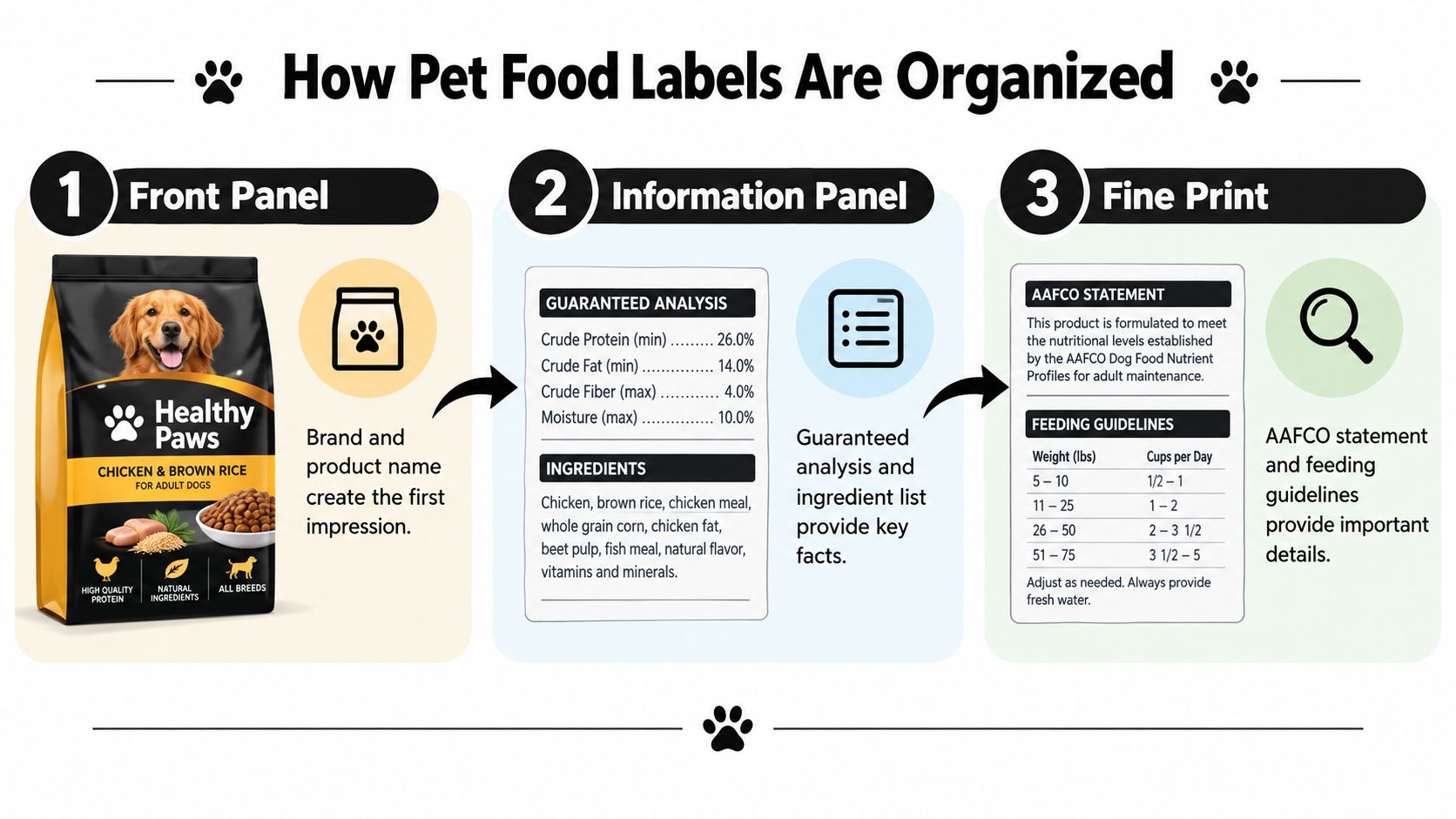
Pet food labels work like a road map. The front panel helps you identify the destination, the information panel gives you measurable details, and the fine print explains how the food is intended to be used. Start in that order, but don't stop at the front.
Start with the front panel
The front usually shows the brand, product name, prominent ingredients, flavor language, intended species, and net weight. Treat it as an index rather than a verdict. The name may tell you whether the package contains dog food, cat food, treats, or another product category, but it won't tell you everything about nutrient density or suitability.
Look for wording that clarifies use. A phrase identifying an adult dog food, kitten food, treat, or supplement immediately narrows the product's role. Net weight helps you compare package size, but it doesn't tell you how much to feed or how many calories each serving provides.
Find the information panel
The information panel normally contains the ingredient list and Guaranteed Analysis. The ingredients are listed in descending order by weight before processing, while the analysis gives selected nutrient guarantees in a standardized format.
This panel answers different questions:
- Ingredient list: What components are included, and how are they named?
- Guaranteed Analysis: What minimum or maximum levels does the product guarantee?
- Calorie statement: How much energy does the food provide, when listed?
- Manufacturer details: Who made or distributed the product, and where can you direct questions?
The Joyfull Probiotic Supplement for Dogs, 30 Single-Serving Packets illustrates why product category matters. It is a dog supplement made with real beef bone broth and veterinarian-formulated probiotic strains, with third-party testing for potency and purity. Those details describe a supplement's purpose and composition, not a claim that it replaces a complete dog food.
Read the fine print
The final area contains details that often matter most for a long-term choice. Check the nutritional adequacy statement, feeding directions, storage instructions, and any warnings or limitations. The adequacy statement helps identify whether the product is intended to provide complete and balanced nutrition for a particular species and life stage.
Feeding directions are starting guidance, not a diagnosis of your pet's exact needs. Age, body condition, activity, health status, and other foods in the diet can change the appropriate amount. If your pet has a medical condition, ask your veterinarian to interpret the label alongside the animal's clinical history.
A human Nutrition Facts label helps as an analogy because both systems organize nutrition information for comparison. Pet labels differ in their required details and in the way the Guaranteed Analysis is expressed, so don't assume you can transfer every human-label habit directly to a bag of kibble.
What the Ingredient List Really Tells You
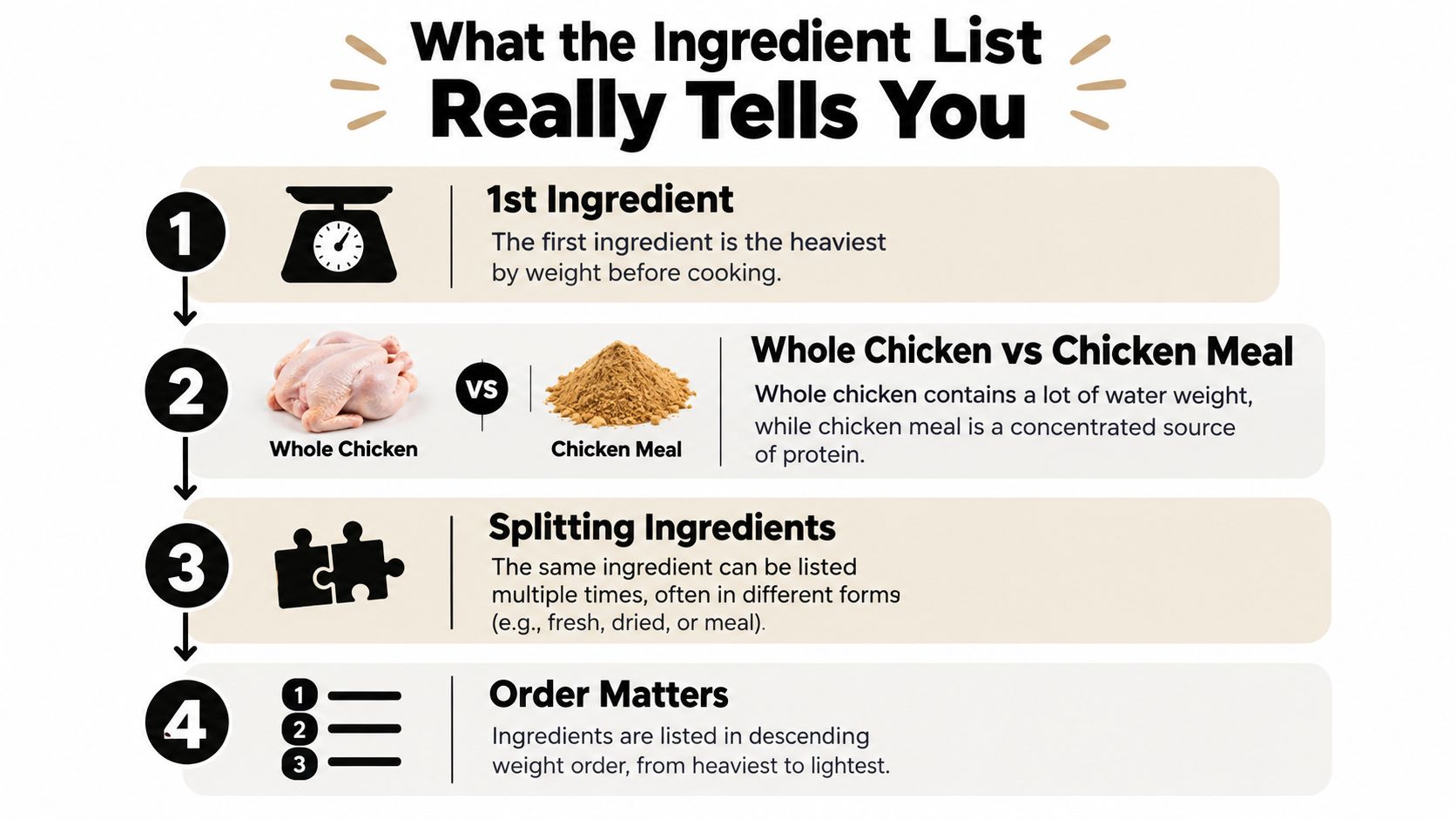
The ingredient list is a recipe map, but it isn't a complete report on digestibility, nutrient absorption, or ingredient quality. Its most useful feature is order by weight before processing. Ingredients near the beginning generally contribute more weight to the mixture than ingredients near the end, although water content can affect how that order looks.
Read the opening ingredients in context
Suppose one recipe starts with “chicken,” while another starts with “chicken meal.” Whole chicken contains substantial water before cooking. Chicken meal has already had much of that water removed, so its listed weight represents a more concentrated ingredient. Neither term alone proves that one food is automatically better. The useful question is how the ingredient fits into the entire recipe and whether the food's adequacy statement matches your pet.
Scan the opening group of ingredients for recognizable protein sources, carbohydrate sources, fats, fibers, vitamins, minerals, and functional additions. The first several entries can show the recipe's broad direction, but don't treat a short ingredient list as a guarantee of nutritional superiority. A complete diet may need a variety of nutrients that aren't visible from the first few words.
Ingredient splitting can also complicate a quick comparison. A manufacturer may list related components separately, such as different forms of a plant ingredient, rather than presenting them under one combined heading. That doesn't automatically mean the recipe is deceptive, but it does mean you should assess the complete list rather than judging one position in isolation.
Separate useful detail from vague reassurance
Terms such as “meat by-products” can be broad, so look for the exact ingredient language and consider your pet's known sensitivities. Added colors may improve the package's appearance without contributing a nutritional purpose. Artificial flavors, preservatives, and other additives deserve a closer look if you're trying to simplify the diet.
An ingredient name also doesn't tell you how your individual pet will respond. A food that looks appealing on paper can still cause digestive upset, itching, or refusal. Introduce dietary changes gradually and contact a veterinary professional if symptoms persist or seem severe.
The Happy Guts Duo for Cats provides an example of reading a product description alongside its category. It combines prebiotic tuna squeeze treats with a veterinarian-formulated probiotic supplement, uses real wild-caught tuna and fish broth in the treats, and excludes artificial colors, preservatives, and flavors. Because it includes treats and a supplement, it belongs in the conversation about supportive additions, not as an automatic substitute for a complete feline diet.
For a visual explanation of ingredient order and common points of confusion, watch this short guide.
A practical comparison works best when you place two similar foods side by side. Match their species, life stage, product type, and calorie information first. Then compare the ingredient lists and adequacy statements, rather than allowing one highlighted ingredient or a colorful front panel to decide for you.
Understanding Guaranteed Analysis and Calorie Content
Guaranteed Analysis is a compliance panel, not a full nutritional biography. On an as-fed basis, pet food labels report minimum crude protein and crude fat, along with maximum crude fiber and moisture, according to AAFCO's explanation of pet food labels. Those terms matter because a minimum guarantee isn't the same as an exact laboratory value, and a maximum guarantee isn't the same as the food's typical amount.
Moisture creates the biggest comparison problem. Water takes up space in wet food, so its protein percentage can look lower than the percentage on dry kibble even when the wet food supplies a meaningful amount of protein after the water is removed.
Convert the label to dry matter
To compare foods with different moisture levels, use this formula:
Dry matter percentage = as-fed nutrient percentage ÷ dry matter percentage × 100
First calculate dry matter:
Dry matter percentage = 100 − moisture percentage
For a simple illustration, imagine a wet food label showing 10% crude protein and 75% moisture. Its dry matter percentage is 25%, so the dry matter protein percentage is 10 ÷ 25 × 100, or 40%. Those figures are illustrative math, not a claim about a particular product.
| Nutrient | As-Fed % on Label | Dry Matter % |
|---|---|---|
| Crude protein | 10% | 40% |
| Moisture | 75% | Not used as a nutrient comparison |
| Dry matter | 25% | 100% |
You can use the same process for crude fat or fiber. Compare like with like, and remember that the analysis still doesn't measure palatability, digestibility, or the full balance of essential nutrients.
Check calories and feeding guidance
The calorie statement tells you how much energy the food provides in a stated amount. Use it with the feeding directions, your pet's body condition, and any treats or toppers added during the day. Feeding charts often provide a starting point, but your veterinarian can help adjust portions for growth, weight management, pregnancy, activity, or disease.
A product such as Prebiotic Tuna Squeeze Treats for Cats should be evaluated as a treat or topper, not compared with a complete meal as if the two products had the same job. Its description identifies real wild-caught tuna, prebiotics, and the absence of artificial flavors, colors, and preservatives. You still need to account for how additions fit into your cat's total daily intake.
The number that looks largest on the panel isn't automatically the number that matters most. Context gives every percentage its meaning.
How to See Through Common Marketing Claims
A front-of-pack claim answers the question, “What does the manufacturer want me to notice first?” It doesn't always answer, “What does this food provide, and is it appropriate for my pet?”
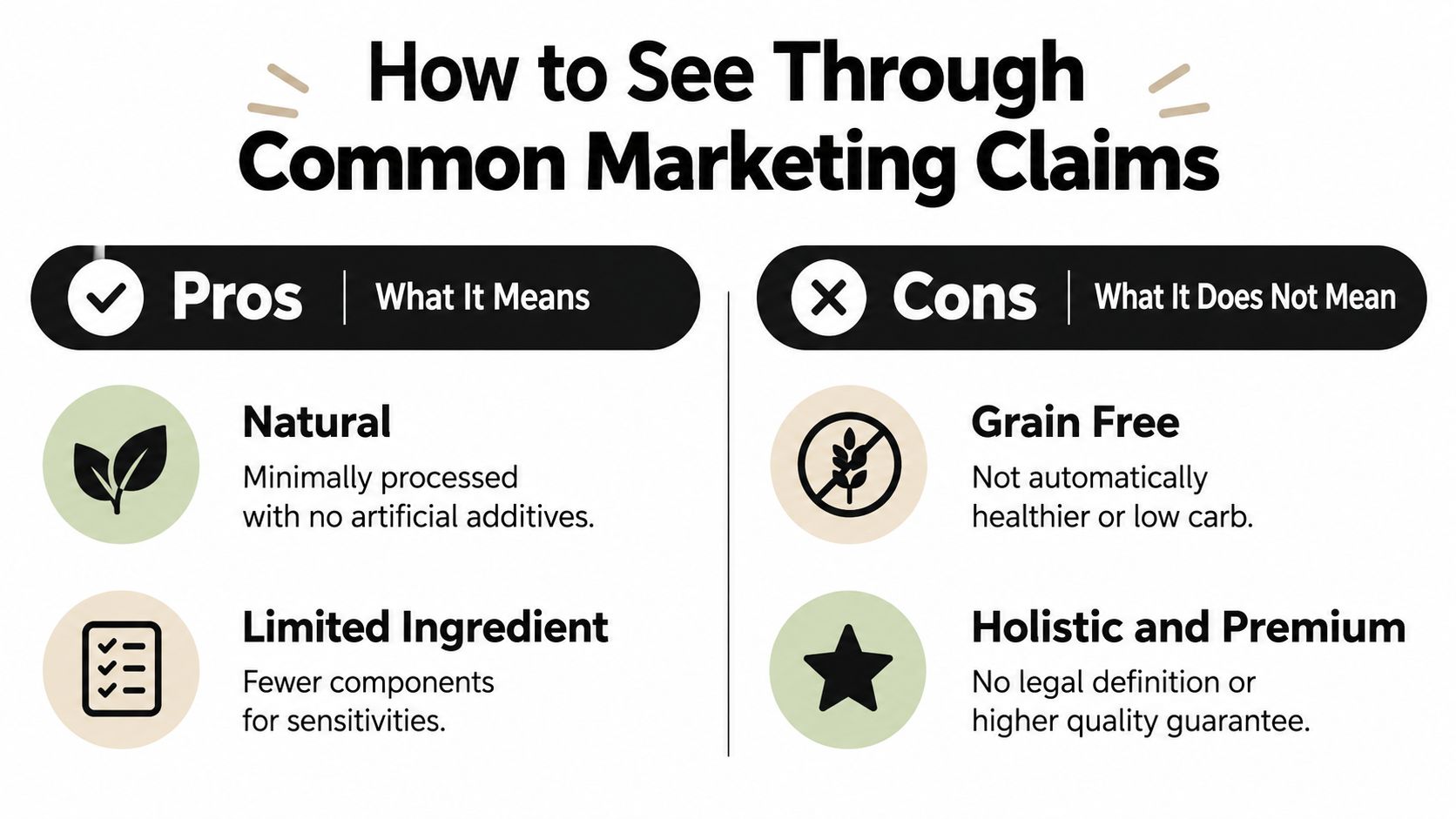
Natural may suggest minimal processing or the absence of certain artificial additives, but the term alone doesn't describe the complete nutritional profile. Premium sounds positive, yet it doesn't independently prove higher nutrient quality. Grain-free tells you that grains aren't included. It doesn't automatically mean the food is healthier, more digestible, or better suited to your dog or cat.
Translate the promise into a question
Use each claim as a prompt for investigation:
- Natural: Which ingredients and additives does the manufacturer identify, and does the ingredient list support that impression?
- Limited ingredient: Is the list simpler for your pet's situation, and have you checked every flavor, supplement, and hidden source of a suspected allergen?
- Grain-free: What replaced the grains, and does your pet have a specific reason to avoid them?
- Premium or holistic: What measurable information supports the wording?
- Functional benefit: Is the claim tied to a clearly named ingredient, an amount, and an appropriate product category?
Health claims deserve particular caution. A U.S. consumer survey found that only 16% of consumers consider health claims very trustworthy, while 1 in 5 struggle to interpret nutritional information, as reported by the NSF survey on food labeling clarity. The lesson applies to pet packaging too. A confident phrase can be easy to read and difficult to verify.
Packaging language works in other aisles as well. If you're evaluating sustainability messages around pet products or related purchases, the discussion of eco-friendly cake box standards offers a useful reminder: environmental wording should be checked against the underlying material and standard, not accepted solely because it sounds responsible.
You can also look for trusted pet food certifications, then confirm what the certification evaluates. A seal can provide useful context, but it shouldn't replace the ingredient list, Guaranteed Analysis, calorie statement, or adequacy statement.
What AAFCO Statements and New Front of Pack Wording Mean
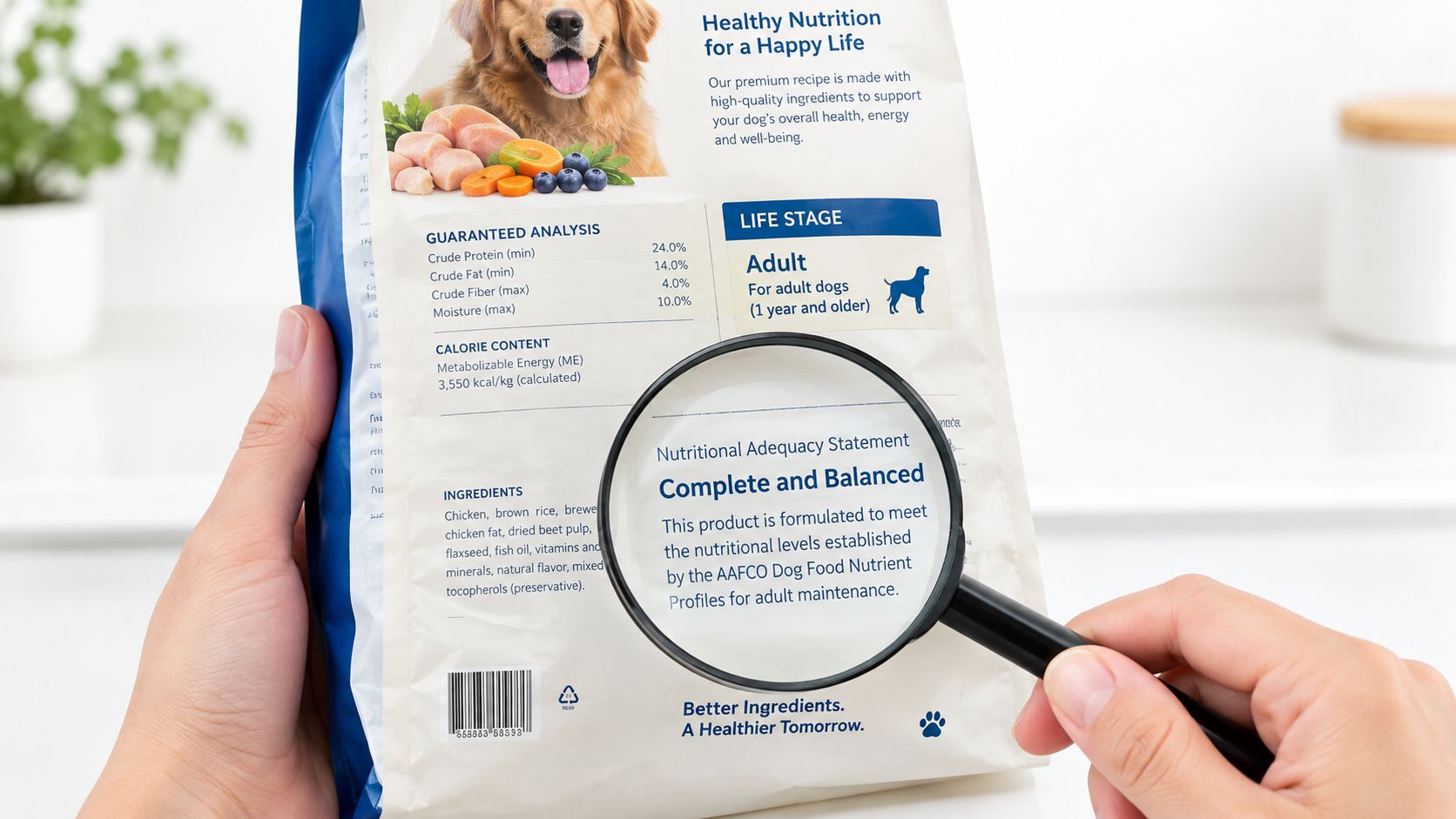
The nutritional adequacy statement is one of the most important sentences on a pet food package. It identifies whether the food is intended to be complete and balanced for a particular species and life stage, or whether it has another role, such as a treat, topper, or supplement.
“Complete and balanced” isn't a universal promise that the food suits every animal. It must be read alongside the species and life-stage wording. A food designed for adult dogs isn't automatically the right choice for puppies. A cat food isn't interchangeable with dog food, and a treat doesn't become a complete diet because its package uses health-focused language.
Match the statement to your pet
Read the adequacy statement as a matching exercise:
| Label wording | What it tells you |
|---|---|
| Complete food for adult dogs | Intended as a complete food for adult dogs |
| Complete food for kittens | Intended for kittens, not automatically adult cats |
| Cat and kitten treats | A treat category, not necessarily a complete meal |
| Supplement for dogs | An addition to the diet, not automatically a complete food |
The wording on the package should agree with the product's role in your pet's bowl. If you're choosing a main diet, look for the appropriate complete-and-balanced statement. If you're choosing a snack or supplement, plan it as an addition and follow its directions.
For a broader explanation of the rules and terminology that shape pet packaging, the Joyfull pet food regulations resource can help you understand why different statements appear on different products.
Understand the 2026 packaging changes
Pet food labels are being modernized to look more like human food labels, with clearer intended-use statements on the front panel. Independent industry coverage describes examples such as “Complete food for adult dogs” and “Cat and kitten treats,” while prescription and veterinary diet labels begin updating first in 2026, as reported by Hill's overview of pet food label information.
These changes should make the product's purpose easier to identify at a glance, but they don't remove the need to read the back. A front statement can clarify species, life stage, and category. The ingredient list, Guaranteed Analysis, calorie information, and feeding directions still provide the detail needed for a thoughtful choice.
When new packaging appears, compare the wording rather than assuming a redesigned front means a new recipe. The practical question remains the same: Is this the right product type for my pet, and does the full label support how I plan to feed it?
Your Practical Checklist for Choosing Healthier Options
A good label routine should work in a busy store or on a product page. Use the same sequence every time so attractive packaging doesn't pull your attention away from the details.
- Identify the product's role. Decide whether you're looking at a complete food, treat, topper, or supplement.
- Check species and life stage. Match dog or cat wording, then look for adult, kitten, puppy, or another intended stage.
- Read the adequacy statement. If this is the main diet, verify that it is complete and balanced for your pet's needs.
- Scan the ingredient list. Examine the opening ingredients, protein sources, possible allergens, and additives.
- Interpret Guaranteed Analysis carefully. Check moisture before comparing protein or fat between wet and dry foods.
- Find calories and feeding directions. Adjust portions for your pet's condition and include treats and toppers in the daily picture.
- Challenge the front-panel claims. Ask what “natural,” “premium,” “grain-free,” or “limited ingredient” proves.
- Check the package details. Review storage instructions, manufacturer information, and date wording before buying.
For a supplement, the same checklist prevents category confusion. A product such as dog probiotics can be assessed by its named ingredients, intended species, serving information, and role alongside the main diet. Joyfull describes its dog probiotic supplement as veterinarian-formulated, third-party tested for potency and purity, made with real beef bone broth, and supplied in individually sealed servings.
Keep the checklist on your phone until the process feels automatic. You don't need to choose the food with the longest ingredient list or the loudest promise. Choose the product whose purpose, recipe, nutrient information, and intended use make sense together, then ask your veterinarian when your pet's age, symptoms, or medical history adds complexity.
Joyfull makes pet wellness products with clean ingredients and high-quality proteins, including prebiotic and probiotic options designed for practical everyday use. Visit Joyfull to explore the formulas and apply the same label-reading questions to the products you bring home.
0 comments