


A Dalmatian can look perfectly healthy while carrying one of the breed's most important inherited risks. Large BAER screening data from Louisiana State University found 28.0% total deafness among 6,249 tested Dalmatians, including 20.8% deafness in one ear and 7.3% in both ears (LSU deafness data). Urinary stones create a second breed-defining concern, especially because Dalmatians handle uric acid differently from most dogs.
That combination changes how owners should think about Dalmatian health problems. Hearing needs objective testing rather than guesswork, while urinary health depends on knowing the dog's inherited risk, sex, stone type, hydration, and veterinary findings. The reassuring part is that owners have practical control points, from BAER screening and stone analysis to everyday water and diet habits.
Table of Contents
- Why Dalmatians Come With a Unique Health Profile
- Congenital Deafness and What BAER Testing Reveals
- The Uric Acid Problem Behind Dalmatian Urinary Stones
- Not Every Stone Is Urate
- Diet, Hydration, and Daily Habits That Lower Risk
- Other Health Issues Worth Knowing About
- Red Flags That Mean Call the Vet Now
- A Long-Term Care Plan for Dalmatian Health Problems and Quick Answers
Why Dalmatians Come With a Unique Health Profile
A young Dalmatian may chase a squeaky toy, follow someone through the kitchen, and seem entirely well at a puppy visit. Those reactions cannot confirm hearing in both ears. LSU screening found 28.0% of tested Dalmatians had some degree of deafness, while an earlier population reported 16.5%, so estimates vary even though the breed-level risk remains meaningful (LSU screening results).
Urinary disease reflects a different inherited pathway. Dalmatians release more uric acid into urine because they do not convert it efficiently to the more soluble allantoin. That chemistry can favor crystals and stones, especially as water intake, urine concentration, sex, anatomy, and stone type change the risk for an individual dog. The issue is not one unsuitable treat.
Two health clusters shape daily care
Congenital sensorineural deafness affects how the nervous system carries sound information. It may involve one ear or both. A dog with one-sided loss can compensate at home, so clapping, calling, or watching for a startle response cannot replace objective testing.
Urinary stone disease develops through another route. The breed's uric-acid handling is associated with the SLC2A9 gene (UFAW overview of Dalmatian hyperuricosuria). Crystals may form in the kidneys or bladder and, in some cases, obstruct urine flow. Male and female Dalmatians can face stones, but anatomy affects how an obstruction presents and how urgently it threatens urine passage.
Understanding these dalmatian health problems means separating the risk clusters instead of applying one generic checklist. Hearing questions call for screening. Urinary questions call for attention to hydration, sex, stone analysis, and veterinary findings.
The practical lesson: Start with objective information, then build daily care around the dog in front of you. Water access, suitable diet, and follow-up testing can reduce avoidable urinary stress, while hearing results guide safer communication and training.
These inherited risks do not define every Dalmatian or justify panic. They do make routine care more deliberate. Owners who understand the biology can notice changes sooner and bring more focused questions to veterinary visits.
Congenital Deafness and What BAER Testing Reveals
About 28.0% of dogs in a large Louisiana State University screening population were reported as totally deaf. The group included 20.8% with unilateral deafness and 7.3% with bilateral deafness, as recorded in LSU BAER incidence information. A separate U.S. study published in 1995 estimated approximately 30% affected, including 18.1% unilaterally deaf and 7.5% bilaterally deaf, with heritability estimated at 0.73 to 0.75 (peer-reviewed Dalmatian hearing study).
This product image is unrelated to BAER screening. It is retained as a catalog asset, not as a recommendation for hearing evaluation.
What the results mean at home
BAER stands for Brainstem Auditory Evoked Response. The test records electrical activity along the auditory pathway after click stimuli reach the ears. It measures hearing objectively, unlike clapping, calling, or watching for a startle response. A puppy hearing through one ear can adapt so well that a household misses the deficit.
| Hearing Status | Approximate Prevalence | Practical Meaning |
|---|---|---|
| Normal hearing | Varies by tested population | The dog hears through both ears |
| Unilateral deafness | 20.8% in the LSU dataset | Sound localization may be difficult, but everyday training can remain strong |
| Bilateral deafness | 7.3% in the LSU dataset | The dog needs visual communication, secure management, and safety adaptations |
BAER testing is commonly performed during the early puppy period, once the puppy is old enough for reliable cooperation. Ask the breeder for the individual puppy's result, rather than relying on a general statement that both parents were tested. Parent records provide useful background, while the puppy's own result answers the question that matters for daily care.
A dog with unilateral deafness can usually learn well. Approach from the hearing side, add hand signals, and teach visual check-ins. Bilateral deafness calls for secure fencing, leash control, vibration-aware communication, and clear identification. These adaptations are practical safeguards, not reasons to expect a poor quality of life.
Breeders can use BAER results with pedigree and other health information when planning pairings. For prospective owners, hearing documentation belongs in the normal puppy-selection file. A digestive product such as Probiotic Supplement for Cats - 30 Single-Serving Packets is made for a different species and concern, so it cannot replace hearing evaluation or veterinary care.
The Uric Acid Problem Behind Dalmatian Urinary Stones
These dalmatian health problems stem from a genetic difference in how uric acid is processed. Most dogs convert uric acid into allantoin, which dissolves more easily in urine. Dalmatians have an inherited transport defect associated with SLC2A9, so they release more uric acid instead of completing that conversion efficiently, as UFAW's explanation of hyperuricosuria describes. If urine is both concentrated and rich in uric acid, crystals have more opportunity to join into stones.
Water helps reduce that concentration. A Dalmatian that drinks freely and produces a larger volume of pale urine generally has a less concentrated urinary environment than one that drinks little and passes small, dark amounts. Hydration cannot correct the inherited defect, but it can dilute substances that contribute to crystal formation.
Why obstruction deserves special attention
Stones may irritate the bladder, cause painful urination, or lodge in the urethra. An obstruction can progress to severe illness, kidney damage, or death. Straining without producing urine is therefore an emergency, not a symptom to watch at home.
Male Dalmatians face extra anatomical risk because the male urethra is longer and narrower. Historical Minnesota data found that 97% of 7,560 Dalmatian stone submissions came from males and estimated that 27% to 34% of male Dalmatians form urate stones (veterinary review of Dalmatian stones). Those figures describe the reviewed dataset, not a guarantee for an individual dog.
If a male Dalmatian repeatedly squats or lifts his leg but produces little or no urine, treat it as an emergency.
Diet and hydration work together. A veterinarian may recommend a low-purine or controlled-protein diet, increased water intake, urine monitoring, or medication, depending on the dog's results. Urinary signs can also reflect infection, inflammation, another stone type, or a separate disorder, so treatment should follow testing rather than the breed label alone.
House-training setbacks can leave urine odors in rugs and flooring. After medical care begins, let Rubber Ducky Rug Cleaning help with cleanup. Treats also need review. Owners managing kidney concerns can find practical ideas in these homemade kidney dog treats, but every recipe should fit the individual veterinary diet.
Not Every Stone Is Urate
The myth that all dalmatian health problems center on stones misses the variety clinicians see. “Dalmatians get urate stones” is useful shorthand, but it should not become an absolute rule. In the Minnesota dataset, analysts reviewed 7,560 stones from Dalmatians collected between 1981 and 2000. Ninety-five percent were urates, and 97% came from males, yet the submissions also included struvite, xanthine, calcium oxalate, cystine, calcium phosphate, silica, and mixed stones (Minnesota stone data summarized by Dogaware).
Stone composition works like a diagnosis-specific map. It influences prevention, so a plan designed for urate disease may not address calcium oxalate recurrence, infection-associated struvite, or a mixed composition. The reviewed female submissions showed a more varied pattern, making “males only” advice incomplete.
Read the laboratory report, not the breed stereotype
If a stone is removed or passed, ask whether the clinic submitted it for quantitative analysis. The report may identify one mineral or several layers. Your veterinarian should read that result alongside urinalysis, urine culture, imaging, bloodwork, urine pH, and the dog's medical history.
| Stone Type | Male Dalmatians | Female Dalmatians | Typical Urine pH | Recurrence Risk |
|---|---|---|---|---|
| Urate | Dominant in the reviewed male submissions | Common, but part of a more mixed profile | Depends on the individual and management | Can recur without targeted prevention |
| Struvite | Present in smaller shares | Present in smaller shares | Often associated with alkaline urine and infection | Depends strongly on infection control |
| Calcium oxalate | Present in smaller shares | Present in smaller shares | Often associated with acidic to neutral urine | Can recur and needs stone-specific planning |
| Xanthine, cystine, calcium phosphate, silica, or mixed stones | Documented in the dataset | More mixed stone patterns were reported | Varies by composition | Depends on the mineral and underlying cause |
The table reflects categories documented in the Minnesota review, not fixed rules for every dog. It does not establish one reliable pH or recurrence value for each stone type in Dalmatians. Those columns are clinical prompts, not a substitute for testing.
Sex still matters, but female owners should not assume their dogs are protected. A Canadian urolith submission study reported 14 female Dalmatian submissions, and 78% of those female submissions were identified as urate stones (Canadian Dalmatian urolith study). A lower-risk group can still include an individual dog with clinically important disease.
Diet, Hydration, and Daily Habits That Lower Risk
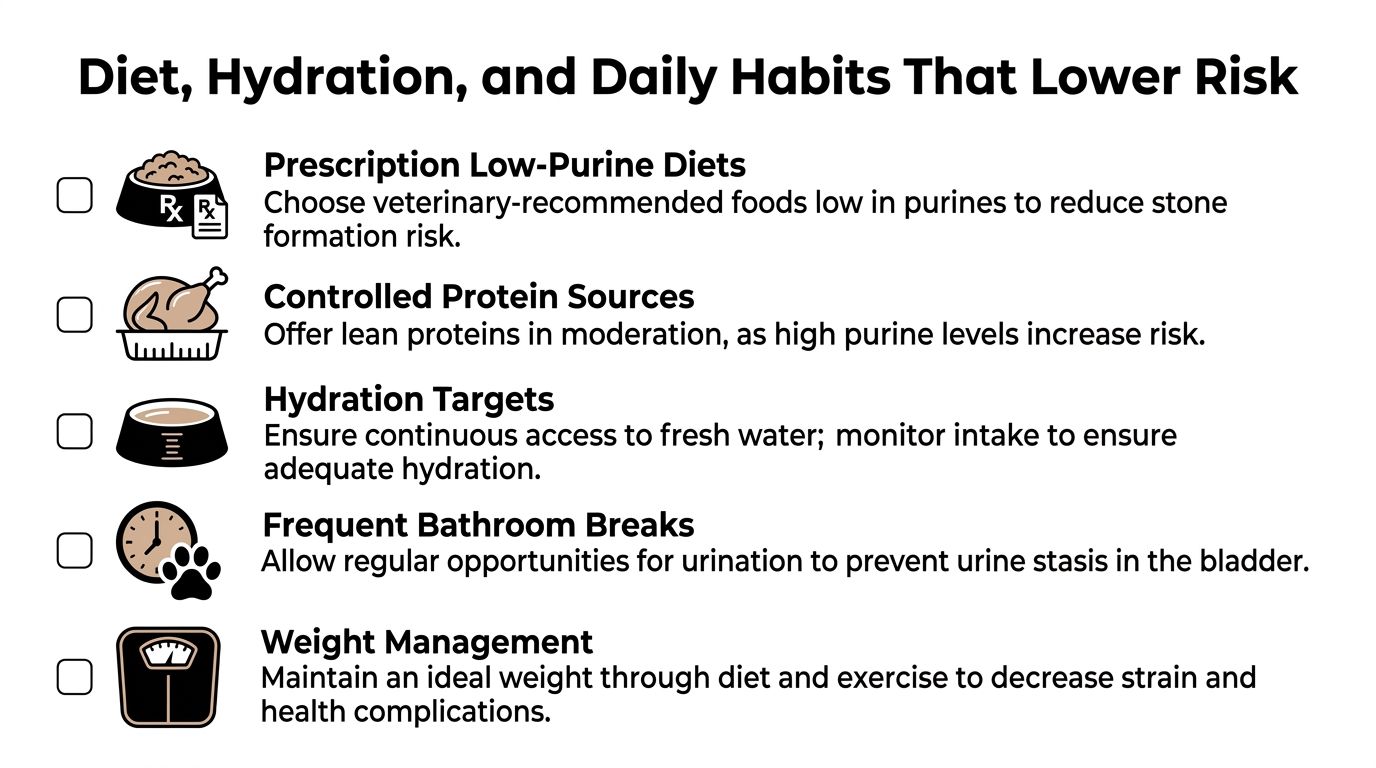
A prevention plan should make urine less concentrated, reduce unnecessary purine exposure, and catch changes before a stone becomes an obstruction. Veterinary guidance commonly emphasizes low-purine or low-protein diets and high urine volume for dogs at risk of Dalmatian hyperuricosuria (UFAW clinical guidance).
Don't change a prescription diet abruptly or build a homemade plan from internet lists. Protein source, treat composition, calories, kidney function, urine findings, and any confirmed stone type all matter. A veterinary nutrition professional can help when a dog needs a long-term home-prepared diet.
Make water easy to choose
Offer fresh water in more than one accessible location. Some dogs drink more from a fountain, while others respond to adding water to meals or using wet food as part of a veterinarian-approved feeding plan. The goal isn't to chase a universal daily volume. It's to support consistent hydration and a healthy urine pattern for that individual dog.
Frequent bathroom opportunities also matter. Holding urine for long periods can work against a prevention plan, particularly when the dog already produces urine with a high uric-acid load. Watch for changes in frequency, effort, stream, odor, color, and accidents.
Match monitoring to the dog
- Puppies: Confirm hearing with BAER testing and discuss baseline urine evaluation, diet, treats, and hydration with the veterinarian.
- Adults: Keep weight stable, maintain regular exercise, and review urinary habits during routine visits.
- Seniors: Ask whether urinalysis, urine culture, kidney-related bloodwork, and imaging should occur more often as health status changes.
Potassium citrate or allopurinol may be appropriate for selected dogs, but neither should be started casually. Allopurinol can contribute to xanthine stone formation if used without proper dietary and veterinary oversight, which is another reason stone analysis and follow-up testing matter.
Treats can undermine a careful diet. Organ meats, some fish-based products, and other high-purine ingredients may need restriction, depending on the plan. Supplements aren't automatically harmless either. If you're considering dog probiotics, show the complete ingredient panel to your veterinarian and keep the product within the dog's overall dietary strategy.
Other Health Issues Worth Knowing About
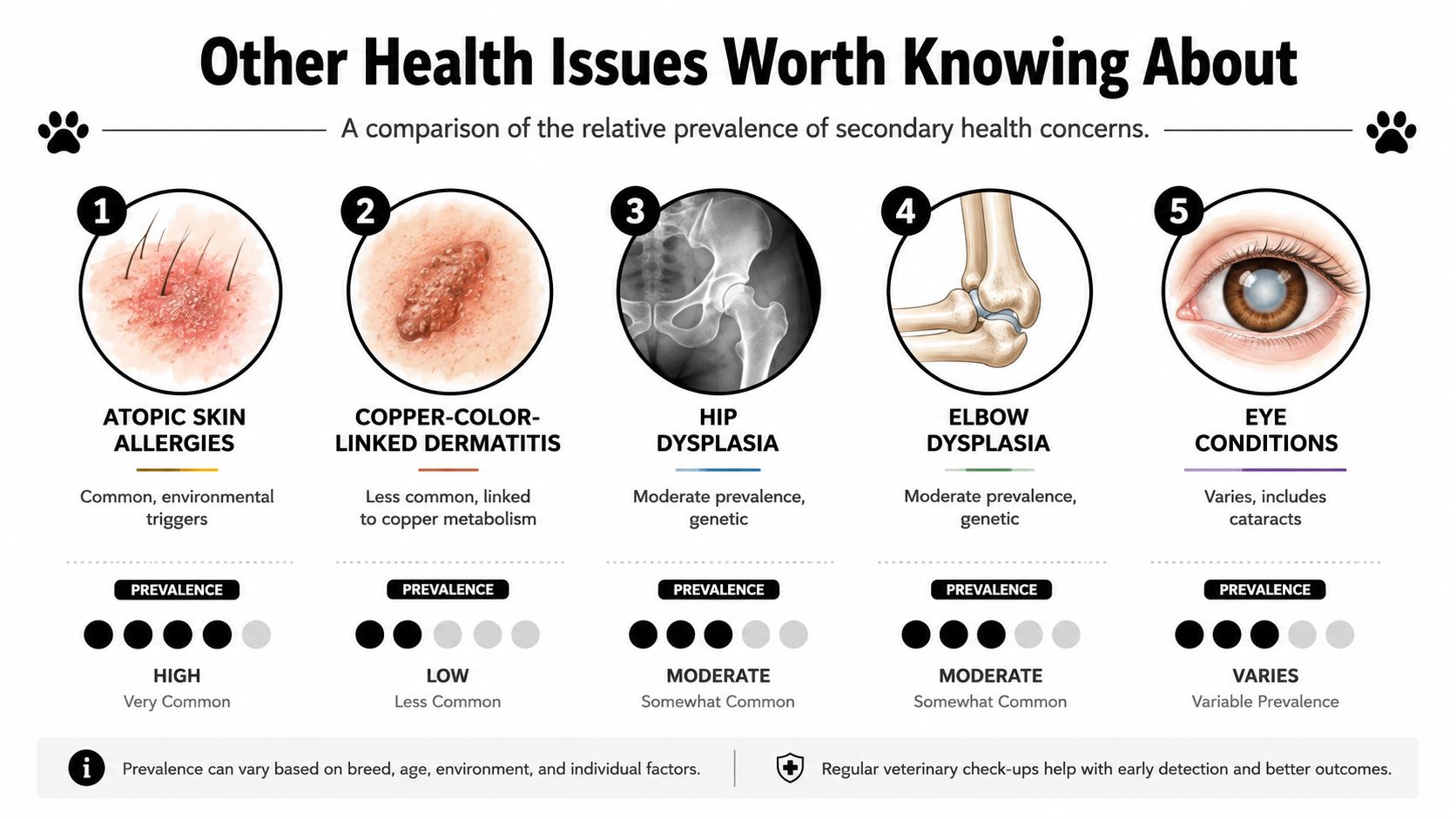
Beyond the two primary concerns, several other dalmatian health problems deserve monitoring. Skin, joints, eyes, the upper airway, and the nervous system each produce different clues. Treat those clues like dashboard lights: they do not identify the fault by themselves, but they show when examination is needed.
Skin and coat
Atopic skin disease is an inflammatory response to environmental allergens. Paw licking, repeated ear inflammation, belly redness, and chewing around the feet are common signs. Copper-color-linked dermatitis and Dalmatian bronzing syndrome can cause reddish-brown staining and irritated skin, which may look similar to allergy, infection, or contact irritation.
Persistent itching needs more than a guess based on appearance. A veterinarian may examine skin cells, check for parasites, assess infection, and match treatment to the dog's pattern. A practical dog skin irritation relief guide can help organize supportive-care questions, but ongoing lesions still require diagnosis.
Joints, eyes, and older-dog changes
Hip and elbow dysplasia are developmental orthopedic conditions shaped by inherited structure and growth. Reluctance to climb, stiffness after rest, an uneven gait, or less interest in exercise can signal joint discomfort. Keeping weight controlled and conditioning the dog appropriately supports mobility. Persistent pain warrants a veterinary examination.
Eye problems may include iris sphincter dysplasia and cataracts. Squinting, cloudiness, sensitivity to light, bumping into objects, or a sudden loss of visual confidence should prompt an eye examination rather than prolonged observation.
Older Dalmatians may develop laryngeal paralysis, with noisy breathing, reduced exercise tolerance, or difficulty coping with heat. Idiopathic epilepsy causes recurring seizures without an identified structural or metabolic explanation, while other causes still need to be excluded. These conditions differ in inheritance and cause. Breeder history can add context, but it cannot predict an individual dog with certainty.
Red Flags That Mean Call the Vet Now
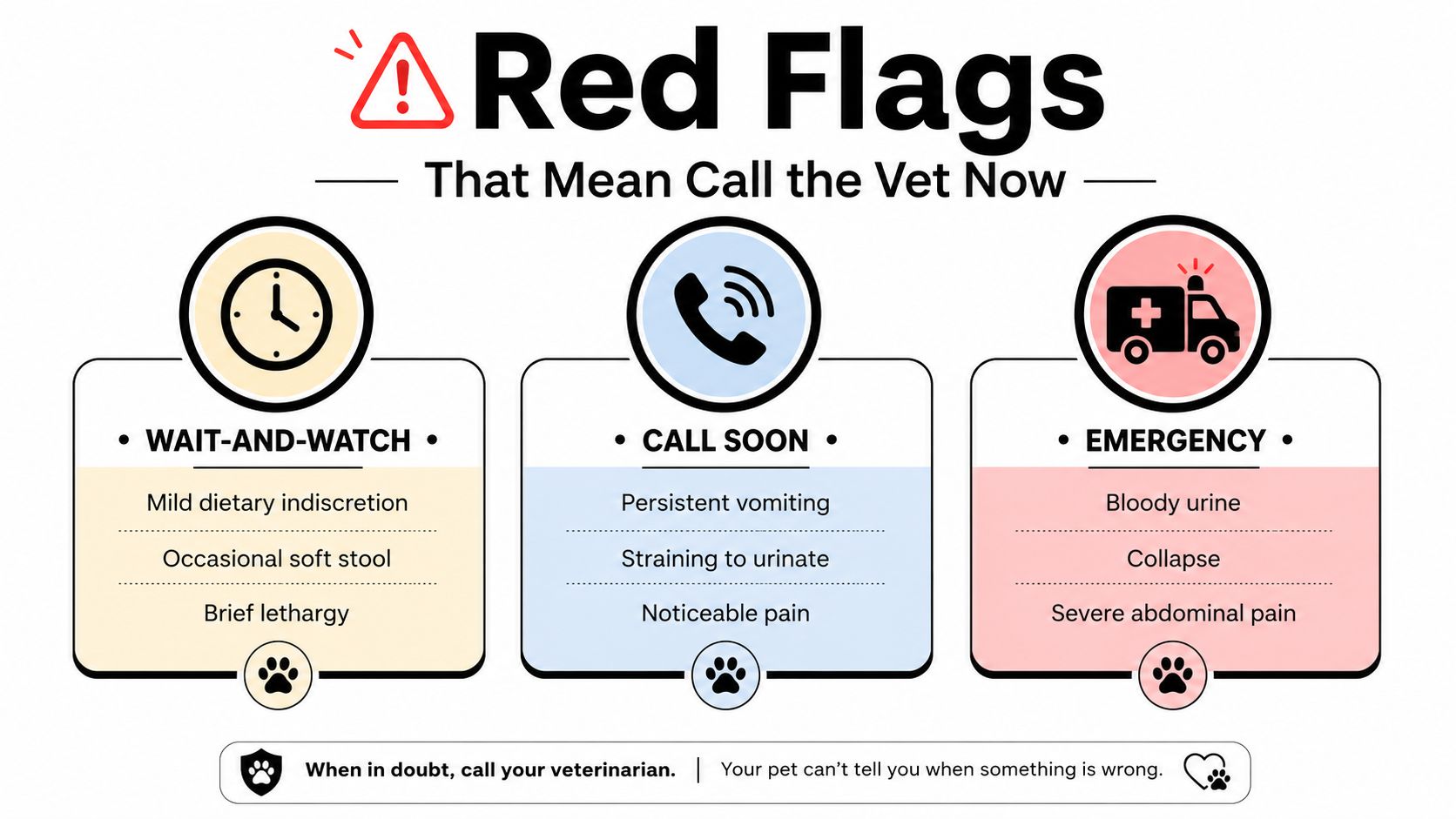
Triage begins with one question: Can the dog perform a normal essential function right now? Urinating, breathing, staying conscious, and responding normally all matter more than whether the symptom seems mild at first.
A soft stool after a minor dietary mistake may be reasonable to discuss with the clinic if the dog remains bright, hydrated, and comfortable. Brief lethargy that resolves can also be watched closely. That changes quickly if vomiting repeats, pain increases, or the dog stops acting normally.
Use this kitchen-table checklist
Call your veterinary clinic soon for persistent vomiting, repeated urinary accidents, obvious discomfort while urinating, new skin lesions, recurrent ear problems, or a noticeable decline in stamina. The clinic may advise an examination, urinalysis, culture, imaging, bloodwork, or skin testing depending on the signs.
Seek emergency care for:
- No urine production: Repeated straining with little or no urine, especially in a male Dalmatian.
- Blood or severe pain: Bloody urine, severe abdominal pain, crying, restlessness, or a tense abdomen.
- Systemic collapse: Sudden collapse, profound weakness, pale gums, or inability to stand normally.
- Repeated vomiting: Especially when paired with abdominal pain, weakness, or suspected urinary trouble.
- Breathing difficulty: Noisy breathing with distress, blue or gray gums, or collapse.
- Neurologic danger: A deaf dog that becomes suddenly disoriented, unresponsive to vibration cues, or unable to move safely.
- Toxin exposure: Any suspected ingestion of a medication, chemical, poisonous food, or unknown substance.
A male unable to urinate may have a complete urethral obstruction, and that can become life-threatening quickly. A female with the same signs still needs same-day care, even though complete obstruction is less common.
Save the checklist to your phone, keep your regular clinic and emergency clinic numbers available, and don't give human pain medication unless a veterinarian specifically instructs you to do so.
A Long-Term Care Plan for Dalmatian Health Problems and Quick Answers
Good Dalmatian care is repetitive in the best sense. You do not need to diagnose a stone, hearing disorder, allergy, or joint disease at home. You do need a routine that makes small changes easier to notice and gives your veterinarian useful information.
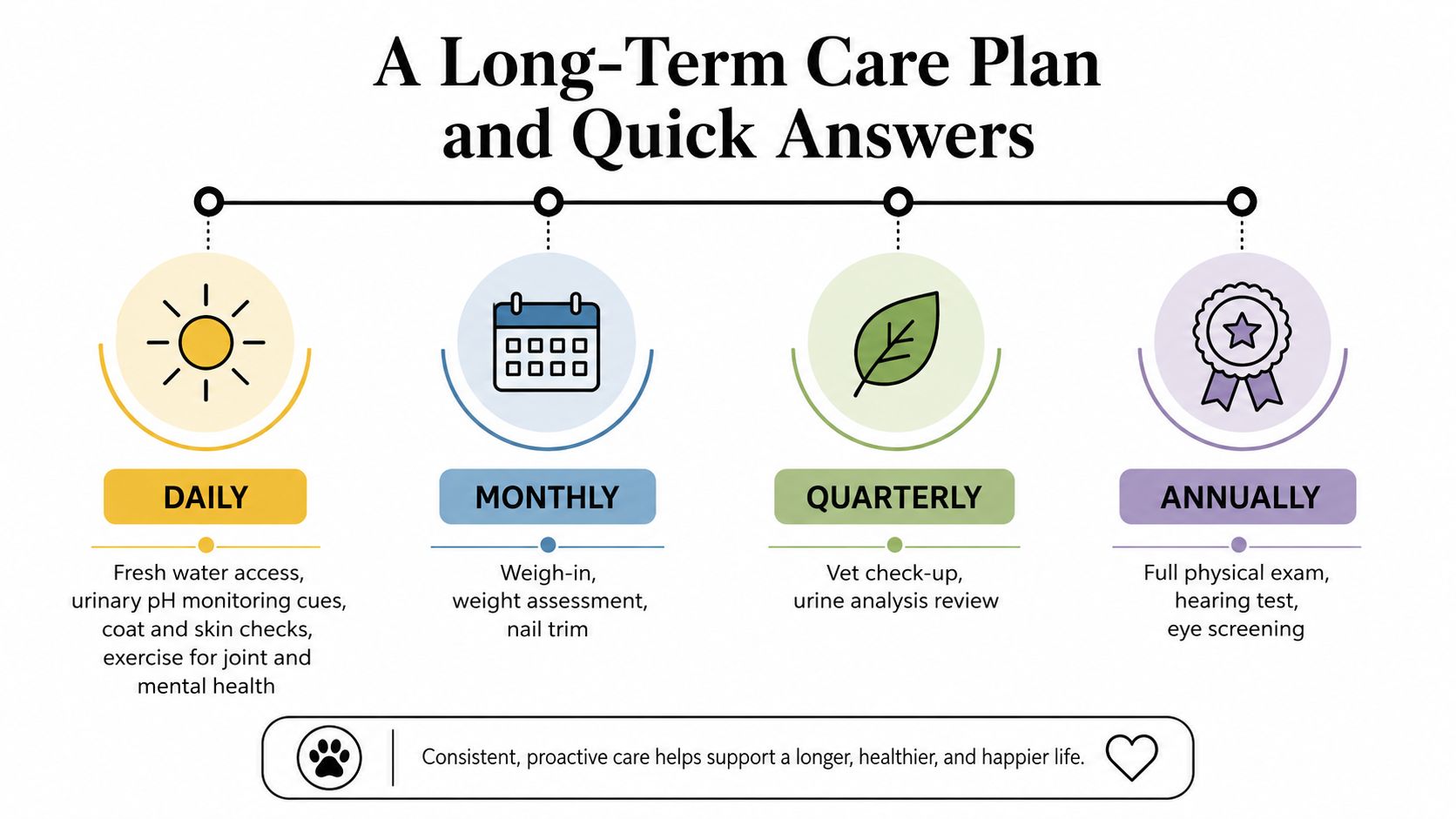
Daily
Refresh water and watch for changes in drinking or urination. Check the coat, paws, ears, and skin, then provide suitable exercise and mental activity. A dog with hearing loss benefits from visual cues and secure handling. A dog with urinary risk benefits from regular bathroom opportunities.
Monthly
Check body condition and weigh your dog when practical. Inspect nails, teeth, ears, and coat. Record recurring changes in urine, stool, appetite, or energy. A brief log helps your veterinarian separate a one-time event from a developing pattern.
Veterinary review
Puppies need hearing confirmation and guidance on diet, growth, socialization, and preventive care. Adults may need periodic urinalysis according to their history and risk. Senior dogs often benefit from closer review of urine, kidney function, joints, eyes, and breathing.
Use our Dalmatian wellness guide to organize questions, not to replace an individualized examination.
Quick answers
Should a Dalmatian eat grain-free food? Not automatically. Grain-free feeding does not treat hyperuricosuria. The appropriate diet depends on nutritional adequacy, ingredients, life stage, and veterinary findings.
Do cranberry supplements prevent Dalmatian stones? Do not use them as the main strategy. They do not replace stone analysis, hydration, dietary management, or veterinary monitoring.
Can a deaf Dalmatian live normally? Yes. Many adapt well with visual communication, secure fencing, leash discipline, and clear identification. Safety planning matters more than expecting a response to sounds the dog cannot hear.
How much water should a Dalmatian drink daily? There is no single safe target for every dog. Ask your veterinarian what intake and urine concentration suit your dog's diet, health status, climate, and urinary history.
The most useful response to dalmatian health problems is a written routine, appropriate screening, attention to urine and hearing, and prompt action when normal function changes.
If you are building a long-term plan for your Dalmatian, Joyfull offers pet wellness products made with stated ingredients and reviewed by an in-house veterinary advisor. Discuss whether they fit your dog's diet and preventive care plan at Joyfull.
0 comments