


You're standing in the pet-store aisle, treat bag in hand, turning it around to search for phosphorus, sodium, and protein. Your dog is watching you with the same hopeful expression as always, but their kidney disease has made a once-simple reward feel risky.
That worry makes sense. Treats are part of how you train, comfort, medicate, and celebrate with your dog. The good news is that a kidney diagnosis doesn't mean every reward must disappear. It means treats need to become small, deliberate parts of the renal feeding plan, chosen with the same care as the main diet.
Table of Contents
- Why Kidney Disease Changes Everything About Treats
- The Phosphorus and Protein Budget Explained
- How to Read Treat Labels for Renal Safety
- Commercial Renal Treats Versus Homemade Options
- Fitting Treats Into Medication and Hydration Routines
- Simple Low-Phosphorus Recipes You Can Make at Home
- Red Flags and Myths Every Owner Should Know
Why Kidney Disease Changes Everything About Treats

A dog with chronic kidney disease, or CKD, can't handle nutrients in quite the same way as a dog with healthy kidney function. The kidneys help regulate minerals, remove waste products, and maintain fluid balance. As kidney function declines, the veterinary team often adjusts phosphorus, protein, and sodium in the overall diet.
That changes the meaning of a treat. A piece of jerky, a bone-based chew, or a salty biscuit might look tiny in your hand, but it still contributes nutrients to your dog's daily intake. Tufts veterinary nutrition guidance recommends that treats for most dogs with CKD stay below 150 mg phosphorus per 100 kcal and 100 mg sodium per 100 kcal. The same guidance warns against many meats, jerky treats, bully sticks, rawhides, pig ears, antlers, and real bones because they can be high in phosphorus and protein. Read the Tufts veterinary nutrition guidance on treats for dogs with kidney disease for the label targets and food examples.
Treats are part of the prescription
Think of your dog's renal diet as the foundation. Treats sit on top of that foundation, so they shouldn't undermine it. The practical aim isn't to eliminate every enjoyable bite. It's to choose rewards that are very small, relatively low in phosphorus and sodium, and unlikely to displace the therapeutic food your veterinarian selected.
For many dogs, the safest reward is a piece of their prescription renal kibble or a spoonful of their approved wet renal food. That approach keeps the reward nutritionally connected to the main diet and avoids introducing an unverified ingredient.
Practical rule: If you can't find reliable mineral information for a treat, treat it as an unknown, not as a safe choice.
Your dog's disease stage, bloodwork, appetite, body condition, and other illnesses all matter. A treat that works for one dog may not suit another, especially if the dog also has hypertension, pancreatitis, food allergies, or significant nausea. Choosing the best treats for dogs with kidney disease is a skill you can learn, but your veterinarian remains the person who can define your dog's actual limits.
The Phosphorus and Protein Budget Explained
A treat can look tiny while using a meaningful share of a kidney patient's daily allowance. That matters most when the same reward appears during training, sits inside a pill, or replaces food on a day when appetite is poor. The renal diet provides the nutritional base, so every extra bite needs to fit around it.
Why phosphorus gets special attention
Healthy kidneys remove excess phosphorus efficiently. Damaged kidneys have more difficulty maintaining that balance, which is why phosphorus restriction has become a central part of CKD nutrition. Veterinary literature recommends beginning phosphorus restriction when CKD is diagnosed, and veterinary practice guidance identifies phosphorus control as a nutritional measure that can slow progression of renal failure.
Therapeutic renal diets differ from ordinary maintenance diets. The AAFCO minimum phosphorus requirement for dogs is 1.4 g per 1,000 kcal, while kidney-support diets use controlled mineral levels rather than ordinary maintenance targets. Veterinary summaries commonly describe renal-support foods as containing about 0.2% to 0.5% phosphorus on a dry-matter basis, with protein often around 14% to 20%. Regular diets may contain roughly 0.5% to 1.0% phosphorus. These figures come from the veterinary nutrition overview at Dog Age Well.
Phosphorus should not be removed completely. Dogs still need a balanced diet, and the goal is to prevent extras from taking up too much of the day's allowance. A concentrated chew can matter more than its size suggests, particularly if it is offered repeatedly or used several times to hide medication.
Protein still matters, but excess creates waste
Protein supports muscle, immunity, tissue repair, and normal body function. A CKD dog still needs it. Renal feeding generally provides moderate amounts of high-quality protein, with the amount adjusted to the dog's condition and veterinary plan.
Protein metabolism produces nitrogen-containing waste products. The kidneys clear those wastes, and damaged kidneys may do so less efficiently. Veterinary practice guidance cites about 35 g of high-quality protein per 1,000 kcal in one evidence-based renal feeding approach. Historical feeding studies found that intake around 110 g per 1,000 kcal worsened clinical signs and increased death rates. The Dog Age Well overview discusses these renal-diet considerations, while the Tufts resource explains why meat-heavy treats may work against a therapeutic diet.
Apply the allowance to the whole day:
- Main food: supplies most calories and nutrients.
- Treats: use only a small share of the remaining phosphorus, protein, and sodium allowance.
- Medication rewards: count even when each piece seems insignificant.
- Chews: may provide more concentrated animal tissue or bone than expected.
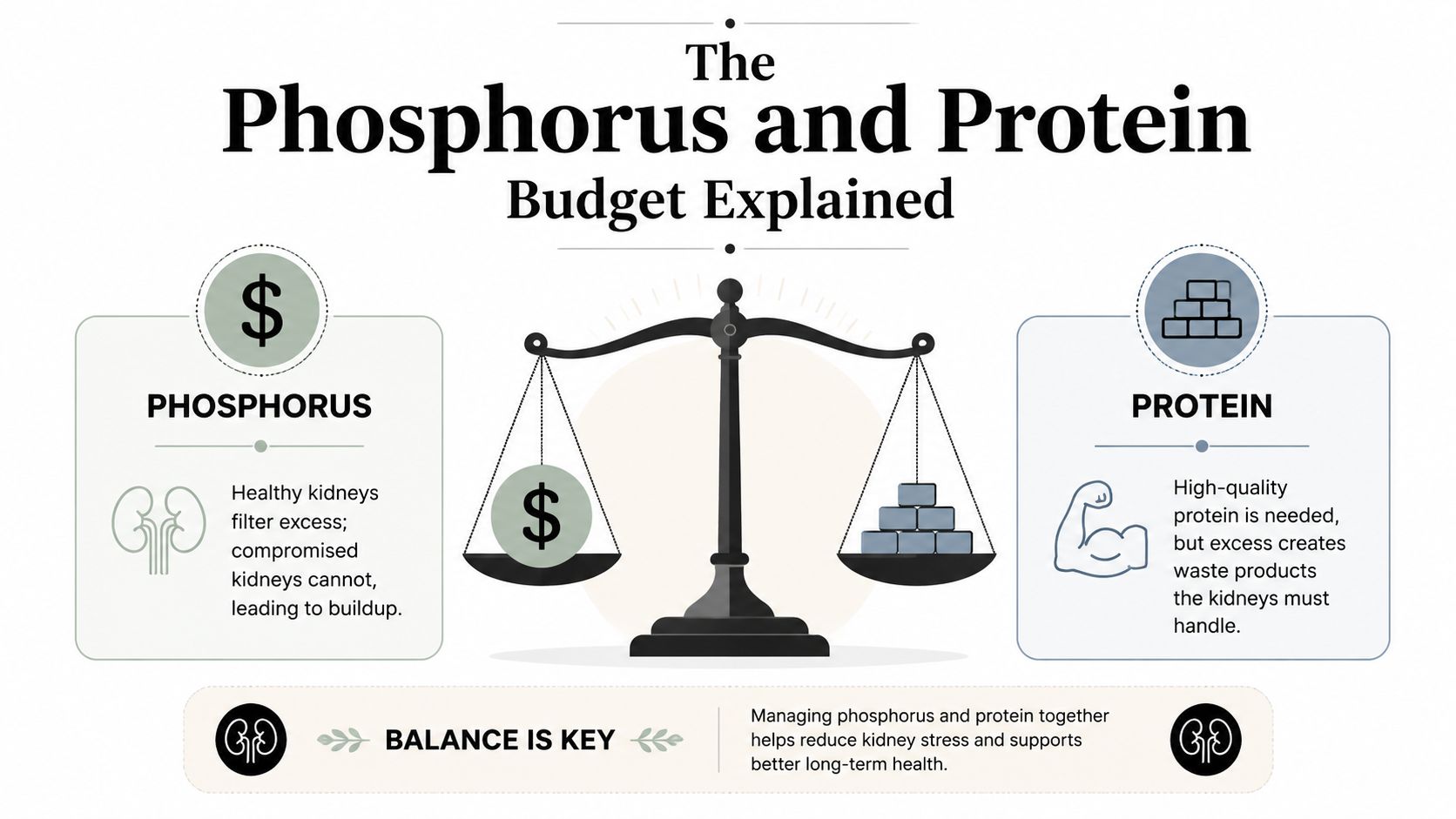
Ask how the treat fits into the dog's entire renal diet that day, not whether it is high in protein. That question keeps prescription food, appetite changes, and medication rewards in the same plan.
How to Read Treat Labels for Renal Safety
A new treat should pass through the same checks as any other part of a renal plan. The label can help you screen choices, but it may not answer every question. Use this process before adding a commercial treat to a dog's routine, especially when the dog eats a prescription diet or receives medication hidden in food.
Start with the guaranteed analysis
Look for crude protein, crude fat, crude fiber, moisture, and ash. Phosphorus and sodium may be missing, even though both affect renal safety. If phosphorus is not listed, contact the manufacturer and request phosphorus and sodium content, preferably on a dry-matter basis.
Dry-matter comparison accounts for water. A moist treat and a dry biscuit can show different percentages because their moisture levels differ. Your veterinarian or veterinary nutritionist can convert an “as-fed” value into a dry-matter value. Do not compare the printed percentages directly and assume the smaller number is safer.
For a practical screening point, Tufts advises that treats for most CKD dogs stay under 150 mg phosphorus per 100 kcal and 100 mg sodium per 100 kcal. These are treat-specific targets, not universal allowances for every dog, as noted earlier.
Scan the ingredient list
Ingredient order cannot reveal the exact phosphorus content, but it can identify reasons to pause:
- Bone ingredients: bone meal, ground bone, and real bones can supply concentrated minerals.
- Organ meats: liver and other organ tissues may be phosphorus-rich.
- Animal-heavy chews: jerky, bully sticks, pig ears, antlers, and rawhides require particular caution.
- Added phosphates: check for sodium tripolyphosphate or pyrophosphate.
- Salty recipes: processed or heavily seasoned treats may add sodium without helping the renal plan.
A short ingredient list is not proof of renal safety. “Natural,” “human-grade,” and “senior” describe marketing or product positioning, not mineral suitability.
Look for usable information
A moisture-rich formulation may be easier to portion and may support fluid intake, but it still has to fit the day's nutrient plan. A clearly identified, moderate protein source may be easier to use than a meat-heavy chew. Phosphorus information remains necessary.
Set a treat aside if the manufacturer will not provide meaningful mineral data, the product contains obvious bone or phosphate additions, or your veterinarian has restricted one of its ingredients. Joyfull's dog food label guide explains common label sections, but individualized renal guidance still determines whether the product fits.
Use this decision sequence:
- Can you verify phosphorus and sodium?
- Does the ingredient list avoid obvious high-phosphorus chews and additives?
- Does the treat fit the dog's protein plan and medical conditions?
- Can you portion it consistently for treats or medication rewards?
- Has your veterinary team approved it when the label is unclear?
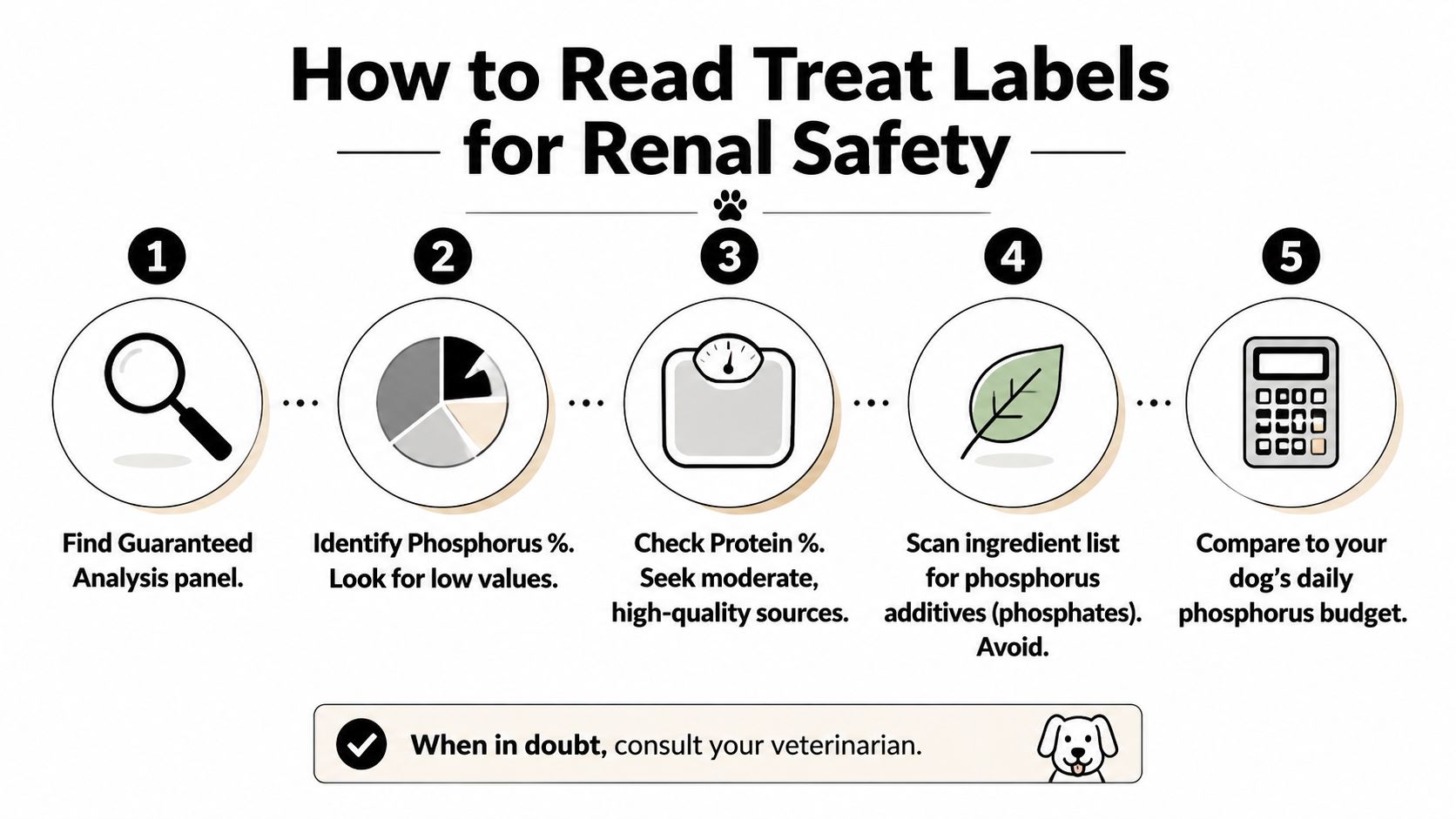
A visual label walkthrough can make the checks easier to follow:
Commercial Renal Treats Versus Homemade Options
Commercial and homemade treats solve different problems. A commercial renal treat can be convenient, consistent, and easy to portion, while a homemade option gives you more control over ingredients and texture. Neither category is automatically safe.
Some commercial treats are formulated around starches and use modest amounts of protein. That can make them easier to fit into a renal plan, but the label may still omit phosphorus. If the product maker can't provide mineral information, you won't know whether the treat matches your dog's needs.
Homemade treats offer control over ingredients such as egg white, rice flour, approved vegetables, or water. They also create room to adjust texture for a dog with dental discomfort or nausea. The trade-off is that homemade recipes can become nutritionally unbalanced when owners improvise, especially if they add meat, dairy, bones, broth, or supplements without checking the mineral load.
| Factor | Commercial Renal Treats | Homemade Treats |
|---|---|---|
| Convenience | Ready to portion and useful for travel | Requires preparation and storage |
| Nutrient consistency | May be consistent if the manufacturer discloses analysis | Depends on the recipe and measuring |
| Phosphorus transparency | Often incomplete, so manufacturer contact may be necessary | Ingredient control is better, but exact analysis still requires reliable data |
| Texture | Fixed by the product | Can be softened, baked, frozen, or made moist |
| Multi-dog households | Easy to keep separate and count | More preparation, but ingredients can be selected carefully |
| Advanced CKD or other illnesses | Requires veterinary review | May be useful only with professional formulation |
Choosing based on the household
Commercial treats make practical sense for travel, training classes, medication routines, or homes where multiple dogs need different foods. You might also prefer a packaged option when you need repeatable portions and don't have time to prepare food.
Homemade treats may suit a picky dog who rejects renal biscuits or a dog whose other condition requires a narrow ingredient list. However, advanced CKD, pancreatitis, poor body condition, and changing bloodwork all make casual recipe experimentation less appropriate.
If you're comparing packaged options, a limited ingredient dog treat may appear appealing because it can be easy to portion, but you still need to confirm its suitability with your veterinarian and verify the relevant nutrient information. “Limited ingredient” doesn't automatically mean low phosphorus or low sodium.
Fitting Treats Into Medication and Hydration Routines
Treats work best when they support the care plan rather than compete with it. A dog may need a renal diet alongside nausea control, appetite support, fluids, or a phosphate binder. Veterinary guidance from VCA on chronic kidney failure in dogs describes CKD care as multimodal, with treatment decisions shaped by the dog's symptoms and veterinary assessment.
Medication timing needs a clear plan
Phosphate binders are used with meals, not as a general permission slip for unlimited phosphorus. IRIS-based guidance recommends considering enteric phosphate binders when serum phosphorus remains above 4.6 mg/dL after dietary phosphorus restriction, as described in this IRIS-based veterinary practice resource.
That means a phosphorus-containing treat shouldn't automatically be given alone just because a binder is part of the prescription. Ask your veterinarian whether a particular reward should be given with a meal, and whether a treat can hide a specific medication. Some medications may have food-related instructions or absorption considerations, so don't assume every pill can go into the same snack.
Use rewards to protect appetite
Nausea and food aversion can make a CKD dog associate food with discomfort. A tiny, approved reward may help maintain a positive association, but a stream of treats can also cause the dog to fill up before eating the renal meal. If appetite is poor, contact the veterinary team rather than covering the problem with increasingly exciting snacks.
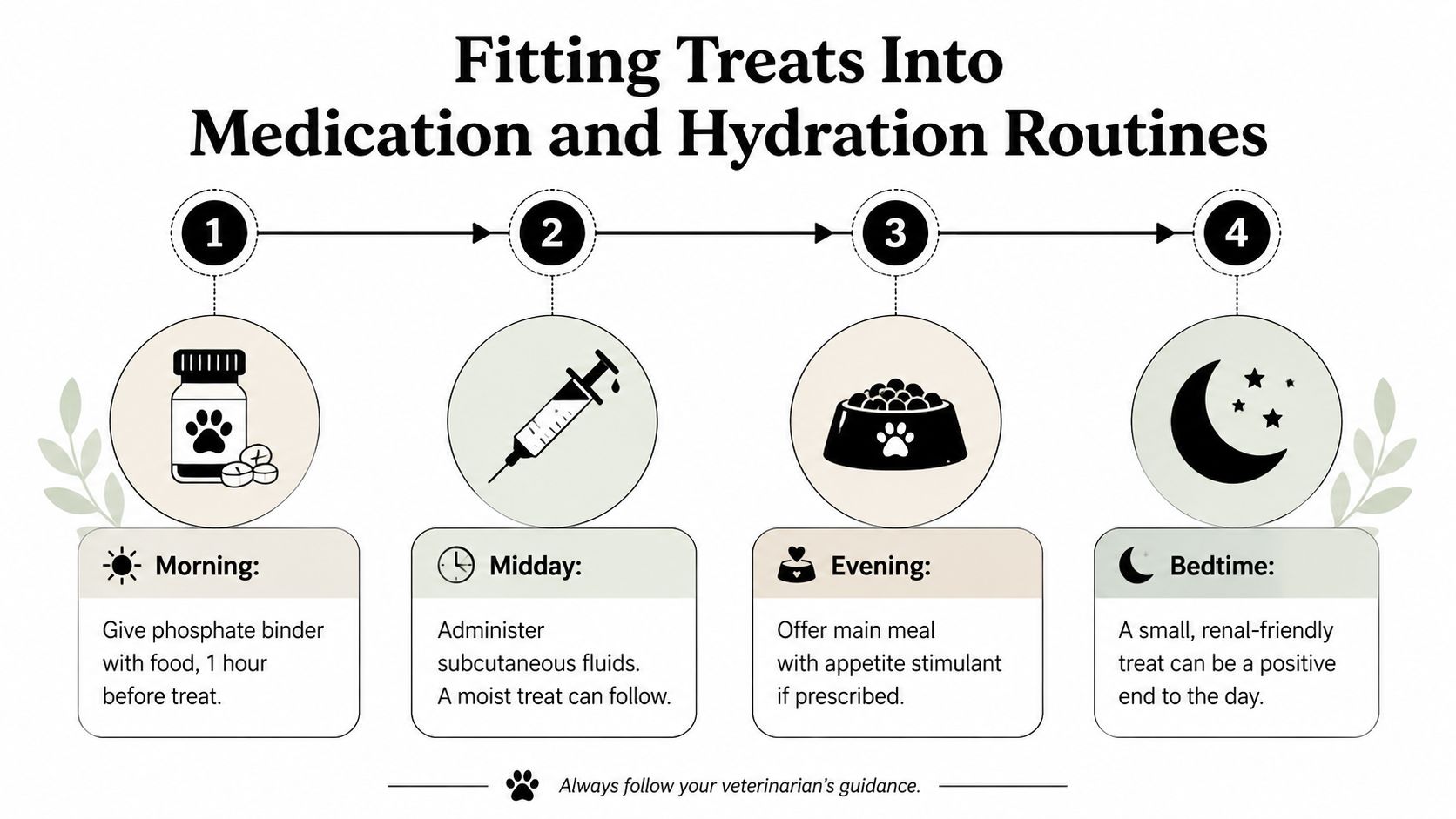
A simple routine might look like this:
- Morning: Offer the prescribed renal meal and give a phosphate binder with food if prescribed.
- Midday: Use a tiny approved moist reward after fluids or a medication routine.
- Evening: Offer the main renal meal, with an appetite stimulant or anti-nausea medicine only as directed.
- Bedtime: Give a small renal-compatible reward if it helps with comfort, training, or medication compliance.
Your veterinarian may change that sequence. Keep a written record of the food, treat, medication, and approximate timing so the team can identify patterns in appetite, vomiting, stool, or phosphorus results.
A product made for cats, such as the Probiotic Supplement for Cats - 30 Single-Serving Packets, shouldn't be repurposed for a dog with CKD without veterinary approval. Its snapshot describes real beef bone broth, veterinarian-formulated probiotic strains, prebiotics, and third-party potency and purity testing, but those facts don't establish renal suitability for an individual dog.
Simple Low-Phosphorus Recipes You Can Make at Home
Homemade treats can be useful, but exact phosphorus and protein values can't be calculated responsibly without verified laboratory or database values for every ingredient and batch. That's especially important for broth, peanut butter, flour, and commercial ingredients, whose mineral content can vary.
Rather than inventing nutrient totals, use these as ingredient frameworks and ask your veterinarian or board-certified veterinary nutritionist to approve the recipe and calculate the portion for your dog.
Soft sweet potato and egg-white bites
Use plain cooked sweet potato and cooked egg white, with no salt, seasoning, butter, or whole egg yolk. Mash the ingredients, shape tiny portions, and bake or dehydrate until they hold together. Egg white can provide a palatable protein source without the same phosphorus contribution as a whole egg, but the amount still needs to fit your dog's complete diet.
Cool the pieces completely, refrigerate them in a sealed container, and prepare only a small batch until your veterinary team confirms the recipe. Freeze extra portions if your dog tolerates the texture.
Blueberry and coconut oil ice bites
Blend a small amount of plain blueberries with water and enough coconut oil to help the mixture set. Freeze in very small molds. These bites provide moisture and a different texture, but coconut oil is calorie-dense, and fruit may not suit every dog with gastrointestinal or metabolic conditions.
Use them as occasional rewards, not as a replacement for the renal meal. Thaw slightly before offering so your dog doesn't gulp a hard frozen piece.
Rice-flour peanut butter drops
Choose plain peanut butter with no xylitol, added salt, chocolate, or sweeteners. Combine a small amount with rice flour and water to form a soft dough, then bake tiny drops until firm. Rice flour can be a practical alternative to whole-wheat flour, but peanut butter still contributes protein, fat, and minerals, so portion control matters.
Read the entire peanut butter label and confirm the ingredient with your veterinarian. Store baked drops in the refrigerator and freeze what you won't use promptly.
Gelatin and low-sodium broth cubes
Use a veterinarian-approved, low-sodium broth with verified phosphorus information, then dissolve unflavored gelatin according to the package directions. Pour the mixture into small molds and chill until set. Avoid ordinary bone broth unless your veterinary team has confirmed its mineral content, because bone-based ingredients can add phosphorus.
These cubes can offer moisture, but they shouldn't be used to hide every medication or replace fresh water. Keep them refrigerated and discard them if they develop an unusual smell, texture, or appearance.
For any recipe, portioning should be based on the dog's complete daily phosphorus and calorie plan, not a generic body-weight formula. A veterinary nutritionist can calculate how many pieces fit after accounting for the renal food, other treats, medications, and the dog's current bloodwork. Joyfull's healthy dog treat ideas may provide general preparation inspiration, but a general recipe isn't a substitute for a therapeutic renal formulation.
Red Flags and Myths Every Owner Should Know
A treat can look wholesome and still conflict with a kidney-care plan. Organ meats, bones, bone meal, jerky, pig ears, antlers, and rawhides may bring excess phosphorus, sodium, or protein. Labels such as “natural,” “senior,” or “light” describe marketing or one nutritional feature, not the whole treat's suitability for your dog.
The amount also matters. A single bite may seem insignificant, yet pill-hiding foods, chews, training rewards, and table scraps can add up across the day. Treats belong in the same daily nutrition plan as the prescription diet, especially when your dog eats several small portions rather than one obvious snack.
Watch the dog, not just the package
Stop a new treat and contact your veterinarian if your dog develops:
- A sudden appetite change: refusal of the renal meal or a marked drop in interest.
- Vomiting or gastrointestinal upset: especially if it follows the new food.
- Unusual lethargy or weakness: a change from your dog's normal behavior.
- Increased drinking or urination: particularly when the change is sudden.
- Strong ammonia-smelling breath: or a sore mouth alongside other signs.
These signs do not prove that a treat caused the problem. Kidney disease itself, medication effects, dehydration, or another illness may be responsible. The change still deserves veterinary assessment, rather than another round of dietary experiments.
Poor appetite can make treat decisions harder. A carefully chosen reward may help your dog accept medication, maintain a hydration routine, or participate in gentle handling. For some dogs, a measured portion of the prescription renal food works best. Another option may be a treat whose phosphorus and sodium information your veterinary team has reviewed.
Bring the package, ingredient list, and feeding record to your appointment. Bloodwork, disease stage, medication schedule, and appetite should guide the decision, not an online list of supposedly safe ingredients.
Joyfull provides pet wellness products with ingredient information and veterinary review. You can examine the available options at Joyfull, then discuss any new treat or supplement with your veterinarian before introducing it.
0 comments