


Most guides tell you to switch from puppy food to adult food on your dog's first birthday. That advice is convenient, but it's too blunt to be reliable. Adult vs puppy food isn't a birthday decision. It's a growth, body-condition, breed-size, and formulation decision.
Puppy food isn't adult kibble with extra calories. Growth diets carry different nutrient targets, particularly for protein, fat, calcium, phosphorus, and energy. Under AAFCO profiles, minimum crude protein is 22.5% for growth and reproduction versus 18.0% for adult maintenance, while minimum calcium is 1.2% versus 0.5% respectively. AAFCO's life-stage guidance explains why the distinction matters.
Switch too soon and a still-developing dog may lose nutritional support needed for lean tissue and skeletal growth. Switch too late and you may keep feeding a calorie-dense formula to a dog whose growth has slowed, encouraging excess weight. The right question is simple: Is this food appropriate for what my dog's body is doing now?
Table of Contents
- Why the Puppy to Adult Switch Is Not a Birthday
- The Life-Stage Rules Behind the Two Formulas
- Adult vs Puppy Food at a Glance
- The Hidden Variable, Minerals and Energy Density
- How to Transition From Puppy to Adult Food
- When to Switch by Breed Size and Body Condition
- Reading the Label Past the Life-Stage Banner
- Owner Scenarios and Common Feeding Questions
Why the Puppy to Adult Switch Is Not a Birthday
A calendar can remind you to reassess your dog's diet, but it can't decide the diet for you. Dogs mature at different rates, and the difference is especially pronounced between small breeds and giant breeds. A compact dog may be close to physical maturity while a giant-breed puppy is still developing its skeleton and adding lean mass.
That's why a healthy small dog may be ready for adult maintenance food around the end of its first year, while a giant breed can need a carefully controlled growth formula considerably longer. The exact choice depends on the dog's expected mature size, current body condition, growth pattern, and the adequacy statement on the bag.
Practical rule: Don't switch because the calendar says your dog is older. Switch when growth has substantially slowed and the formula no longer matches the dog's nutritional demand.
Growth is more than visible size
A puppy can stop looking lanky while still developing muscle and bone. Owners often mistake a calmer appetite or a less dramatic change in height for complete maturity. That's where the popular “first birthday” rule can fail.
Large- and giant-breed puppies need particular care because mineral excess can be as problematic as mineral deficiency. Veterinary nutrition guidance emphasizes controlled calcium and phosphorus for growth, with a calcium-to-phosphorus ratio near 1:1 to 1.5:1 for growing dogs. Veterinary nutrition guidance on mineral control is especially relevant for owners feeding rapidly growing dogs.
Body condition gives you a better signal than a birthday. You should be able to feel the ribs without pressing hard, the waist should remain visible from above, and the dog shouldn't be carrying a soft layer over the abdomen or back. A puppy gaining weight too quickly needs a portion review, not automatic permission to continue a richer food.
The Life-Stage Rules Behind the Two Formulas
The switch from puppy to adult food is a formulation decision, not a birthday ritual. A puppy is building tissue, bone, organs, and muscle. A mature dog is maintaining those structures. Choose the food that matches the dog's current growth rate, expected adult size, and body condition, then verify that the bag's nutritional adequacy statement supports that choice.
AAFCO separates growth and reproduction from adult maintenance because their nutrient demands differ. Its profiles set minimum crude protein at 22.5% for growth and reproduction and 18.0% for adult maintenance. Minimum fat is 8.5% for growth and reproduction versus 5.5% for adult maintenance. These figures are based on dry matter, so compare them carefully with the guaranteed analysis on the label. The AAFCO framework for selecting pet food explains how species, life stage, and condition shape food selection.
What the standards mean in practice
Protein is the nutrient to watch first, but energy and mineral balance determine whether the formula fits the dog. The National Research Council's growth guidance lists 45 g per 1,000 kcal ME for puppies 4–14 weeks old and 35 g per 1,000 kcal ME for puppies older than 14 weeks. It also describes energy needs at roughly 3× resting energy requirement before 4 months and 2× RER after 4 months, according to the NRC and AAFCO standards reference.
| Nutrient (per kg DM) | Growth & Reproduction Minimum | Adult Maintenance Minimum | Why It Differs |
|---|---|---|---|
| Crude protein | 22.5% | 18.0% | Supports active tissue synthesis during growth |
| Fat | 8.5% | 5.5% | Provides concentrated energy for development |
| Calcium | 1.2% | 0.5% | Supports developing bones, with careful control required |
An all-life-stages food is usually built to satisfy the more demanding growth profile. That may suit a puppy if the adequacy statement confirms it, but the same food can supply more energy than an inactive adult needs. Some foods labeled “adult” also lack a complete-and-balanced claim, so the life-stage banner alone cannot make the decision.
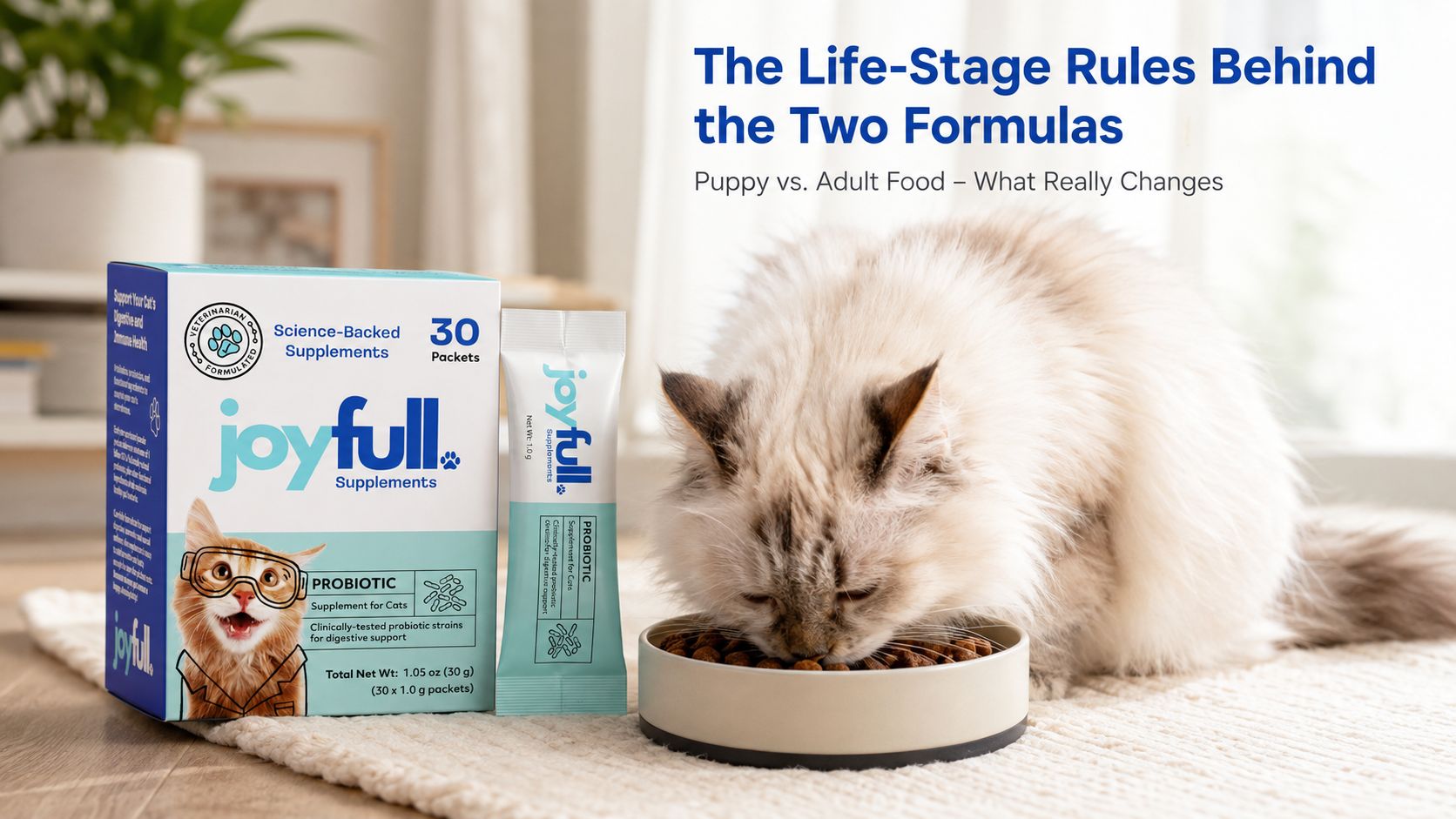
For owners comparing digestive-support products, the Probiotic Supplement for Cats, 30 Single-Serving Packets is intended for cats. It cannot replace complete dog food or a puppy growth formula.
Adult vs Puppy Food at a Glance
The clearest way to compare adult vs puppy food is to separate nutrient purpose from marketing language. Puppy formulas generally provide more concentrated nutrition because they support growth. Adult formulas are designed to maintain a mature body, so they're often less energy-dense and less focused on high growth demands.
AAFCO's minimums establish the foundation. Growth and reproduction diets require at least 22.5% crude protein and 8.5% fat, while adult maintenance diets require at least 18.0% protein and 5.5% fat, based on dry matter. These AAFCO profile differences don't tell you everything about a specific product, but they show why the two categories exist.
| Nutrient or Feature | Puppy Formula, Typical | Adult Formula, Typical | Practical Implication |
|---|---|---|---|
| Protein | Higher growth-oriented target | Lower maintenance-oriented target | Puppies need support for lean tissue development |
| Fat | Higher minimum growth target | Lower minimum maintenance target | Puppy food can provide more concentrated energy |
| Calories | Often more concentrated | Often moderated for maintenance | The same scoop can affect weight differently |
| Calcium | Higher growth minimum | Lower adult minimum | Mineral control matters during skeletal development |
| Phosphorus | Controlled for growth balance | Set for maintenance | Ratio and total intake matter, especially for large breeds |
| DHA | Commonly emphasized in puppy formulas | May not be emphasized in adult formulas | Developmental ingredients shouldn't be assumed from front-label claims |
| Kibble design | Often smaller and more heavily coated | More varied in size and texture | Shape and palatability support puppy eating, but don't prove adequacy |
Treat this table as a reference card, not a buying verdict. Formulas vary by brand, recipe, calorie density, and intended size category. Two foods labeled for the same life stage can still differ substantially in mineral levels, digestibility, fat content, and portion recommendations.
The guaranteed analysis is only a starting point. If your puppy is large or giant breed, look for a formula explicitly intended for controlled growth rather than assuming any food labeled “puppy” has the same mineral profile. If your adult dog gains weight after the switch, reduce the portion based on body condition and calorie density instead of blaming the food category alone.
The Hidden Variable, Minerals and Energy Density
Protein gets most of the attention in adult vs puppy food discussions, but mineral control is often the more consequential issue for a growing large-breed dog. Calcium and phosphorus work together during skeletal development. More calcium isn't automatically better, and adding supplements to a complete growth diet can create an imbalance.
The ratio matters, but so does the total amount supplied. Veterinary guidance places the growth calcium-to-phosphorus ratio near 1:1 to 1.5:1, while also warning that excess calcium can disrupt skeletal development, particularly in large and giant breeds. This veterinary reference on canine nutrition supports the cautious approach.
Calories decide the portion
Energy density changes how much food reaches the bowl. A calorie-dense puppy formula can look like a modest serving while supplying enough energy to push a slow-growing or recently neutered dog above its needs. Owners commonly keep the old scoop size after changing foods, even though the new product may contain a different amount of energy per gram or cup.
| Nutrient/Density | Puppy, Growth | Adult, Maintenance | Why It Matters |
|---|---|---|---|
| Calcium | Higher minimum with controlled limits | Lower maintenance minimum | Protects the growing skeleton when balanced correctly |
| Phosphorus | Carefully balanced for growth | Appropriate for mature maintenance | Supports bone metabolism without encouraging excess |
| Energy density | Often concentrated | Often moderated | Portion size must change with the formula |
| Protein density | Designed for tissue accretion | Designed for tissue upkeep | More isn't automatically better after maturity |
Don't add calcium, bone meal, or broad vitamin products to a complete puppy food unless a veterinarian has identified a specific need. A supplement can turn a carefully balanced diet into an unbalanced one.
For broader guidance on evaluating supplements rather than adding them reflexively, use safe dog vitamins and minerals as a label-reading reference. The principle is straightforward: complete food first, targeted supplementation only when justified.
How to Transition From Puppy to Adult Food
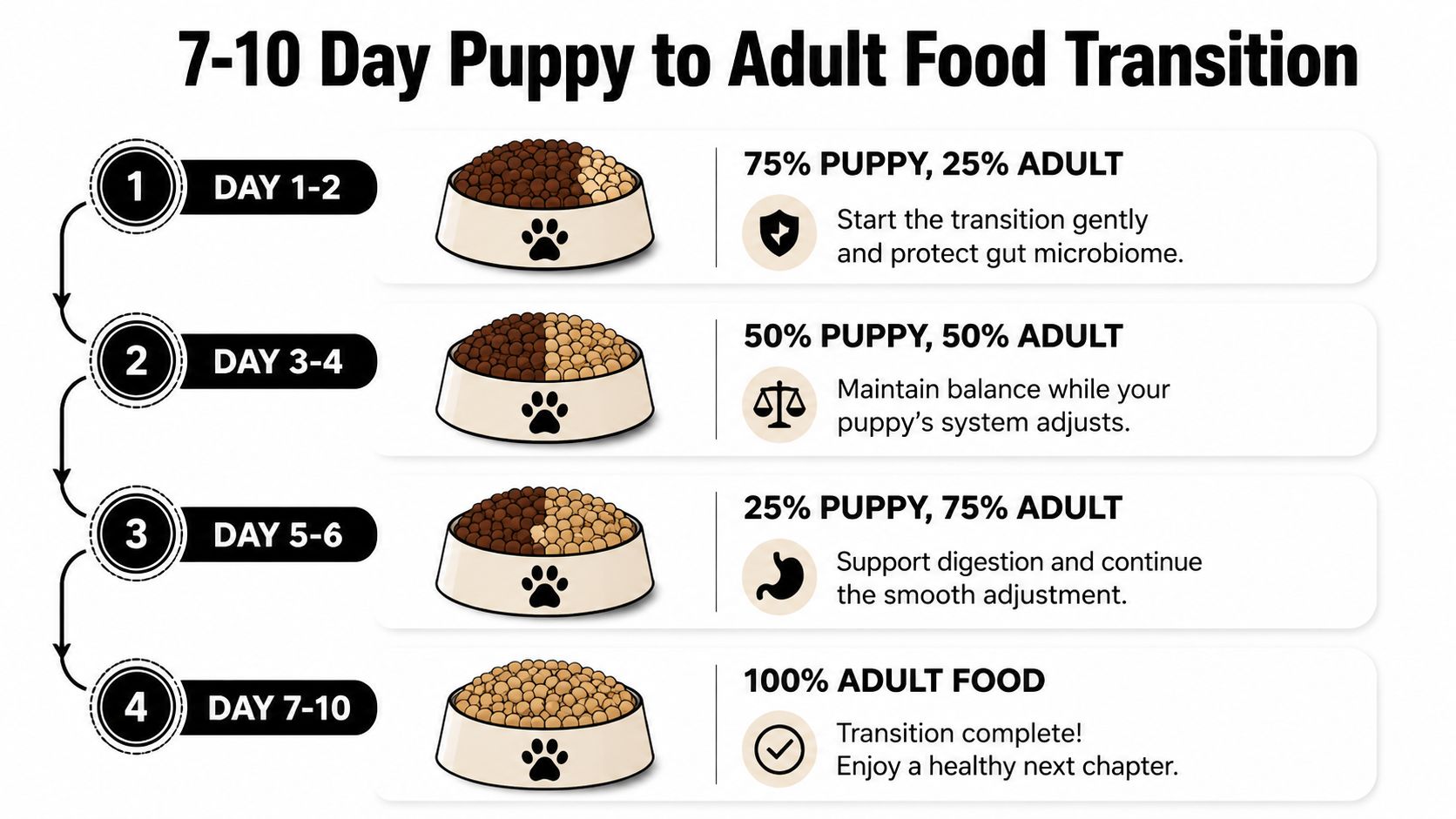
A sudden food change can produce loose stool even when the new formula is nutritionally appropriate. Mix the foods gradually so the digestive system has time to adapt. A healthy dog can often complete the process in a week, while a dog with a sensitive stomach may need the longer end of the range.
Use this mixing schedule
- Days 1–2: Feed 75% puppy food and 25% adult food.
- Days 3–4: Move to a 50% puppy and 50% adult mixture.
- Days 5–6: Feed 25% puppy food and 75% adult food.
- Days 7–10: Serve 100% adult food.
If stool becomes loose, hold the current mixture instead of moving forward. Vomiting, persistent diarrhea, marked lethargy, or refusal to eat warrants veterinary advice rather than another food experiment. Extend the transition for dogs with sensitive digestion or a recent antibiotic course.
Portions need to change with the formula. Veterinary references commonly describe puppies under 4 months at about 3× RER and puppies over 4 months at about 2× RER, while adult maintenance is lower and varies with the individual. The NRC and AAFCO standards reference explains the life-stage energy distinction.
Monitor the dog, not the measuring cup
Check the ribs, waist, stool, coat, and energy after the transition. A suitable formula and portion should leave the dog alert, comfortable after meals, and steadily maintaining an appropriate body condition.
Use Joyfull pet food transition tips for additional practical guidance, but don't treat any generic schedule as more important than your dog's response. A transition plan is a tool, not a test your dog has to pass.
When to Switch by Breed Size and Body Condition
Breed size gives you a useful starting point, but body condition should make the final call. Small dogs generally mature sooner, medium dogs follow a middle timeline, and large or giant breeds may continue developing after a smaller dog would already be eating adult maintenance food.
| Breed Size | Typical Switch Window | Growth Plate Closure | Post-Neuter Adjustment |
|---|---|---|---|
| Toy and small | Around 9–12 months | Earlier than larger breeds | Recheck portions and body condition sooner |
| Medium | Around 12 months | Intermediate timing | Watch for reduced energy needs |
| Large | Around 12–15 months | Later skeletal maturation | Avoid excess weight during the transition |
| Giant | Around 18–24 months | Slowest maturation | Keep growth controlled and reassess regularly |
These windows are practical starting points, not guarantees. A giant-breed puppy that still has a lean, steady growth pattern shouldn't be pushed onto adult food just because it reached a familiar birthday. Conversely, a small dog that has stopped growing and is becoming soft through the ribs may need a lower-energy maintenance plan earlier.
Three checkpoints beat one date
Use these checks together:
- Rib feel: You should be able to feel the ribs without a thick covering, while the dog still maintains a healthy shape.
- Weight trend: Look for a stable, appropriate trend rather than rapid gain or unexplained loss.
- Appetite and energy: A dog that remains ravenous after meals, gains weight, or becomes less active may be receiving too much energy.
Spaying or neutering can change appetite and energy needs, so reassess portions after the procedure instead of waiting for visible weight gain. Don't assume a newly fixed puppy automatically needs adult food, though. The better adjustment may be a measured portion change or a controlled-growth formula, depending on size and maturity.
If your dog has a medical condition, unusual growth pattern, or orthopedic concern, ask your veterinarian to review the formula and feeding amount together. Changing life stage without checking calories and minerals solves only part of the problem.
Reading the Label Past the Life-Stage Banner
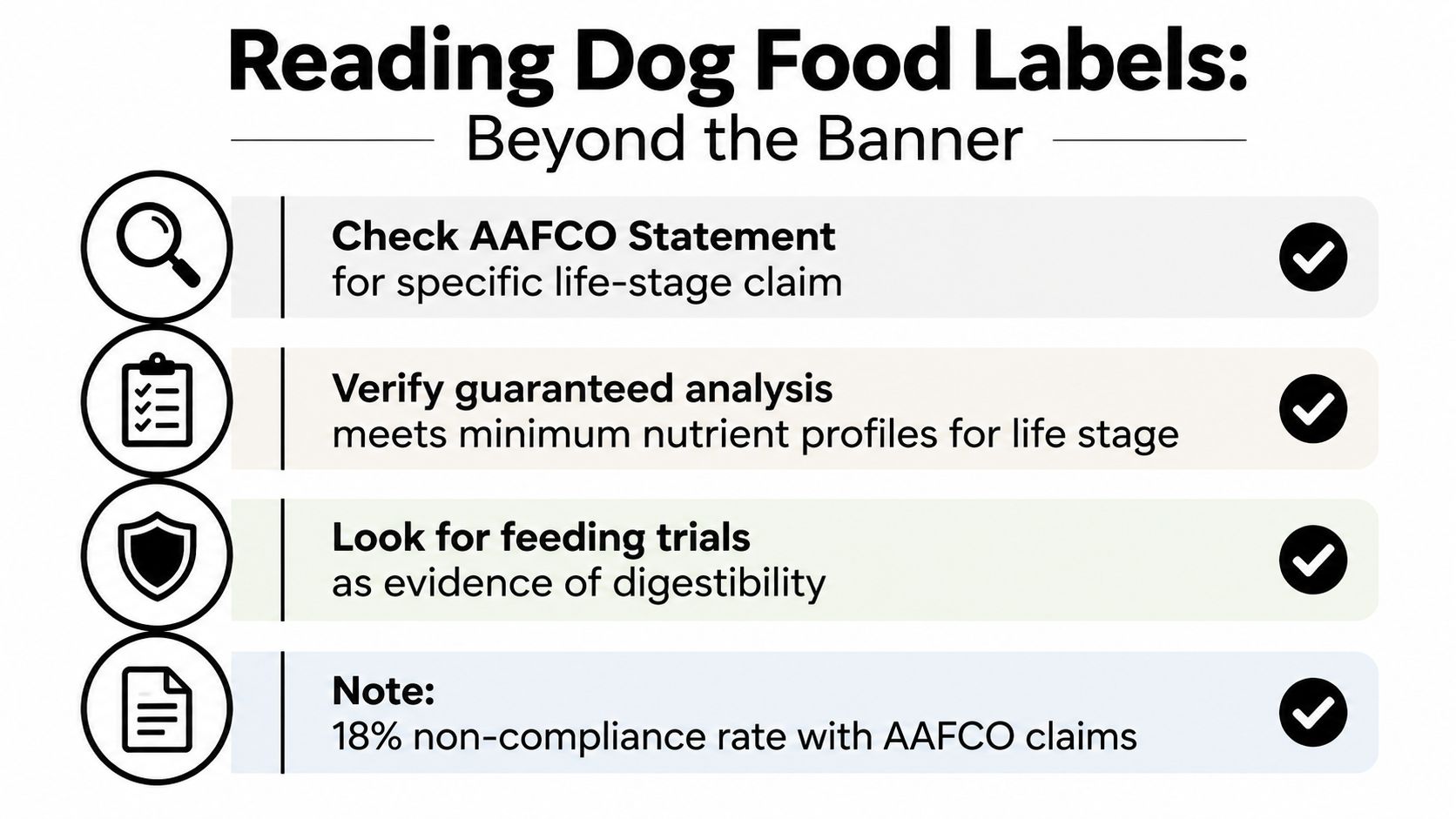
The word “puppy” on the front of a bag isn't enough. A recent analysis of commercial dog diets found that 18% of tested products failed at least one AAFCO adult-maintenance requirement, and nutrient variability was especially notable in fiber, fat, and energy density. The published analysis of commercial dog diets is a good reason to inspect the adequacy statement rather than trusting the banner.
The five-question aisle audit
- What life stage does the adequacy statement name? Look for growth and reproduction, adult maintenance, or all life stages. Don't infer adequacy from ingredient names.
- Does the formula match the dog's size? A large-breed puppy needs controlled growth nutrition, not just any calorie-rich puppy recipe.
- What is the calorie density? Compare the stated energy content before keeping the same scoop.
- Does the label disclose meaningful nutrient information? Protein and fat percentages matter, but they don't replace the full adequacy statement or mineral review.
- Is the food complete for the intended use? A topper, treat, or supplemental product isn't equivalent to a complete diet.
The same research also identified methionine plus cystine and vitamin D among nutrients most often missing minimum recommendations in adult canine foods. That finding matters because owners can't reliably spot those gaps from a front-of-bag claim.
Watch the video below for a visual explanation of label details.
For a more detailed label checklist, use picking the best dog nutrition. Ingredient quality still matters, but the regulatory adequacy statement answers the first question: was this formula designed and substantiated for the life stage you're feeding?
Owner Scenarios and Common Feeding Questions
My rescue dog came home after the first year. Should I use puppy food to make up for lost time? Usually, no. If the dog is physically mature, feed a complete adult-maintenance diet and focus on a veterinary exam, appropriate portions, and gradual adjustment. Puppy food doesn't repair an unknown past, and extra calories can worsen an already poor body condition if the dog is overweight.
My puppy and senior dog share a home. Can they eat the same food? Only if the label supports both life stages and the portions suit each dog. Otherwise, feed separately. A shared bowl makes it difficult to control mineral intake for the puppy or energy intake for the senior.
My working dog needs more energy. Should I keep it on puppy food? Not automatically. Choose a complete diet that matches the dog's activity and monitor body condition. A mature working dog may need a different energy strategy than a growing puppy, even if both are active.
Should I switch immediately after spaying or neutering? No. Reassess appetite, activity, and weight after the procedure, then adjust portions or formula as needed. The operation can change feeding needs, but it doesn't erase the dog's developmental stage.
Should a healthy adult stay on puppy food for a shinier coat? I wouldn't. A healthy adult should receive a complete maintenance diet unless a veterinarian has a specific reason to choose otherwise. More fat or calories isn't a free coat upgrade, and weight gain places unnecessary stress on joints.
Can I free-feed? Meal feeding is the safer default because it lets you measure intake and notice appetite changes. Free-feeding is especially poor practice for food-driven puppies, dogs gaining weight, and households with multiple pets.
Do treats count? Yes. Treats contribute energy, so reduce the main meal when treats become a regular part of training or routine.
What if my dog needs a prescription diet? The medical diet takes priority over general life-stage marketing. Follow the prescribing veterinarian's instructions and don't add supplements or switch formulas without checking first.
The bottom line is firm: keep puppies on a complete growth diet while they're actively developing, choose controlled nutrition for large and giant breeds, and move mature dogs to an adult formula when body condition and growth pattern support it. Don't let a birthday, a glossy label, or a desire for a shinier coat make the decision for you.
Joyfull develops pet wellness products with clean ingredients, high-quality proteins, and veterinary review, giving you another option to consider alongside a complete, life-stage-appropriate diet. Visit Joyfull to explore products that can fit into a practical pet wellness routine.
0 comments