


You're standing in the pet aisle with two nearly identical bags in your hands. Both say turkey in large letters. One feels like a simple strip of dried meat. The other is a soft, shaped bite with several ingredients, a flavoring statement, and a calorie count you need to search for. Your dog would probably eat either one. The harder question is whether either one fits your dog's health, diet, and daily calorie budget.
Turkey dog treats can be a useful source of animal protein, but the word turkey doesn't tell you everything that matters. Processing, fat content, moisture, calorie density, ingredient sourcing, and your dog's individual history all change the decision. Turkey isn't automatically hypoallergenic, and a dried treat labeled “lean” may still deliver concentrated calories.
Table of Contents
- What Turkey Dog Treats Actually Are
- The Nutrition Profile Behind the Label
- Allergies, Sensitivities, and the Chicken Myth
- Making Turkey Treats at Home
- How to Evaluate Store-Bought Turkey Treats
- Feeding Guidelines and Portion Control
- Storage and Shelf-Life Best Practices
- A Vet-Aligned Approach to Choosing Turkey Treats
What Turkey Dog Treats Actually Are
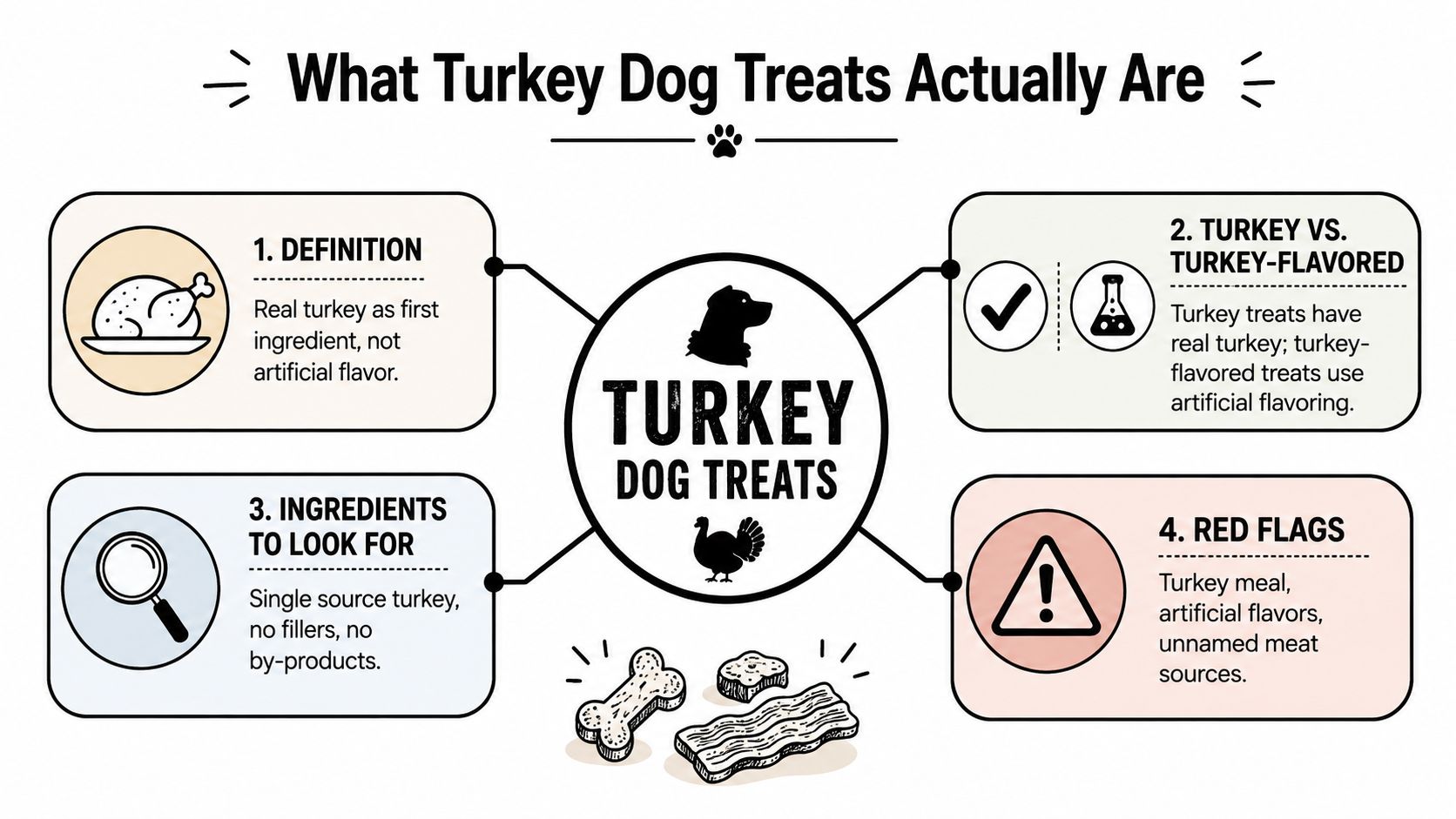
A turkey dog treat is defined by more than its flavor name. It may be made from turkey muscle meat, organ meat, ground poultry parts, turkey meal, or rendered ingredients, then shaped or preserved as a strip, training bite, chew, topper, or jerky-style snack. Processing can include dehydration, freeze-drying, baking, smoking, or freezing.
That distinction matters in the aisle. A bag that lists turkey as a named ingredient gives you more useful information than one that promises “turkey flavor.” The first tells you that the recipe includes turkey. The second may contain flavoring while relying on another meat source for most of the treat.
The protein source changes the treat
A single-ingredient turkey treat is usually straightforward to evaluate. If the ingredient list contains only turkey, you know the principal food source, although you still need the guaranteed analysis and calorie information. A short recipe might add a binder or carbohydrate such as oat flour, while a highly processed product could include glycerin, flavorings, sweeteners, or several unnamed animal ingredients.
The physical form also suggests how you might use it:
- Small training bites work well when you need frequent rewards and can account for each piece.
- Strips and jerky suit larger rewards or dogs that prefer something to chew, but they can be harder to portion precisely.
- Dental chews serve a different purpose and shouldn't be judged only by their turkey content.
- Toppers can add palatability to a meal, though they still contribute calories.
- Raw or frozen formats require stricter food-safety handling and aren't appropriate for every dog.
Practical rule: Treat “turkey” as the beginning of your label review, not the conclusion.
The category has meaningful commercial momentum. Turkey pet snacks and treats in Türkiye were estimated at USD 296.92 million in 2024 and are projected to reach USD 675.23 million by 2033, with a projected 9.61% CAGR from 2025 to 2033, according to Turkey pet snacks and treats market data. Dogs are identified as the largest segment, which supports turkey's role in mainstream dog biscuits and high-protein treats rather than only specialty products.
The nutrition deep dive is where the biggest surprises appear. Two treats can both feature turkey and still differ sharply in protein, fat, moisture, processing, and calories.
The Nutrition Profile Behind the Label
The front of a package may make turkey sound like a complete nutritional description. It isn't. Actual product analyses show how widely turkey dog treats can vary: one lists 41.2% crude protein, 26.3% fat, and 7.9% moisture, while another lists 63.3% protein, 13% fat, 5.1% moisture, and 4.6% fibre, as shown in these turkey treat product analyses.
Those figures describe the finished treats, not fresh turkey. Dehydration and freeze-drying remove water, so the remaining protein and calories become more concentrated by weight. A small piece may look insignificant while containing far more nutrition than its size suggests.
A label-reading comparison
| Treat Type | Protein % | Fat % | Moisture % | Calories per Piece (avg) | Best Use |
|---|---|---|---|---|---|
| Dehydrated turkey treat | 41.2% | 26.3% | 7.9% | Not stated | Occasional reward or larger chew |
| High-protein turkey training treat | 63.3% | 13% | 5.1% | Not stated | Frequent training when portioned carefully |
| Freeze-dried turkey treat | Not stated | Not stated | Low | About 3 kcal per piece | Small rewards, if the label confirms calories |
| Dehydrated turkey snack | Not stated | Not stated | Low | 18.36 kcal per treat | Larger rewards, with strict piece control |
The last two examples come from consumer guidance on turkey treats and calorie density, which highlights the practical problem. A freeze-dried piece may contain about 3 kcal, while another dehydrated snack contains 18.36 calories per treat and more than 2,800 kcal/kg. “Turkey” and “dried” don't provide enough information to estimate a safe serving.
What to ask the guaranteed analysis
Look for three figures:
- Protein minimum, which helps you assess the treat's contribution from an animal-protein perspective.
- Fat maximum, particularly if your dog has a history of digestive upset, weight gain, or pancreatitis risk.
- Moisture, which helps explain why a low-moisture product may be more concentrated.
Organ content can also change the nutrient profile. A treat made with muscle meat won't necessarily resemble one made with organ meat or ground whole poultry parts. That's why the ingredient list and guaranteed analysis need to be read together, rather than treating a front-of-package protein claim as a complete health assessment.
Plain turkey is often well tolerated and digestible, but tolerance depends on the whole recipe. A source discussing turkey ingredients reports protein digestibility for dogs and cats at 85% to 90%, while a separate digestibility assessment of a turkey-based recipe measured 82.9% total tract digestibility, 91.9% protein digestibility, and 95.2% fat digestibility. Those figures are cited in this turkey ingredient analysis. They shouldn't be interpreted as a guarantee for every turkey treat, especially when skin, seasoning, or added fat changes the formula.
Allergies, Sensitivities, and the Chicken Myth
Many owners switch from chicken to turkey because they've heard that turkey is the safer poultry protein. That assumption is too broad. Turkey can cause an allergy or intolerance, and a dog that reacts to chicken isn't automatically protected by changing to another bird.
An allergy involves an immune response to a protein. An intolerance may instead appear as digestive upset, though individual dogs can show overlapping signs. Itchy skin, recurrent ear problems, or hot spots may point toward an allergic process, while vomiting, loose stool, gas, or appetite changes can suggest poor tolerance. These signs have many possible causes, so a treat swap alone can't establish the diagnosis.
The key buying question is whether turkey is novel for your dog, not whether turkey sounds lean or gentle. Independent guidance also cautions that dogs allergic to one poultry protein aren't automatically safe with another, as explained in this overview of whether dogs can eat turkey.
When turkey is a poor substitute
If your dog already eats turkey in the main diet, a turkey treat isn't a novel-protein test. The same applies when a product contains chicken fat, poultry meal, mixed animal proteins, or vague flavorings that make the source unclear.
For a suspected food allergy, veterinarians commonly use a controlled elimination diet with a novel protein or a hydrolyzed formula. The dog must receive the selected diet without other treats, table food, or flavored medications during the trial. Your veterinarian should guide the process, especially when skin disease, ear disease, chronic digestive signs, or weight loss are involved.
Venison, rabbit, or hydrolyzed formulas may be more logical options than moving from chicken to turkey, depending on what your dog has eaten before and what your veterinarian is testing.
For practical ingredient screening, the Joyfull pet food label tips can help you look beyond the large protein name on the front of a package. Check every ingredient for poultry sources, because a product marketed as turkey may still include another bird protein.
Making Turkey Treats at Home
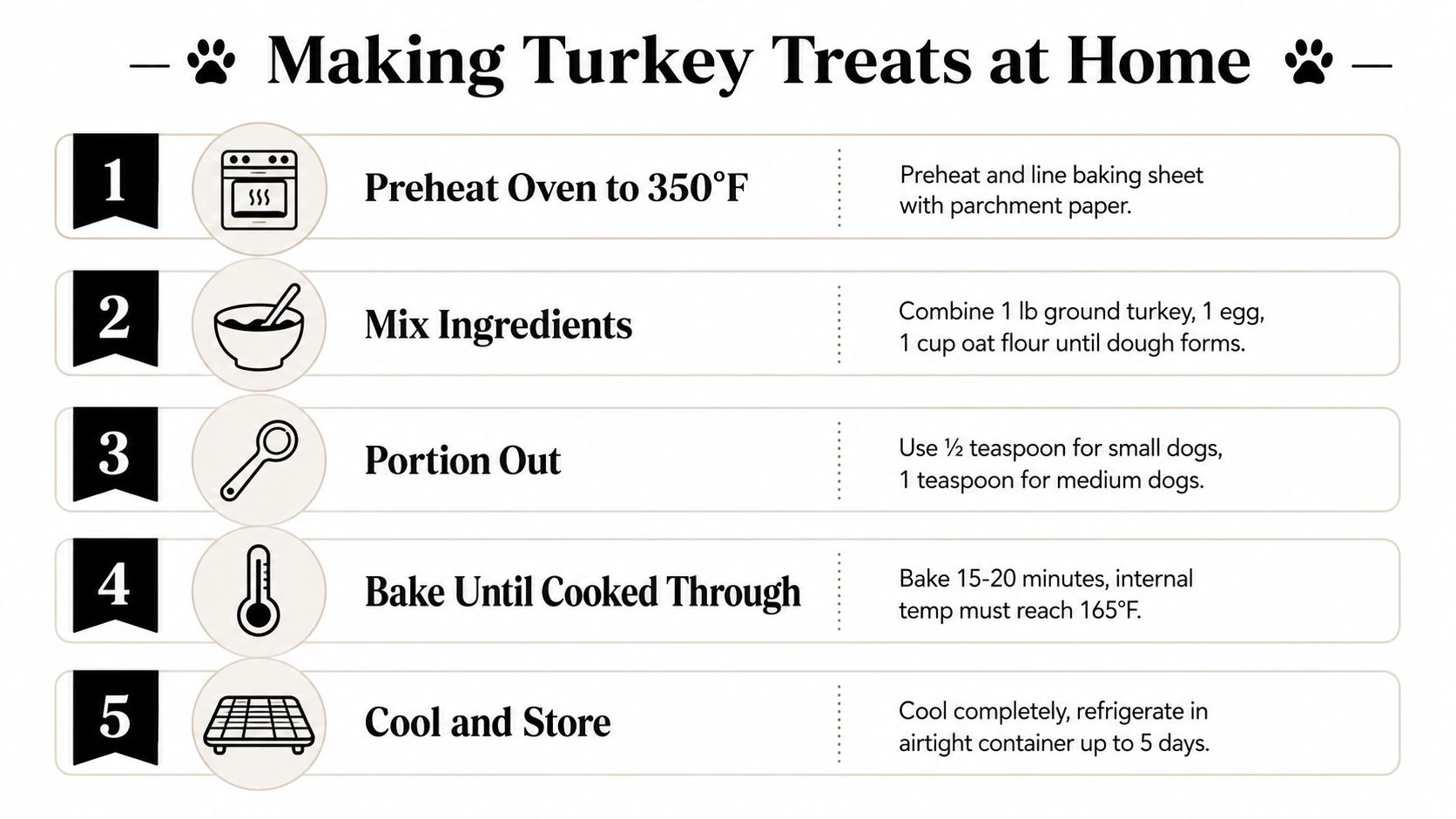
Homemade treats can make ingredient control easier, but they don't remove the need for food safety or portion discipline. A simple baked recipe uses one pound of ground turkey, one egg, and one cup of oat flour, mixed into a dough and portioned into small bites.
A simple preparation method
- Preheat the oven to 350°F and line a baking sheet with parchment.
- Combine the ground turkey, egg, and oat flour until the mixture forms a workable dough.
- Portion the dough into small pieces. The supplied recipe guide suggests ½ teaspoon for small dogs and 1 teaspoon for medium dogs. Larger dogs can receive larger pieces, but their daily calorie budget still matters.
- Bake for 15 to 20 minutes, checking that the internal temperature reaches 165°F.
- Cool the treats completely before placing them in an airtight container.
A dehydrated version can be made by spreading thin portions and drying them at 170°F for 3 to 4 hours, but the final texture and safety depend on thickness, moisture removal, and the reliability of your equipment. Refrigerate or freeze homemade treats rather than assuming they're shelf-stable.
Before cooking, wash your hands and keep preparation surfaces separate from those used for human food. Never add onion, garlic, xylitol, or seasoning blends. Deli turkey and pre-seasoned ground turkey are poor choices because they can contain ingredients and sodium levels that aren't appropriate for dogs.
Introduce the new treat gradually over several days. Watch stool quality, appetite, vomiting, itching, and ear irritation. If symptoms appear, stop the treat and speak with your veterinarian instead of adding more ingredients to “balance” the recipe.
For another clean-ingredient approach, see these wholesome dog snacks from scratch.
Here's a visual walkthrough of the preparation process:
How to Evaluate Store-Bought Turkey Treats
A veterinarian reading a treat label usually starts with the ingredient list, not the marketing claim. Find the named protein, inspect the first several ingredients, then compare the guaranteed analysis with the intended use.
A label beginning with turkey, pea flour, glycerin describes a different product from one beginning with meat by-product, wheat, sugar, smoke flavor. The first example gives you a named poultry source and identifies the supporting ingredients. The second leaves the principal animal source less clear and adds several ingredients that may contribute more to texture and palatability than to the protein profile you expected.
A practical label comparison
| Criterion | Clean-Ingredient Treat | Typical Ultra-Processed Treat |
|---|---|---|
| Named protein | Turkey appears clearly as the main animal ingredient | Generic meat or meat by-product may appear first |
| Supporting ingredients | Short list such as pea flour or glycerin | Wheat, sugar, smoke flavor, and multiple additives |
| Flavor statement | Real turkey identified in the ingredient list | Turkey may appear mainly as a flavor claim |
| Preservatives and colors | Fewer unnecessary additives | May include artificial colors or preservatives |
| Nutrition review | Protein, fat, moisture, and calories are easy to locate | Calorie density may be harder to interpret |
| Sourcing | Country or inspection information is stated | Origin may be unclear |
Watch for BHA, BHT, propylene glycol, artificial colors, and unnamed meat sources. Their presence doesn't tell you the entire safety story by itself, but it does give you a reason to ask why each ingredient is there.
Ingredient splitting can also make a recipe appear more meat-heavy than it is. Manufacturers may list pea flour, pea protein, and pea fibre separately, so each appears lower on the list even though they come from a related ingredient family. You don't need to reject every treat containing plant ingredients. You do need to read the list as a whole.
The dog food label decoding guide provides a useful framework for checking ingredient order, analysis, and marketing language. For turkey treats, the essential comparison remains simple: identify the protein, check fat and moisture, and find calories per piece or per kilogram.
Feeding Guidelines and Portion Control
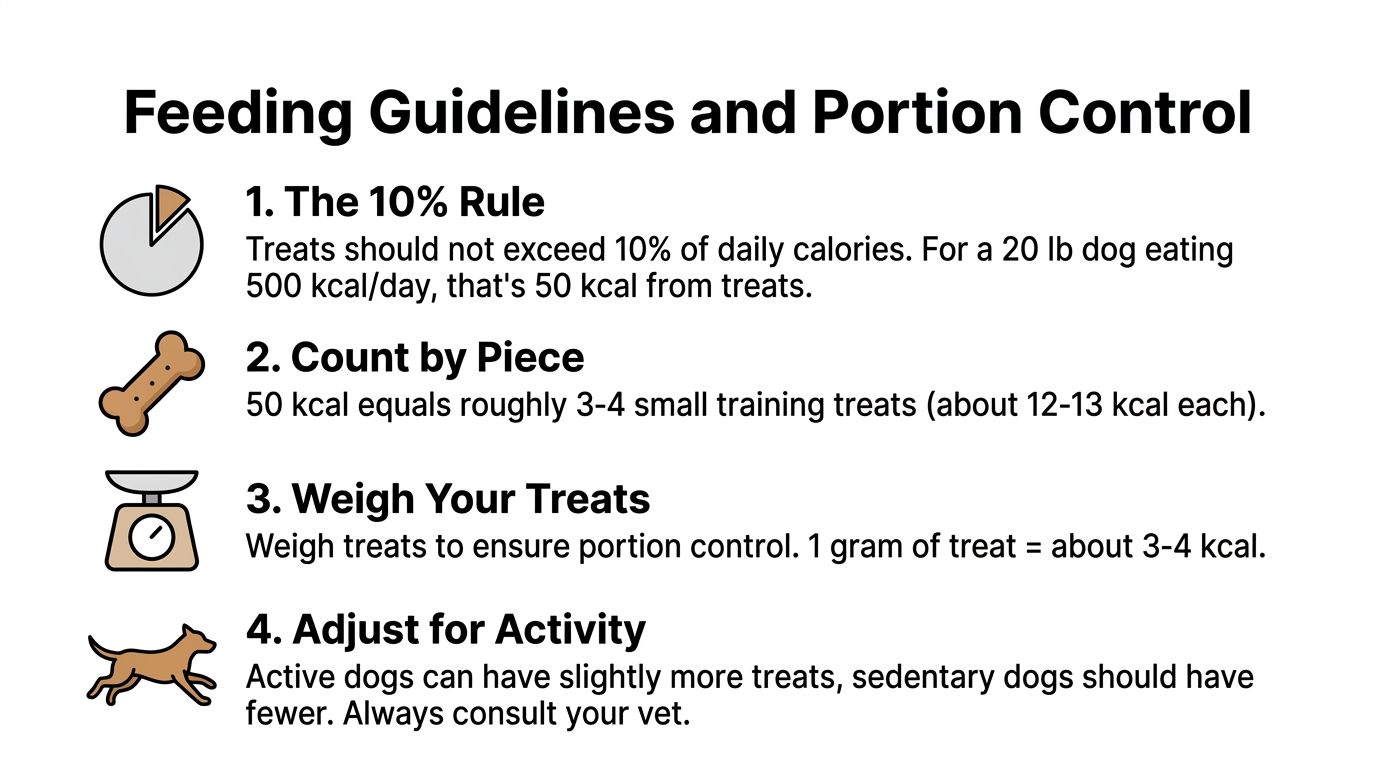
A turkey treat can fit a healthy diet, yet its calories still count. Veterinary nutrition guidance commonly keeps treats below 10% of daily calories, a principle also reflected in turkey feeding guidance.
Use this formula:
Daily calories × 0.10 ÷ calories per treat = maximum treat pieces per day
For the example in the product guidance, a 20-pound dog eating 500 kcal per day has 50 kcal available from treats. That could equal roughly 3 to 4 small training treats, or about 8 grams of dehydrated turkey, depending on the product. These figures illustrate the calculation, not a universal portion for every dog.
Match the reward to the job
Training usually benefits from tiny, frequent pieces. Reserve larger strips for occasional rewards, and break them before training starts. That removes guesswork when your dog is excited. Dried turkey can be calorie-dense because removing water concentrates its nutrients, so a small piece may provide more calories than its size suggests.
If treats add substantial energy, reduce the regular meal slightly with veterinary guidance rather than feeding both portions unchanged. Puppies need rewards compatible with their growth diet and developing digestion. Seniors may manage softer pieces better when dental disease or missing teeth makes jerky difficult to chew. Dogs carrying excess weight need smaller portions and a defined calorie plan, regardless of whether the package uses a healthy-sounding label.
Weigh your dog regularly under consistent conditions and use weight change as feedback. A rising trend calls for fewer treat calories and a discussion with your veterinarian. Portion control is not only about the number of pieces. It is also about accounting for how concentrated the food becomes after drying.
Storage and Shelf-Life Best Practices
A turkey treat's storage life depends on moisture, oxygen, and temperature. Drying reduces moisture, but it doesn't make fat immune to oxidation or eliminate every storage concern. A treat can lose quality even before it develops an obvious spoilage odor.
Commercial packaging may provide useful protection through resealable closures, oxygen absorbers, or nitrogen flushing. The package only helps if you close it after each serving and keep it away from heat and humidity.
Choose storage by the product
| Method | Shelf-Life | Best For | Watch Out For |
|---|---|---|---|
| Sealed pouch at room temperature | 7 to 10 days | Commercial dry treats in a cool home | Heat, humidity, and poor resealing |
| Refrigerated container | 2 to 3 weeks | Opened dry treats and homemade batches | Condensation and moisture entering the container |
| Vacuum-sealed frozen portions | Up to 6 months | Bulk purchases and homemade treats | Freezer burn and repeated thawing |
These storage windows come from the supplied storage guidance and should be treated as practical targets, not guarantees for every recipe or package. Always follow the manufacturer's instructions if they're more conservative.
If your home stays below 70°F and the bag reseals securely, room storage may be reasonable for less than a week. Otherwise, refrigerate the treats. Homemade jerky should be refrigerated or frozen because it lacks the preservation system used in commercial products.
Rancid fat often smells stale, sharp, or paint-like. Discard treats with an unusual odor, visible mold, dampness, or a change in texture. A premium package is only useful when you handle it properly, so reseal the bag immediately instead of leaving it open beside the training pouch.
A Vet-Aligned Approach to Choosing Turkey Treats
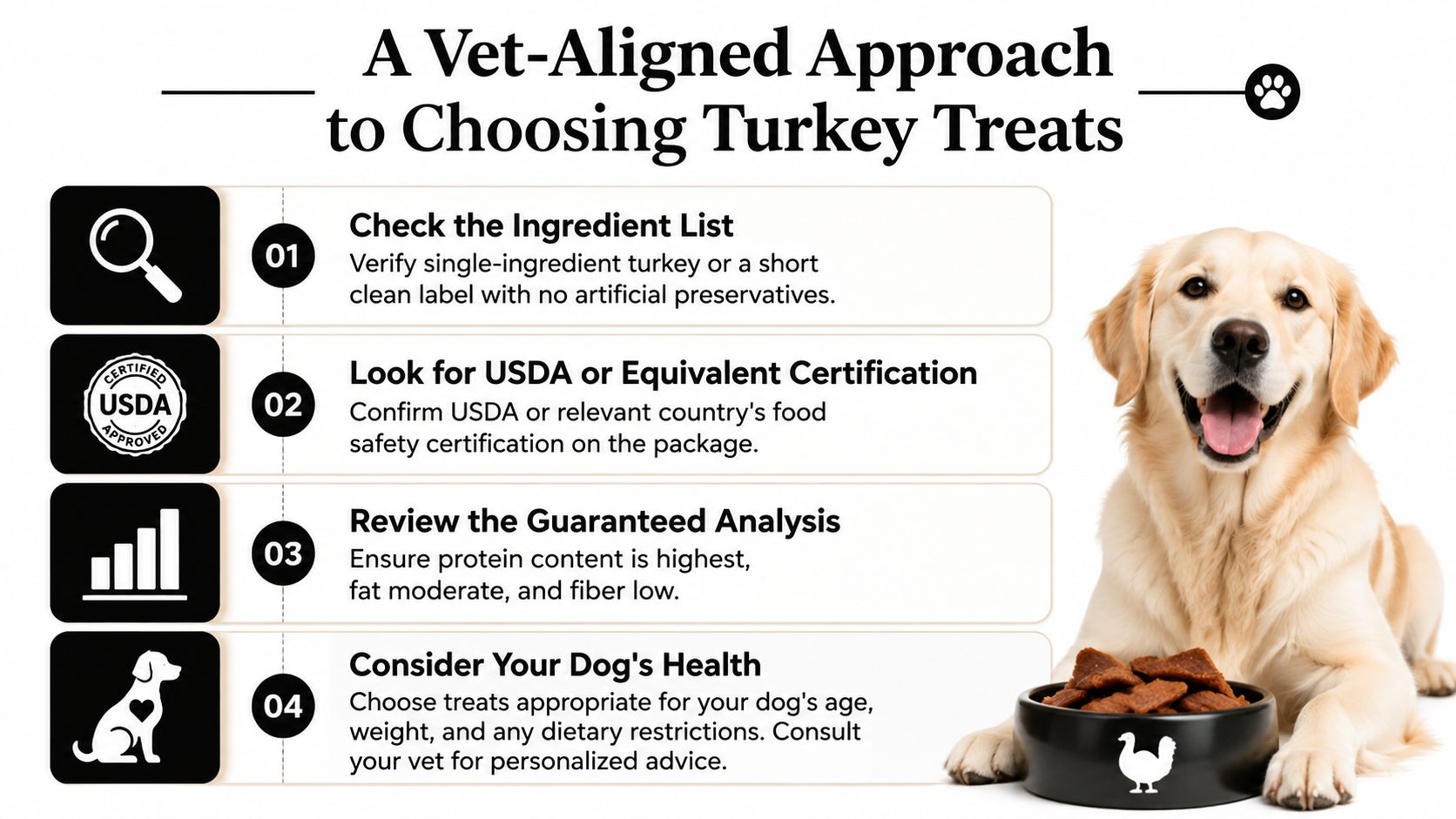
A repeatable process beats attractive packaging. In the store, make four checks before buying:
- Read the first three ingredients. Look for a clearly named turkey source and decide whether the recipe is short enough for you to understand.
- Check the origin statement. USDA or equivalent food-safety information can improve traceability, but it doesn't make every product nutritionally suitable.
- Calculate the daily allowance. Use calories per piece or kcal/kg, then keep the total within your dog's treat budget.
- Assess the package. Choose a format you'll reseal, refrigerate, or freeze correctly.
Clean-ingredient treats are a practical default because they reduce common sources of confusion, including vague animal ingredients, undisclosed fillers, and unclear protein mixtures. That doesn't mean every single-ingredient jerky is ideal. These treats can cost more per ounce, smell stronger, and become too dense or difficult for dogs with dental disease.
Joyfull is one option for owners who want pet wellness products made with clean ingredients and high-quality proteins, with formulas undergoing scientific review by an in-house veterinary advisor. The useful standard isn't brand loyalty. It's whether the product gives you enough information to make a sound choice for your own dog.
Screenshot checklist: Check the first three ingredients, confirm the country of origin, calculate pieces per day from the calorie statement, and reseal the bag immediately.
For dogs that spend time outdoors, owners may also want to review practical surfaces designed for easier cleanup, such as pet-friendly artificial grass, especially when treats are used during outdoor enrichment or training.
Joyfull offers clean-ingredient pet wellness products built around high-quality proteins and veterinary review, giving you another place to compare ingredients and product purpose. Visit Joyfull to explore options and keep your dog's treats aligned with their health needs, calorie budget, and daily routine.
0 comments