


You're standing in the pet aisle with a bottle of calming chews in one hand and a digestive powder in the other. Your dog has been scratching more than usual, or your cat has started turning away from dinner, and every label seems to promise a healthier, happier life. The difficult part isn't finding options. It's deciding which pet wellness products solve a real need, which add another layer of marketing, and which might be unnecessary for your individual pet.
Wellness works best as a set of preventive habits, not a shopping list. Good nutrition, dental care, grooming, enrichment, exercise, and veterinary attention form the foundation. A supplement or functional product can fill a specific gap, but it shouldn't replace diagnosis, a complete diet, or professional care. This guide will help you understand the main categories, read labels more intelligently, assess evidence, and create a practical routine for either a dog or a cat. If you're ready to compare options, you can browse pet wellness supplies with a clearer sense of what your pet needs.
Table of Contents
- Introduction to Pet Wellness Products and Why They Matter Now
- What Pet Wellness Products Are and How They Support Daily Health
- The Five Core Categories of Pet Wellness Products Explained
- How to Evaluate Evidence Ingredients and Quality Before You Buy
- Vet Verified Safety Tips and a Smart Selection Checklist
- How JoyFull Fits Into a Simple Pet Wellness Routine With Real Examples
- Building Your Pet Wellness Plan and Next Steps
Introduction to Pet Wellness Products and Why They Matter Now
A cat skips breakfast, a dog starts licking its paws, and the pet aisle offers a product for nearly every concern. Some choices support a daily routine. Others add cost without addressing the root problem. Pet wellness products make sense when they serve a clear purpose alongside suitable food, hygiene, activity, enrichment, and veterinary care.
The category includes practical tools and functional products, from dental chews and grooming tools to food toppers and supplements. Their value depends on the job they perform. A grooming tool may prevent painful mats, while a topper may help a picky pet eat more consistently. A supplement may support a defined need, but it cannot diagnose illness or repair an unsuitable diet.
Wellness products aren't automatically health products. A soft chew can be easy to give, yet convenience does not show that it works. A short ingredient list may look reassuring, but it does not confirm an effective amount. A higher price may reflect careful formulation, or premium packaging. Labels need the same practical test as any household tool: what does it do, and is that function useful for this pet?
The market has grown as owners place more attention on prevention and everyday comfort. Independent industry reporting estimates the global pet care market at USD 190.5 billion in 2026, with a projection of USD 283.7 billion by 2033, representing a projected 5.9% CAGR over that period. Pet health products alone are estimated at USD 14.5 billion in 2026 and projected to reach USD 27.7 billion by 2033, with a faster projected 9.6% CAGR, according to Grand View Research's pet care market analysis.
The useful question isn't “What's trending?”
Ask, “What problem am I trying to solve, and how will I know whether this product helps?” Recurring digestive symptoms in a cat call for veterinary attention, not just a supplement. Stiffness in an older dog may justify discussing joint support, while still requiring assessment. Cats also have gaps that are easy to miss, including hydration, dental care, enrichment, and protein they can digest comfortably.
A healthy pet eating a complete diet may not need extra products. Start with one identifiable need, check the label, and watch the response. If you are comparing options, browse pet wellness supplies with that purpose in mind.
What Pet Wellness Products Are and How They Support Daily Health
Pet wellness works like a three-level pyramid. The broad base supports everything above it, while the upper levels address more specific needs. If nutrition and daily care are unstable, adding more products will not create a reliable plan.
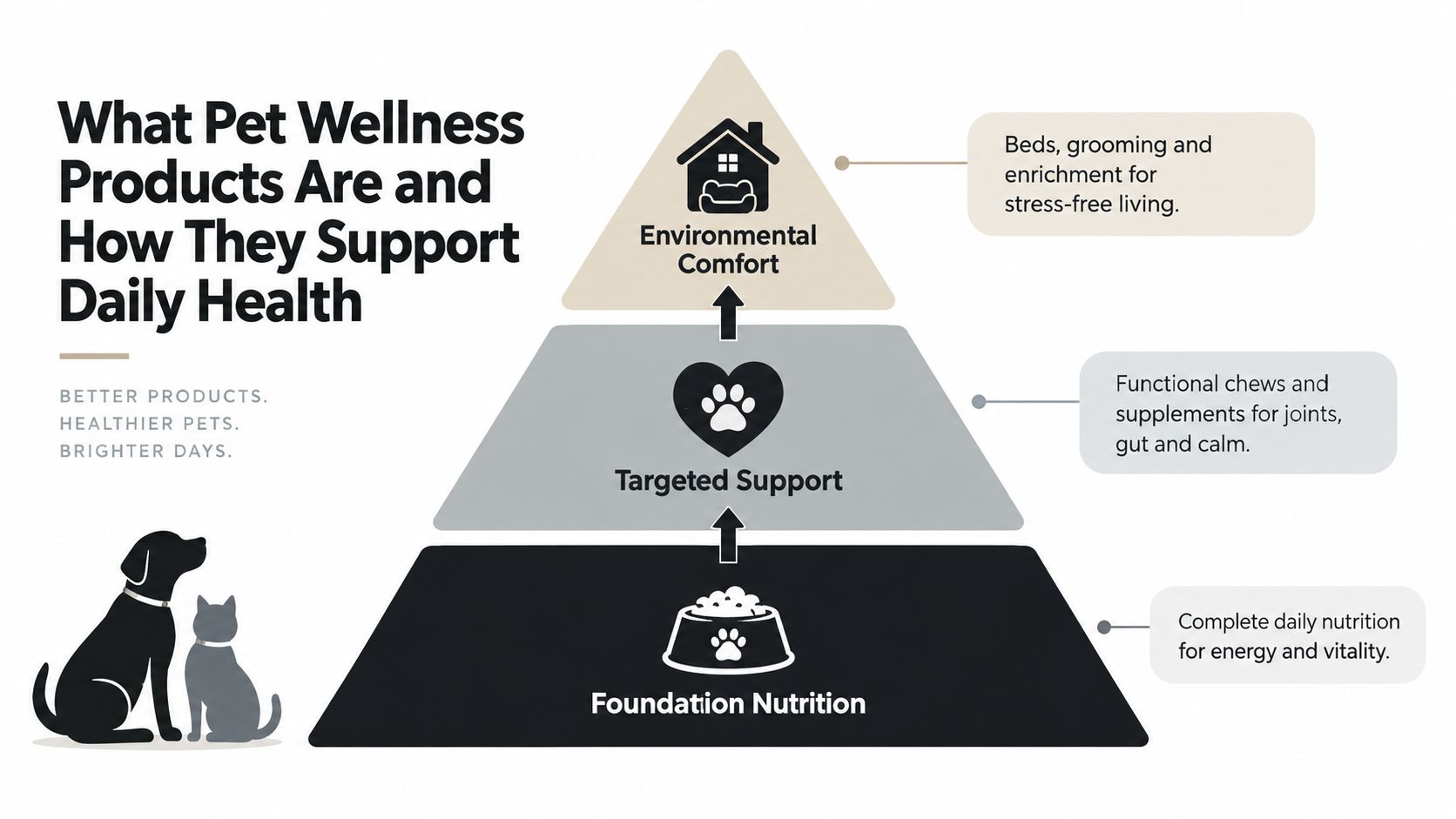
The foundation is complete nutrition
At the bottom sits a complete, suitable daily diet. Food supplies energy and nutrients, and it should match the animal's species, life stage, and health needs. A supplement cannot correct food that is unsuitable or poorly tolerated. Treats, toppers, and chews also contribute to daily intake, so include them in the overall plan rather than treating them as invisible extras.
Protein deserves special attention, particularly for cats. Cats may need protein sources they can digest comfortably, and a long ingredient list does not prove that a food will suit an individual animal. Observe appetite, stool quality, body condition, and tolerance instead of choosing by marketing language alone.
A healthy pet already eating an appropriate complete diet may need no additional wellness product. Products add value when they solve an identifiable problem, fill a practical gap, or make a healthy routine easier to maintain.
Targeted support addresses a specific concern
The middle level includes supplements, nutraceuticals, functional foods, and products designed for a particular purpose. Examples include digestive support, joint support, skin and coat care, or calming routines. These options make more sense when the need is clear and the formula provides enough information for you and your veterinarian to assess it.
A daily routine shows how the levels work together. A dog might receive its complete food as the foundation, a measured topper for a defined digestive goal, and a supportive bed that encourages comfortable rest. A cat may benefit more from moisture in meals, a digestible protein source, a scratching area, and predictable feeding than from a generalized supplement.
Food-based support can also be easier to use than a separate product. A topper or chew may fit naturally into feeding or training, while a powder may suit a cat that refuses tablets. Choose the format your pet accepts consistently and that allows accurate serving.
Environmental comfort completes the picture
The top level includes beds, grooming supplies, enrichment, scratching resources, feeding tools, and other changes to the home. These items do not act like medication, but they can influence rest, movement, stimulation, stress, and hygiene. An older dog may settle better on a comfortable sleeping surface, while a cat may gain more from hiding spaces, climbing opportunities, and regular scratching.
Pet wellness products therefore support daily health in different ways. Food nourishes, targeted products supplement, and the environment makes healthy behavior easier. None should replace veterinary diagnosis or treatment. Start with the foundation, add support only for a clear purpose, and remove products that provide no observable benefit.
The Five Core Categories of Pet Wellness Products Explained
The easiest way to compare products is to start with the job they're meant to do. A dental chew isn't interchangeable with a probiotic, and a calming aid isn't a replacement for environmental enrichment. Dogs and cats can share broad wellness goals, but their preferences, feeding behaviors, and tolerances differ.
| Category | Primary Purpose | Common Formats | Best For |
|---|---|---|---|
| Nutrition and functional foods | Provide daily nourishment or add targeted dietary support | Complete foods, toppers, treats, chews | All pets, when matched to species and dietary needs |
| Supplements and nutraceuticals | Support a defined function such as digestion, joints, or calm | Powders, capsules, liquids, soft chews | Pets with a clearly identified support goal |
| Grooming and skin care | Maintain coat, skin, nails, and physical comfort | Brushes, shampoos, wipes, conditioners | Long-coated pets, shedding pets, and pets needing routine hygiene |
| Dental health | Help manage daily oral hygiene | Toothbrushes, dental chews, water additives | Dogs and cats that tolerate regular dental care |
| Behavioral and environmental aids | Encourage comfort, enrichment, and predictable routines | Beds, puzzles, scratchers, calming products | Pets affected by boredom, stress, restlessness, or home setup |
Nutrition and functional foods
Nutrition is the category with the broadest daily impact. A complete diet supports ordinary maintenance, while functional foods and treats may offer a narrower purpose. Dogs often accept chews and toppers readily, but cats can be more selective about texture, smell, and serving temperature. If a cat stops eating a familiar food after a new powder is added, palatability has become a practical health issue.
Supplements and nutraceuticals
Supplements are usually chosen for a specific objective. Digestive products may contain probiotics or prebiotics, while joint products often use combinations of functional ingredients. The label should identify the active ingredients and serving instructions clearly. Current reporting estimates that supplements and nutraceuticals represent 35% to 40% of total pet health and wellness market value in 2026, driven by interest in joint, digestive, and calming formulations, according to World Metrics' pet wellness industry summary.
For owners comparing pet probiotics for digestion, the key questions are whether the product identifies its strains, serving guidance, storage requirements, and quality controls. One example is the Probiotic Supplement for Cats - 30 Single-Serving Packets, which the catalog describes as containing real beef bone broth, veterinarian-formulated probiotic strains, two prebiotics, individual serving seals, and third-party testing for potency and purity.
Grooming, dental, and environmental care
Grooming products support cleanliness and comfort, but they can also reveal changes. A new odor, greasy coat, excessive licking, or sudden resistance to brushing may deserve attention rather than a stronger shampoo. Dental routines work best when introduced gradually, especially for cats and pets with sensitive mouths.
Environmental aids often deliver value without adding nutritional ingredients. A puzzle feeder, a suitable scratching surface, a quiet resting place, or a predictable bedtime routine can support daily wellbeing while reducing the temptation to supplement every behavior.
How to Evaluate Evidence Ingredients and Quality Before You Buy
The front of a package is written to attract attention. The back is where you make a decision. Look for a complete ingredient list, clear serving instructions, species and life-stage guidance, storage information, and a way to contact the manufacturer. A product that uses broad language but avoids quantities makes it difficult to judge what your pet will receive.
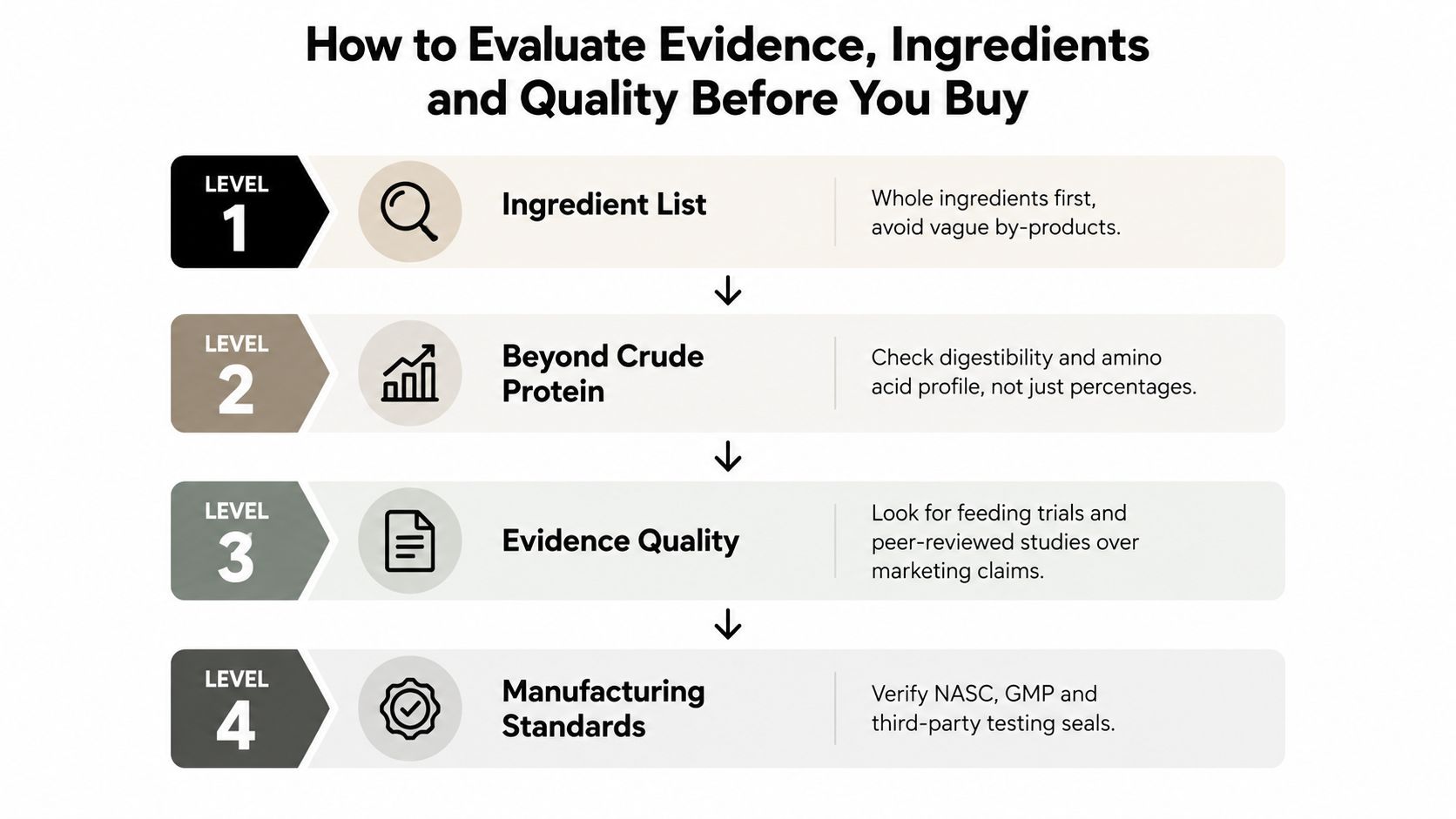
Protein quality starts with digestibility
Crude protein is a label measurement, not a complete description of nutritional value. A veterinary review in the Journal of the American Veterinary Medical Association explains that ingredient lists and guaranteed analysis don't reveal protein digestibility, amino-acid pattern, or bioavailability. As a result, two foods with the same labeled protein can provide different nutritional value, as discussed in the JAVMA review on protein quality.
Merck classifies digestibility below 80% as low, 80% to 85% as average, 86% to 93% as high, and above 93% as very high, based on the same veterinary evidence summary. These ranges are useful for understanding why a bigger crude-protein number isn't automatically better.
Practical rule: A protein percentage tells you how much is present on the label. Digestibility and amino-acid availability tell you how much the animal can use.
Highly digestible animal proteins, balanced amino acids, and validated digestibility are more informative formulation priorities than increasing crude protein. The same review notes that AAFCO nutrient-profile guidance relates minimum nutrient requirements to expected apparent digestibility, reinforcing the need to evaluate the usable nutrition behind the headline number.
Supplement evidence needs a closer look
For supplements, ask three separate questions. Is the ingredient plausibly relevant to the stated goal? Is there evidence for that ingredient in the target species? Does the product disclose a serving that can be followed accurately? Human wellness logic doesn't transfer automatically to dogs or cats.
Watch for proprietary blends that list ingredients without individual amounts, vague sourcing, unsupported promises, and labels that focus on “natural” language while offering little information about testing. For a plain-language explanation of how testing can verify identity, purity, or potency, consult this guide to third-party testing for shoppers.
Manufacturing quality matters because contamination, degradation, or inconsistent potency can undermine an otherwise sensible formula. Third-party testing can add useful information, but it doesn't prove that a product is necessary or effective for your particular pet. Quality and suitability are separate decisions.
Vet Verified Safety Tips and a Smart Selection Checklist
A safe selection process is deliberately boring. You check the match, confirm the serving, introduce one change, and watch what happens. That routine prevents a common mistake, adding several products at once and then having no way to identify which one caused an upset stomach, itching, or appetite change.
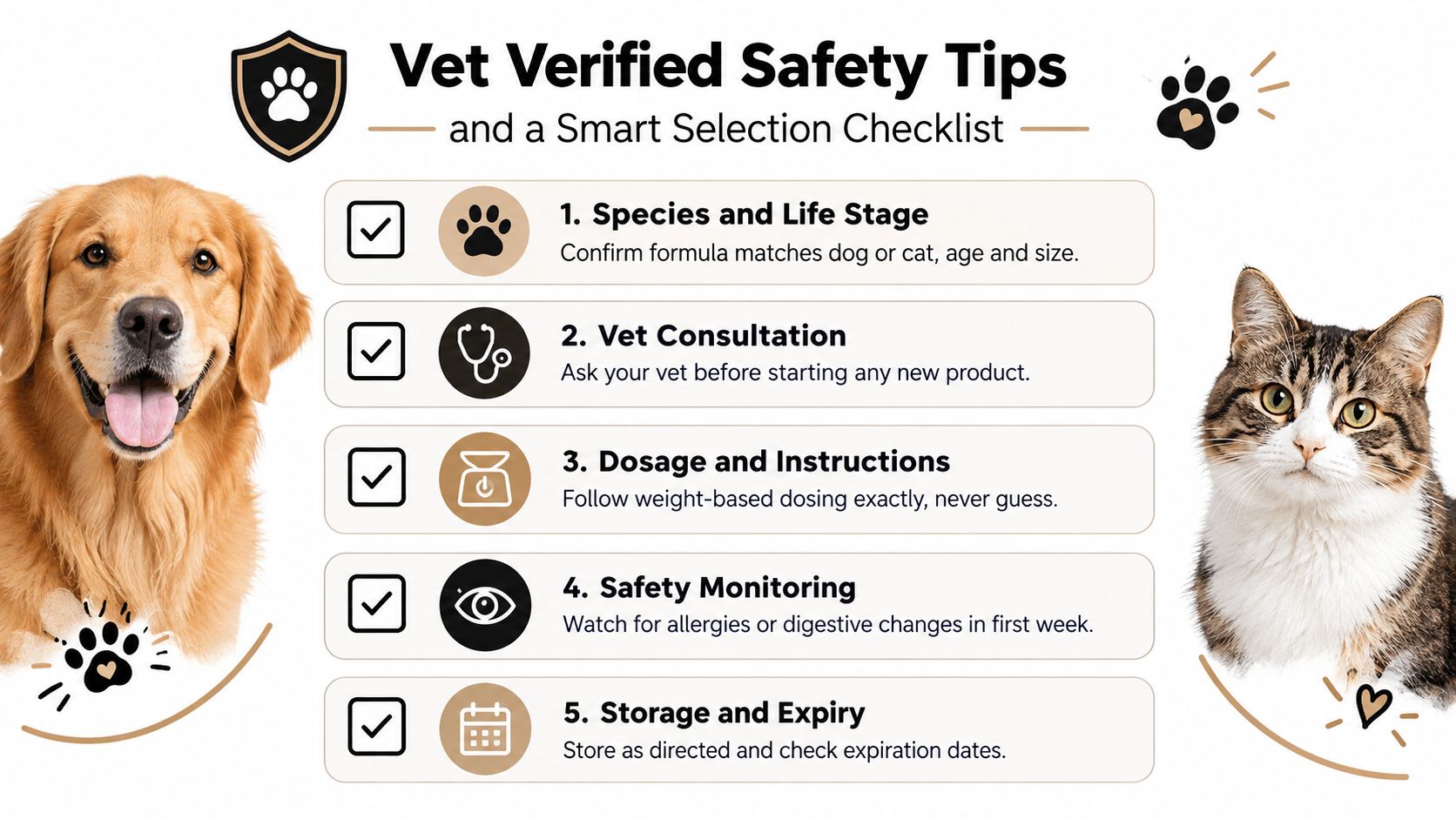
Use the five-question check
- Species and life stage: Confirm that the formula is made for your pet's species, age, and size. A product intended for dogs shouldn't be assumed safe for cats, and a product suitable for an adult may not fit a growing animal.
- Reason for use: Write down the problem you're addressing. “General health” is difficult to measure, while “support a sensitive digestive routine” gives you a clearer basis for choosing and monitoring.
- Dose and serving: Follow the label exactly, especially when dosing is weight-based. Don't estimate a cat's serving from a dog product or split a product unless the instructions support doing so.
- Veterinary review: Ask your veterinarian before starting a new supplement if your pet has a diagnosed condition, takes medication, is pregnant, is elderly, or has unusual symptoms.
- Response and storage: Introduce one product at a time, store it as directed, check the expiry date, and observe appetite, stool, skin, energy, and behavior.
Safety data can be incomplete even for familiar ingredients. A National Institutes of Health review reports that the NRC found insufficient quality safety data for ingredients including lutein, evening primrose oil, and garlic, relying instead on historical safe intakes and presumed safe intakes rather than modern toxicology datasets. The NIH review of veterinary pet supplements also highlights uncertainty around nutraceutical efficacy and the importance of species-specific dosing.
Cats need extra practical attention
Cats may reject a supplement because of smell or texture, and refusal can interfere with food intake. Multi-ingredient formulas also deserve caution because several active ingredients can create interaction or dosing concerns. If your cat has a narrow food preference, choose a format that can be offered without turning every meal into a struggle.
Keep a simple record of the product name, serving, start date, and any changes you notice. That information gives your veterinarian something more useful than a vague impression that “the supplement seems to help.”
How JoyFull Fits Into a Simple Pet Wellness Routine With Real Examples
A wellness routine doesn't need to contain a product for every possible concern. Consider a dog whose basic needs are already covered by a complete diet, daily movement, regular grooming, and veterinary care. The owner might use a dental product during a calm evening routine, offer enrichment through a food puzzle, and reserve a targeted supplement for a clearly identified need rather than adding several at once.
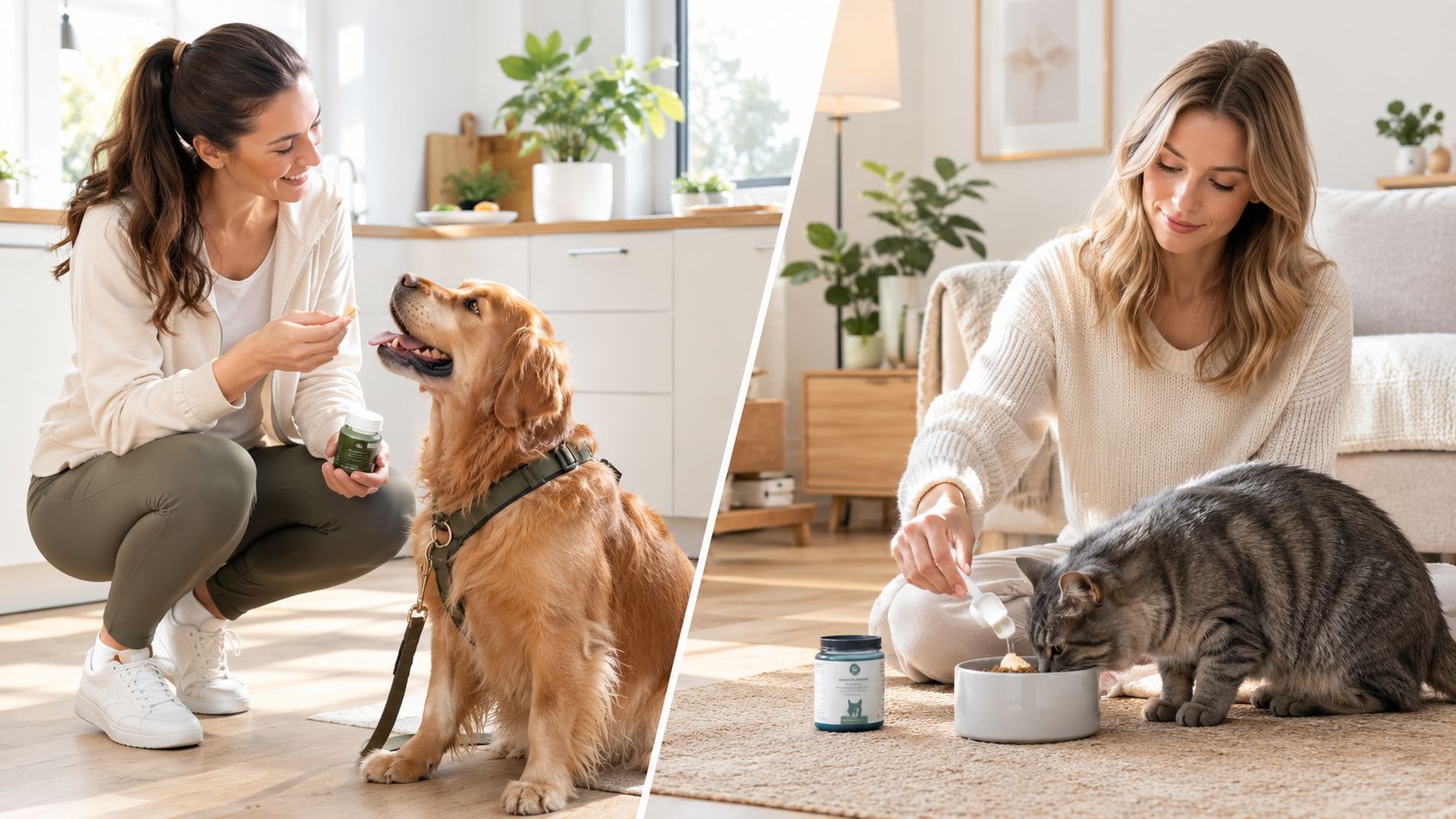
For a cat, the routine may look different. A complete diet remains the base, while fresh water, clean feeding areas, regular coat checks, scratching opportunities, and quiet resting spaces support everyday comfort. If digestive support is appropriate, a palatable powder may be easier than a tablet, but the owner should still introduce it gradually and monitor eating and stool quality.
JoyFull describes its approach as convenient, no-BS pet wellness, with clean ingredients, high-quality proteins, and scientific review by an in-house veterinary advisor. That philosophy fits the broader decision framework when the product has a defined purpose, transparent directions, and a place in a routine you can maintain. It doesn't mean every pet needs every JoyFull product.
The brand's catalog also includes prebiotics for dogs, a format that may fit naturally into a dog's existing treat routine. The practical question remains the same as it is for any wellness product: what need does it address, how will you serve it accurately, and what response will you track?
Cat-specific products deserve more attention as demand develops. One market report projects cat supplements to grow at a 7.2% CAGR from 2026 to 2033, while North America is identified as the largest overall market, according to Grand View Research's pet supplements analysis. Growth may create more options, but owners still need guidance on palatability, dosing, and whether a product adds value for an individual cat.
Building Your Pet Wellness Plan and Next Steps
A useful plan has three layers. First, check the foundation: appropriate nutrition, water, movement, sleep, hygiene, enrichment, and preventive veterinary care. Second, map the concern to the right category instead of reaching for a generalized supplement. Third, apply quality filters, including transparent ingredients, usable serving information, evidence appropriate to the species, and credible testing.
Start with a short audit of your current routine. Note what your pet already receives, the problem you'd like to address, and any medications or health conditions that could affect product choice. Then choose one high-value addition, introduce it as directed, and track a small set of practical observations such as appetite, stool, coat, mobility, or behavior.
If nothing changes, that's useful information too. A product that isn't necessary, tolerated, or measurably helpful may not belong in the routine. Wellness should remain simple, consistent, and suited to the individual animal, not driven by the pressure to buy everything at once.
JoyFull offers pet wellness products built around clean ingredients, high-quality proteins, and scientific review, including convenient options for targeted daily routines. Visit Joyfull to explore products and choose the next step that fits your dog's or cat's actual needs.
0 comments