


You notice it on an ordinary morning. Your dog gets up more slowly, pauses before the stairs, or skips the enthusiastic leap into the car. Later, after a walk, your companion may seem comfortable enough, but the change stays in your mind. Is it normal aging, temporary soreness, or the beginning of a joint problem?
Joint dog treats can be useful in a broader mobility plan, but they aren't a cure for arthritis, a replacement for veterinary care, or a guarantee of restored cartilage. Their value depends on the active ingredients, the amount delivered, the product's quality, and your dog's actual condition.

This guide separates ingredient popularity from clinical support. You'll learn how joint treats are supposed to work, why omega-3 fatty acids currently have stronger support than glucosamine and chondroitin, how to read a label without getting distracted by attractive packaging, and when a treat is the wrong tool altogether. The aim is simple, practical clarity, so you can make a thoughtful choice with your veterinarian rather than buy based on ingredient folklore.
Table of Contents
- Introduction to Joint Dog Treats and Why Mobility Matters
- What Joint Dog Treats Are and How They Work
- Key Active Ingredients Inside Joint Dog Treats
- What the Evidence Really Says About Efficacy
- How to Read Labels Dosing and Safety Essentials
- When to Consider Joint Dog Treats by Age and Condition
- How to Choose Clean High Quality Joint Dog Treats With Confidence
Introduction to Joint Dog Treats and Why Mobility Matters
A dog that hesitates on stairs may not look seriously ill. There may be no yelp, obvious swelling, or dramatic limp. Dogs often adjust their movement before owners recognize discomfort, which is why small changes matter: taking longer to rise, avoiding a favorite jump, shortening walks, or resting more after play.
Those signs don't identify a diagnosis by themselves. Stiffness can relate to osteoarthritis, an injury, body condition, activity changes, or another medical issue. A veterinarian can assess gait, joints, muscle condition, and pain more reliably than a supplement label can.
Treats are one part of joint care
Joint dog treats are best understood as daily delivery vehicles for selected nutrients. They may make a routine easier because many dogs accept a soft chew or flavored treat more readily than a capsule. That convenience matters only if the product provides clearly identified active ingredients in an amount appropriate for the dog.
A useful joint plan may also involve maintaining a healthy body condition, choosing controlled exercise, improving footing at home, using rehabilitation exercises, and discussing pain relief when needed. A treat can support that plan, but it can't replace the parts that address pain, movement, or excess load directly.
Practical rule: A treat is a delivery format, not proof that the ingredient inside it works.
What this guide will help you judge
Some formulas emphasize glucosamine and chondroitin because owners recognize those names. Others highlight omega-3s, collagen, green-lipped mussel, or botanical ingredients. The label may sound thorough while revealing little about the amount of each active or the evidence behind the combination.
You'll get a clearer way to compare them:
- Evidence: Which ingredients have meaningful clinical support in dogs?
- Transparency: Does the label state active amounts per treat and serving?
- Safety: Could the product conflict with your dog's condition or medication?
- Expectations: Are you prepared to assess gradual change rather than an overnight transformation?
That framework turns treat shopping from a search for a miracle into a manageable health decision.
What Joint Dog Treats Are and How They Work
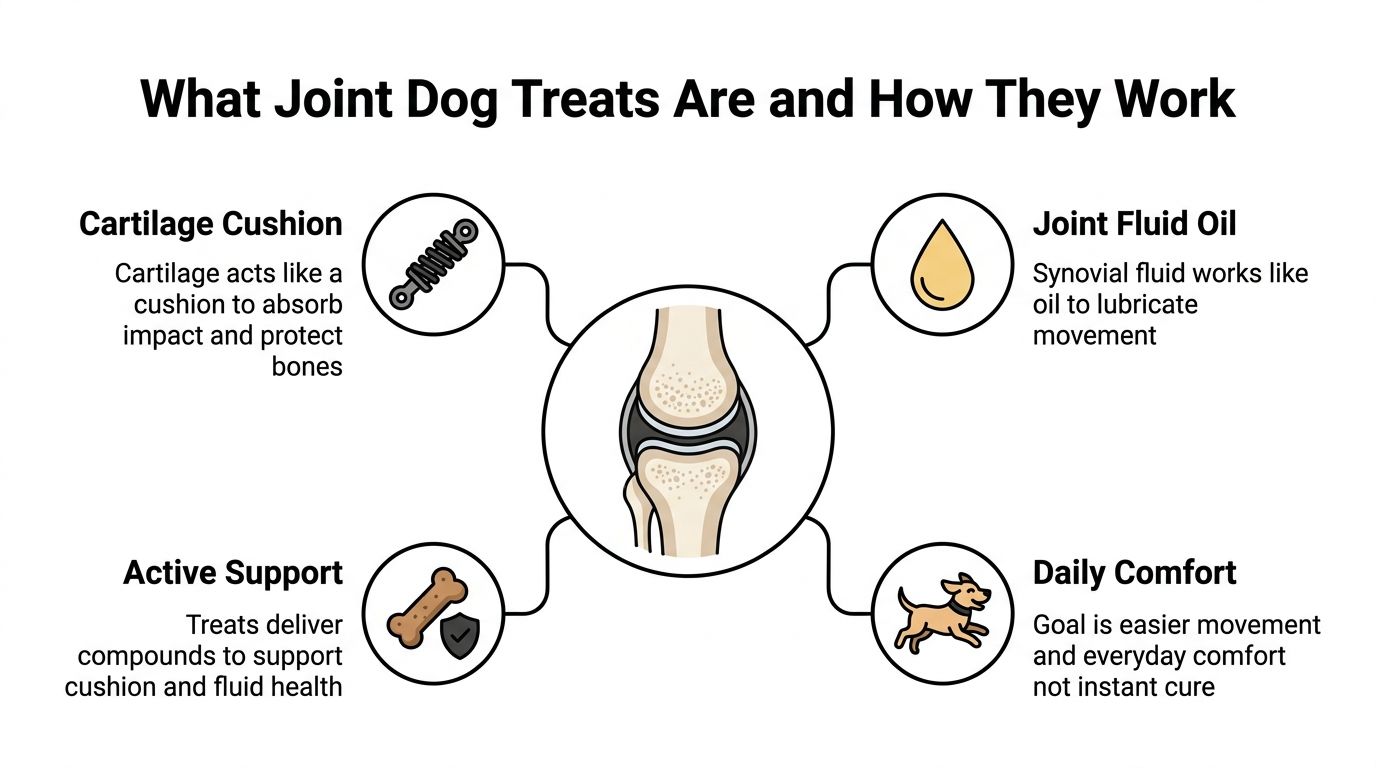
Think of a healthy joint as a smooth hinge. Cartilage acts as a cushioning surface, while synovial fluid helps the joint move with less friction. Muscles, tendons, ligaments, body condition, and normal movement all contribute to how comfortably that hinge functions.
Joint treats aim to support one or more parts of this system. Some ingredients are marketed for connective-tissue support, some for lubrication, and others for pathways involved in inflammation. Those are intended roles, not automatic outcomes. The body must absorb the compound, receive an appropriate amount, and respond in a way that produces a noticeable functional benefit.
Treats, chews, and capsules
A tablet or capsule separates the active ingredient from the reward. A chew combines the supplement with flavor, texture, and a serving routine. That can improve adherence for dogs that resist pills, but it can also create a formulation challenge. A treat has limited space for active ingredients, and flavoring, binders, and other components may occupy much of the serving.
Check whether the package tells you:
- What each active ingredient is
- How much appears per treat or daily serving
- How serving size changes with body weight
- Whether the formula uses a proprietary blend
- How the product should be stored and administered
The word “chew” doesn't tell you whether a formula is clinically meaningful. Nor does “natural,” “advanced,” or “complete.”
How gradual support differs from pain control
One early clinical trial involved 35 dogs with confirmed hip or elbow osteoarthritis. It compared an oral glucosamine hydrochloride and chondroitin sulfate combination with carprofen in a randomized, double-blind, positive-controlled, multicenter design. The supplement group showed statistically significant improvements in pain, weight-bearing, and disease severity by day 70, but its onset was slower than carprofen, as reported in the published canine osteoarthritis trial.
That distinction helps explain why owners may feel disappointed after a few servings. Joint treats aren't designed to act like an immediate prescription analgesic, and the evidence doesn't justify promising instant comfort. Their intended role is usually a consistent, supportive routine whose effect, if present, should be judged through movement and daily function.
For comparison, a separate product category may address a different body system entirely. The Probiotic Supplement for Cats - 30 Single-Serving Packets is described as a veterinarian-formulated cat supplement with clinically tested probiotic strains, real beef bone broth, two complementary prebiotics, and third-party testing for potency and purity. It isn't a joint product, which is precisely why matching the supplement to the health concern matters.
Key Active Ingredients Inside Joint Dog Treats
A dog may receive a treat every day, yet the ingredient panel still may not show whether that routine offers meaningful joint support. Read the label in two layers: first, identify each ingredient's claimed role; then ask how strong the evidence is for dogs and whether the product provides a useful amount.
Glucosamine and chondroitin are commonly added for cartilage and connective-tissue support. Their familiar names can make a formula seem purpose-built, but current evidence does not support treating this pair as dependable standalone pain relief.
MSM is usually included for connective-tissue and inflammatory support. Its value depends on the finished product, including the amount, purity, ingredient combination, and whether the formula itself has been evaluated. A name on the label cannot answer those questions.
Omega-3 fatty acids, especially EPA and DHA, have stronger clinical support than glucosamine and chondroitin in dog joint products. In a multicenter veterinary study, dogs fed an omega-3-enriched diet showed owner-reported improvement in rising from rest by 6 weeks and walking by 12 and 24 weeks. Their blood omega-3 concentrations also increased, according to the reported canine omega-3 study. A label that lists only “fish oil” without EPA and DHA amounts is difficult to assess.
Emerging ingredients need careful wording
Collagen, green-lipped mussel, and undenatured type-II collagen are promising areas, but their evidence remains incomplete. Eggshell membrane, hyaluronic acid, astaxanthin, and Boswellia also appear in multi-ingredient formulas. These additions may have a reasonable purpose, yet a long ingredient list is not the same as a proven outcome.
The evidence review of joint supplements describes the main evidence gap: glucosamine and chondroitin are often overstated, omega-3s have stronger support, and several newer ingredients still need clearer research. Treat the formula like a recipe. Each ingredient matters, but the amounts, preparation, and testing determine what the finished product can realistically do.
| Ingredient | Intended Role | Evidence Strength in Dogs |
|---|---|---|
| Glucosamine | Cartilage and connective-tissue support | Weak or inconsistent as a standalone active |
| Chondroitin | Cartilage and joint-structure support | Weak or inconsistent as a standalone active |
| MSM | Connective-tissue and inflammatory support | Mixed and formula-dependent |
| EPA and DHA omega-3s | Support for inflammatory pathways and mobility | Stronger clinical support than glucosamine/chondroitin |
| Collagen | Support for connective tissues | Promising, but incomplete |
| Green-lipped mussel | Multi-compound joint support | Promising, but incomplete |
| Undenatured type-II collagen | Immune and cartilage-related support | Promising, but incomplete |
| Boswellia and related botanicals | Comfort and inflammatory support | Mixed and dependent on extract quality |
For a closer look at a familiar ingredient, see Joyfull's glucosamine treat guide. The useful question is not whether glucosamine appears. Check the full formula, the amount your dog receives, and the change in movement you can realistically monitor.
What the Evidence Really Says About Efficacy
The honest answer is mixed. An early controlled trial reported significant improvements in clinical measures by day 70, while a 2022 systematic review and meta-analysis concluded that chondroitin-glucosamine had no analgesic effect in dogs and cats. The same review found that omega-3 products beneficially modulated pain in osteoarthritic dogs and cats, as summarized by this veterinary evidence report.
Those findings aren't necessarily contradictory. A single trial can identify improvement under its specific formulation, dose, population, and measurement method. A systematic review asks whether the broader body of research produces a consistent effect. When studies use different products, dosing strategies, disease severity, and outcome measures, pooled conclusions may become cautious.

Why the outcome matters
Owners may notice that a dog rises more easily. Researchers may measure weight-bearing, gait, validated mobility scores, or force-plate data. These approaches don't answer exactly the same question.
Owner observations are valuable because they capture normal life at home. They're also vulnerable to expectation and day-to-day variation. Objective gait testing can detect movement changes more consistently, but it may not capture every improvement an owner values, such as willingness to play or comfort on stairs.
A thoughtful product claim should therefore avoid jumping from “contains a joint ingredient” to “reduces pain.” Look for evidence connected to a specific formula and a meaningful outcome.
Use a trial period with a defined endpoint
Omega-3 research points toward a medium-term assessment, not a same-day judgment. The study described earlier observed changes across weeks, with different mobility observations improving at different points. That supports a practical expectation of 6 to 12 weeks for a structured trial, without promising that every dog will respond.
Track a few repeatable behaviors:
- Rising: Does your dog stand from rest with less hesitation?
- Walking: Is the pace or distance more consistent?
- Stairs: Does your dog approach them with greater confidence?
- Play: Does activity return without a longer recovery afterward?
- Veterinary score: Does your veterinarian observe a meaningful mobility change?
If there's no improvement, if signs worsen, or if pain appears significant, don't keep extending the experiment indefinitely. Reassess the diagnosis and the entire care plan.
How to Read Labels Dosing and Safety Essentials
A polished package can hide an unhelpful label. Start with the back panel, not the front. You need to know the active amount your dog receives, not the total weight of the bag or the number of ingredients named in large type.
A practical label audit
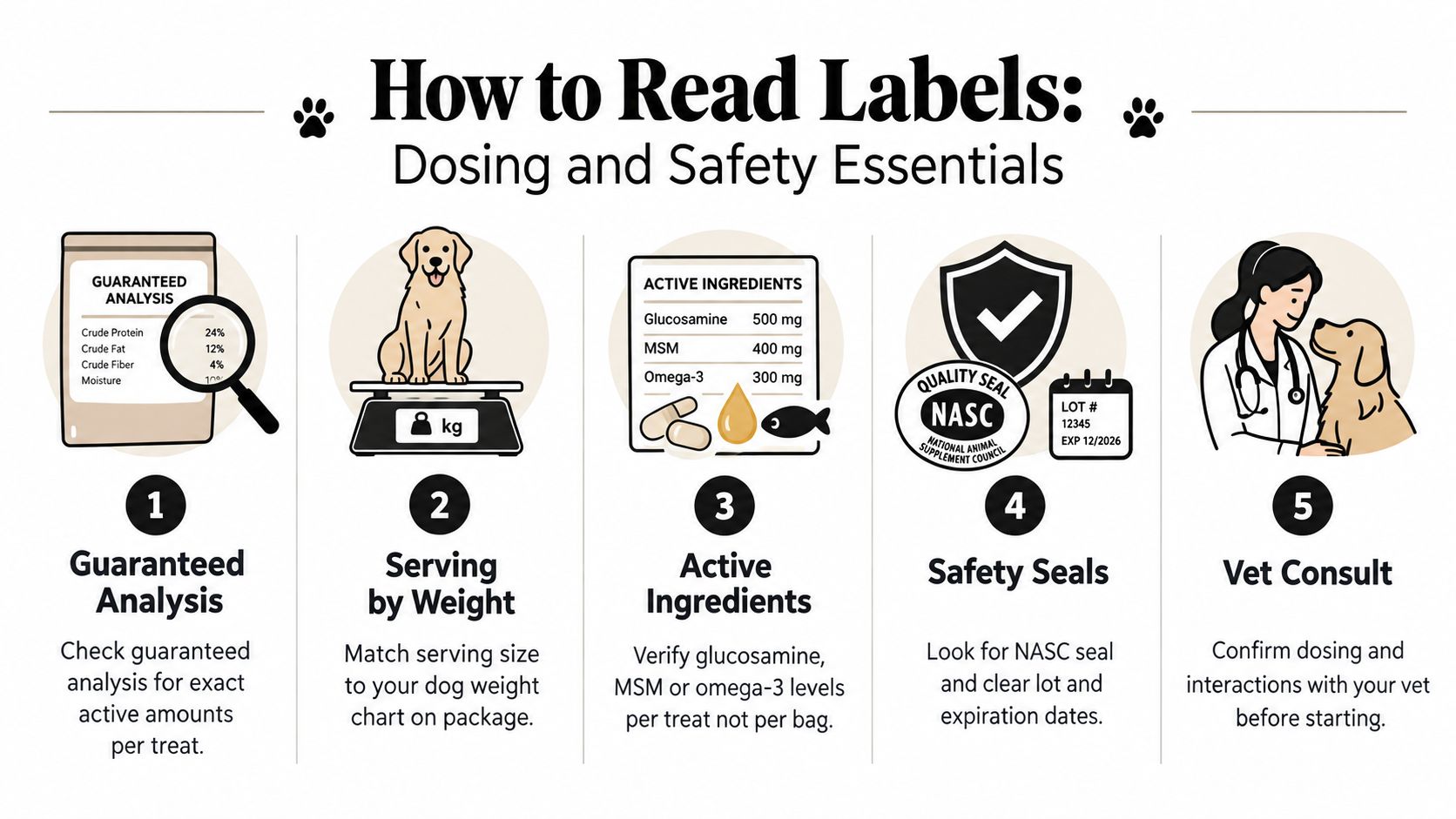
Guaranteed analysis may provide nutritional information, but it doesn't always reveal every active supplement amount. Look for a separate supplement facts panel or clear statement of the quantity of glucosamine, MSM, EPA, DHA, collagen, or other featured compounds per treat and per daily serving.
Then check the serving chart. A small dog and a large dog may require different numbers of treats, and the active exposure changes with that serving. If the package gives only a broad blend without individual amounts, you can't compare it meaningfully with a formula that reports each ingredient.
Use this checklist:
- Ingredient identity: Prefer specific compounds and named sources over vague “joint blend” language.
- Active amount: Confirm the amount per treat, not only per package.
- Weight guidance: Follow the product's dog-weight chart and ask your veterinarian about individual adjustments.
- Quality information: Look for lot identification, expiration details, storage guidance, and independent quality signals.
- Calorie awareness: Count treats as part of the daily food routine, especially for dogs whose body condition affects mobility.
A proprietary blend isn't automatically unsafe, but it limits your ability to judge dose. Marketing phrases such as “rebuilds cartilage” or “guaranteed pain relief” deserve extra skepticism, particularly for glucosamine and chondroitin.
Label-reading insight: If you can't identify the amount of the ingredient responsible for the main claim, you can't properly evaluate the claim.
Safety deserves a veterinary conversation
Ask your veterinarian before adding a joint treat if your dog takes medication, has a chronic illness, has a history of digestive sensitivity, or is already receiving pain management. Stop and seek advice if your dog develops vomiting, diarrhea, appetite changes, unusual lethargy, or a worsening gait after starting a product.
The following video can serve as a visual reminder of the label questions to raise with your care team:
Consistency also matters. Changing several supplements at once makes it difficult to know what helped, what caused a reaction, or whether the change came from exercise, weight, or natural variation.
When to Consider Joint Dog Treats by Age and Condition
The right question isn't whether every dog should receive joint dog treats. It's whether a particular dog has a reason to try one, whether the formula is suitable, and whether the owner can recognize when a stronger intervention is needed.
Match the tool to the dog
A healthy young dog may not need a joint supplement because a label mentions prevention. Large, active dogs and growing puppies can still benefit from a conversation about nutrition, appropriate exercise, body condition, and breed-related risk. Supplementing without a clear reason can add complexity without solving a problem.
For a middle-aged dog showing occasional stiffness, a veterinarian may suggest a measured trial alongside movement and weight guidance. The goal is to observe function, not to assume that a treat will prevent all future joint disease.
A senior dog with diagnosed osteoarthritis may use a joint treat as one supportive component of a larger plan. That plan may include controlled exercise, rehabilitation, environmental adjustments, weight management, and prescription pain control. Explore practical options for dog joint health treats, but keep the individual diagnosis at the center.
Recognize when treats aren't enough
The best available evidence doesn't support glucosamine and chondroitin as a reliable standalone active for canine osteoarthritis. A 2022 systematic review and meta-analysis found a “very marked non-effect” for chondroitin-glucosamine nutraceuticals and recommended that they no longer be used for pain management in dogs and cats, as reported in the peer-reviewed systematic review.
That doesn't mean every joint treat has no place. It means owners shouldn't use a familiar ingredient to delay care when a dog is painful or deteriorating.
Contact your veterinarian promptly for:
- Sudden lameness: A new limp may indicate injury or another acute problem.
- Swelling or heat: These signs need assessment rather than casual supplementing.
- Severe pain: Crying, guarding, inability to settle, or refusal to move calls for professional care.
- Rapid decline: A quick change in walking, appetite, behavior, or ability to rise shouldn't wait for a treat trial.
At home, record short observations under similar conditions. Note rising, walking, stairs, play, and recovery. Bring those observations to the veterinarian so decisions rely on patterns rather than one unusually good or difficult day.
How to Choose Clean High Quality Joint Dog Treats With Confidence
A clean formula starts with a clear purpose. Choose a product that names its active ingredients, reports meaningful amounts per serving, provides weight-based directions, and avoids hiding the central formula inside an unexplained blend.
For evidence, give greater weight to omega-3s with identified EPA and DHA than to a label that relies only on glucosamine and chondroitin. Collagen, green-lipped mussel, undenatured type-II collagen, and other emerging ingredients may be worth discussing, but their evidence is still developing. Palatability matters too, because a scientifically interesting product can't help if your dog refuses it.
Use this short decision framework:
- Ask your veterinarian whether your dog's signs justify a supplement trial.
- Choose one transparent formula rather than changing several products together.
- Confirm the daily active amount and serving instructions.
- Track mobility consistently at home.
- Review the result after 6 to 12 weeks, sooner if signs worsen.
Joyfull's functional treat collection offers treat-based wellness products as one option for owners who want daily rewards connected to a specific health purpose. Evaluate any product, including a Joyfull formula, by the same standards: clear ingredients, appropriate use, and realistic claims.
A mobility-support routine should help you make better observations, not replace them. Your veterinarian can help determine whether the next step is a treat, exercise adjustment, weight plan, rehabilitation, medication, or a combination.
Joyfull creates functional pet wellness products with clean ingredients, high-quality proteins, and scientific review by an in-house veterinary advisor. Visit Joyfull to explore treat-based options and choose a more informed daily routine for your dog.
0 comments