


Your dog yawns beside you, and the smell arrives before the head does. You sprinkle a green powder over dinner because it feels easier than negotiating with a toothbrush, then wonder whether fresher breath means healthier teeth.
That question matters. Green powder for dogs' teeth can be useful as a daily maintenance adjunct, especially after a veterinary cleaning, but it isn't a tartar remover and it can't replace brushing, dental chews, or professional care when disease is already present. The most helpful way to judge it is to separate breath chemistry from measurable changes in plaque, calculus, and gum inflammation.
Table of Contents
- What Green Dental Powder Is and Why Owners Try It
- Does Green Powder Actually Help Teeth or Just Breath
- Key Ingredients Inside Green Powders and What They Do
- How to Use Green Powder for Best Results
- Safety Checks and When to Skip Green Powder
- Simple Alternatives to Keep Your Dog Smile Healthy
What Green Dental Powder Is and Why Owners Try It
Green dental powder is a food supplement designed to be mixed into a dog's meal. Its color usually comes from ingredients such as seaweed, kelp, parsley, chlorophyll-rich plants, or other botanical materials. Depending on the formula, it may also contain minerals, probiotics, postbiotics, or compounds intended to influence the oral environment.
Owners often reach for it after noticing bad breath, yellow film near the gumline, or recurring plaque. Those signs can begin with a soft bacterial coating called plaque. If plaque remains, it can harden into calculus, commonly called tartar, which irritates the gums and can contribute to periodontal disease.
The appeal is practical. A powder doesn't require your dog to hold still while you reach into the mouth, and it can be easier than introducing a toothbrush to a nervous, older, small-mouthed, or stubborn dog. It also differs from toothpaste because the dog generally swallows it with food rather than relying on brushing to move the product across each tooth.
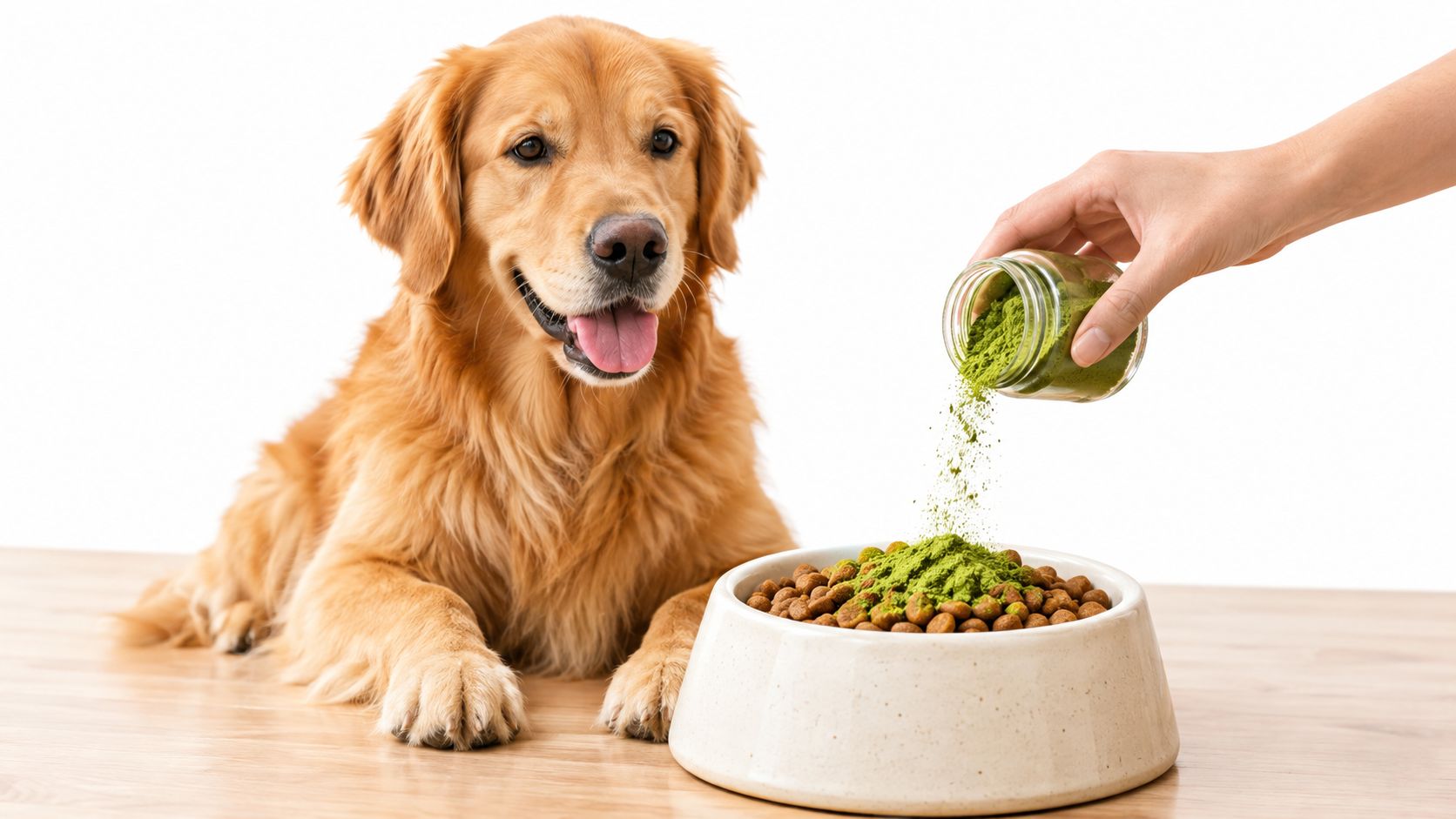
What a realistic result looks like
Think of powder as a habit-building tool for maintenance, not a rescue treatment. A dog with a recently cleaned mouth may be a sensible candidate, provided the formula suits the dog's health history. A dog with thick brown tartar, painful chewing, or bleeding gums needs an examination rather than a larger scoop.
For a useful plain-language explanation of the sprinkle-on approach, see PetScy's guide to how plaque powder works. The key distinction is simple: a powder may help manage the conditions that support plaque and odor, but it won't physically remove hardened deposits below the gumline.
During the first weeks, owners may notice that breath smells less intense or that soft buildup appears slower. Those are encouraging observations, but they aren't proof that established calculus has disappeared. The best candidates are dogs whose owners can apply the product consistently and continue other appropriate dental care.
Does Green Powder Actually Help Teeth or Just Breath
The answer depends on which outcome a product has measured. Breath studies often track volatile sulfur compounds, the chemicals associated with oral odor. A lower reading may indicate improved halitosis, but it doesn't automatically show that plaque or calculus has been removed.
Dental studies use different measures. A plaque index evaluates soft deposits, a calculus index evaluates hardened deposits, and gingival-bleeding scores help indicate gum inflammation. These measures tell you more about dental health than a pleasant smell alone.
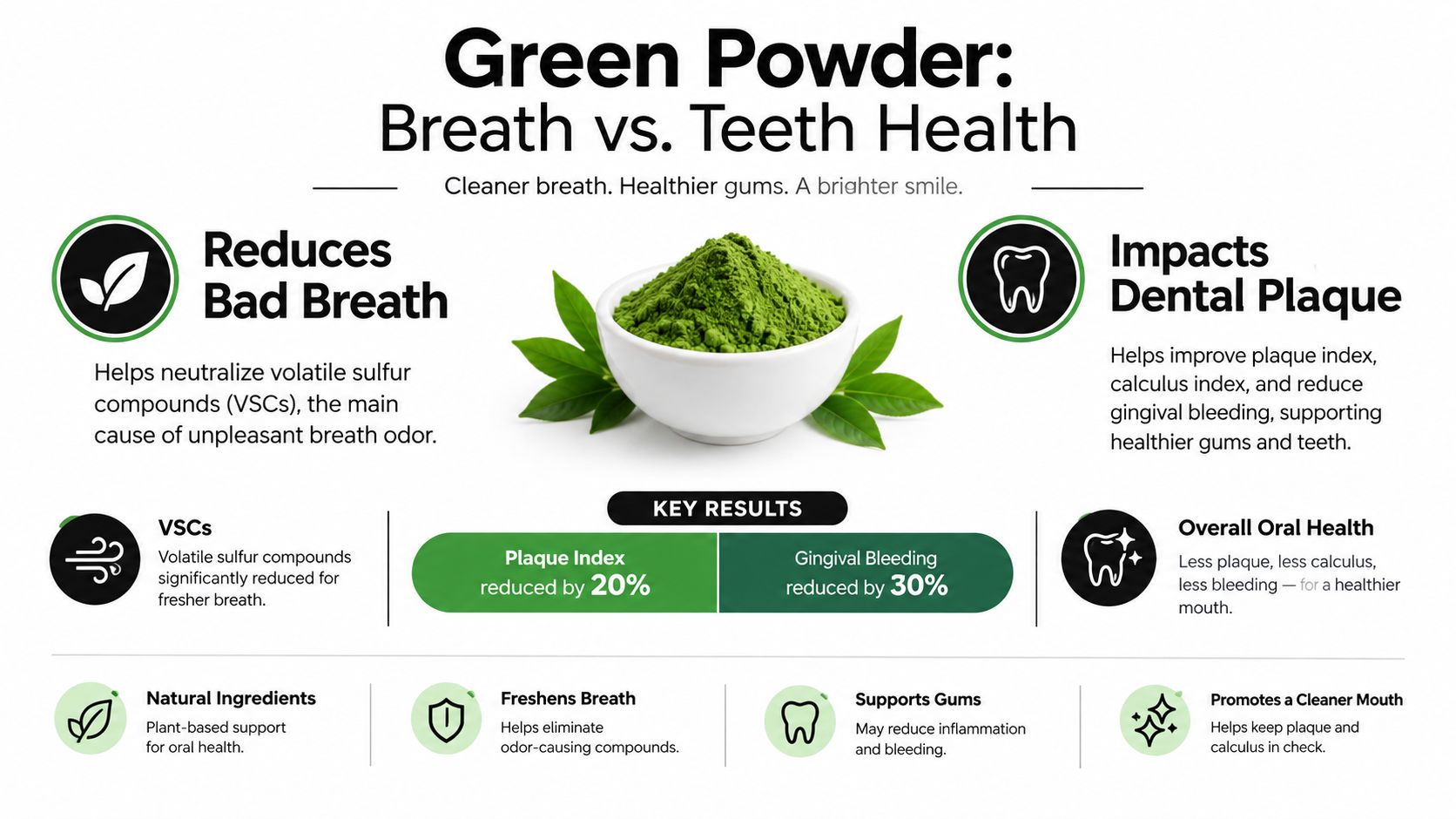
What controlled evidence can and cannot show
In a 30-day placebo-controlled, double-blind study of powdered brown algae in dogs, researchers reported reductions of about 32% in plaque index, 35% in calculus index, and 67% in gingival bleeding index versus placebo (peer-reviewed study). Those findings support the possibility that a consistently dosed seaweed powder can affect more than breath.
Another placebo-controlled, double-blind study followed 60 client-owned dogs after professional cleaning for 90 days. Daily Ascophyllum nodosum supplementation produced significantly better plaque, calculus, gingival-bleeding, and volatile-sulfur-compound scores than placebo, with assessments at 30, 60, and 90 days (methodology summary). The protocol matters because it tested powder as post-cleaning maintenance, not as a way to dissolve heavy tartar.
Dental chews provide a useful comparison. In a controlled 2020 study, daily use of two novel chews reduced plaque coverage by 12.3% and 13.3% versus control dogs (veterinary study PDF). A later study reported lower calculus coverage, gingivitis scores, pocket bleeding, and breath compounds while also measuring consumption, acceptance, hardness, and breaking strength in the chew itself. Mechanical action and palatability therefore matter, but chew findings shouldn't be transferred directly to every powder.
Evidence rule: If a label promises fresher breath, ask whether the evidence measured breath chemistry only, or whether it also measured plaque, calculus, and gum bleeding.
A product is more credible when its directions are clear, its ingredient amounts are disclosed, and its claims match the outcome tested. For owners considering broader digestive support alongside oral care, the Joyfull Probiotic Supplement for Dogs - 30 Single-Serving Packets is described as veterinarian-formulated, third-party tested for potency and purity, and made with real beef bone broth.
Key Ingredients Inside Green Powders and What They Do
Labels can make several ingredients sound interchangeable, but they serve different purposes. Brown algae and kelp are usually included for oral-environment support, while parsley, mint, and chlorophyll are more closely associated with odor control. Probiotics and postbiotics aim to influence microbial balance, and minerals may help limit the conditions that allow deposits to form.
The strength of evidence also varies. A named ingredient with controlled canine research behind it deserves a different level of confidence than a botanical included mainly because it sounds fresh or natural.
Green Powder Ingredients Compared
| Ingredient | Primary Purpose | Evidence Signal | Watch Out |
|---|---|---|---|
| Ascophyllum nodosum | Plaque, calculus, gum, and odor support | Controlled canine powder studies have measured several oral outcomes | Ask your veterinarian about seaweed suitability and iodine exposure |
| Kelp or other seaweed | Oral-environment and breath support | Some evidence is promising, but formulas and doses differ | Sourcing, iodine content, and contaminant testing matter |
| Chlorophyll | Breath deodorizing | More relevant to odor than proven calculus removal | Don't treat fresher breath as proof of cleaner teeth |
| Parsley or mint | Flavor and breath support | Primarily a breath-adjacent role | Confirm the full formula is dog-safe |
| Probiotics | Microbial balance, depending on strain | Evidence depends on the specific strain and measured outcome | Check the exact strain, handling, and veterinary suitability |
| Postbiotics | Support for oral microbial balance or breath chemistry | Recent canine research is developing and may measure breath rather than deposits | A breath result doesn't establish tartar prevention |
| Zeolite or other minerals | Deposit and oral-environment support | Evidence depends on the compound and product formulation | Look for transparent sourcing and contaminant controls |
Seaweed deserves particular care because “natural” doesn't mean automatically appropriate for every dog. If your dog has thyroid disease, receives iodine-sensitive treatment, or has a complicated diet, ask the veterinary team before choosing a kelp-heavy powder.
A digestive product isn't automatically a dental product. For example, dog probiotics may support digestive balance, but you shouldn't assume a gut supplement has been tested for plaque, calculus, or gum inflammation unless the label or study says so. The same principle applies to cat products. The Happy Guts Duo for Cats is described as a veterinarian-formulated, third-party tested two-part routine with prebiotic tuna squeeze treats and a probiotic supplement, but it isn't evidence that a dog dental powder works.
How to Use Green Powder for Best Results
Consistency usually determines whether a powder becomes useful or becomes another half-used container in the cupboard. Start by reading the product's own serving directions and choosing the dose by your dog's weight. Don't copy a scoop size from another brand, because formulas can differ in concentration.
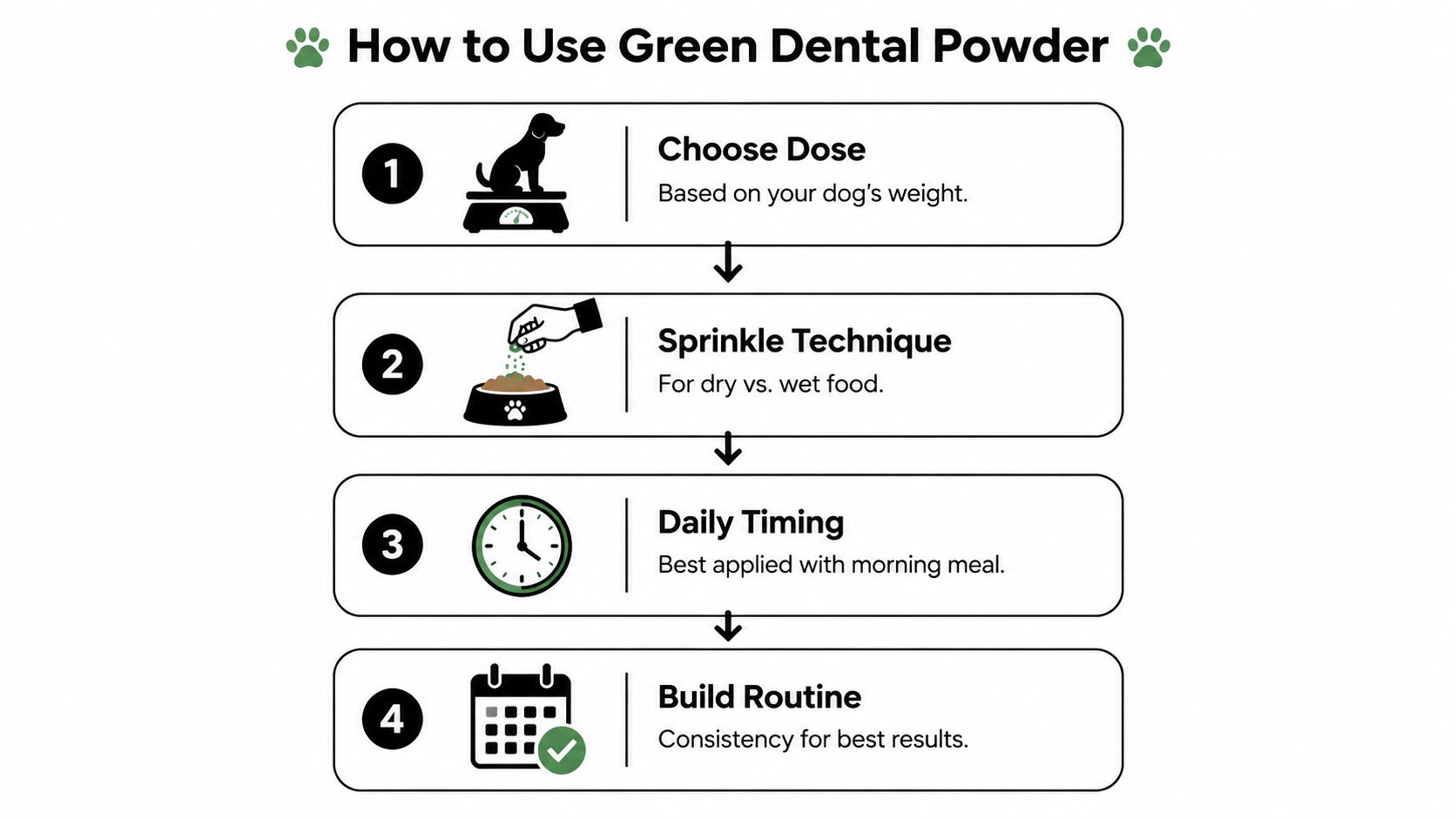
Make the serving easy to repeat
Sprinkle the measured amount over food your dog reliably finishes. Dry kibble works well for some dogs, while wet food, a small meal topper, or a moist portion of the normal diet can help the powder adhere for dogs that leave loose particles behind.
Morning feeding often creates a dependable cue, but the best time is the meal you can repeat. If your dog is selective, introduce the powder gradually according to the label or your veterinarian's advice. Mixing it into a familiar food is usually less disruptive than adding it to an entirely new treat.
Store the container as directed, close it promptly, and use a dry measuring scoop. Moisture can change the texture and may affect product quality, especially when the formula contains sensitive ingredients.
Track the routine instead of guessing
Use a phone note or calendar with four simple observations:
- Serving given: Mark whether the intended amount went into the meal.
- Breath: Record better, unchanged, or worse.
- Gumline: Look for redness, swelling, or bleeding without scraping the teeth.
- Visible deposits: Note whether soft film seems slower to return, while recognizing that hard tartar requires veterinary assessment.
A 30-to-90-day window is more useful for judging maintenance than expecting an overnight transformation. The powder may support a cleaner routine, but brushing still provides direct contact with tooth surfaces, and an appropriate dental chew can add mechanical action. Pair the powder with short, positive brushing practice when your dog allows it, even if you begin with only a few teeth.
Practical routine: Put the powder beside the food container, use the same meal each day, and take occasional mouth photos from a similar angle. A repeatable cue is more valuable than an ambitious plan you can't maintain.
Stop treating the routine as successful if bad breath persists alongside red gums, chewing discomfort, or visible heavy deposits. Those signs change the task from maintenance to triage.
Safety Checks and When to Skip Green Powder
A green label can create a false sense of security. Natural ingredients can still cause problems, interact with medical conditions, or expose a dog to unnecessary ingredients when the formula lacks clear sourcing.
Read the entire label, not just the front panel. Kelp and other seaweed ingredients raise questions about iodine, while poorly controlled raw materials may raise concerns about heavy-metal contamination. Avoid products containing artificial sweeteners that are unsafe for dogs, and never substitute a human dental powder or toothpaste without veterinary approval.
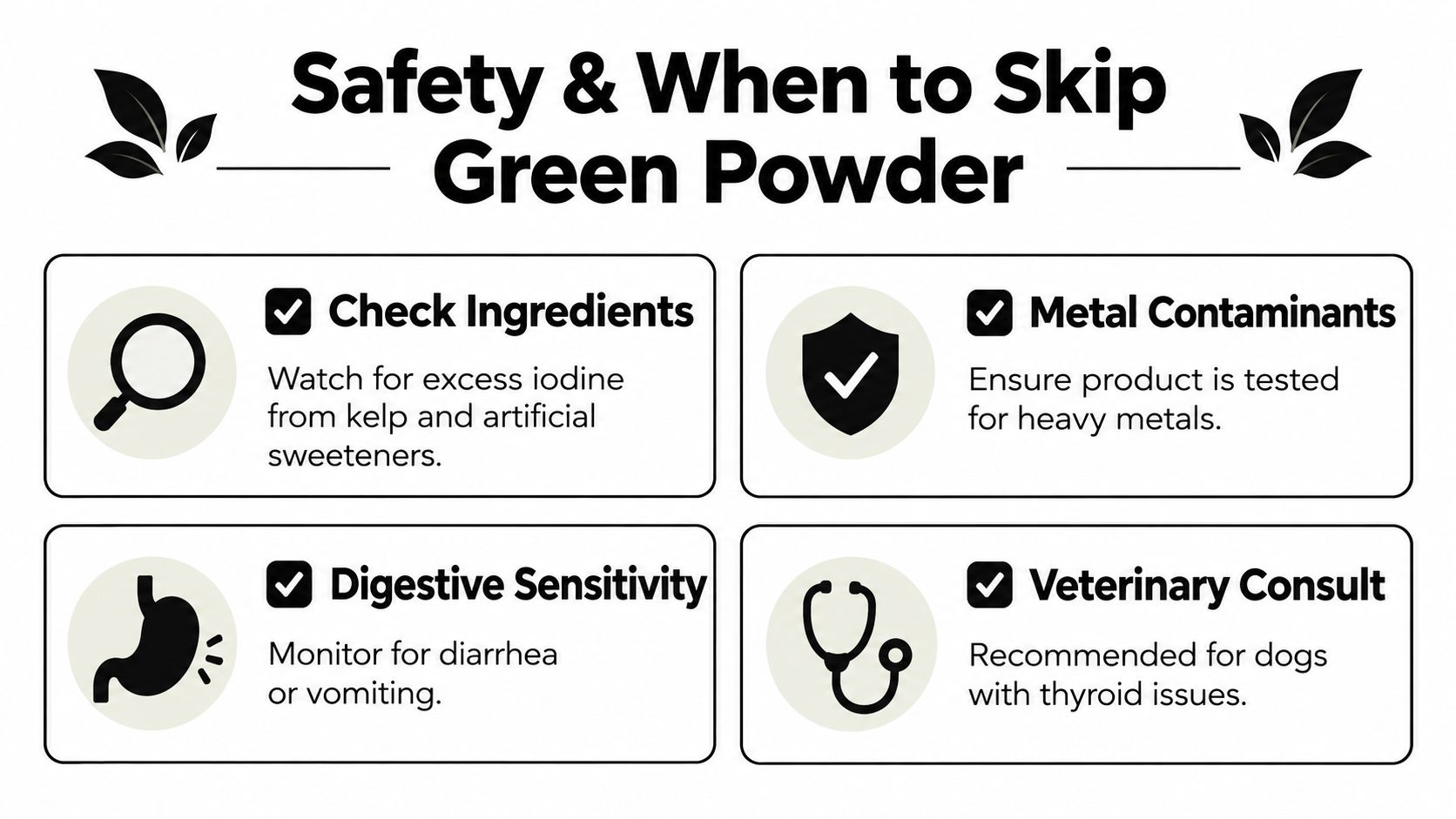
Dogs who need extra caution
Speak with your veterinarian before use if your dog has:
- Thyroid disease or iodine concerns: Seaweed-heavy formulas may not fit the medical plan.
- Kidney disease: Mineral content and supplement use deserve individual review.
- A sensitive stomach or food allergy: Introduce only one new product at a time and watch for vomiting, diarrhea, or appetite changes.
- Advanced periodontal disease: Powder won't resolve infected, painful, or diseased structures below the gumline.
- Current medication or a restricted diet: The complete ingredient list may affect suitability.
For broader supplement decisions, a veterinarian-led review is more useful than assuming one “natural” ingredient is harmless. Even educational material about safe turmeric use for pets illustrates why the animal's condition and the full product context matter.
A powder shouldn't delay a cleaning when you see bleeding gums, loose or broken teeth, facial swelling, drooling, pain while chewing, or persistent foul breath. Professional dental care can assess areas home products can't reach, including below the gumline.
If you're researching dental powders for other oral appliances, keep the product category clear. Guidance on how to secure denture with Polident concerns human dentures, not a dog's teeth, and shouldn't be transferred to canine care.
The Happy Guts Duo for Pups is described as a veterinarian-formulated, third-party tested routine containing prebiotic chicken squeeze treats and a probiotic supplement. It may be relevant to digestive-support discussions, but it isn't a replacement for a canine dental evaluation.
Simple Alternatives to Keep Your Dog Smile Healthy
Green powder makes the most sense when it fills a gap in a larger plan. Brushing reaches tooth surfaces directly, dental chews can provide mechanical contact, water additives create another daily delivery route, and professional cleanings address hardened deposits and disease that home care cannot safely remove.
Choose the option your dog will tolerate and you can repeat. A perfect dental routine that happens once is less useful than a modest routine practiced consistently.
Match the tool to the problem
| Tool | What it contributes | Main limitation |
|---|---|---|
| Toothbrush and dog-safe toothpaste | Direct cleaning of accessible tooth surfaces | Requires training and cooperation |
| Veterinary-approved dental chew | Mechanical contact during chewing | Not suitable for every dog, tooth, or chewing style |
| Green powder | Convenient daily maintenance support | Doesn't replace brushing or remove established tartar |
| Water additive | Low-effort daily exposure | Acceptance and evidence vary by product |
| Professional cleaning | Assessment and removal of deposits, including areas home care can't reach | Requires veterinary scheduling and procedure planning |
For a dog who won't accept a brush, powder paired with an appropriate chew may be more realistic than abandoning dental care. For a cooperative dog, keep brushing as the foundation and use powder as an adjunct. You can also review guidance on choosing healthy dog treats for teeth, while checking that any treat fits your dog's size, chewing habits, and medical needs.
Keep a simple maintenance checklist: inspect the mouth regularly, monitor breath and gum appearance, practice brushing when possible, use any supplement as directed, and arrange veterinary dental assessments when warning signs appear. Nutrition matters too, so owners comparing complete diets can consult resources such as Vitamin Planet canine nutrition, without confusing general nutrition information with dental-treatment evidence.
Joyfull offers veterinarian-formulated supplements made with clearly described ingredients, including a dog probiotic supplement with real beef bone broth and individually sealed servings. If you're building a broader, consistent wellness routine alongside responsible dental care, visit Joyfull to explore the available options.
0 comments