


Most advice about dog vitamins for gut health starts in the wrong place. It jumps straight to probiotics, as if a bottle can fix everything, when many dogs need better food, more moisture, steadier meals, and fewer digestive stressors before any supplement has a real job to do. That order matters because gut support is usually a foundation problem first, and a product-choice problem second.
If your dog's stool is off, the answer isn't always “add bacteria.” Cornell's canine health guidance emphasizes basics like complete food, hydration, gradual diet changes, and parasite control, while ISAPP-aligned guidance says probiotic choice should be dog-specific and strain-specific, not a vague wellness shortcut (Cornell's probiotics overview, ISAPP guidance on probiotics for dogs). The smarter approach is to fix the soil before you spread fertilizer.
Table of Contents
- Why Dog Gut Health Starts Before Any Supplement
- What Dog Vitamins for Gut Health Include
- Reading the Signs Your Dog's Gut Needs Support
- Probiotics, Prebiotics, and the Supporting Cast Compared
- The Case for Diet Over Supplements
- How to Choose a Safe Dog Gut Health Supplement
- Dosing, Timing, and When to Call the Vet
- A Practical Plan to Put It All Together
Why Dog Gut Health Starts Before Any Supplement
Start with the bowl, not the bottle
A lot of gut trouble starts at mealtime. If the food does not fit the dog, the water bowl stays too full, or the routine keeps changing, a supplement may only cover up a problem that returns the next day. Basic care comes first, so the starting point is complete and balanced food, enough hydration, gradual food transitions, and parasite control.
That is why the soil analogy fits so well. Fertilizer does little for a plant in compacted dirt, and a gut product does not do much if the diet is erratic or the dog is chronically under-hydrated. If a dog is stressed, switched to a new food too quickly, or missing fiber, the first fix is usually nutrition management, not another capsule.
Practical rule: if stool quality changed after a food switch, a boarding stay, a new routine, or a stomach bug, stabilize those variables before buying a supplement.
The four foundations that come first
The order is simple, even if labels make it feel more complicated. First, confirm the diet is complete and balanced. Second, make sure the dog drinks enough and gets moisture from food when that helps. Third, keep transitions gradual so the gut has time to adapt. Fourth, rule out obvious disruptors like parasites and repeated stress.
Reading the food bag matters here. If you are not sure whether the current food is doing its job, start with how to read dog food labels before you shop for a gut product. A clearer label often answers more questions than a trendy ingredient list.
What Dog Vitamins for Gut Health Include
The category problem
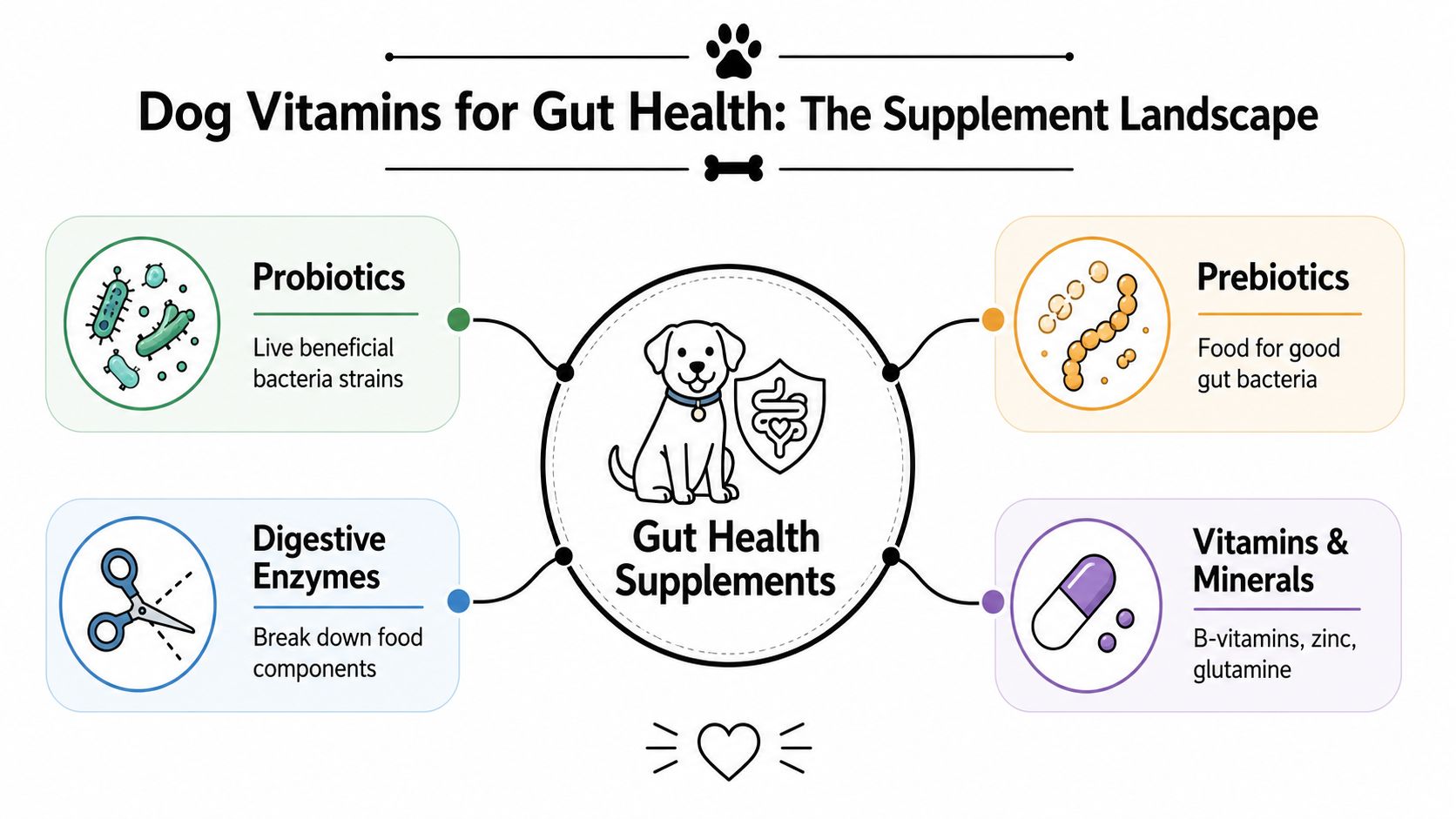
The phrase dog vitamins for gut health gets used as if everything in the bottle does the same job. It does not. Some ingredients add live microbes, some feed those microbes, some leave behind helpful compounds, and some support digestion in different ways entirely. When shoppers group them together, they end up comparing things that do not belong in the same bucket.
A useful way to sort them is by job, not by label appeal. Probiotics are live microbes, prebiotics feed those microbes, postbiotics are the compounds left behind after microbial activity, digestive enzymes help break food apart, and selected vitamins and minerals support the tissues involved in digestion. If you treat all five as interchangeable, you miss what your dog needs.
What belongs in each bucket
Probiotics are live beneficial bacteria, and in dogs they are usually discussed for digestive balance rather than as a cure-all. Prebiotics are fibers that help those helpful bacteria thrive, which is why many gut formulas pair them with probiotics. Postbiotics are a newer, less flashy category, and they show up more often on labels because they do not depend on live organisms to do every part of the work.
Digestive enzymes are different again. They help break down food components, so they make more sense for specific dogs with digestion challenges than for every healthy adult on the block. The vitamin and mineral side is narrower than people expect, too. In gut-focused formulas, the goal is usually support for mucosal integrity and normal digestion, not a random multivitamin dump.
If you are comparing product styles, the line between dog and cat products matters too. Joyfull's Probiotic Supplement for Cats is a cat formula with real beef bone broth, clinically tested probiotic strains, third-party testing, and complementary prebiotics, so it is a clear example of how species-specific gut products are formulated differently.
Reading the Signs Your Dog's Gut Needs Support
Loose stool is only one clue
A dog with loose stool doesn't automatically need a probiotic, but stool changes are one of the clearest signals that something inside the gut has shifted. If the poop is inconsistent, soft one day and normal the next, I'd look first at recent food changes, treats, stress, and hydration. A gut supplement can help in some cases, but the symptom usually tells you to investigate the pattern, not just the product aisle.
Gas and bloating can point in a different direction. Some dogs swallow air when they eat too fast, while others ferment food differently when fiber balance is off. Either way, the question is the same, what changed before the gassiness started?
Appetite changes and skin changes matter too
A dog that becomes picky overnight may be showing mild nausea or gut irritation, even if the stomach noise is the only obvious clue. If a normally eager eater keeps walking away from the bowl, that's worth tracking with the same seriousness as loose stool. The timeline matters more than the drama of the symptom.
The gut-skin connection is easy to miss because owners often separate digestive issues from coat issues. A dull coat, itching, or skin flare-ups don't prove a gut problem, but they can travel together in some dogs, especially when food quality or tolerance is poor. If you notice a skin change at the same time as a digestion change, bring both notes to the vet.
What to write down before the appointment: when it started, what the stool looks like, what the dog ate, any recent stress, and whether the issue seems acute or chronic.
Probiotics, Prebiotics, and the Supporting Cast Compared
The honest verdict on each category
Probiotics get most of the attention, but dog evidence is mixed enough that broad promises do not hold up well. A systematic review of 17 studies found limited, possibly clinically unimportant evidence for acute gastrointestinal disease, and for chronic disease it favored dietary intervention over probiotic supplementation. The label matters less than the strain, the situation, and the diet around it.
Prebiotics often do steadier work because they feed the bacteria already living in the gut. That is why fiber sources show up so often beside probiotic formulas, and why the benefits of prebiotic fiber are usually discussed as part of the whole feeding plan, not as a stand-alone fix.
Postbiotics are getting more attention because they can be easier to build into stable products, but they are still newer for most dog owners. Digestive enzymes make the most sense when digestion itself is the issue, especially in dogs whose food seems to sit heavily or whose age makes digestion less efficient.
Evidence at a glance
| Category | What it does | Evidence in dogs | Best for |
|---|---|---|---|
| Probiotics | Adds live beneficial bacteria | Mixed, strain-specific, and context-dependent | Some dogs with diarrhea or GI upset |
| Prebiotics | Feeds helpful gut bacteria | Supportive and practical | Dogs needing fiber support |
| Postbiotics | Delivers beneficial bacterial byproducts | Emerging | Owners who want shelf-stable gut support |
| Digestive enzymes | Helps break down food | More targeted than general | Specific digestion concerns |
| Vitamins and minerals | Supports the gut lining and general nutrition | Adjunctive, not standalone | Dogs with broader nutritional gaps |
That table is the short version. The longer version is that a gut product only helps if it matches the problem in front of you.
The newer canine data points in the right direction, but it is not magic. In one controlled synbiotic study, dogs on the product had diarrhea on 2.0% of scored days versus 3.2% on placebo, and the share of dogs with diarrhea in the first 14 days dropped to 18.8% from 27.2% in controls. For shoppers comparing prebiotics for dogs, the practical point is simple, the supporting cast often matters as much as the microbes themselves, and a product should make clear which bucket each ingredient belongs to.
The Case for Diet Over Supplements
Why the food bowl usually wins
Most healthy dogs do not need a supplement before they need a better feeding setup. A complete, balanced diet, steady meal timing, and enough moisture often do more for the gut than the average capsule ever will. That is not anti-supplement thinking, it is just giving the digestive tract what it responds to first.
The review of 17 probiotic studies matters here because it pushes back on the idea that probiotics should be the default answer for every digestive wobble. For acute issues, the evidence was limited, and for chronic GI disease, the review favored diet over probiotic supplementation, as noted earlier. In plain English, if the diet is wrong, a probiotic rarely gets the chance to catch up.
What diet-first actually looks like
Diet-first does not mean raw feeding, fancy toppings, or a dramatic overhaul. It means choosing a complete food that fits the dog, changing foods gradually, and keeping the gut environment steady enough to settle. Moisture matters too, which is why wet food, water toppers, and steady access to clean water can be part of digestive support, not just a side note.
For active dogs, a structured feeding pattern is often more useful than a catch-all supplement stack. A resource like nutritional dog food for active dogs is relevant because it shows how much gut support starts with the base diet, not the add-on.
A supplement should earn its place after the bowl is already doing its job.
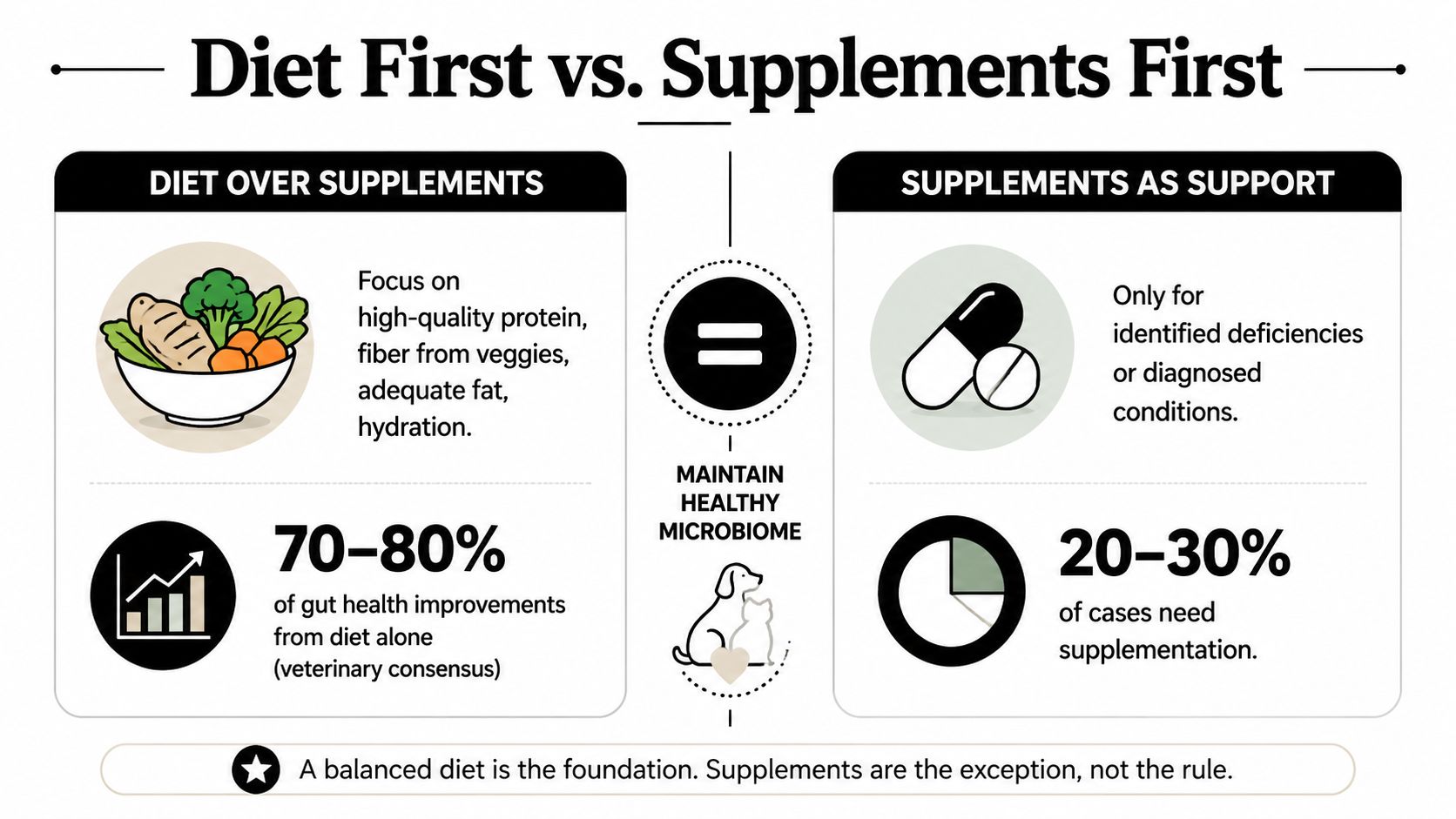
A lot of owners reach for dog probiotics first because the label sounds targeted and simple. The problem is that gut support is usually broader than one strain in one capsule. Fiber feeds helpful bacteria, hydration keeps stool moving in the right direction, and a stable diet gives the gut a predictable routine to work with. Probiotics can help in some cases, but they are one part of the picture, not the whole frame.
That is why the better question is not, “Which gut vitamin should I buy?” It is, “What is the diet already missing?” If the answer is poor fiber balance, low moisture, or a food that does not suit the dog, those issues deserve attention before any supplement does.
How to Choose a Safe Dog Gut Health Supplement
Five filters that actually matter
Start with species. A product made for dogs belongs in a different category from a human probiotic repackaged for pets, and the label should make that clear. Use dog probiotics made for canine digestion, not a vague wellness blend dressed up to look targeted.
Then check for named strains, not just “proprietary probiotic blend.” A label that lists something like Enterococcus faecium or Bifidobacterium animalis gives you something concrete to evaluate. That matters because strain names tell you more than marketing copy ever will, and they make it possible to ask whether the product has been studied for the job it claims to do.
What else belongs on the label
Third-party testing or quality certification should be visible, especially for products that claim potency or purity. CFU counts should also be believable and easy to compare with the product's stated purpose. You do not need the biggest number on the shelf, you need a dose that is disclosed clearly enough to judge whether it fits the formula.
Good label, bad label: a clear ingredient list beats a glossy promise every time.
Red flags are usually obvious once you slow down and read. Skip products that hide the species, rely on miracle language, or make the supplement sound like it can replace veterinary care. Be careful with formulas that promise to fix stool, immunity, and coat quality all at once, because that usually means the label is carrying more marketing than evidence.
Joyfull's own philosophy fits here, clean ingredients, veterinary review, and a format people can use consistently. That matters more than hype, because consistency beats clever branding in gut care. If you are already comparing dog probiotics, use the same checklist on every option, including the one in your cart.
Dosing, Timing, and When to Call the Vet
Start low and watch the stool
A new gut supplement is usually easier on the digestive tract if you introduce it gradually over a few days. That matters most for dogs with sensitive stomachs, because a sudden change can muddy the picture and make it hard to tell whether the product is helping or causing a reaction. The label still matters, but the first few days tell you whether the formula fits the dog in front of you.
Patience matters here. The useful timeline is often 2 to 4 weeks, not two meals, because gut support tends to show its effect slowly. In the 2024 nutraceutical study in Animals, measurable changes showed up after a longer stretch, and digestive outcomes in canine gut-health research are usually tracked over short intervention windows. That is why owners need to watch for a pattern, not a quick verdict. A supplement can be a steady tool, not an instant fix.
Who should not self-start
Some dogs need a vet conversation before any supplement goes in the bowl. Puppies that are not fully weaned, dogs on immunosuppressive therapy, dogs with chronic GI disease, dogs with a history of pancreatitis, and dogs who are pregnant or nursing all fit that category. These are the dogs where supervision matters most, because the margin for error is smaller.
If diarrhea, vomiting, lethargy, or a clear appetite drop shows up after starting something new, stop and call the vet. Bring the label, because the ingredient list usually tells a clearer story than a general description of the product.
A Practical Plan to Put It All Together
A simple five-step sequence
Start with the bowl, not the bottle. If the current diet is incomplete, unstable, or hard for your dog to digest, fix that first. A supplement can only support a system that already has some basic structure, and the food bowl sets that structure. Hydration and meal timing matter too, because a gut that gets fed and watered on a predictable schedule has less to react to.
Then watch the stool, appetite, gas, and overall routine for two weeks on the current setup. Write down what you see, along with any recent changes in stress or food. If the gut looks steadier after diet and routine changes alone, a supplement may be unnecessary.
When a supplement earns its place
If there is still a clear gap, choose one targeted product instead of stacking three. Use a safety checklist that looks for dog-specific design, strain-specific ingredients, transparent labeling, and testing. A supplement should address a defined problem, not become an expensive habit that is supposed to cover every digestive issue at once.
The most sensible gut plan is usually the least dramatic one. It gives the food bowl, the water bowl, and the dog in front of you more weight than the loudest label on the shelf. If you want a gut-health routine built around clean ingredients and veterinary review, compare products with the same evidence-first standard you would use for any other part of your dog's care.
If your dog's digestion has been off, start with the foundation, then choose support that matches the actual problem. Joyfull focuses on clean, vet-reviewed pet wellness products that fit that practical mindset, so you can compare options without getting pulled into hype.
0 comments