


You've portioned out your dog's dinner, turned around to grab a towel, and come back to find an empty bowl and a dog still searching the floor. Later, boredom barking starts, or your dog follows you from room to room with restless energy. A dog treat mat can give that food-seeking behavior somewhere useful to go, turning a quick snack into a small problem-solving activity.
Used thoughtfully, the mat can support enrichment, slower eating, crate routines, and cooperative grooming. It isn't a cure for anxiety, and it shouldn't become an unlimited source of calorie-dense treats. This guide focuses on the practical details that often get skipped, including how mats work, which dogs may benefit, how to choose safe materials, how much spread to use, and how to clean the surface properly. If fast eating is your main concern, start with this Joyfull guide to fast eating for useful context before adding a new feeding tool.
Table of Contents
- Introduction to Dog Treat Mats and Why They Matter
- What a Dog Treat Mat Is and How It Works
- Benefits and Limits of Using a Dog Treat Mat
- Comparing Dog Treat Mat Types Materials and Durability
- How to Use and Clean Your Dog Treat Mat Safely
- Training and Enrichment Ideas With JoyFull Treats
- Buying Guide Safety Checklist and Final Takeaways
Introduction to Dog Treat Mats and Why They Matter
A treat mat fits into ordinary moments. You might spread a little soft food over it while answering emails, offer it before a nap, or place it nearby during brushing so your dog has an appropriate activity instead of trying to escape. The mat gives your dog a task with a clear beginning and end: find the food, work through the texture, and finish the portion.
That matters because many household problems aren't caused by a dog being “bad.” A dog who barks during a meeting may need more purposeful engagement. A dog who gulps meals may need food presented in a way that slows access. A dog who dislikes handling may need carefully planned positive reinforcement rather than a distraction dropped into a stressful situation.
The category has also moved beyond a niche accessory. Independent market research estimates that the global lick mat market reached USD 210 million in 2024 and projects growth at a compound annual growth rate of 8.2% from 2025 to 2033, with the market projected to reach about USD 419.5 million by 2033. Dogs accounted for about 62% of total market revenue in 2024, according to the same lick mat market report. Those figures describe commercial demand, not proof that every dog needs one or that every product claim is valid.
A useful tool, not a magic accessory
The best way to think about a dog treat mat is as a portion-controlled enrichment tool. It changes how a dog obtains food, encourages sustained licking and investigation, and can make a familiar routine more engaging. It doesn't replace walks, training, social contact, veterinary care, or behavior support.
You'll also need to match the mat to your dog. A gentle licker may enjoy a flexible surface with shallow textures. A determined chewer may need a different enrichment format altogether, because silicone can be damaged when a dog uses teeth instead of tongue. Success starts with observing your dog's behavior, not assuming the mat will produce the same response for every household.
What a Dog Treat Mat Is and How It Works
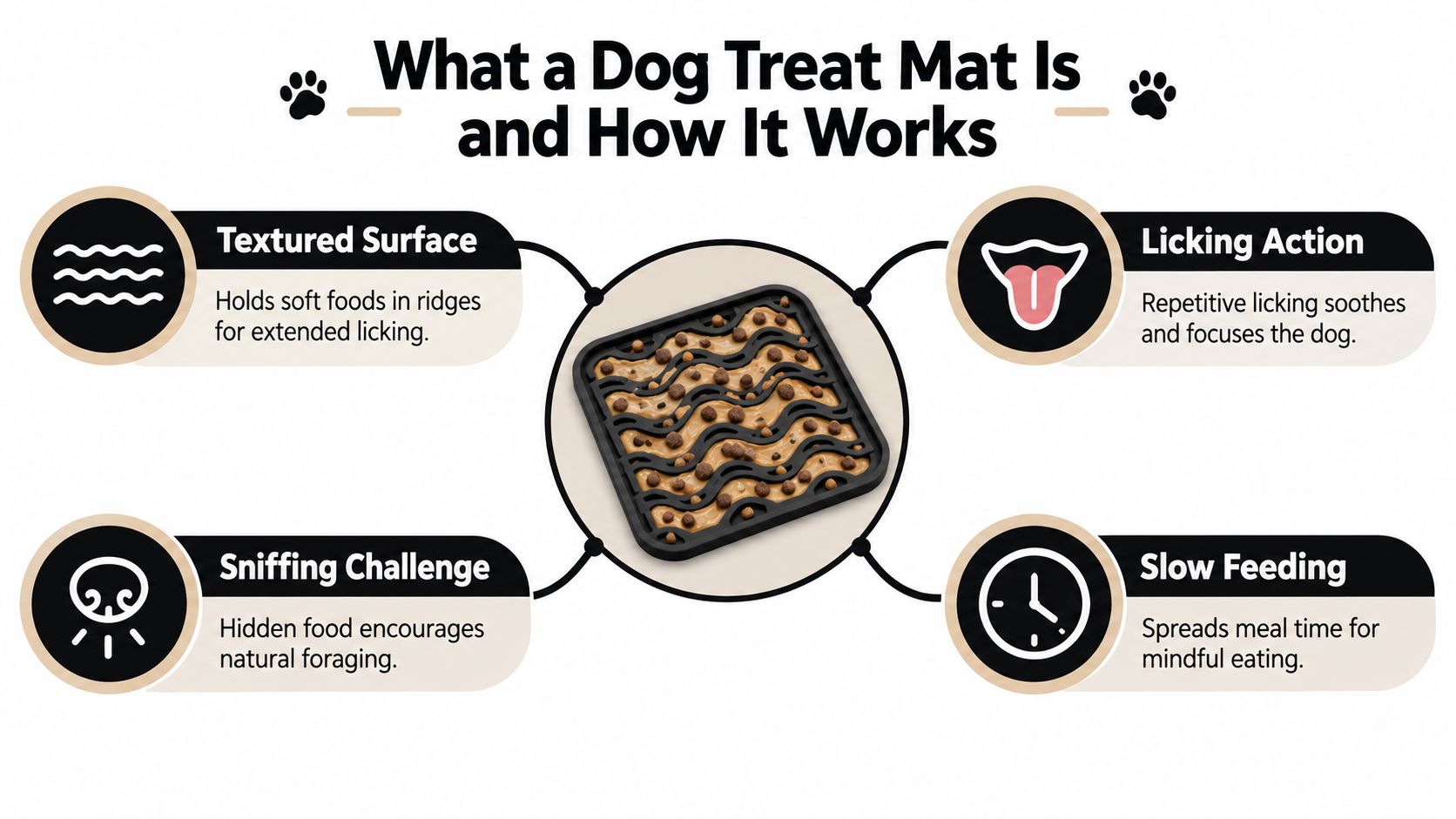
A dog treat mat is a textured feeding and enrichment surface designed to hold soft food in grooves, ridges, or small recessed areas. Your dog uses its tongue and nose to collect the food, so access takes longer than it would from a flat bowl. The mat doesn't make food disappear. It distributes the work across the surface.
Think of a regular bowl as a plate and a textured mat as a puzzle plate. The meal remains visible, but the dog must follow the contours to reach it. A thin smear creates repeated licking. A soft puree tucked into deeper patterns adds more searching. Some designs use suction on the underside to reduce sliding, while others rely on weight or a non-slip base.
Lick mats, snuffle mats, and slow feeders
These products overlap, but they don't create the same task.
- Lick mats: Hold soft, spreadable foods and emphasize tongue work over a textured surface.
- Snuffle mats: Hide dry food among fabric strips, encouraging nose-led searching and foraging.
- Slow feeders: Use raised barriers or channels to make food harder to gulp from a bowl-like container.
A lick mat generally works best with wet food, plain puree, or another dog-safe spread. Dry kibble may sit on top rather than become integrated into the texture, depending on the design. If the grooves are too deep or tightly packed, some dogs may struggle to retrieve the last food and give up.
The product's history also helps explain its purpose. LickiMat says the concept began in Australia under the LickiMat brand, evolving from the earlier OH Bowl. The company says it originally worked with veterinarians on oral hygiene and anxiety-related needs, then developed a broader rubber mat to encourage licking as food enrichment and a calming behavior, a history also noted by a 2023 trade publication in its account of the product's Australian origin. You can read the brand's LickiMat origin story, while keeping the historical account separate from clinical proof.
For a spreadable option, Prebiotic Chicken Squeeze Treats for Dogs - 24 Packets contains real cage-free chicken and prebiotics, and is described as free of artificial colors, preservatives, and flavors. A small amount can be distributed through the mat's textures rather than served as one concentrated lick.
Benefits and Limits of Using a Dog Treat Mat
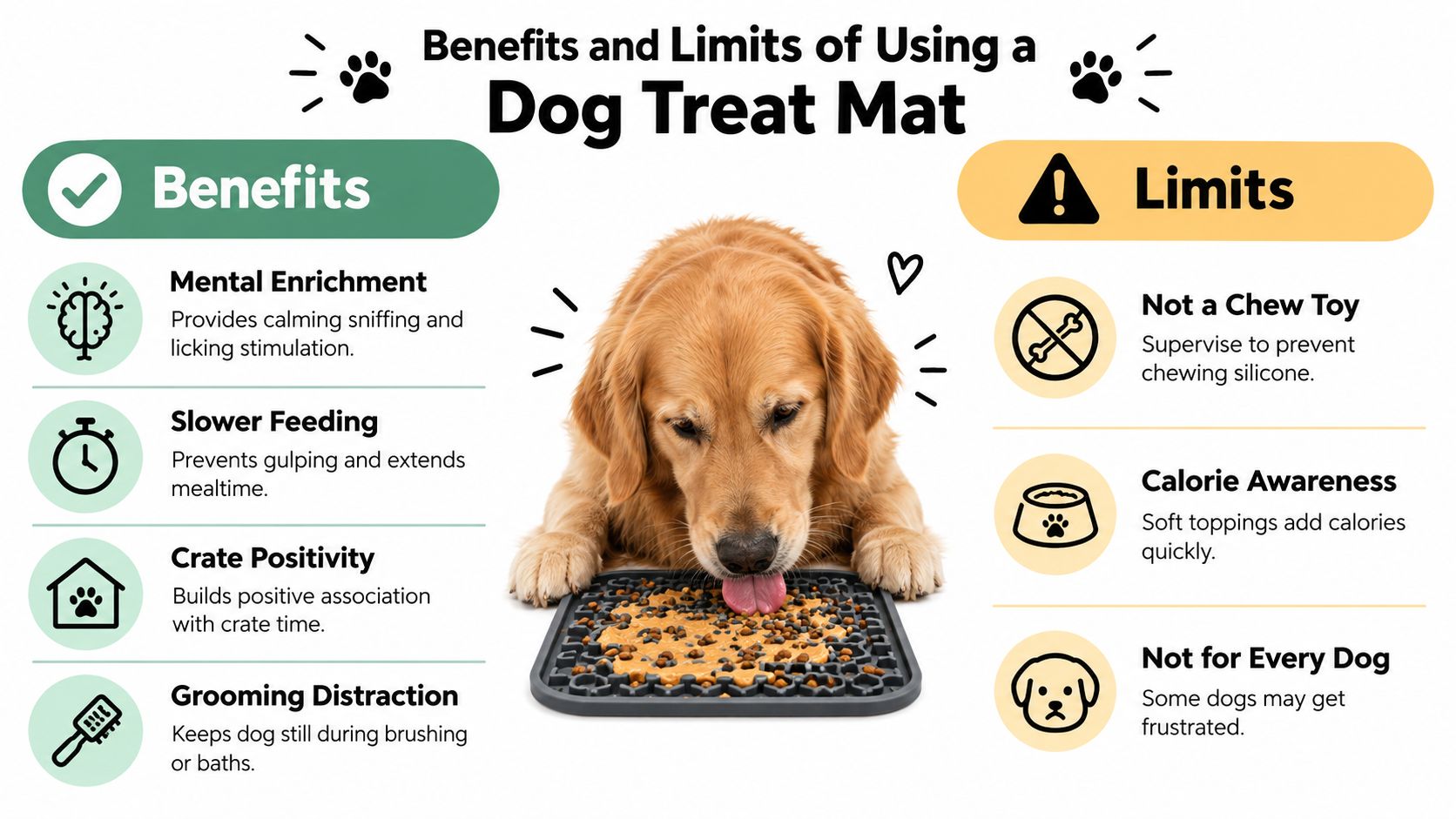
The clearest benefit is engagement. Your dog has to lick, investigate, and move across the surface instead of consuming a soft topping immediately from a bowl. That can make a snack feel more substantial without requiring a large volume of food.
A mat can also support a slower eating pattern. It isn't a substitute for a veterinary feeding plan, and it won't automatically solve gulping, but changing food access can be useful for dogs who finish soft meals too quickly. The same surface may help create positive associations with a crate, grooming area, or calm station when you introduce it before the dog feels overwhelmed.
What the mat can realistically do
A treat mat can be especially useful when your dog:
- Eats soft food quickly: The texture spreads access across the surface.
- Needs indoor enrichment: Licking and searching give the dog a food-based activity.
- Finds handling difficult: A mat may provide reinforcement during gradual brushing or nail-care training.
- Needs a predictable routine: Offering the same mat in a quiet location can become a recognizable activity.
- Enjoys food puzzles: Dogs who like manipulating food may prefer a mat to a plain bowl.
The effect is behavioral enrichment, not a medical treatment. A veterinary review states that there's currently no evidence that lick mats reliably reduce anxiety or trigger a specific calming hormone response. The veterinary review of lick mat pros and cons supports a cautious interpretation: the likely value is sustained licking and enrichment, not clinically proven anxiety reduction.
Practical rule: Use the mat to offer a manageable activity. Don't use it to dismiss persistent fear, panic, pain, or compulsive behavior.
When licking becomes the wrong assignment
Some dogs become frustrated when food is trapped in textures they can't work out. Others may fixate intensely, shove the mat around, guard it, or switch from licking to biting. A dog with stress-related or compulsive licking deserves careful observation, because redirecting an existing problem onto another licking object may not address the underlying welfare issue.
Stop the session if your dog chews the mat, shows escalating frustration, guards it aggressively, or appears unable to disengage. For repeated skin licking, object licking, sudden behavior changes, or signs of distress, involve your veterinarian and, when appropriate, a qualified behavior professional. A dog treat mat can complement a plan, but it shouldn't stand in for diagnosis or treatment.
Comparing Dog Treat Mat Types Materials and Durability
Material selection affects hygiene, comfort, and risk. Lick mats commonly hold soft, wet foods, and they encounter saliva, acidic ingredients, and repeated washing. Expert guidance recommends food-grade, non-porous silicone, with attention to certification and long-term durability. You can review the properties of food grade silicone to understand why non-porous construction is relevant for food-contact products.
Silicone is flexible and easy to freeze, but flexible doesn't mean indestructible. An independent technical review notes that chew-resistant performance is limited, and aggressive chewers can tear silicone mats, creating an ingestion risk. TPR and rubber products may feel firmer, but the label alone doesn't tell you whether a specific mat will withstand your dog's teeth.
| Material | Best For | Cleaning and Durability Notes |
|---|---|---|
| Food-grade silicone | Wet foods, freezing, regular enrichment | Non-porous surfaces are practical for washing, but aggressive chewers can tear them |
| TPR | Dogs who prefer a firmer-feeling surface | Check the maker's food-contact, dishwasher, and freezer guidance; inspect edges carefully |
| Natural or synthetic rubber | Owners seeking a flexible, grippy surface | Texture and durability vary; avoid assuming that rubber means chew-proof |
| Stainless steel inserts or dishes | Dogs who damage soft mats or need a very smooth surface | Easy to inspect and clean, though the experience differs from a flexible textured mat |
Match the design to the dog
A small dog may need a compact surface that doesn't require stretching or pushing. A large, enthusiastic dog may benefit from a heavier mat with a broad base. Suction can help on smooth floors, but it won't prevent a determined dog from lifting or chewing the mat. Raised patterns should hold enough food to create engagement without making retrieval so difficult that your dog abandons the activity.
Look for rounded edges, sturdy construction, and a texture you can reach with a brush or sponge. Very narrow channels may trap residue. A strong chemical odor, thin corners, peeling surfaces, or exposed seams should make you reconsider the purchase.
One catalog item that doesn't belong in this dog-focused use case is Probiotic Supplement for Cats - 30 Single-Serving Packets. It's formulated for cats with real beef bone broth, veterinarian-formulated probiotic strains, and third-party testing for potency and purity, so it shouldn't be treated as a dog mat topping without appropriate veterinary guidance.
How to Use and Clean Your Dog Treat Mat Safely
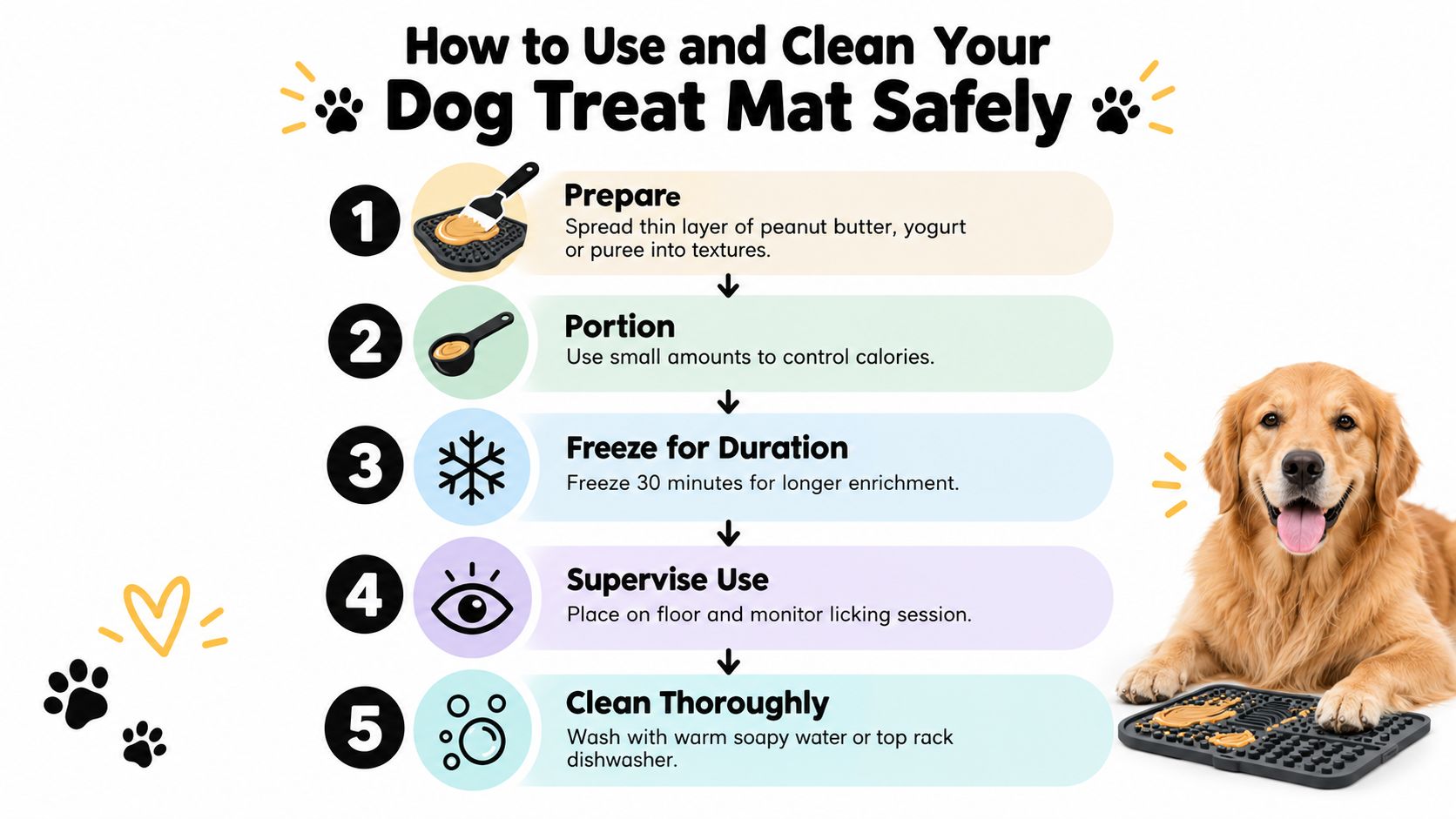
Start with the mat on the floor and offer a very thin layer of a food your dog already tolerates. Let your dog investigate without holding the mat in place or placing a hand near the food. Supervise the first sessions so you can see whether your dog licks, paws, pushes, guards, or bites.
A simple preparation routine
- Choose the food carefully. Use a dog-safe spread such as an appropriate wet diet component, plain puree, or another ingredient your veterinarian has approved. Avoid foods containing xylitol, onions, garlic, grapes, raisins, chocolate, or other ingredients known to be unsafe for dogs.
- Use part of the normal food allowance. Treats and toppers add calories, even when the layer looks small. Reserve some of your dog's regular meal or reduce other extras according to the food's energy information and your veterinarian's advice.
- Spread for access, not abundance. Press the food into the surface lightly. A thin coating across the ridges encourages licking and makes the activity last without turning the mat into a large bonus meal.
- Freeze only when appropriate. Freezing can make the food last longer, but check the manufacturer's instructions first. A frozen mat may be too difficult for a frustrated dog, so begin with a soft, chilled texture rather than making the challenge unnecessarily hard.
- Watch the dog, not the clock. End the session if your dog starts chewing silicone, becomes distressed, or guards the mat. A mat is successful when the dog remains engaged and comfortable, not when every trace of food has been removed.
Cleaning is part of safe use
Rinse the mat soon after the session so food doesn't dry inside the grooves. Wash it with warm, soapy water, paying attention to the underside and edges, or use the top rack of a dishwasher only if the manufacturer says the product is dishwasher safe. Let it dry fully before storing it, because damp folds and recessed textures can hold residue.
Perform a closer inspection during every wash. Replace the mat if you find tears, missing pieces, peeling material, or a damaged edge. Cleaning accessories and household setup matter too. If you're creating a dedicated enrichment corner, pet portrait inspiration with blankets can help you think about a comfortable, washable space without turning the mat into a permanent fixture.
A cat-specific product such as Prebiotic Tuna Squeeze Treats for Cats contains real wild-caught tuna and prebiotics, and is described as free of artificial and “natural” flavors, colors, and preservatives. It's intended for cats, so choose species-appropriate food for your dog's mat.
Training and Enrichment Ideas With JoyFull Treats
The mat becomes more useful when you assign it different jobs instead of serving the same spread in the same place every day. Begin with easy access, then alter only one feature at a time, such as texture, location, temperature, or whether the mat appears before a routine.
Five ways to build useful habits
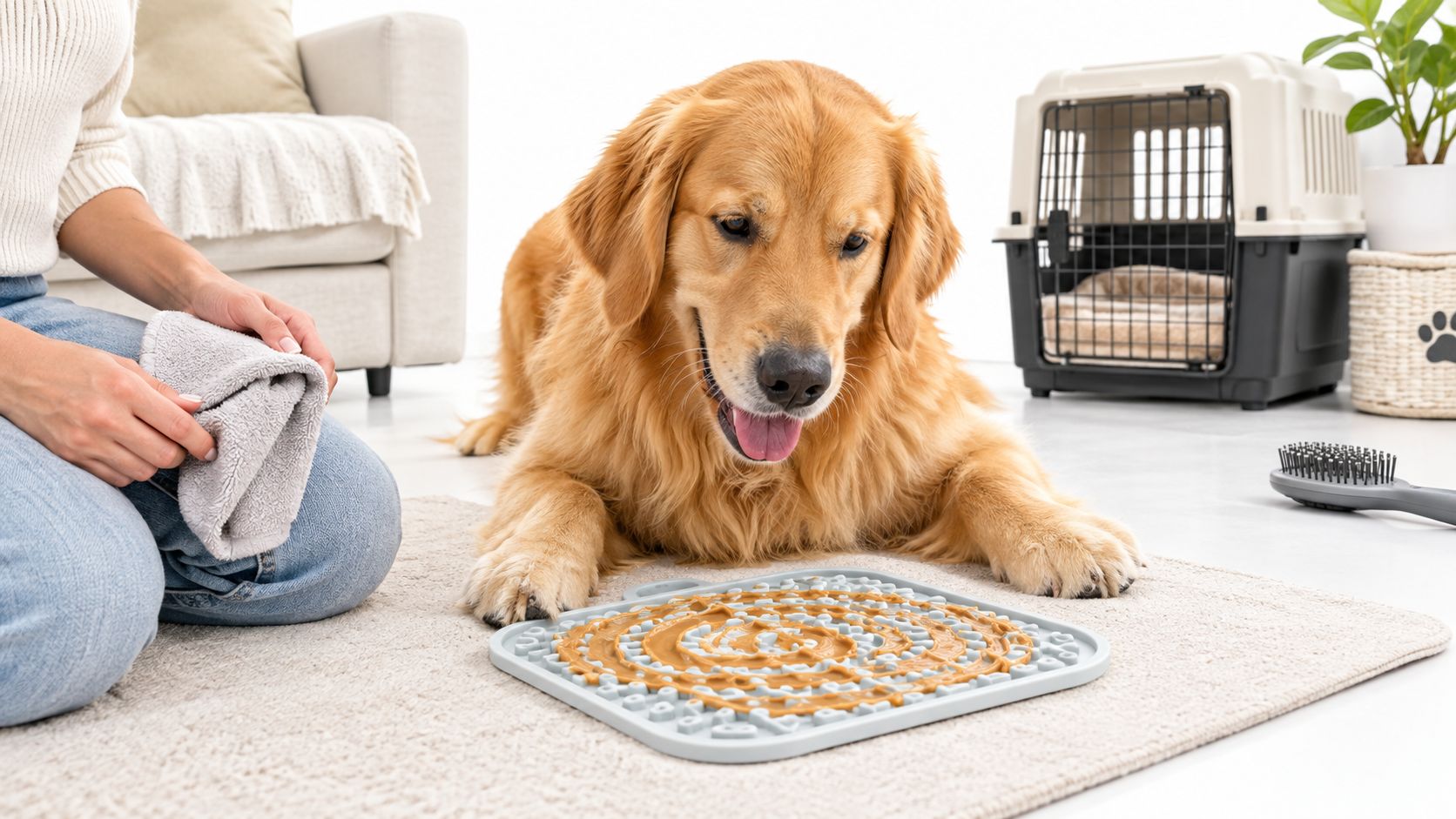
Create a station. Place the mat on a washable surface and reward your dog for stepping onto it. Once your dog returns willingly, add a brief settle cue. This supports stationing without forcing the dog to remain still.
Pair it with a crate routine. Offer the mat near the crate first, then inside an open crate, and only later during short periods with the door closed if your dog is comfortable. The mat should predict good experiences, not conceal a sudden long separation.
Use it during cooperative care. Present the mat while you touch a shoulder, lift a paw, or show a brush. Pause the handling when your dog pauses or moves away. The food supports the process, but your dog's ability to opt out remains important.
Add a sniffing layer. Hide a small amount of food in a few accessible areas, leaving other sections empty. This encourages searching without making every part equally difficult. If your dog gives up, simplify the pattern rather than adding more food.
Rotate texture and format. Alternate the mat with a snuffle mat, a slow feeder, scatter feeding, training games, or a stuffed enrichment toy. Different tools exercise different behaviors, and variety helps you notice what your dog enjoys.
For a convenient spread, dog squeeze treats can be used across the mat, inside another enrichment toy, or as a meal topper. The product snapshot describes real cage-free chicken, prebiotics, and no artificial colors, preservatives, or flavors. Use it as part of the dog's overall food plan, not as an unlimited layer.
This demonstration can help you visualize how licking-based enrichment fits into a routine:
Watch for the outcome you want. A dog who finishes and settles may be ready for a quiet transition. A dog who becomes frantic, paws repeatedly, or bites the mat needs an easier setup or another activity.
Buying Guide Safety Checklist and Final Takeaways
Choose the mat by starting with your dog's habits, not the product's calming language. A gentle licker, a fast eater, and an aggressive chewer need different designs. The safest choice is the one your dog can use without chewing, guarding, or becoming frustrated.
Check these features before buying
- Size and stability: The surface should suit your dog's body and stay reasonably stable during use.
- Food-contact material: Look for food-grade, non-porous construction and clear care instructions.
- Texture depth: Choose grooves that hold soft food but remain reachable and washable.
- Cleaning access: Confirm whether the mat is dishwasher safe and whether you can clean its underside.
- Freezer compatibility: Verify that freezing is approved before preparing chilled enrichment.
- Edge strength: Avoid thin edges, loose layers, and surfaces with a strong chemical odor.
- Chewing risk: Supervise dogs who bite, tear, or carry the mat. Replace it after damage.
- Food and calories: Treat the spread as part of the daily intake, and check every ingredient for safety.
A dog treat mat is one enrichment option among many. It can slow access to soft food, create a purposeful licking activity, and support carefully planned training routines, but evidence doesn't establish it as a reliable anxiety intervention. If your dog shows persistent fear, compulsive licking, pain, or serious guarding, ask a veterinarian or qualified behavior professional for help.
For a broader look at pet accessories, you can explore dog fashion items, but keep enrichment purchases separate from safety decisions. A stylish accessory can't compensate for a mat that tears, traps residue, or encourages unsafe chewing.
Joyfull offers lickable dog enrichment options made with clearly described ingredients, including Prebiotic Chicken Squeeze Treats that can be spread on a treat mat or used as a meal topper. Visit Joyfull to find a convenient option for your dog's portion-controlled enrichment routine.
0 comments