


You're in the pet aisle with one bag in each hand, and both of them swear they're packed with real meat. One says beef first, another says with beef, and both look convincing until you turn them over and start reading the small print. That's where the confusion starts, because the front of the bag is built to sell you a feeling, while the back of the bag is built to tell you what the food is allowed to be.
The tricky part is that dog food with real meat isn't one thing. It can mean a meat-heavy kibble, an air-dried formula with concentrated nutrients, or a fresh meal that has a lot of water removed only after cooking. The label can point you in the right direction, but it doesn't automatically tell you how much meat is in the food, whether the recipe is complete and balanced, or whether the format fits your dog's needs.
A good buying decision comes from reading three layers together, the product name, the ingredient panel, and the guaranteed analysis. Once you know how those pieces work, the bag stops looking like a marketing puzzle and starts reading like a set of clues.
Table of Contents
- Why the Bag Says What It Says
- What Real Meat Actually Means
- How AAFCO Naming Rules Reveal Real Meat Content
- Reading the Ingredient Panel and Guaranteed Analysis Together
- Kibble, Air-Dried, and Fresh Real-Meat Formats Compared
- Three Myths That Distract From Real-Meat Quality
- A Vet-Aligned Checklist for Choosing Real-Meat Dog Food
- Switching Foods and Answering the Questions That Remain
Why the Bag Says What It Says
A lot of dog parents have the same moment in the store. You pick up two bags, both claim real meat, both use photos of glossy cuts or rustic bowls, and both sound healthier than the shelf next to them. Then you notice that one says beef dog food while the other says with beef, and suddenly the whole decision feels less obvious.
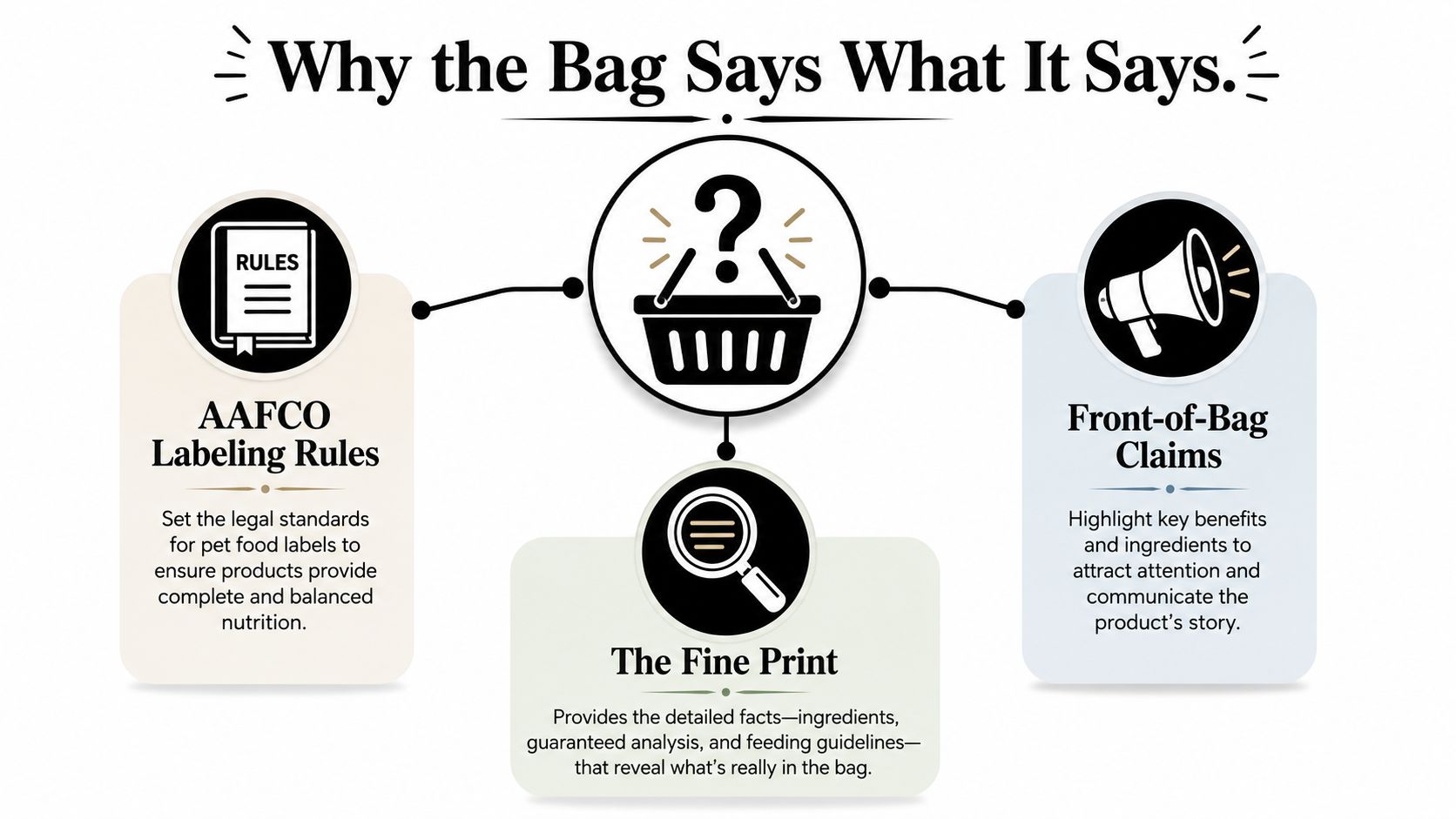
That's because the bag is doing three jobs at once. Front-of-bag claims are designed to catch your eye, AAFCO labeling rules control how the name can be used, and the fine print tells you whether the food is complete for your dog's life stage. The front can be honest and still be misleading if you don't know the naming rules.
The three places to check
Start with the product name. It's the fastest clue to what dominates the formula, especially when species names are used in a specific way. Then move to the ingredient panel, because that's where you can tell whether the protein is clearly identified or buried under vague terms.
Practical rule: treat the front of the bag as a headline, not a verdict.
Finally, read the guaranteed analysis and the nutritional adequacy statement. The analysis gives you minimums and maximums, while the adequacy statement tells you whether the food is formulated for growth, adult maintenance, or another life stage. If you skip that line, you can end up with a food that sounds premium but doesn't fit the dog in front of you.
There's also a useful gap in the way people shop today. Many articles tell you how to spot real meat on the label, but they don't answer the more practical question of whether that wording predicts a nutritionally complete food. That's why the rest of the bag matters as much as the front, and why a label can be technically true without being the whole story.
What Real Meat Actually Means
In pet food language, real meat means animal muscle tissue. Think of the same parts people eat as steak, roast, or ground meat, not a vague flavor cue and not a catch-all for anything that came from an animal. Purina's guidance uses that basic idea and also points out that dogs can get nutrition from both animal and plant sources, which is why a meat claim alone doesn't tell you whether the whole recipe is well built.
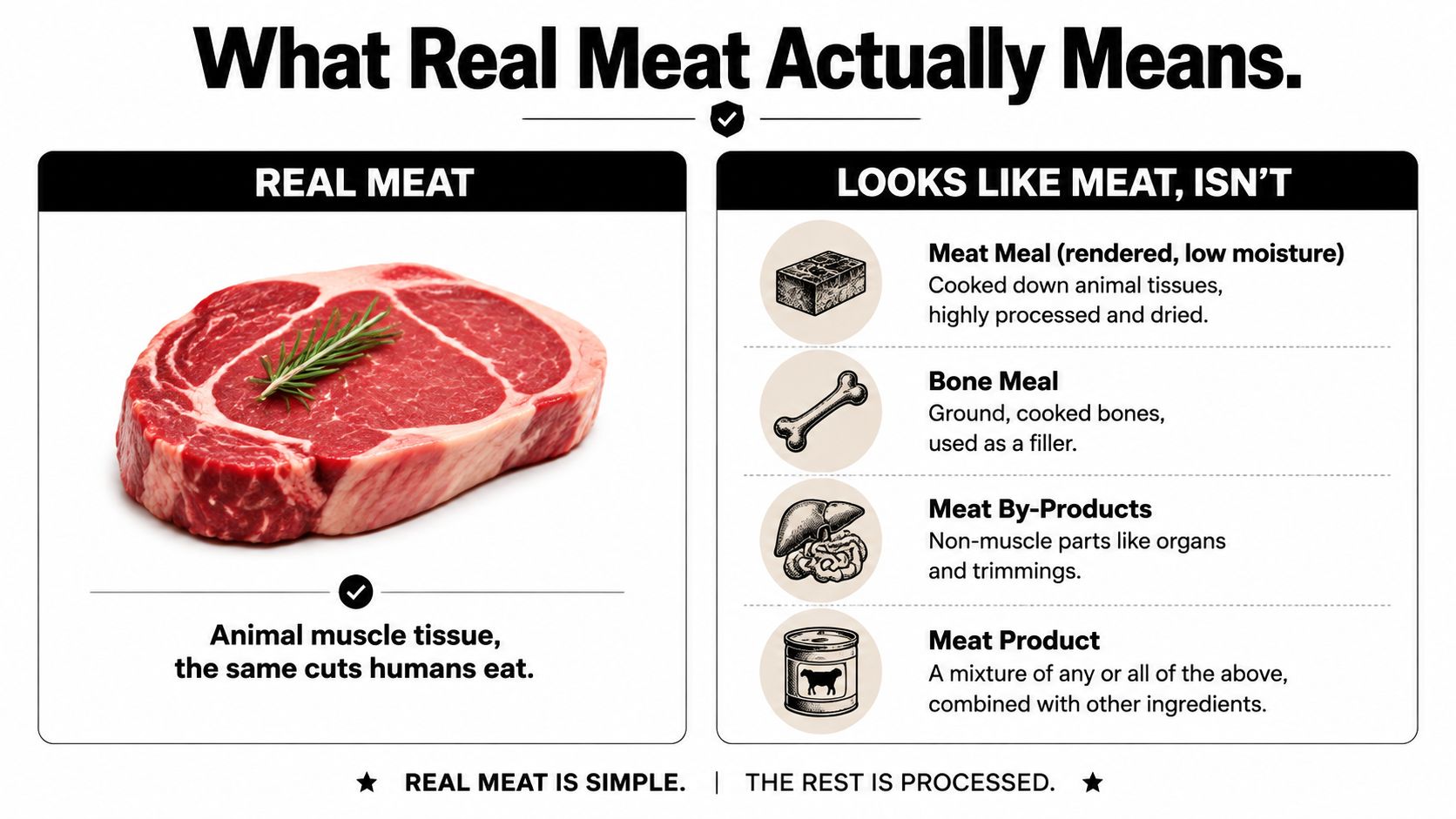
The ingredient names that sound similar but aren't the same
A meat meal is meat with the water removed, so it's more concentrated than fresh muscle tissue. That's why jerky and steak are a good analogy, steak carries more water, while jerky is the dried, tighter version of the same basic ingredient.
Meat by-products are different again. They can include organ tissue and other non-muscle parts, and that doesn't automatically make them bad. In fact, a smoothie analogy fits here better than a steak analogy, because whole-animal nutrition often uses more than just muscle meat.
Meat digest is a flavor ingredient. It's meat that's been broken down so it can add taste, not a stand-alone signal of meat content.
One other label wrinkle is the word meat inside a broader name. If a bag says “meat flavor” or uses a vague speciesless term, it may not mean what a shopper assumes. The ingredient list is where you separate actual muscle tissue from marketing language.
Dogs don't eat labels. They eat what the formula actually contains.
That's why a bag can lean hard on the phrase real meat and still lean on a broad ingredient system behind the scenes. If the panel lists named organs, meals, or digests, you're looking at a processed formulation, not a single unprocessed cut. The question isn't whether those ingredients are allowed, it's whether you understand what role they're playing in the recipe.
One practical example from the market: a product like Probiotic Supplement for Cats is marketed around real beef bone broth, but even there, the useful question is what the full formulation is designed to do, not just which ingredient appears on the front. That same mindset applies to dog food, because front-panel language is only the starting point.
How AAFCO Naming Rules Reveal Real Meat Content
The label stops being fuzzy and starts becoming measurable. In U.S. pet-food naming, “beef dog food” isn't a casual phrase, it's a technical one. According to AAFCO and Merck guidance, if a product is named with the species, beef ingredients must make up at least 70% of the total product or at least 95% of the total ingredient weight excluding water; by contrast, “with beef” only requires about 3% beef. Merck Veterinary Manual guidance on dog and cat foods
Reading the name like a decoder ring
That means the same word on the front can signal very different realities. A bag called Beef Dog Food is supposed to be overwhelmingly beef-based. A bag called Beef Dinner sits much lower on the scale, and a product labeled With Beef can contain only a small amount of beef while still saying the word prominently on the front.
This is the part most shoppers miss. “Real meat first” sounds strong, but the actual name category matters more than the slogan. A kibble can put beef at the top of the ingredient list and still use a naming pattern that allows far less beef than a shopper would expect from the front panel alone.
Why the wording changes the meaning
The rule helps explain why two products can both look like meat-forward foods and still be built very differently. One is meant to signal a dominant protein base, while the other may use beef as a supporting ingredient or flavor note. If you don't translate the name, you may assume the bag contains much more meat than the rule requires.
For a broader walk-through of the label language, the guide to pet food rules is useful because it separates naming claims from formulation claims in plain English. The key takeaway is simple, the front of the bag is not a meat meter. It's a regulated naming system.
When buyers ask whether a food is meat-heavy, the answer starts with the name, then moves to the ingredient panel, and only then lands on the guaranteed analysis. That sequence keeps you from over-reading a single phrase like with beef or under-reading a phrase like beef dog food.
Reading the Ingredient Panel and Guaranteed Analysis Together
The ingredient list and the guaranteed analysis work like two halves of the same map. The ingredient panel tells you what was used, while the guaranteed analysis tells you how much nutrition is present in the finished food, at minimum or maximum levels. The mistake is reading one without the other, then assuming you've understood the formula.
As-fed numbers can mislead you
A lot of shoppers compare protein percentages on the bag and stop there. That works only if the foods have similar moisture, and many real-meat formats do not. A product with lower moisture naturally looks more concentrated on paper, even if the recipe ingredients are different.
Here's a concrete comparison from two beef formulas. One air-dried beef formula lists 35% crude protein, 20% crude fat, and 15% moisture. Another beef formula lists 3835 kcal/kg, 28% crude protein, 27% crude fat, and 17% moisture. Because dry-matter content is roughly the inverse of moisture, both products are about 83–85% dry matter, which is why they can pack more nutrition into less serving size than high-moisture foods. Real-meat air-dried beef product data
| Metric | Formula A (As-Fed) | Formula A (Dry Matter) | Formula B (As-Fed) | Formula B (Dry Matter) |
|---|---|---|---|---|
| Crude Protein | 35% | Higher after moisture is removed | 28% | Higher after moisture is removed |
| Crude Fat | 20% | Higher after moisture is removed | 27% | Higher after moisture is removed |
| Moisture | 15% | 85% dry matter | 17% | 83% dry matter |
| Calories | Not listed in the snapshot | Not calculated here | 3835 kcal/kg | Not recalculated here |
The one line that settles the life-stage question
The most important sentence on the back of the bag is the nutritional adequacy statement. That's the line that tells you whether the food is complete and balanced for adult maintenance, growth, or another life stage. If that statement doesn't fit your dog, the food may still be perfectly fine as a topper or rotational option, but it shouldn't be treated like a full diet.
Watch the serving math: denser foods can look cheaper until you realize you feed less or, in some cases, need to recalibrate portions because the calories are concentrated.
If you want a cleaner example of how people learn to read labels step by step, the how to read dog food labels guide is a useful companion. The big idea here is that ingredient identity and nutrient density are not the same thing. One tells you the recipe story, the other tells you how the meal behaves in the bowl.
Kibble, Air-Dried, and Fresh Real-Meat Formats Compared
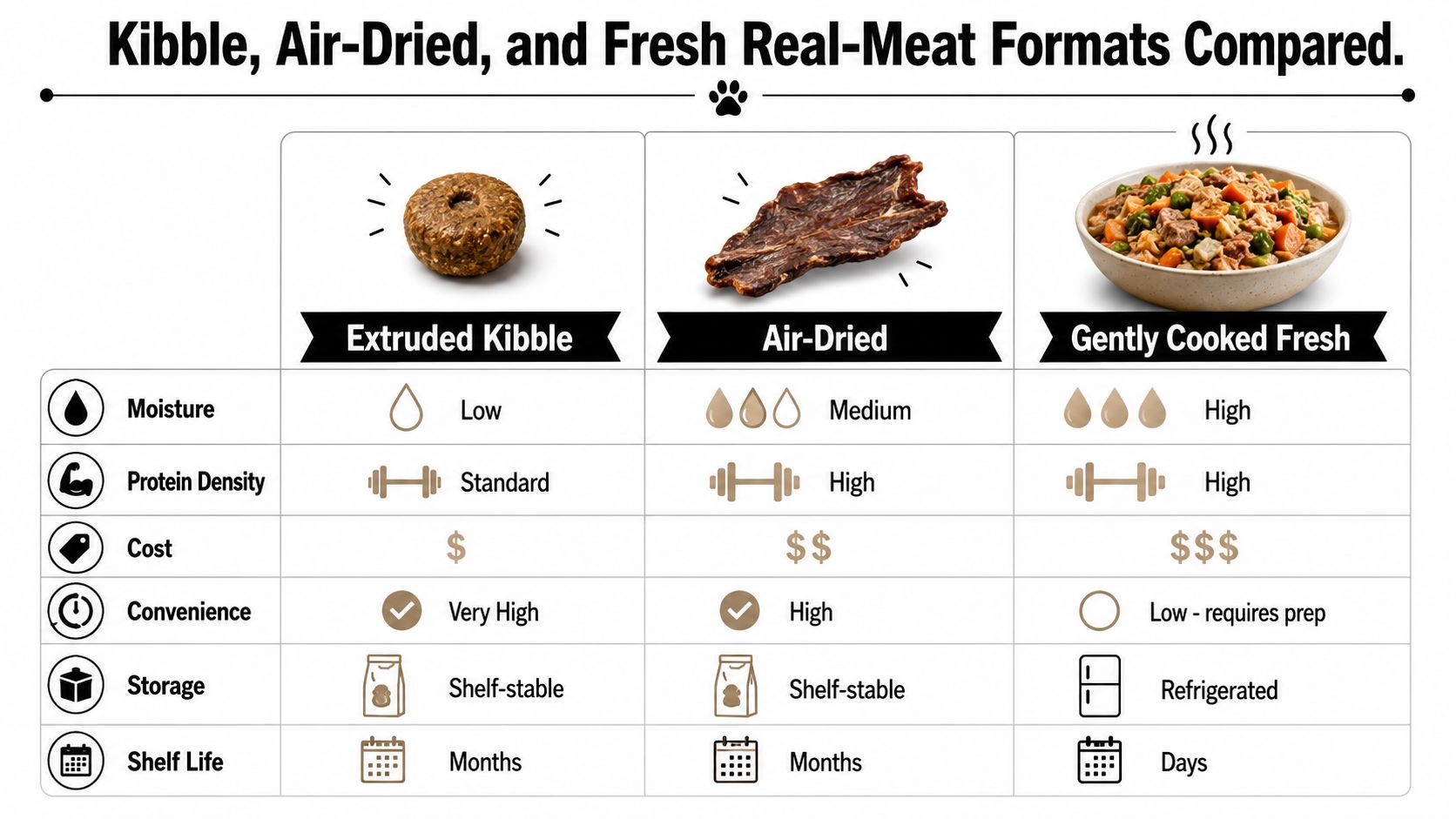
Format changes how much value you get from a real meat claim. A bag can say the same thing on the front and still deliver a very different feeding experience depending on whether it's extruded kibble, air-dried, or gently cooked fresh. That difference matters for storage, serving size, portion control, and how easy it is to keep the food on hand day to day.
What each format is good at
Extruded kibble is the most convenient. It's shelf-stable, easy to measure, and simple to store. For a budget-conscious household or a travel-heavy routine, that convenience often matters more than texture or moisture.
Air-dried food sits in the middle. It's still shelf-stable, but because dehydration removes water and keeps solids, the nutrients are concentrated into a smaller serving. That can make it appealing for active dogs or for people who want a more meat-forward bowl without freezer space.
Gently cooked fresh food usually brings the highest moisture and the most prep friction. It often needs refrigeration and a quicker turnover, so it suits people who are comfortable managing storage and portions carefully.
The trade-offs nobody wants to explain
Fresh and air-dried foods can make “real meat” feel more visible, because the ingredients look and smell closer to food you'd recognize at the human table. That doesn't automatically mean they're better for every dog. A senior dog who does well on smaller, easier-to-chew bites may appreciate one format, while a hiking dog may need something else entirely.
The market is already crowded with fresh and air-dried positioning. Brands like Chewy's Get Real and PetPlate market gently cooked, human-grade meals, while The Real Meat Company highlights air-dried foods with 95% meat and no fillers, according to the product coverage in the brief. At the same time, brands such as Purina ONE and Blue Buffalo still use “real meat first” language in conventional kibble, which shows that the phrase itself has become a baseline marketing expectation, not a guarantee of format or quality.
The format can amplify the meat claim, or it can hide it behind convenience.
For practical enrichment and treat comparisons that think about format the same way, the vet-reviewed dog treat benefits discussion is a helpful adjacent read. The same logic applies here, the best format is the one you can feed consistently, store safely, and portion accurately for your dog's actual routine.
Three Myths That Distract From Real-Meat Quality
One of the easiest ways to waste money on dog food is to chase a slogan instead of a formula. Three myths keep pulling people off track: that grain-free is automatically better, that by-products are always filler, and that the first ingredient tells the whole story. Each one has a grain of truth, but none of them is a reliable shortcut by itself.
Grain-free is not a universal upgrade
Some shoppers see grain-free and assume the food is cleaner or more biologically correct. That mindset ignores the fact that grains are tolerated by most dogs, and it also skips over the fact that the FDA has investigated potential diet-related heart concerns around certain diet patterns. The safer question is not whether a food is grain-free, but whether it's complete, balanced, and appropriate for your dog.
By-products can be useful parts of the recipe
“By-products” sounds like waste to many people, but the term can include organ meats such as liver and kidney. Those ingredients are nutrient-dense in nature, and they fit a whole-animal model much better than a muscle-meat-only model. A food can still be poorly made with by-products, but the category itself isn't the problem.
The first ingredient only tells you so much
Ingredients are listed by pre-processing weight, which means water content can influence the order. A fresh ingredient can look dominant on the list even if the finished formula is less meat-heavy than you expect after processing. Brands can also split similar ingredients across multiple lines, which makes the total contribution harder to see at a glance.
Simple rule: don't judge the bag by the first line only, judge it by the whole panel.
That's why a label like “real meat first” needs context. It can be a useful clue, but it doesn't tell you whether the food relies on a complete nutrient profile, whether the meat is the dominant component after processing, or whether the formula is built for the right life stage. The bag wins your attention with a short phrase, but the ingredient panel is where the assessment starts.
A Vet-Aligned Checklist for Choosing Real-Meat Dog Food
A good shopping decision doesn't need a spreadsheet. It needs a short checklist you can run in under a minute. Start with the nutritional adequacy statement, because that tells you whether the food is complete and balanced for your dog's life stage. Then look for a named protein source near the top of the ingredient list, not a vague catch-all like “animal” or “meat” with no species attached.
The store shelf test
Ask these questions in order.
- Is there a life-stage statement? If the bag doesn't tell you whether it's for growth, adult maintenance, or all life stages, keep moving.
- Is the protein named? Beef, chicken, turkey, lamb, and similar terms give you more clarity than generic animal ingredients.
- Does the front name match the meat content language? “With beef” and “beef dog food” are not interchangeable.
- Does the brand explain how it was formulated? Feeding trials and formulation methods matter because they show the company did more than write a marketing claim.
- Is the origin clear? Country-of-origin labeling helps you understand sourcing and traceability.
If you're also choosing food with oral health in mind, the dental care diet recommendations from PetScy are a useful extra lens, since food texture and chewing behavior can matter alongside protein content. The point isn't to find one magical bag. It's to choose a formula that fits your dog's body, your routine, and your willingness to store and serve it correctly.
A clean-ingredient brand like Joyfull follows a similar logic in its own product process, with formulas that are reviewed by an in-house veterinary advisor and tested for ingredient quality. That's the kind of process clue worth looking for anywhere, because it tells you the company is thinking about nutrition, not just label appeal.
Switching Foods and Answering the Questions That Remain
When you move a dog onto a new food, go slow. A 7 to 10 day gradual mix gives the gut time to adjust, and it's especially helpful when you're moving from kibble to a denser air-dried or fresh format. Start with a small portion of the new food mixed into the old one, then increase the new food step by step while watching stool quality, appetite, and energy.
What to watch during the switch
If the new food is more calorie-dense, portions may need recalibration. A dog can look like it's eating “less food” while still getting the right calories, or it can gain weight if the new format is richer than the old one and the bowl size stays the same. Keep an eye on stool volume too, because more concentrated diets can change what comes out the other end.
Call your vet if you see persistent vomiting, repeated diarrhea, a big drop in appetite, or a sudden energy change that doesn't settle. Those signs matter more than label hype. A good food still needs to work in your dog's actual body.
Quick questions people ask
Do puppies need different real-meat considerations? Yes. Puppies need food that's specifically labeled for growth or all life stages, because they need consistent nutrient balance while they're developing.
Should senior dogs always switch to lower protein? No. Age alone doesn't tell you the answer. The right decision depends on body condition, kidney status, activity, and whether the formula is complete.
What if my dog has chicken or beef sensitivities? Pick a clearly named alternative protein and read the full panel carefully, because “single protein” and “limited ingredient” aren't magic words unless the formula supports them.
Are raw real-meat diets worth the handling risk? They can be appropriate for some households, but the average home has to weigh storage, cross-contamination, and consistency. For many families, a complete and balanced cooked, air-dried, or kibble format is easier to manage safely.
If you want help choosing a real-meat food without decoding every bag on your own, start at Joyfull and look for products built with clean ingredients, veterinary review, and practical feeding in mind. The same label-reading habits you used here will help you compare options quickly and choose a food that fits your dog, your routine, and your standards.
0 comments