


Your new puppy comes home, settles in for a few days, and then develops soft stools. Or perhaps your older dog has a sensitive stomach, and you're looking for gentle immune or digestive support. A colostrum supplement for dogs can look appealing in either situation, especially when product labels promise help for immunity, gut health, allergies, and recovery.
Colostrum is biologically interesting, but it isn't a miracle cure. The useful questions are more practical: What does colostrum contain? Which benefits have been measured in dogs? How should owners think about dosing and safety? And can processing or storage reduce the activity of the ingredients that matter?
This guide focuses on those questions. You'll learn how bovine colostrum differs from ordinary milk, what controlled canine trials have found, which dogs may be reasonable candidates, and how to assess a product before it reaches your shopping basket. A veterinarian should remain part of the decision, particularly if your dog has ongoing diarrhea, vomiting, allergies, a diagnosed illness, or takes medication.
Table of Contents
- Introduction to Colostrum Supplements for Dogs
- What Colostrum Is and How It Works in Dogs
- Clinical Benefits and What the Evidence Actually Shows
- Which Dogs May Benefit Most and When to Be Cautious
- Dosing Guidelines Safety and Possible Interactions
- How to Evaluate Product Quality and Choose Wisely
- Making Confident Choices for Your Dog's Wellness
Introduction to Colostrum Supplements for Dogs
A puppy's first weeks involve several changes at once. Rehoming separates the puppy from its mother and littermates, while a new diet, unfamiliar sounds, altered sleep, and travel can all challenge digestion. Loose stool during this transition may be minor, but it can also signal parasites, infection, food intolerance, or another issue that needs veterinary attention.
That's why colostrum deserves a measured explanation rather than a sales pitch. The supplement comes from the first milk produced after birth, and bovine colostrum is commonly used in canine products because it contains immune proteins and other biologically active components. Those ingredients make it plausible as a supportive gut and immune supplement, but plausibility isn't the same as proof for every product or every dog.

The strongest canine evidence is specific. An early controlled trial examined stool quality in puppies experiencing a stressful diet and environment change. A later trial looked at vaccine response, fecal IgA, and gut microbiota in adult dogs. Those findings help explain where colostrum may be useful, but they don't justify calling it a treatment for disease or assuming that every powder, chew, or blend has the same activity.
A sensible starting point: Identify the problem first, then decide whether a supplement has a reasonable role. A supplement shouldn't delay diagnosis.
The shelf introduces another layer of uncertainty. Processing and storage can affect biological activity, and a product that contains colostrum in principle may not deliver the same useful components after manufacturing and shelf life. The label therefore matters almost as much as the ingredient name.
You'll also see an important distinction throughout this guide: safe does not automatically mean effective. A recent study found good tolerability in healthy and atopic dogs but no measurable immunological effects, so owners should judge products by controlled evidence, transparent labeling, and a clear goal rather than by broad claims.
What Colostrum Is and How It Works in Dogs
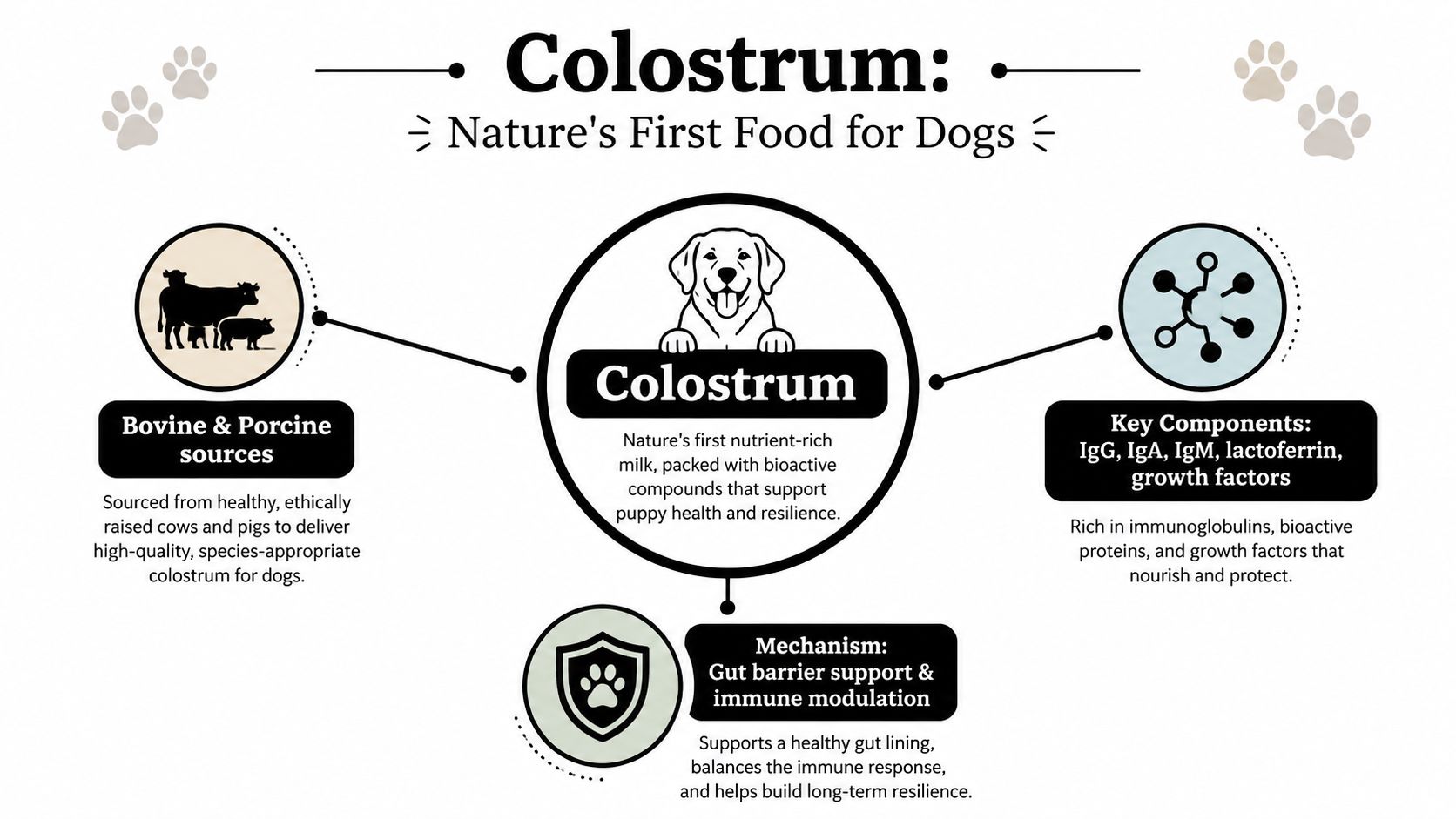
Colostrum is the thick first milk produced after a mammal gives birth. It differs from mature milk because it contains a concentrated mix of proteins, immune factors, growth-related compounds, and other nutrients intended to support a newborn during a vulnerable stage.
A useful analogy is a starter toolkit. Immunoglobulins are like tools that can recognize and bind certain unwanted material at the gut surface. Growth factors and related compounds are more like repair supplies, supporting the tissues that line the digestive tract. Neither analogy means colostrum acts as a guaranteed shield or repairs every intestinal problem. It shows why researchers examine both immune and digestive outcomes.
Common components include:
- Immunoglobulins: IgG and IgA are antibody classes associated with immune defense at and around the gut. Colostrum can also contain IgM.
- Lactoferrin: This iron-binding protein is studied for immune and microbial interactions.
- Growth factors: These compounds are associated with tissue maintenance and repair, including the gut lining.
- Oligosaccharides and related compounds: These may interact with the intestinal environment and resident microbes.
- Other signaling proteins: Colostrum contains additional bioactive compounds that may influence immune regulation rather than "boost" immunity.
Why bovine colostrum appears in dog products
Most commercial canine products use bovine colostrum, collected from cows, rather than canine colostrum. The reason is practical and biological. Cows produce colostrum in quantities suitable for collection, and several of its components are relevant to mammalian gut and immune biology. Some products may use other animal sources, including porcine colostrum, so owners should check the source instead of assuming every product is identical.
The supplement may come as a powder, capsule, chew, or ingredient in a broader gut-health blend. A spray-dried powder is often mixed into food, while a chew may be easier for some households to administer. The form doesn't prove potency. A convenient chew can still have unclear active-ingredient content, and a powder can still lose activity if it was processed or stored poorly.
Colostrum also shouldn't be confused with a probiotic. Probiotics supply live microorganisms, while colostrum supplies proteins and other compounds. For comparison, Probiotic Supplement for Cats - 30 Single-Serving Packets is described as a cat product made with real beef bone broth, veterinarian-formulated probiotic strains, two complementary prebiotics, and individual sealing to help preserve probiotic potency. That's a different category from colostrum, even though both products may be discussed in the context of digestive support.
The key question is not whether colostrum contains interesting molecules. It does. The more useful question is whether the finished product preserves those molecules and whether the dog's specific goal matches the outcomes studied in canine research.
Clinical Benefits and What the Evidence Actually Shows
A dog may finish a new diet with softer stools, while another develops no digestive change at all. Controlled trials help separate those outcomes from testimonials by comparing groups under defined conditions. They also show where a supplement's effects stop.
Stool quality during a stressful transition
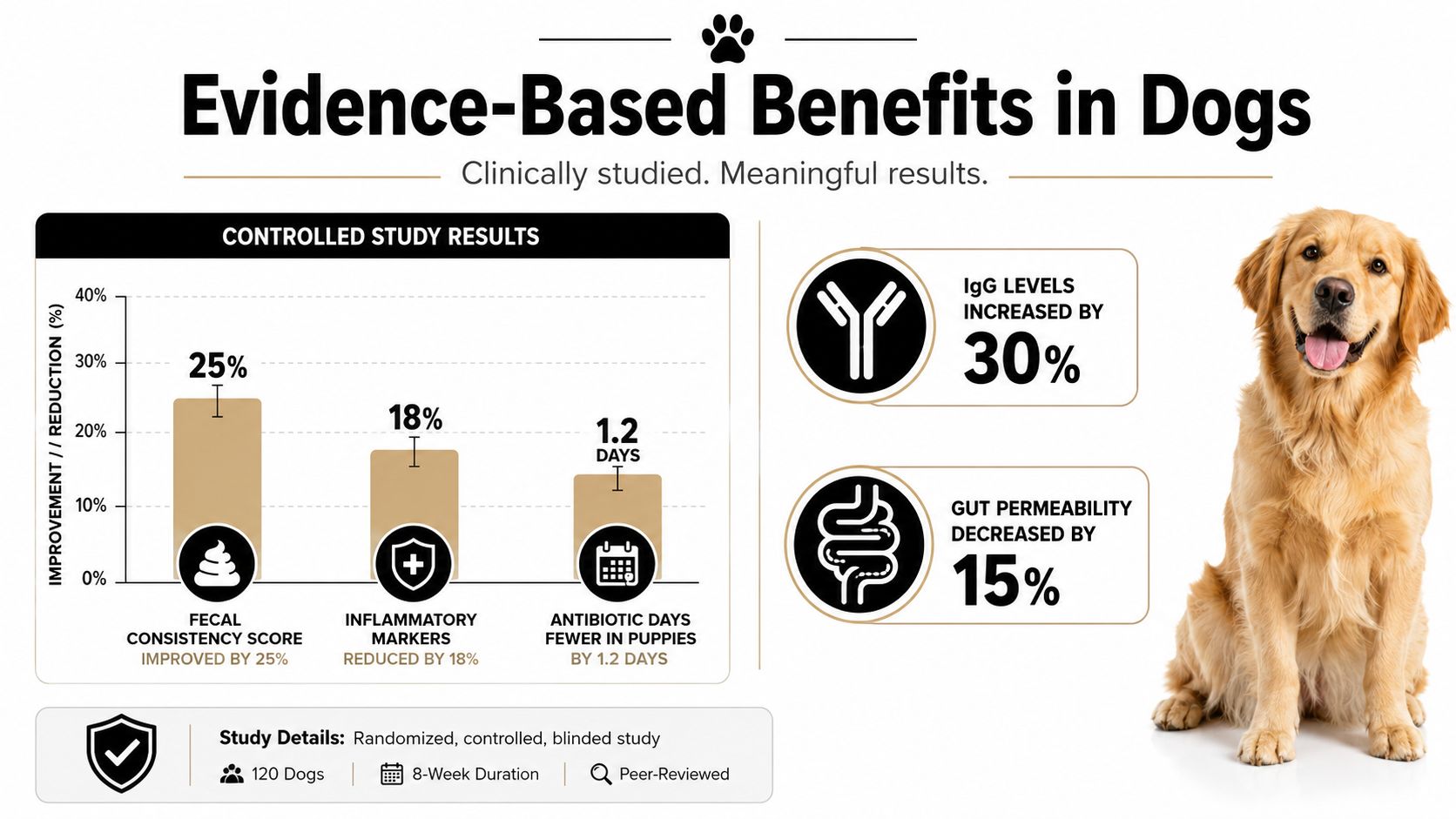
A randomized, placebo-controlled trial in Japan followed 70 puppies, mostly toy breeds, aged 40 to 50 days, for 10 days during a diet and environment change. The colostrum group received 0.5 g of bovine colostrum powder daily, and the control group received 0.5 g of skim milk powder daily. From days 6 to 9, the colostrum group had significantly lower fecal scores, indicating better stool quality during that transition. Read the controlled puppy trial in the full publication.
The result measures something owners can observe, rather than relying on broad promises about “detoxification” or “immune boosting.” Its relevance is narrow, however. It supports a possible benefit during a short, stressful change in young puppies. It does not show that colostrum resolves chronic diarrhea, replaces parasite testing, or helps every adult dog with digestive symptoms.
Vaccine response and gut immune markers
A controlled dog study published in 2013 included 24 dogs with a mean age of 2.5 years. The dogs completed an 8-week pre-test phase, followed by a 40-week test phase. After the pre-test phase, every dog received a canine distemper virus vaccine. The test group then ate a diet containing 0.1% spray-dried bovine colostrum.
Compared with controls, supplemented dogs showed a significantly higher vaccine response, higher fecal IgA, and greater gut microbiota diversity and stability. The study reported no detectable side effects. See the 2013 controlled study abstract.
These outcomes examine more than stool appearance. Vaccine response is a measured immune result, fecal IgA provides information about mucosal immune activity, and microbiota diversity and stability describe parts of the gut ecosystem. The findings belong to the tested formula and feeding protocol. A product labelled only as a generic “colostrum blend” may not reproduce them, especially if processing or storage has reduced the activity of its proteins.
Why tolerability needs a separate category
A 2024 study found bovine colostrum was well tolerated in healthy and atopic dogs but produced no measurable immunological effects, as reported in its study record. Tolerability and effectiveness answer different questions. A dog can take a product without an obvious reaction while showing no measurable immune change.
Owners considering broader allergy-support habits can read this winter allergy relief guide for general context, but human wellness advice does not transfer directly to dogs. Diet, disease, medication, and vaccination decisions require species-appropriate veterinary guidance.
Overall, evidence is most encouraging for targeted outcomes, particularly stool quality during a puppy transition and selected immune or microbiome measures. It remains limited across different products, processing methods, storage conditions, and adult dogs. A safe product is not automatically an effective one.
Which Dogs May Benefit Most and When to Be Cautious
The best candidate isn't “a dog that needs more immunity.” Immune activity has to stay balanced. Adding a supplement without a defined purpose can create expense, dietary complexity, and confusion about what caused a benefit or side effect.
Situations where a discussion may be reasonable
Puppies going through change have the clearest practical connection to the early stool-quality trial. Weaning, rehoming, travel, and a diet change can all alter bowel habits. A veterinarian should still assess persistent or severe signs, but a carefully selected supplement may be discussed as one part of a transition plan.
Dogs with recurring digestive sensitivity may also prompt a conversation about gut support. Colostrum isn't a substitute for checking diet ingredients, parasites, pancreatic disease, infection, or inflammatory conditions. If your dog has repeated symptoms, the diagnostic work comes first.
Senior dogs can have changing nutritional and digestive needs, although age alone doesn't prove that colostrum will help. The sensible approach is to define the goal, review the dog's current diet and medications, and introduce only one new variable at a time.
Dogs with atopic disease deserve realistic expectations. The available tolerability finding in healthy and atopic dogs did not show measurable immunological effects, so colostrum shouldn't replace an allergy diagnosis or an established treatment plan.
Situations that call for extra caution
Dogs with known dairy or beef-protein sensitivities may react to bovine colostrum. Pregnant or nursing dogs, dogs taking immunosuppressive medication, and dogs with diagnosed illness should receive individualized veterinary advice before supplementation.
Avoid treating active illness with a supplement alone. Vomiting, persistent diarrhea, weight loss, marked lethargy, breathing trouble, or a sudden change in appetite can require prompt assessment.
Use the goal as your filter: If you can't describe what you want to monitor, you'll struggle to tell whether the product is helping.
A probiotic may be a more direct category for some digestive goals. Owners comparing options can review dog probiotics, but the choice should follow the dog's symptoms and veterinary advice, not a label's promise that every gut ingredient works in the same way.
Dosing Guidelines Safety and Possible Interactions
A study dose is a research recipe, not a universal scoop. The puppy trial used 0.5 g daily, while the adult-dog diet trial included 0.1% spray-dried bovine colostrum in the food. Each amount applied to a particular product, formulation, dog group, and study design. Body size, health status, the finished product, and the label's directions all matter, so use these protocols as context rather than instructions to copy.
A safer household routine is simple:
- Ask your veterinarian first if your dog has a medical condition, takes medication, is pregnant or nursing, or has a history of food reactions.
- Follow the product label instead of converting a study dose into a standard scoop.
- Introduce it gradually, particularly for a dog with a sensitive digestive system.
- Give it consistently, usually mixed with food if the label allows.
- Track the baseline, including stool, appetite, vomiting, itching, energy, and the reason for starting supplementation.
Stop the product and contact a veterinarian if you notice softer stool, gas, vomiting, facial swelling, hives, or breathing difficulty. Facial swelling and breathing difficulty require urgent care.
Colostrum should not delay treatment for infection, ongoing diarrhea, unexplained weight loss, or another active medical problem. Safe use also does not guarantee a meaningful effect. The adult controlled trial found a stronger vaccine response under its specific conditions, whereas another study found no measurable immunological effects despite good tolerability. Those findings do not establish that colostrum improves vaccine protection in every dog.
Ask your veterinarian whether colostrum fits with probiotics, allergy treatment, vaccines, or prescription medication. They can also help determine whether a symptom points to a nutritional issue, an adverse food reaction, or a disease requiring a different intervention. A controlled trial can show what happened with one tested protocol, but it cannot replace checking the product's processing, storage instructions, and suitability for your individual dog.
How to Evaluate Product Quality and Choose Wisely
The ingredient name alone doesn't tell you how much biological activity remains in the finished product. A 2025 evidence review notes that processing and storage can reduce biological activity, while controlled studies in adult dogs and cats remain sparse. That makes the shelf-life question central, not secondary. Review the discussion of bovine colostrum evidence and product stability.
Start with the source. The label should identify whether the product uses bovine or another type of colostrum, rather than hiding the origin inside a proprietary blend. Then look for meaningful details about the active fraction, such as stated immunoglobulin or IgG content. A vague “immune complex” claim gives you less information than a label that identifies what the manufacturer measures.
Processing deserves equal attention. Ask whether the company explains its drying method, temperature controls, packaging, and storage requirements. Spray-drying appeared in the controlled adult-dog diet study, but that doesn't mean every spray-dried product is equivalent. Manufacturing conditions, testing, and shelf life still matter.
Use this shelf checklist:
- Source clarity: The animal source is identified.
- Active-ingredient transparency: The label states measurable immunoglobulin content when available.
- Testing: The company explains testing for potency, contaminants, and identity.
- Freshness information: Expiration dates and storage instructions are easy to find.
- Formulation simplicity: You can see how much colostrum is present, rather than relying on an undisclosed blend.
- Practical administration: The format suits your dog and lets you follow the serving guidance accurately.
Powders may make it easier to see and measure the colostrum ingredient, while chews can add flavoring, binders, and moisture that affect formulation and storage. Neither format automatically wins. Choose the one with the clearest evidence and handling instructions.
If your goal is broader digestive support rather than colostrum specifically, you may also encounter prebiotics for dogs. Prebiotics and colostrum are different tools, so compare the stated ingredients and intended use instead of treating them as interchangeable.
Making Confident Choices for Your Dog's Wellness
A thoughtful decision starts with four questions. What problem are you trying to address? What evidence matches that problem? Is your dog a safe candidate? Can you verify the product's quality and storage requirements?
For a puppy facing a stressful transition, the controlled stool-quality evidence is relevant, but veterinary monitoring still matters. For an adult dog, the vaccine-response and microbiome findings are encouraging, yet they came from a defined diet and study product. For an atopic dog, tolerability alone shouldn't create an expectation of measurable immune benefit.
Keep the trial simple. Change one dietary variable at a time, record the outcome you care about, and stop if your dog develops signs of intolerance. A veterinarian can help decide whether colostrum, a probiotic, a prebiotic, or no supplement is the most appropriate option.
Clean ingredients and transparent testing won't guarantee a result, but they give you better information than a broad promise. You can compare related options in the gut health favorites collection for pets, then bring the product label to your veterinarian for a final review.
Joyfull offers pet wellness products built around clearly identified ingredients and veterinary review, which can help owners compare digestive-support options more thoughtfully. Visit Joyfull to explore the collection, read the product details, and choose the next step with your dog's specific needs in mind.
0 comments