


62% of global pet owners switch foods because of ingredient lists, and 90% say reading those lists matters before buying. Clean cause ingredients therefore means more than removing artificial colors. It means choosing traceable, digestible proteins, limiting unnecessary additives, and asking whether a formula has been tested for contaminants and designed to deliver complete nutrition.
Why does a short ingredient list often feel reassuring, even when it tells you little about digestibility, sourcing, or safety? That question exposes the gap between clean-label appearance and genuine pet wellness. A food can look simple on the front of the package while leaving important questions unanswered about protein quality, preservation, manufacturing, and nutrient adequacy.
For dogs and cats, “clean” should describe a standard of decision-making, not a magic category. The useful question isn't whether every ingredient sounds familiar. It's whether each component has a clear purpose, comes from a transparent source, and contributes to a safe, balanced product.
Table of Contents
- What Clean Cause Ingredients Actually Means for Pets
- Breaking Down the Two Words Behind Clean Pet Ingredients
- Contaminants, Formats, and Why Ingredient Purity Matters
- How to Read Pet Food Labels Like an Informed Owner
- Preservation, Digestibility, and the Science Behind Clean Formulations
- Cause-Driven Brands in Practice
- Unfamiliar Ingredients That Deserve a Closer Look
- Questions to Ask Before You Buy Pet Products
What Clean Cause Ingredients Actually Means for Pets
A dog owner stands in a pet-food aisle, turns over a pouch, and recognizes chicken, broth, and vegetables. The label feels trustworthy because the ingredients sound familiar. But the owner still needs to ask where those ingredients came from, how the food was processed, whether the protein is digestible, and whether the finished product is complete and balanced.
That is where clean cause ingredients becomes useful. The phrase describes ingredients selected for three connected reasons: traceability, safety, and a meaningful nutritional or functional purpose. It isn't just a promise to remove artificial colors. It also isn't a claim that every unfamiliar ingredient is harmful.
Demand for clearer labels is easy to understand. A 2025 Innova Pet Owners Survey cited by ADM's pet nutrition insights report found that 62% of global pet owners said ingredient lists are the top reason they switch pet foods. The same report cites a separate U.S. survey of 330 dog and cat owners in which 90% said reading ingredient labels before buying pet food or treats is important.
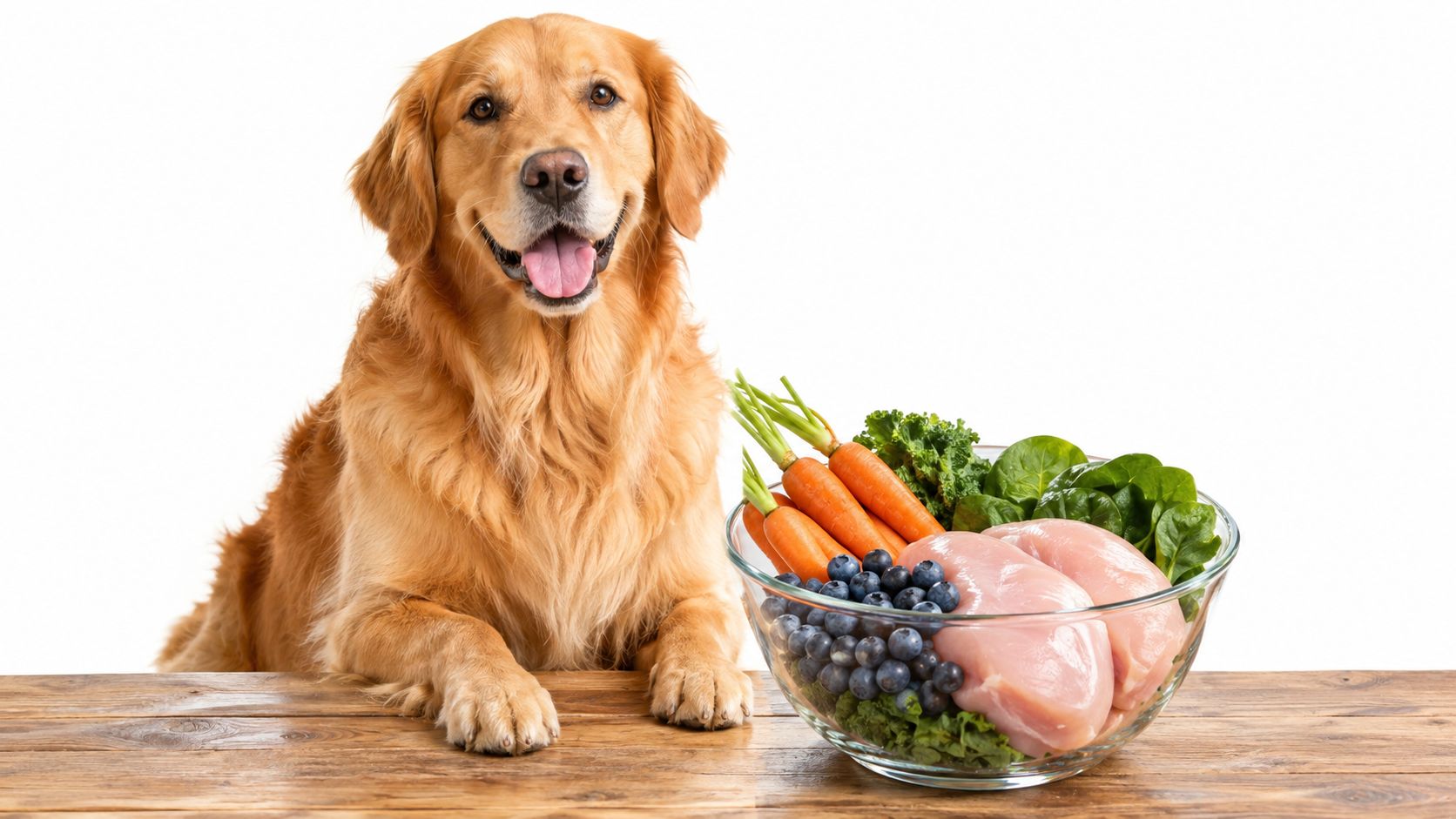
A practical definition
Think of clean cause ingredients as a shopping filter:
- Traceable: The brand can explain where key ingredients come from and how the product is made.
- Functional: Each ingredient serves a nutritional, digestive, preservation, or formulation purpose.
- Appropriate: The formula fits the pet's species, life stage, health needs, and feeding role.
- Tested: Safety claims extend beyond attractive packaging to quality controls and finished-product review.
This approach resembles the broader logic behind clean eating in Georgia, where shoppers often look for understandable ingredients and sourcing context rather than relying on a single word on the package. For pet food, however, human-style simplicity isn't enough. Dogs and cats need nutrients in appropriate amounts, and a clean-looking formula can still be inadequate if it doesn't meet those needs.
The working rule is simple: judge the finished product, not just the ingredient aesthetic. A recognizable ingredient matters, but so do digestibility, contaminant controls, preservation, and nutritional completeness.
Breaking Down the Two Words Behind Clean Pet Ingredients
"Clean" and "cause" answer different questions. Clean ingredients asks what goes into the product and whether the label communicates that fully. Cause-driven responsibility asks why the brand chose those ingredients, how it manages sourcing and testing, and whether its stated mission influences the formula rather than just the packaging.
Clean ingredients usually involve recognizable components, transparent labeling, and restraint around unnecessary colors, flavors, or preservatives. That doesn't mean all laboratory-created ingredients are automatically bad or that every natural ingredient is automatically beneficial. An ingredient's value depends on its purpose, dose, safety, stability, and role in the complete formulation.
Cause-driven responsibility adds accountability. A brand that takes this approach should be able to explain its protein sources, manufacturing expectations, quality testing, and formulation oversight. It should also acknowledge tradeoffs. Fresh ingredients may appeal to owners, while dry formats may offer different storage and feeding conveniences. Natural antioxidants may support stability, but a formula still needs effective protection from oxidation.
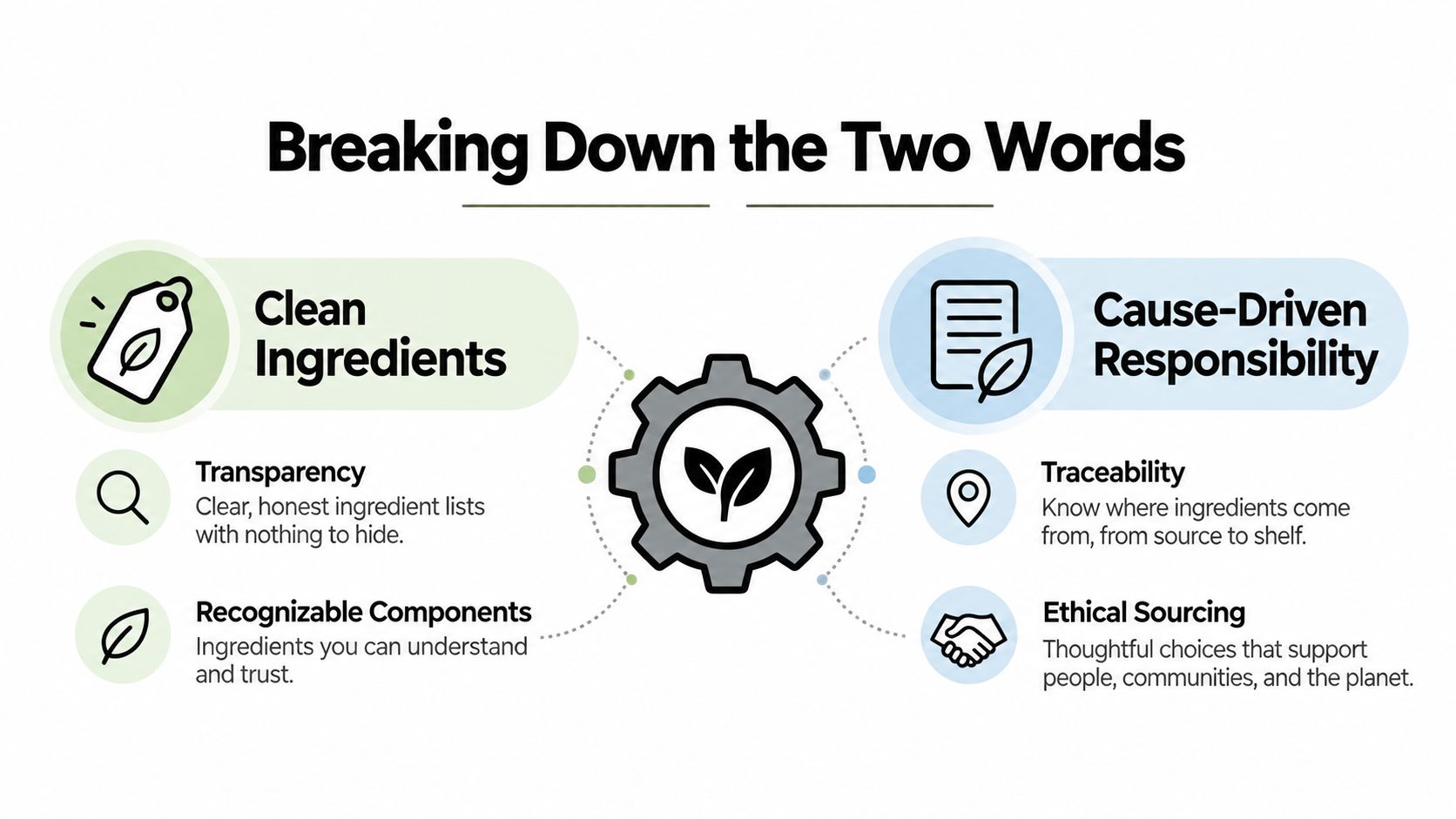
The two pillars in practice
| Pillar | The owner should look for | Why it matters |
|---|---|---|
| Clean ingredients | Recognizable components, clear functions, and no reliance on vague front-label language | It makes the formula easier to evaluate |
| Cause-driven responsibility | Sourcing information, quality controls, and meaningful formulation standards | It connects the ingredient list to actual decisions |
| Both together | Evidence that the finished product is safe, useful, and nutritionally appropriate | It prevents label simplicity from replacing science |
A practical example is Prebiotic Chicken Squeeze Treats for Dogs, which the product description identifies as made with real cage-free chicken, prebiotics, and no artificial colors, preservatives, or flavors. The relevant question isn't whether “prebiotic” sounds fashionable. It's whether the ingredient has a defined digestive purpose and whether the treat is used appropriately within the pet's overall diet.
Practical rule: A clean claim earns trust when a brand can explain the ingredient, its purpose, and the control used to keep the finished product safe.
This distinction helps owners move past defensive label reading. Instead of asking only, “What has been removed?” ask, “What has been deliberately included, and what evidence supports that choice?”
Contaminants, Formats, and Why Ingredient Purity Matters
Ingredient purity includes more than avoiding ingredients a shopper dislikes. It also includes managing substances that may enter food unintentionally through soil, water, equipment, processing, or raw-material supply chains. A short ingredient list doesn't prove that a product has strong contaminant controls.
A major 2026 Clean Label Project dog-food study tested 79 best-selling products across fresh, frozen, kibble, and air- or freeze-dried formats. The study found that dry dog food had about 21 times more lead and mercury than fresh and frozen dog foods, while nearly 81% of the commercial dog foods analyzed exceeded the maximum tolerated mercury level and 100% exceeded the maximum tolerated lead level. These findings are reported by CNN's coverage of the study.
Those figures shouldn't be turned into a universal verdict that one format is always safe and another is always unsafe. The study compared analyzed products, not every food available, and format alone doesn't explain every result. It does show why owners should ask brands about testing and sourcing rather than treating “natural,” “fresh,” or “clean” as proof of purity.
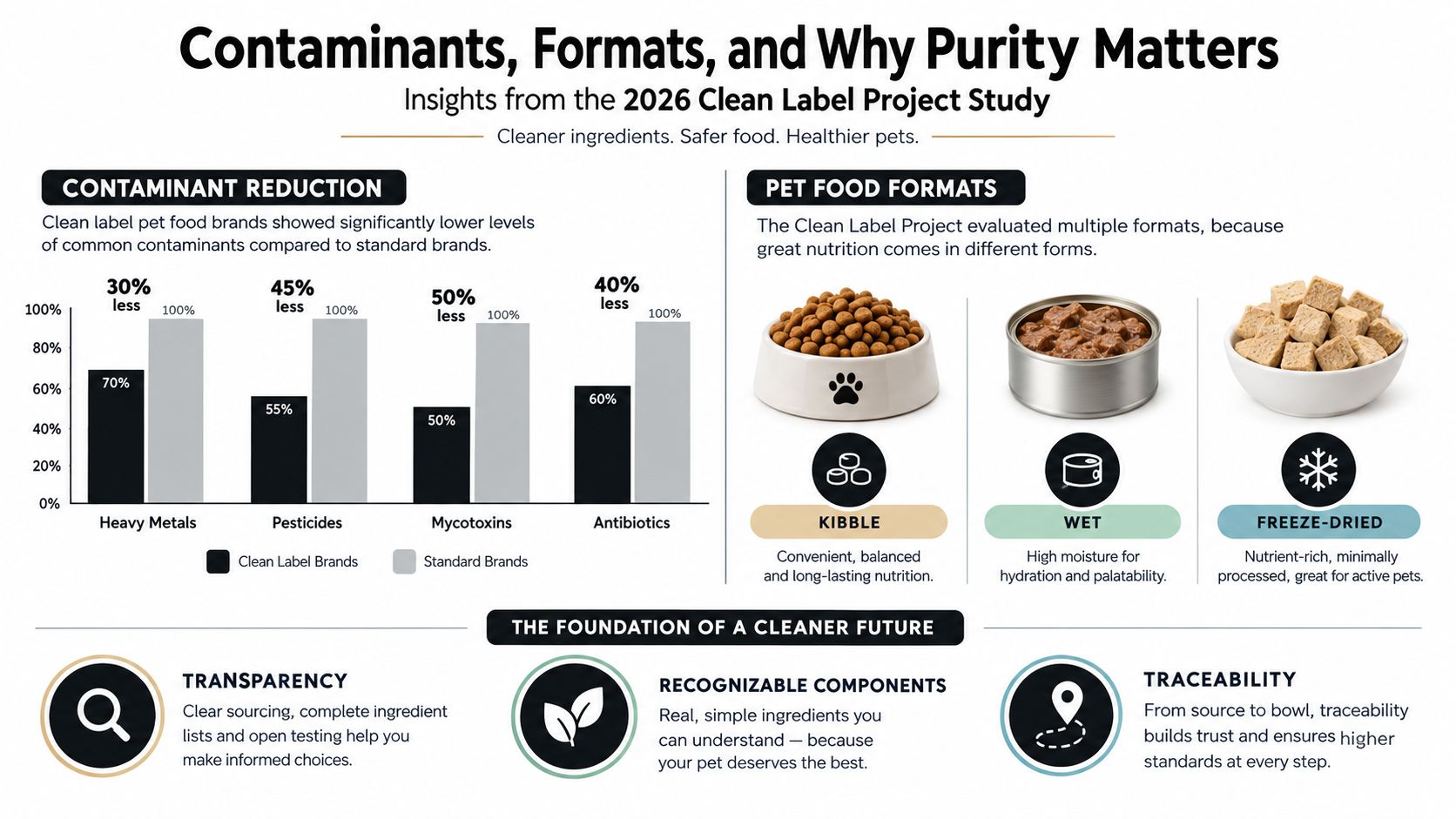
Compare the claim with the control
A responsible evaluation separates three questions:
- What is in the recipe? Look for named proteins and understandable supporting ingredients.
- What could enter during production? Ask whether the company screens raw materials and finished products for relevant contaminants.
- How does the format affect handling? Consider storage, moisture, processing, and feeding instructions without assuming that one category answers every safety question.
The difference between ingredient identity and ingredient control matters. A named fish or meat source may be nutritionally useful, but the brand still needs to manage the risks associated with sourcing and manufacturing. “Human-grade,” “natural,” and “clean label” can describe aspects of a product, yet none replaces a complete explanation of quality assurance.
The study also gives owners a better vocabulary. Instead of asking whether a food is “pure,” ask what the brand tests, how often it tests, what standards it applies, and whether it can share meaningful information about the finished product.
A transparent label tells you what the company wants you to notice. A testing program helps show what the company is checking.
For pets eating the same food regularly, this distinction deserves attention. Ingredient purity isn't a decorative feature. It's part of the safety conversation, alongside digestibility, nutritional adequacy, storage stability, and veterinary guidance.
How to Read Pet Food Labels Like an Informed Owner
Start with the ingredient panel, but don't stop at the first named ingredient. Ingredients appear in descending order by weight before processing, and the list doesn't tell you everything about digestibility, nutrient balance, or contaminant testing. Use it as an entry point, then verify the claims around it.
Independent research comparing ingredient classes found that fish meals typically reached about 89–92% digestibility, while meat meals reached about 52–72% completely digested, according to the Purina Institute's explanation of pet-food ingredients. The comparison shows why a high-protein statement isn't enough. The body needs access to amino acids, not just a large number on a guaranteed analysis.
Read the label in a deliberate order
- Identify the main protein sources. Look for named ingredients and ask whether the source is appropriate for your pet.
- Find the functional ingredients. Fiber, prebiotics, probiotics, and antioxidants should have a stated purpose, not appear only as trend language.
- Check the feeding role. A treat or topper isn't automatically a complete diet. Confirm how the product is intended to fit into daily feeding.
- Look beyond “free from.” The absence of artificial colors or flavors doesn't establish protein quality, nutrient balance, or contaminant control.
- Verify oversight. Look for veterinarian involvement, third-party testing, and clear information about formulation and manufacturing.
| Label Term | What It Usually Means | What to Verify |
|---|---|---|
| Natural | Ingredients or processing presented as closer to their original source | The exact definition used, plus the complete ingredient list |
| High protein | The formula contains a comparatively substantial protein level | Protein source, digestibility, amino-acid quality, and feeding purpose |
| No artificial colors | Artificial coloring agents aren't included | Preservation method, nutrient adequacy, and other additives |
| Prebiotic | A substrate intended to support beneficial gut microbes | The ingredient's identity, intended use, and product feeding guidance |
| Third-party tested | Testing is performed beyond the brand's own internal checks | What is tested, by whom, and whether the product is complete and balanced |
For a more detailed walkthrough, these dog food label tips for owners can help you compare front-of-package language with the information on the back.
A cat-focused example is Happy Guts Duo for Cats, described as combining prebiotic tuna squeeze treats with a veterinarian-formulated probiotic supplement. Its product information also identifies high-quality protein, third-party testing, and the absence of artificial colors, preservatives, and flavors. Those details are useful because they connect a clean-label preference with a specific digestive function and a defined routine.
Preservation, Digestibility, and the Science Behind Clean Formulations
A clean formulation still needs protection from spoilage and nutrient loss. Fats and oils can react with oxygen, creating rancid odors and flavors, while poor storage stability can reduce the quality of the food over time. Preservatives and antioxidants aren't automatically evidence of a poor formula. Their purpose and safety depend on the substance used, the amount, and the applicable formulation standards.
European pet-food guidance explains that preservatives help keep food safe and nutritious across its shelf life, while antioxidants protect fats and oils from oxygen-related deterioration. UK Pet Food identifies tocopherols, a form of vitamin E, and ascorbic acid, vitamin C, among commonly used natural preservation options. The European Pet Food Industry Federation guidance on additives also cites a recent systematic review that found no substantiated evidence of harm from approved additives and preservatives when used within AAFCO guidelines.
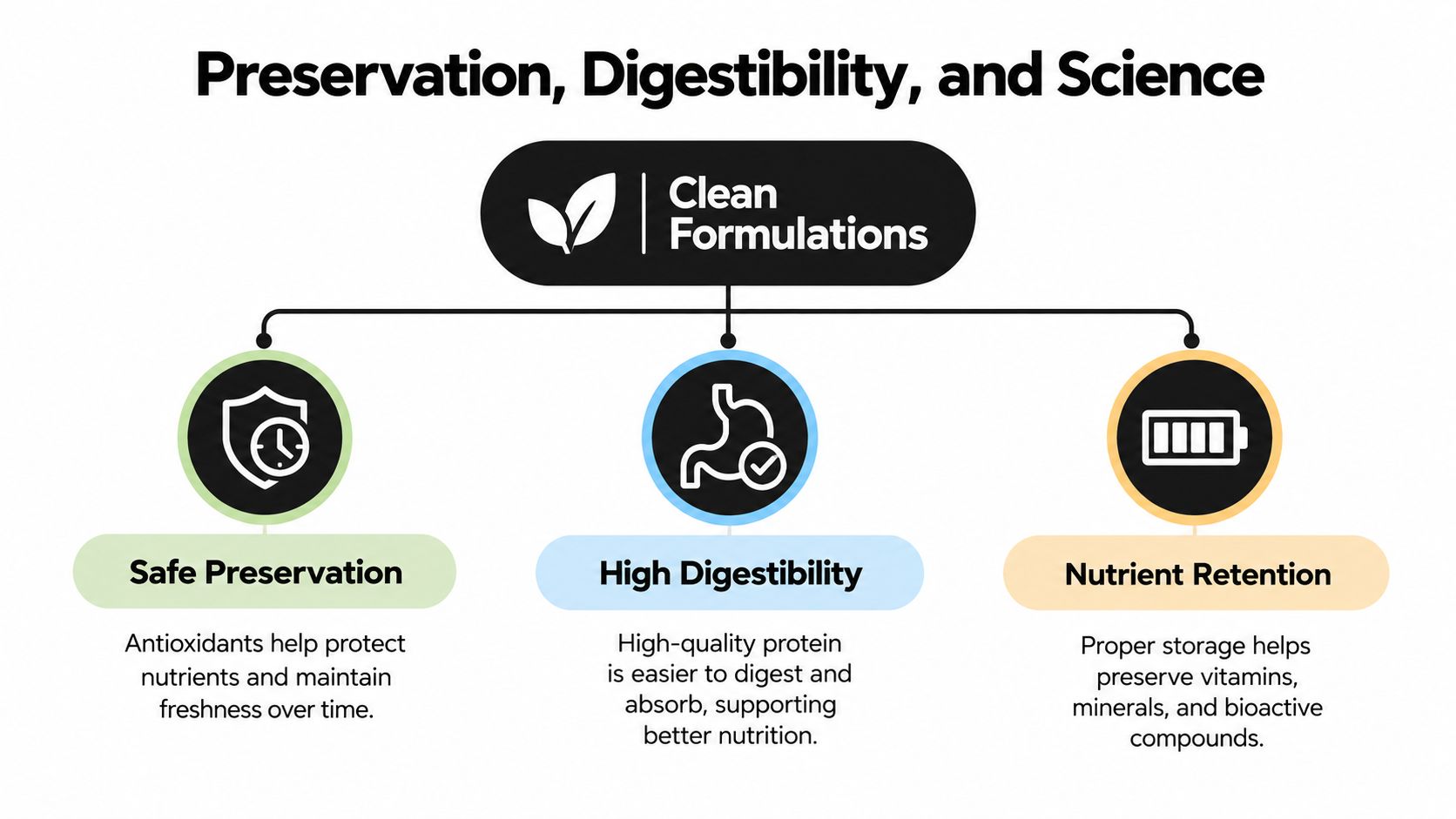
Protein percentage isn't the whole story
Protein quality depends on how efficiently a pet can digest and use the protein. Small-animal nutrition classifies digestibility below 80% as low, 80–85% as average, 86–93% as high, and above 93% as very high. Ingredients and processing can therefore change nutritional performance even when two products show similar crude-protein values.
The same guidance notes that pulse ingredients used in pet foods showed 80–90% digestibility for essential amino acids except methionine, while DIAAS-like scores above 100% are treated as high protein quality for dogs and cats. Owners don't need to calculate these measures at home, but they should understand the principle: a label's protein percentage doesn't reveal the entire nutritional story.
Functional ingredients also deserve a purpose-based reading. The cited systematic review associated antioxidants, enzymes, fibers, probiotics, and omega-3s with improvements in measures such as digestibility, gut-health markers, or metabolic indicators. That doesn't mean every product containing one of these ingredients will produce the same result. It means the ingredient should be judged by its formulation role and supporting evidence.
For digestive support, owners may compare products that provide prebiotics for dogs with the pet's existing diet and veterinary advice. A prebiotic can support beneficial gut microbes, but it remains one part of a broader feeding plan.
Cause-Driven Brands in Practice
How can owners tell whether a cause-driven pet brand is applying its values, rather than printing them on a package? The answer is to examine four connected details: ingredient transparency, contaminant controls, digestible protein quality, and science-backed formulation. A brand should identify what goes into a product, explain its purpose, address relevant testing, and show how the formula is reviewed.
Joyfull describes its products as using clean ingredients and high-quality proteins, with scientific review from an in-house veterinary advisor. Its catalog includes digestive-support products, including treats and probiotic supplements. This approach gives owners more to evaluate than broad terms such as “natural” or “clean,” especially when a recognizable ingredient is linked to a defined purpose.
What applied responsibility looks like
A simple treat formula can illustrate the difference. Real chicken identifies the protein source. Prebiotic fiber has a digestive role. Excluding artificial colors, preservatives, and flavors addresses a specific formulation preference. Third-party testing or veterinary formulation review can add accountability, but owners should ask what the testing covers and how the product fits the pet's complete diet.
Joyfull's cat routine product description identifies wild-caught tuna and fish broth in its prebiotic squeeze treats, alongside a veterinarian-formulated probiotic supplement. It also states that the treats contain five ingredients and exclude meat byproducts, seed oils, and processed flavorings. Those details help owners assess transparency and ingredient purpose. They do not establish that every unfamiliar ingredient is harmful.
Responsible brands also set clear boundaries around health claims. Digestive support does not equal disease treatment. A clean treat cannot replace a complete diet, and a product suitable for one pet may not fit another with allergies, ongoing gastrointestinal symptoms, or a prescribed feeding plan.
Owners looking for a routine can compare probiotic supplements for dogs and cats by checking the organism or blend, serving guidance, storage requirements, formulation oversight, and the claims the brand supports. The most credible brands make those details easier to find.
The practical test is consistency. Does the company apply its stated standards to ingredients, contaminant testing, label information, and health claims? If so, clean cause ingredients becomes a usable standard for judging products. If not, the phrase remains packaging language.
Unfamiliar Ingredients That Deserve a Closer Look
Unfamiliar doesn't mean unsafe. One industry analysis found that yeast, collagen, and algae were the three ingredients pet owners were most unsure about, highlighting a shift from broad natural-versus-artificial debates toward questions about origin, processing, and purpose. The finding is reported by GlobalPETS' analysis of pet-owner ingredient preferences.
Yeast
Yeast may appear in formulas for flavor, fermentation-related functions, or nutritional contributions. The important questions are which yeast is used, why it is included, and whether the pet has a known sensitivity. “Yeast” by itself isn't enough information to judge the ingredient.
Collagen
Collagen is an animal-derived structural protein often associated with connective tissues. Its presence may make sense in a functional treat, but owners should verify the source, processing, and whether the product makes a modest nutritional claim or an unsupported medical promise.
Algae
Algae can serve different purposes depending on the species and processing method. Some forms may contribute nutrients or functional compounds, but the label should identify the ingredient clearly enough for an owner and veterinarian to evaluate it.
The same evidence-first habit applies to non-food wellness products. Owners exploring environmental or household pet-care topics may find ArtNaturals pet aromatherapy tips useful, but they should be especially cautious with concentrated substances around animals and consult a veterinarian before use.
Questions to Ask Before You Buy Pet Products
Use this checklist before placing a food, treat, or supplement in your cart:
- What does each prominent ingredient do? Don't accept a name without a purpose.
- Can the brand explain sourcing and testing? Look for specifics rather than broad cleanliness claims.
- Is the protein likely to be digestible and appropriate? Protein percentage alone isn't enough.
- How is the product preserved? Safe stability matters, whether the preservative is natural or synthetic.
- Is it complete and balanced, or is it a treat or supplement? Match the product to its feeding role.
- Does my pet have a medical condition or dietary restriction? Ask your veterinarian before changing food or adding functional products.
Clean cause ingredients gives owners a better standard than fear-based label scanning. Choose products with understandable purposes, accountable manufacturing, and nutrition that serves the whole animal, not just the front of the package.
Joyfull offers treats and digestive-support products built around recognizable ingredients, functional components, and veterinary-reviewed formulation. Visit Joyfull to compare its dog and cat wellness options and choose a product that fits your pet's daily routine.
0 comments