How to Read a Cat Food Ingredient List Like an Expert
A cat food ingredient list is the most honest part of the packaging. It tells you exactly what’s inside, with every single component listed in descending order by weight. Honestly, learning to read it is the best thing you can do to make sure your little hunter is getting the high-quality, species-appropriate food they need for a long, happy life.
Why Decoding Your Cat's Food Label Matters
You know the feeling. You're standing in the pet food aisle, staring at a wall of bags and cans. You see pictures of majestic-looking cats, and words like "natural," "premium," and "gourmet" are everywhere. It’s completely overwhelming, and it's easy to wonder if you're really making the right choice.
The thing is, marketing jargon can be incredibly deceptive. The real story isn't on the front of the bag; it's on the back, tucked away in the ingredient list. Learning to read that list is like learning a secret code—one that reveals everything about your cat’s nutrition.
From Confusion to Confidence
Think of this guide as your decoder ring. We're going to slice through the confusing terms and industry-speak to give you a simple, practical way to understand what you're actually putting in your cat's bowl. Making smart choices is step one, and our more general guide on how to choose cat food can give you the bigger picture.
By the time you're done here, you'll be able to:
- Instantly spot high-quality ingredients versus cheap fillers.
- Grasp the roles of proteins, fats, and carbs in your cat's diet.
- Recognize common red flags and misleading marketing tricks.
- Draw a straight line between the ingredients on the label and your cat's health.
Your cat's energy, the softness of their coat, their digestion, and their overall well-being are all tied directly to what they eat every single day.
This knowledge gives you the power to see past the flashy packaging and focus on what truly counts. It’ll take you from being a confused shopper to a confident advocate for your pet's health. We’ll break down every part of the label, starting with the most important rule of thumb: the first five ingredients tell most of the story. Let's get started.
The First Five Ingredients Tell You Almost Everything
Think about a recipe you'd make yourself. The ingredients you use the most, like flour for a cake or tomatoes for a sauce, always come first. Cat food follows the same simple rule, and it's your single best tool for a quick quality check right there in the aisle.
By law, all ingredients must be listed in descending order by their weight before cooking. This means the first three to five ingredients make up the vast majority of what’s actually in that bag or can. For a cat, who is an obligate carnivore, this is non-negotiable: you absolutely must see high-quality animal protein leading the charge.
What to Look For at the Top of the List
When you pick up a bag of food, your eyes should immediately jump to the top of the ingredient list. You're looking for specific, easily identifiable sources of animal protein. These are the gold-standard building blocks that provide the essential amino acids your cat needs to thrive.
You want to see clear, unambiguous terms like:
- Deboned Chicken: This is pure muscle meat—a fantastic, high-quality protein.
- Salmon: An excellent protein that also delivers those beneficial omega-3 fatty acids.
- Turkey: Another great source of lean muscle meat.
- Beef: A rich source of protein and iron, perfect for active cats.
Finding one or more of these at the very top is a huge green flag. It tells you the food is built on a solid, species-appropriate foundation, not one padded out with cheap fillers.
Vague Terms Are a Major Red Flag
On the flip side, generic or vague terms in those first few spots should give you pause. These ingredients are often cheaper and can be of questionable or inconsistent quality, making it impossible to know what your cat is really eating.
Key Takeaway: If the first ingredient is "chicken," you know you're getting chicken. But if it says "meat by-products," the source is a mystery—it could be a mix of less nutritious animal parts from completely different, unspecified animals.
This distinction is crucial. As cat owners become more savvy, they’re demanding better for their pets. The global pet care market, valued at over USD 207 billion as of 2025, has seen cat food become one of its fastest-growing segments. This boom is fueled by owners who want premium, transparently sourced ingredients for their feline family members. You can discover more insights into how consumer preferences are reshaping the pet food industry.
Good vs Poor First Ingredients
Let's make this crystal clear by putting some common ingredients head-to-head. This table breaks down exactly what you want to see at the top of a cat food ingredient list versus what you should probably put back on the shelf.
| High-Quality Ingredient (What to Look For) | Why It's Good | Low-Quality Ingredient (What to Avoid) |
|---|---|---|
| Deboned Chicken | A specific, high-quality source of animal protein from muscle tissue. | Meat By-Products |
| Salmon | A named fish, rich in protein and essential omega-3 fatty acids. | Poultry Meal |
| Whole Eggs | A complete protein source that is highly digestible and nutrient-dense. | Corn Gluten Meal |
Getting a handle on this difference is your shortcut to making better choices for your cat. When you pick a food that leads with a high-quality, named protein, you know you're starting with the best possible foundation for their diet. It's a simple check that reveals a lot about whether a company prioritizes quality or just cutting costs.
A Cat's Nutritional Blueprint: Proteins, Fats, and Carbs
To really get the hang of reading a cat food label, you have to understand the "why" behind the "what." Every ingredient fits into one of three buckets: proteins, fats, or carbohydrates. For our feline friends, these are not created equal. As obligate carnivores, their bodies are built on a very specific nutritional blueprint.
Think of it like building a house. Proteins are the bricks and the frame—the very structure of the building. Fats are the electrical wiring, providing the essential energy to power everything. Carbohydrates? They're often just the throw pillows. Nice in small amounts, maybe, but you can't build a foundation with them.
Proteins: The Unshakeable Foundation
For a cat, protein is everything. It's the cornerstone of their diet. As true carnivores, their entire system is designed to get energy and vital nutrients from animal tissue. The protein in their food gets broken down into amino acids, which are the literal building blocks for muscle, skin, fur, enzymes, and antibodies.
One of these amino acids, taurine, is absolutely critical. Unlike dogs or humans, cats can't make enough of it themselves. They must get it from their food. A lack of taurine can lead to devastating health problems, including blindness and a life-threatening heart condition called dilated cardiomyopathy.
This is exactly why seeing a high-quality, named animal protein like "chicken," "turkey," or "salmon" at the top of the ingredient list isn't just a suggestion—it's non-negotiable. These are the sources packed with the complete amino acid profile your cat needs to thrive, not just survive.
A cat’s diet is a direct reflection of its wild ancestry. They didn't evolve to eat cornfields or wheat farms; they evolved to hunt. High-quality animal protein honors that biological reality.
This pyramid gives you a quick visual of the quality hierarchy you'll find when scanning that ingredient list.
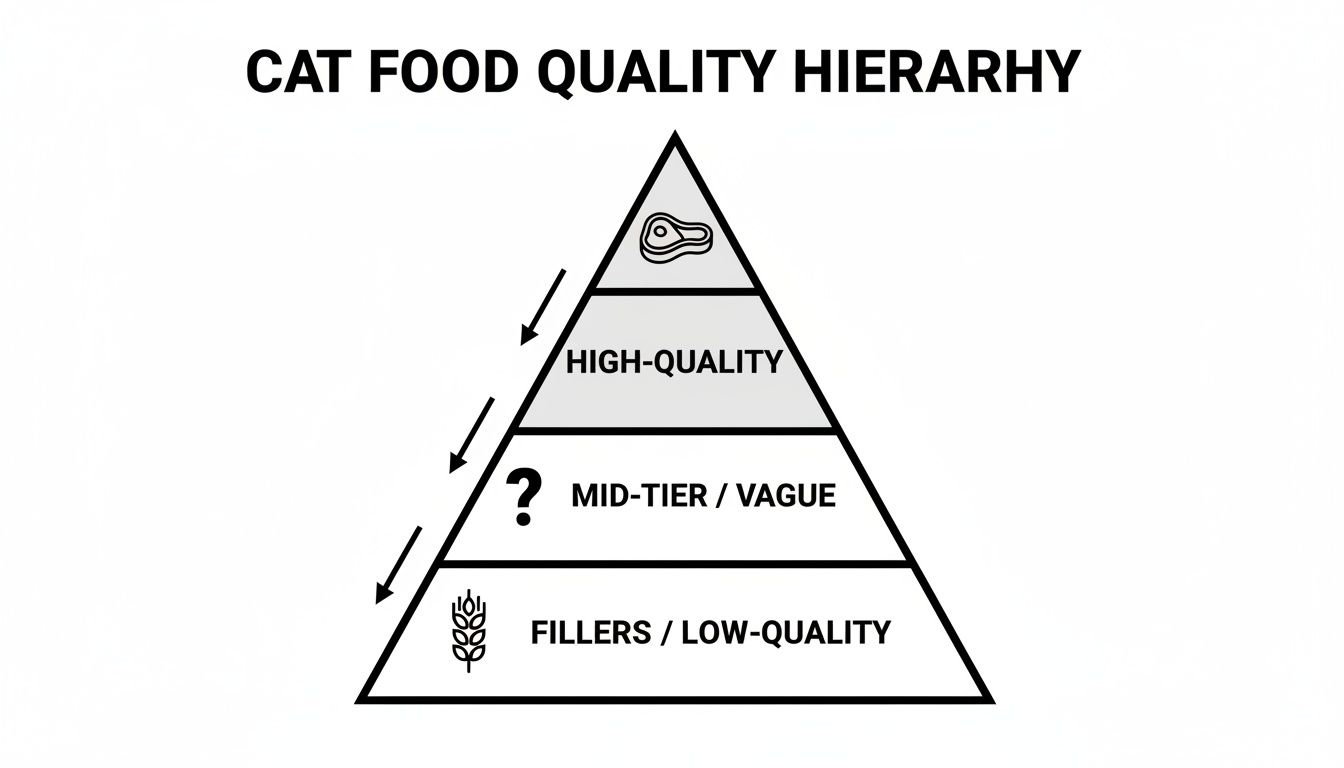
As you can see, specific, named meats are at the very top, representing the best nutritional value, while vague terms and cheap fillers sit at the bottom.
Fats: The Essential Fuel Source
Right after protein, fat is the next most important macronutrient. It's a dense, efficient fuel that powers everything your cat does, from a sudden burst of the zoomies to a long, cozy nap in a sunbeam. Fats also do the crucial job of helping the body absorb certain vitamins (like A, D, E, and K) and are key to maintaining a healthy, shiny coat.
Of course, not all fats are the same. You want to see healthy, clearly named sources, such as:
- Chicken Fat: An excellent, highly palatable source of energy.
- Fish Oil (like Salmon Oil): Prized for its rich concentration of omega-3 fatty acids.
- Flaxseed: A solid plant-based source of omega fatty acids.
Omega-3 and omega-6 fatty acids are especially important. They're fantastic for reducing inflammation, supporting brain health, and keeping your cat's skin supple. A diet lacking in these essential fats often shows up as dry, flaky skin and a dull, lackluster coat.
Carbohydrates: The Great Debate
Now we get to the tricky part. Carbohydrates—ingredients like corn, wheat, soy, and potatoes—are probably the most misunderstood part of a cat’s diet. Let’s be clear: biologically, cats have zero nutritional requirement for carbohydrates. Their digestive tracts are short and acidic, perfectly designed to process meat, not to break down a bunch of complex starches.
So why are carbs in almost every bag of dry cat food?
It’s simple, really: they’re cheap binders. Ingredients like corn and wheat are inexpensive fillers that add bulk and calories. They also provide the starchy glue needed to form kibble into those little shapes. While a small amount of carbs from better sources like peas or sweet potatoes is generally fine, a food that leads with them is a major red flag.
When you see multiple carb sources crowding the top of the ingredient list, it's a good sign the manufacturer is putting cost-cutting ahead of species-appropriate nutrition. If you want to dive deeper, you can learn more about the best ingredients for cat food in our full guide. At the end of the day, a great cat food will always put high-quality protein and healthy fats first, keeping carbs to a minimum.
Understanding Additives, Vitamins, and Fillers
Once you get past the first few proteins and fats on a cat food ingredient list, the names can start to look more like a chemistry experiment than a meal. This is where you'll find the vitamins, minerals, preservatives, and other additives that either round out the nutritional profile or just add bulk.
Don't let the scientific terms throw you off. This part of the label is just as crucial as the big-ticket items at the top. Learning to tell the good stuff from the junk is the key to picking a truly high-quality food.
The Good Stuff: Beneficial Additives
Not every long, complicated name is a red flag. In fact, many of these additives are absolutely essential for your cat’s health. The cooking process for cat food can strip out some natural nutrients, so reputable brands add specific vitamins and minerals back in to make sure the meal is truly "complete and balanced."
The most important one you’ll see is taurine. It’s an amino acid that’s absolutely vital for a cat's heart, vision, and digestion. Since cats can't make enough of it on their own, they have to get it from food. Seeing taurine on the list isn't just a good sign—it's a non-negotiable must-have.
Other green flags to look for include:
- Natural Preservatives: Things like tocopherols (a source of vitamin E), rosemary extract, or ascorbic acid (vitamin C) keep the food from spoiling without resorting to harsh chemicals.
- Essential Vitamins and Minerals: Zinc proteinate, iron proteinate, and folic acid are common examples. These chelated minerals are easier for your cat's body to absorb and use for everything from immune support to healthy blood.
- Probiotics: Seeing ingredients like Lactobacillus acidophilus means the food is formulated to support a healthy gut, which is the foundation of overall wellness.
These kinds of ingredients show that a company is thinking about the science behind a healthy, safe meal for your cat.
The global cat food market is growing fast, and a big reason is that owners are becoming more demanding. This "pet humanization" trend means more people are checking labels for clean, functional ingredients. It’s pushing brands to focus on nutrition and be more transparent, which is great news for our cats. You can learn more about trends in the cat food market to see how consumer demand is changing the industry.
The Questionable Stuff: Red Flags to Watch For
Just as there are good additives, there are also ones that should make you think twice. These ingredients are often just for show, used as cheap preservatives, or to give the food color. They offer zero nutritional benefit and could even be harmful over time.
Be on high alert for chemical preservatives like BHA (butylated hydroxyanisole) and BHT (butylated hydroxytoluene). They definitely make food last longer, but their long-term safety is still up for debate. For that reason, many health-conscious brands have ditched them completely.
The same goes for artificial colors like Red 40, Yellow 5, and Blue 2. Your cat couldn't care less if its kibble is brown or a rainbow of colors—that's all for you, the human buyer. These dyes are totally unnecessary and have been linked to health problems in some studies.
The Empty Stuff: Unmasking "Fillers"
Finally, let's talk about fillers. These are cheap, low-nutrition ingredients used to add bulk and structure to pet food, especially dry kibble. While they aren't necessarily toxic, they provide almost no value for your obligate carnivore and take up space that should be filled with high-quality animal protein.
Common fillers are almost always carb-heavy grains and starches. When these ingredients appear high up on a cat food ingredient list, it's a huge clue that the food's nutritional foundation might be shaky.
Keep an eye out for these usual suspects:
- Corn and Corn Gluten Meal: A cheap filler that provides plant-based protein cats struggle to digest and use.
- Wheat Gluten: Often used to bind kibble together, it offers little nutritional value and is a common allergen.
- Soy: Another inexpensive plant protein that isn't ideal for a cat's carnivorous digestive system.
- Cellulose: It’s essentially wood pulp. Brands add it as a fiber source, but its presence is often an indicator of a low-quality formula.
To help you sort through the good, the bad, and the just plain useless, here's a quick cheat sheet for common additives you'll find on the label.
Common Additives: Green, Yellow, and Red Flags
| Ingredient/Additive | Category (Green/Yellow/Red) | What It Is & Why It Matters |
|---|---|---|
| Taurine | Green | An essential amino acid for heart, eye, and digestive health. A must-have in any cat food. |
| Tocopherols (Vitamin E) | Green | A natural preservative that also provides antioxidant benefits. A safe way to keep food fresh. |
| Rosemary Extract | Green | Another effective natural preservative with antioxidant properties. |
| Probiotics (e.g., Lactobacillus) | Green | Beneficial bacteria that support a healthy gut microbiome, aiding digestion and immunity. |
| Chelated Minerals | Green | Minerals (like Zinc Proteinate) bound to amino acids, making them easier to absorb. |
| Carrageenan | Yellow | A thickener and stabilizer derived from seaweed, commonly used in wet food. Some studies link it to gut inflammation. |
| Cellulose | Yellow | A plant fiber (wood pulp) used for bulk and to control hairballs. In high amounts, it’s a sign of a low-quality filler. |
| Artificial Flavors | Red | Unnecessary chemicals used to make low-quality ingredients more appealing. Good food doesn't need them. |
| Artificial Colors (Red 40, etc.) | Red | Dyes added purely for human appeal. They offer no nutritional value and are linked to potential health risks. |
| BHA / BHT | Red | Chemical preservatives with potential links to health issues. Safer, natural alternatives exist. |
| Propylene Glycol | Red | A humectant used to keep semi-moist foods soft. It is toxic to cats in high doses and is banned in cat food in some regions. |
Spotting these ingredients helps you see which brands are prioritizing your cat's health and which might be cutting corners for profit. A great food keeps the junk to a minimum, focusing instead on the high-quality animal proteins and fats your cat truly needs.
Spotting Red Flags and Misleading Marketing Terms
Alright, let's get into the nitty-gritty. Think of cat food packaging as prime real estate for marketers. Their one and only job is to get you to pick that bag off the shelf. They'll use pictures of happy cats, fields of green, and words that pull at your heartstrings to make their product look like the best thing since sliced bread.
This is where your newfound label-reading skills become your secret weapon. When you learn to see past the flashy marketing, you can focus on the one thing that truly matters: what's actually inside the bag. Let's arm you with the ability to spot the tricks of the trade.
Decoding Meaningless Marketing Buzzwords
You've seen them plastered all over the front of the bag—words that sound fantastic but often mean absolutely nothing. Pet food companies love using terms that make you feel like you're buying something special, but many of these buzzwords aren't regulated by organizations like the Association of American Feed Control Officials (AAFCO).
Because they aren't legally defined, manufacturers can slap them on the package without having to meet any real standard. Here are a few of the most common offenders:
- Premium or Gourmet: These words have zero official definition in the pet food world. They're pure marketing fluff designed to make a food sound fancier than it is.
- Natural: This one is a little more regulated, but it's still slippery. "Natural" usually just means the ingredients came from a plant, animal, or mineral source. A food can be labeled "natural" and still be packed with low-quality fillers.
- Holistic: Just like "premium," this word has no legal or regulatory teeth. It's meant to make you think of whole-body health, but it doesn't require the food to meet any specific formulation guidelines.
A flashy package with the word "Gourmet" on the front is meaningless if the cat food ingredient list on the back starts with corn and meat by-products. Always trust the list, not the marketing.
The Deceptive Tactic of Ingredient Splitting
Now for one of the sneakiest tricks in the book: a technique called ingredient splitting. This is a clever way for manufacturers to make a cheap, less desirable ingredient look less significant than it really is, pushing a better-sounding ingredient up to the top of the list.
Here’s how it works. Let's say a formula contains a lot of corn, which isn't great for cats. Instead of listing "corn" as a single, heavy ingredient, they break it down into different forms.
For example, an ingredient panel might look like this:
- Chicken
- Corn Gluten Meal
- Brewers Rice
- Ground Yellow Corn
- Corn Grits
See what happened? On their own, each of those corn ingredients weighs less than the chicken, so they appear further down the list. But if you could magically scoop them all out and weigh them together, corn would almost certainly be the true first ingredient in the food. It's a crafty way to hide that you're buying a corn-based kibble, not a meat-based one.
How to Spot Ingredient Splitting
To catch this trick, just scan the first five to seven ingredients. Are you seeing multiple variations of the same grain or vegetable? Be on the lookout for different forms of corn, wheat, peas, or potatoes.
If you see "pea protein," "pea flour," and "split peas" all in the top section of the list, that's a dead giveaway. They're splitting the peas! For a deeper dive into problematic ingredients, check out our detailed guide on cat food ingredients to avoid. Knowing these tactics helps you see what a food is really made of, so you can make sure you're giving your cat the meat-rich diet they were born to eat.
Answering Your Top Cat Food Ingredient Questions
Alright, you've learned the basics of decoding a cat food ingredient list. Now, let's put that knowledge to work by tackling some of the most common questions and confusing terms out there. This is where the rubber meets the road—moving from theory to making confident choices in the pet food aisle.
Is Grain-Free Food Really Better for My Cat?
This is easily one of the biggest, most persistent debates in the pet food world. The grain-free movement took off with a simple, powerful message: cats are carnivores, and they don't eat fields of corn in the wild. That part is absolutely true. A diet packed with corn, wheat, or soy just isn't what a cat's digestive system is designed for.
But here’s the catch: "grain-free" doesn't automatically equal "high-quality." Many brands simply swap out grains for other starchy fillers like potatoes, peas, or lentils. If those ingredients are still hogging the top spots on the list, you haven't actually solved the problem—you've just traded one carb source for another.
The real goal isn't just to avoid grains; it's to get as much high-quality animal protein into the bowl as possible. A food that leads with chicken and turkey but includes a small amount of a whole grain like brown rice is often far better for your cat than a "grain-free" formula that's mostly pea protein and potatoes.
The secret is to look past the flashy "grain-free" slogan on the front of the bag. Always flip it over and read the actual ingredient panel. Is the food built on named animal proteins, or is it just a clever substitution of fillers?
Ultimately, every cat is an individual. Some do wonderfully on grain-free diets, while others are perfectly healthy with a little bit of high-quality grain. The non-negotiable part is that meat should always be the star of the show.
What's the Real Difference Between a "Meal" and a "By-Product"?
These two terms trip up a lot of people, but understanding them is a game-changer. It’s one of the fastest ways to judge the quality of the protein in a food. Let's clear this up once and for all.
- Animal "Meal" (like Chicken Meal): This sounds a little weird, but it's not what you think. A "meal" is created through a cooking process called rendering. Fresh animal tissue is cooked down to remove water and fat, leaving behind a very concentrated, dry protein powder. A named meal, like "chicken meal" or "salmon meal," is actually a fantastic, dense source of protein. The key word here is "named."
- "By-Products" (like Meat By-Products): This is where you want to pause and be skeptical. By-products are the leftover parts of an animal after the main cuts are taken for human food. This can include organs, blood, and bone. While some by-products like liver or heart are incredibly nutritious, the term itself on a label is a red flag because it's so vague. It doesn’t tell you which parts or even which animals are in there, which means quality can be wildly inconsistent from one batch to the next.
Think of it like this: "chicken meal" tells you exactly what you're getting. "Meat by-products" is a mystery box, and you can't be sure of the quality inside.
How Do I Safely Switch My Cat to a New Food?
So you've done your homework and found a fantastic new food for your cat. Awesome! But you can't just pour it into their bowl tomorrow. Cats, in particular, are known for their sensitive digestive systems. A sudden switch can easily lead to an upset stomach, vomiting, or diarrhea. The only way to do it right is with a slow, gradual transition.
The whole process is pretty straightforward and should take about 7 to 10 days. Here’s a simple schedule for a headache-free switch:
- Days 1-2: Start with a mix of 75% old food and 25% new food. This just introduces the new tastes and ingredients without overwhelming their system.
- Days 3-4: Adjust the ratio to a 50/50 mix of the old and new food. Keep a close eye on your cat’s appetite and what's happening in the litter box.
- Days 5-6: Now you can shift to 25% old food and 75% new food. You're on the home stretch!
- Day 7 (and beyond): Make the final move to 100% new food. If you know your cat is extra sensitive, feel free to stretch each of these stages out for another day or two.
This slow-and-steady method gives your cat's gut bacteria time to adapt to the new diet, making the change a smooth and positive experience for both of you.
At JoyFull, we believe that a healthful life isn't just for humans—our pets deserve it, too. That's why every one of our formulas is built on clean ingredients, high-quality proteins, and a foundation of scientific rigor. We make it easy to give your best friend the very best. Explore our approach to pet wellness at https://joyfullpet.com.