


Calming chews for cats are dietary supplements designed to reduce feline anxiety over time, using ingredients such as L-theanine and alpha-casozepine rather than acting as instant sedatives. The most relevant feline evidence supports gradual, partial stress reduction, not an immediate switch that makes a frightened cat sleepy.
Your cat may be hissing at the vacuum, crouching under the bed during a thunderstorm, or refusing to leave a carrier after a difficult veterinary visit. You want to help, but the shelf is crowded with chews that promise calm in vague, confident language. The important question isn't which package looks most convincing. It's which ingredients have direct feline evidence, how should they be used, and when does stress require veterinary care instead of a supplement?
Table of Contents
- Understanding the Need for Feline Calm
- What Are Calming Chews for Cats
- Key Ingredients and Their Scientific Backing
- How to Choose a High-Quality Product
- Dosing and Administration Tips
- Alternative Approaches to Managing Cat Stress
- Red Flags and Common Myths
- Conclusion and Final Thoughts
Understanding the Need for Feline Calm
A stressed cat may flatten their ears, puff their coat, growl, or sprint for cover when the vacuum starts. During a storm, another cat may tremble, hide behind furniture, or stay frozen in one room long after the noise stops. These reactions aren't misbehavior. They're signs that the cat perceives a threat and is trying to create distance from it.
Stress can also appear less dramatically. A cat might groom one area repeatedly, stop interacting with the family, change eating habits, or begin urinating outside the litter box. Because cats often conceal pain and vulnerability, owners may notice a behavioral change only after the underlying problem has persisted.
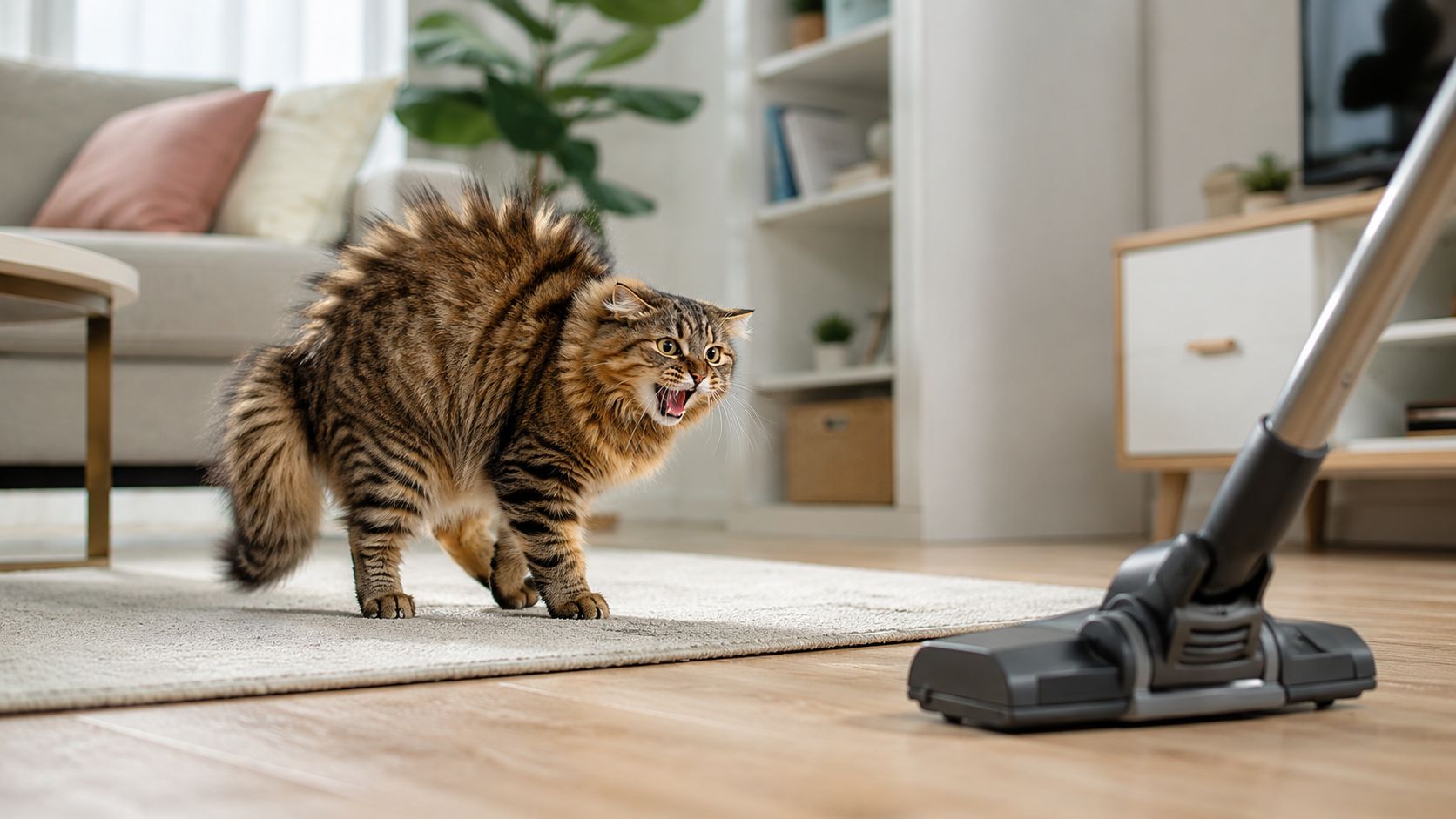
Stress isn't always a supplement problem
A new behavior deserves attention rather than an automatic calming chew. Urinating outside the litter box, for example, can have medical causes, and veterinary evaluation should come before assuming anxiety is responsible. A frightened cat may also avoid a box because of its location, a conflict with another animal, an unpleasant litter texture, or a previous painful experience.
Practical rule: Treat a sudden behavioral change as information. First ask what changed in the cat's body, environment, routine, or relationships.
Environmental stressors can include visitors, renovations, unfamiliar animals, loud appliances, travel, and household schedule changes. Some cats cope by hiding, while others become vocal, restless, defensive, or unusually clingy. The behavior tells you that the cat needs a safer plan, but it doesn't identify the cause by itself.
That distinction matters because nutritional support works best as one part of a longer stress-management approach. A chew may help lower the background level of tension for some cats, but it can't remove a threatening animal, diagnose urinary discomfort, or teach a cat that a carrier is safe. Owners get better results when they identify the trigger and use the supplement, if appropriate, alongside changes that make the environment more predictable.
What Are Calming Chews for Cats
Calming chews for cats are edible dietary supplements, not general-purpose sedatives. Manufacturers may combine amino acids, milk-derived peptides, herbs, vitamins, or other compounds intended to support relaxation. The label should tell you which active ingredients are present and, ideally, how much of each serving contains.
A useful comparison is a daily nutritional support product versus an emergency brake. A prescription sedative or anti-anxiety medication is selected by a veterinarian for a defined medical purpose and may have a more direct, predictable pharmacological effect. A chew generally aims to support the cat's stress response gradually. It shouldn't be expected to produce an instant “off switch.”
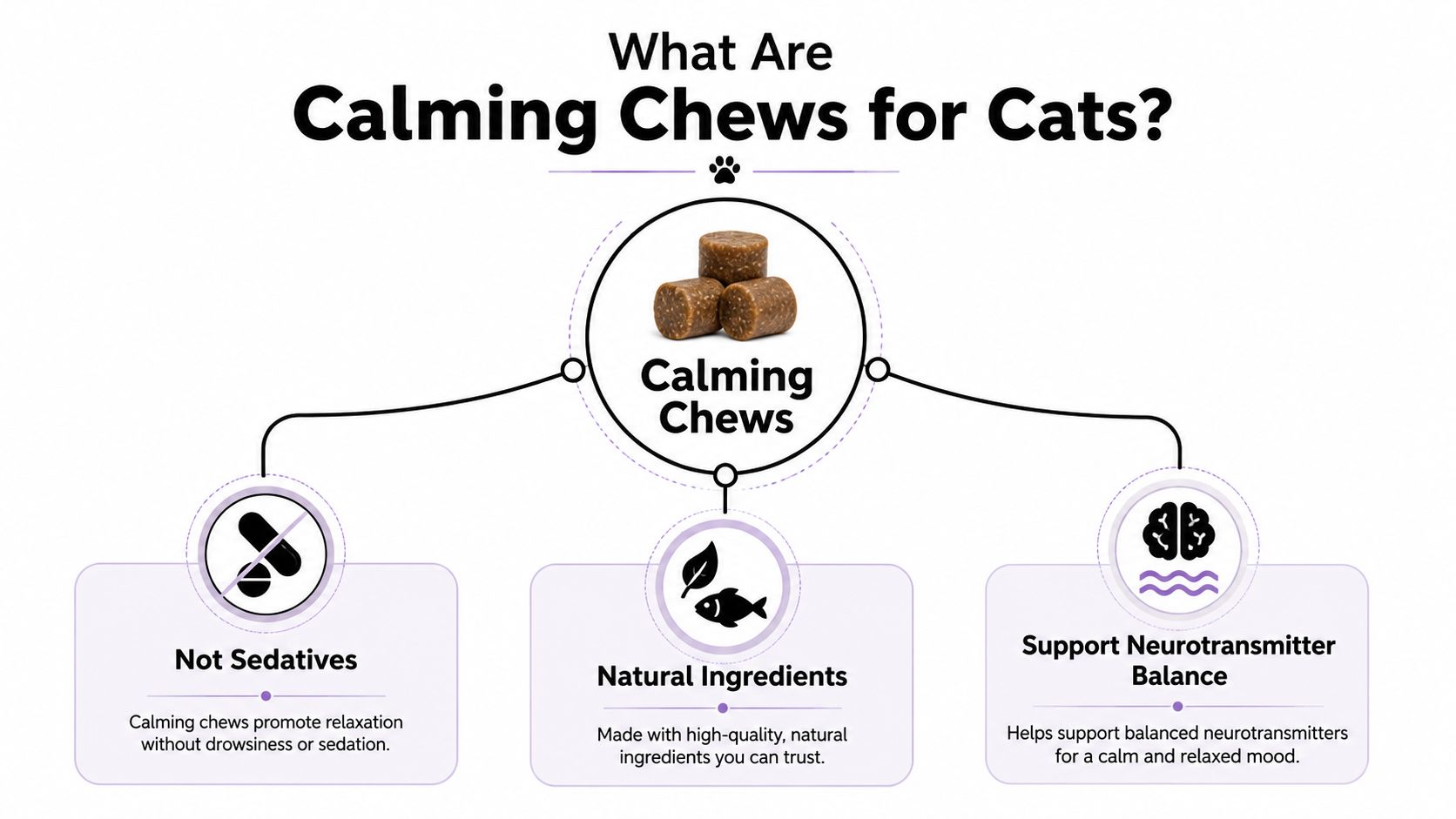
How the format fits into daily care
The chew format can make regular administration easier, especially when a cat accepts it as food. But convenience doesn't make every formula effective. Independent market research estimated the global pet calming supplements category at $1.8 billion in 2025, with chews holding the largest product share at 38.5% (Marketintelo pet calming supplements research). Those figures describe market activity, not proof that every chew works.
The same analysis estimated cats represented 22.6% of the category, valued at about $406.8 million in 2025 (Marketintelo feline segment data). This shows meaningful demand for feline products, but it doesn't replace ingredient-specific clinical evidence.
A product designed for digestive support may be useful for a different goal. For example, Probiotic Supplement for Cats - 30 Single-Serving Packets is described as veterinarian-formulated with clinically tested probiotic strains, real beef bone broth, two complementary prebiotics, individually sealed servings, and a minimum of 1 billion CFU per serving. Those features relate to digestive balance, not direct proof of an anti-anxiety effect, so don't confuse a gut supplement with a calming formula.
What a chew can't promise
A calming chew shouldn't replace a medical assessment, behavior plan, or prescribed treatment. It also shouldn't be described as universally effective for every fear. Cats differ in age, health, temperament, diet, stressor, and ability to absorb or tolerate ingredients.
The most accurate expectation is modest and practical. A suitable product may help a cat recover more easily, remain less reactive, or tolerate a recurring situation better over time. It may not prevent hiding during a severe storm, and it won't necessarily help with every form of fear.
Key Ingredients and Their Scientific Backing
A cat that hides before visitors may need a different approach from one that becomes distressed during travel. Ingredient labels therefore deserve closer reading than relaxed-cat packaging. The evidence is uneven, and a long list of botanicals does not automatically make a chew more effective.
L-theanine and alpha-casozepine
L-theanine has the clearest direct over-the-counter feline field evidence among commonly discussed chew ingredients. In an open-label multicenter study of stressed cats, median scores across 20 stress-related parameters were significantly reduced by day 30. 30 of 33 cats had lower global stress scores, and 21 of 33 achieved at least a 50% reduction in their global stress score (open-label feline L-theanine study).
The study reported improvement as early as 15 days, with stronger results by 30 days. Since it was open-label and had no placebo comparison, it supports a possible cumulative benefit rather than proving that every cat will respond. L-theanine should be understood as a gradual support option, not an instant sedative.
Alpha-casozepine has placebo-controlled feline data, giving it a different kind of evidentiary strength. A veterinary review describes a trial involving 34 cats receiving alpha-casozepine at 15 mg/kg across three veterinary visits, with reduced stress-related behaviors. Other studies found only partial benefits (veterinary review of feline calming therapies). The finding is encouraging but limited to particular measures and situations. It does not show that alpha-casozepine removes anxiety in every cat.
Read the rest of the label skeptically
Valerian, chamomile, and similar additions may sound reassuring, yet their inclusion is not the same as strong cat-specific evidence. Veterinary reviews describe limited support for many calming therapies, while multi-ingredient products may influence selected anxiety behaviors without broadly removing fear.
Species matters when owners compare products. Information about THC-free CBD for dogs from HempWell USA concerns dogs and a different product context, so it cannot establish that CBD is suitable for cats.
The same distinction applies to cat gut health. Digestive and emotional wellbeing may intersect for an individual cat, but a gut-focused product should not be described as a clinically proven calming treatment unless its formula has direct feline stress evidence.
How to Choose a High-Quality Product
A cat may still hide during visitors even after receiving a calming chew. That response does not automatically mean the product failed. These supplements are usually cumulative, ingredient-specific tools, so selection should begin with evidence and label clarity rather than a picture of a relaxed cat.
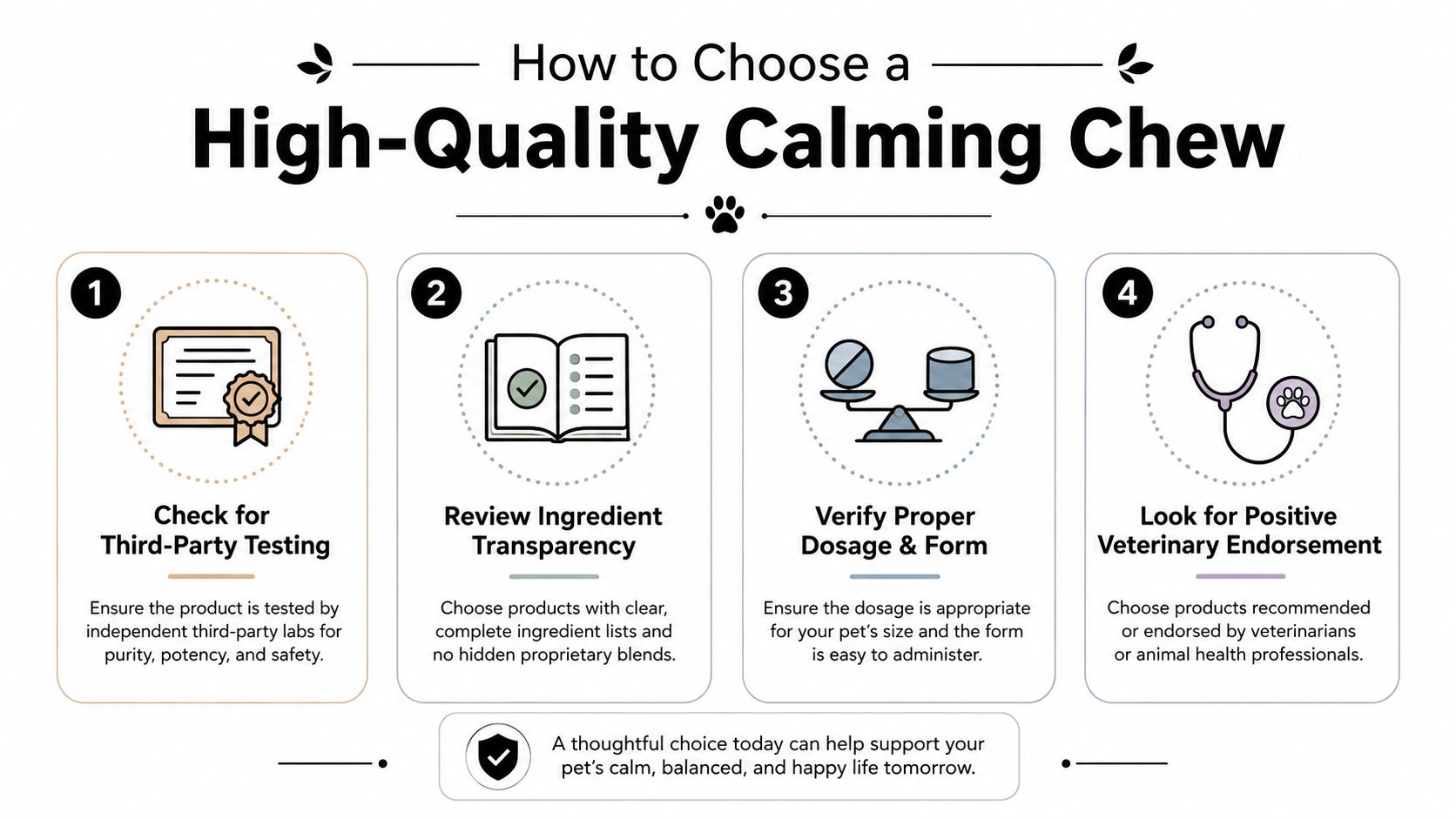
A practical label checklist
- Look for feline relevance. Give greater weight to ingredients studied in cats than to claims borrowed from dogs, humans, or laboratory theory.
- Demand transparency. The label should list active ingredients, serving size, directions, warnings, and the manufacturer's contact information. “Proprietary blend” wording is a concern when it hides the amount of each compound.
- Check independent testing. Testing for potency, purity, and contaminants helps confirm what the package contains. It does not establish that the formula reduces anxiety.
- Assess formulation oversight. Veterinary formulation or review provides useful context, especially when the label explains dosing and contraindications.
- Match the product to the stressor. A formula may suit recurring situational stress while offering little help for severe, generalized fear.
A clear label is only the starting point. Look for an explanation of why each ingredient is included, and check whether the manufacturer separates feline evidence from traditional use. Promises of instant calm, guaranteed results, or one solution for aggression, separation distress, travel, fireworks, and veterinary handling should prompt caution.
The delivery format also affects stress. A cat that refuses a chew may become more distressed when the owner repeatedly forces it. Choose a form the cat can accept without restraint. A chew is like a key that works only if the cat will take it, so ease of administration matters alongside the formula.
The following video offers visual context for evaluating calming products and administration routines.
For food-based routines unrelated to anxiety claims, owners may also encounter healthy cat treats. Keep the stated purpose clear, because a digestive supplement should not be presented as a calming chew. Ask a veterinarian to review the complete ingredient panel when a cat has chronic disease, takes medication, is pregnant, or is very young or old.
Dosing and Administration Tips
Follow the product label and your veterinarian's instructions rather than adapting a dog dose or increasing the serving because the first attempt seemed uneventful. Cat size, age, health status, diet, and concurrent medication can all affect tolerance. If the label doesn't clearly explain the amount per serving, ask the manufacturer or choose a more transparent product.
Introduce the chew when the cat is already calm. Offer it beside a familiar food or place a small portion with a preferred meal if the product allows that use. Don't chase a hiding cat around the house with a new supplement, because the administration process can become part of the stressor you're trying to reduce.
Make consistency boring
The feline L-theanine field study reported improvement as early as 15 days and better results by day 30 (feline L-theanine evidence). That timeline supports a days-to-weeks expectation, not a last-minute dose before a frightening event. A daily routine also makes it easier to notice whether the cat's behavior is changing.
Keep a simple record of the date, serving given, trigger, behavior, appetite, stool, and recovery. This doesn't need to be elaborate. You're looking for patterns, such as less hiding after visitors or faster recovery after a carrier appears.
Stop and contact a veterinarian if the cat develops vomiting, diarrhea, marked lethargy, unusual restlessness, or another concerning change. If the cat eats substantially more than directed, call promptly for individualized advice. Extra servings aren't a reliable shortcut to calm, and an accidental ingestion may require a different response depending on the formula.
Alternative Approaches to Managing Cat Stress
A chew works best when the environment stops asking the cat to cope with the same threat repeatedly. Start by identifying the stressor. Is another cat blocking access to food or the litter box? Does the carrier appear only before unpleasant trips? Is the cat exposed to loud machinery without a retreat?
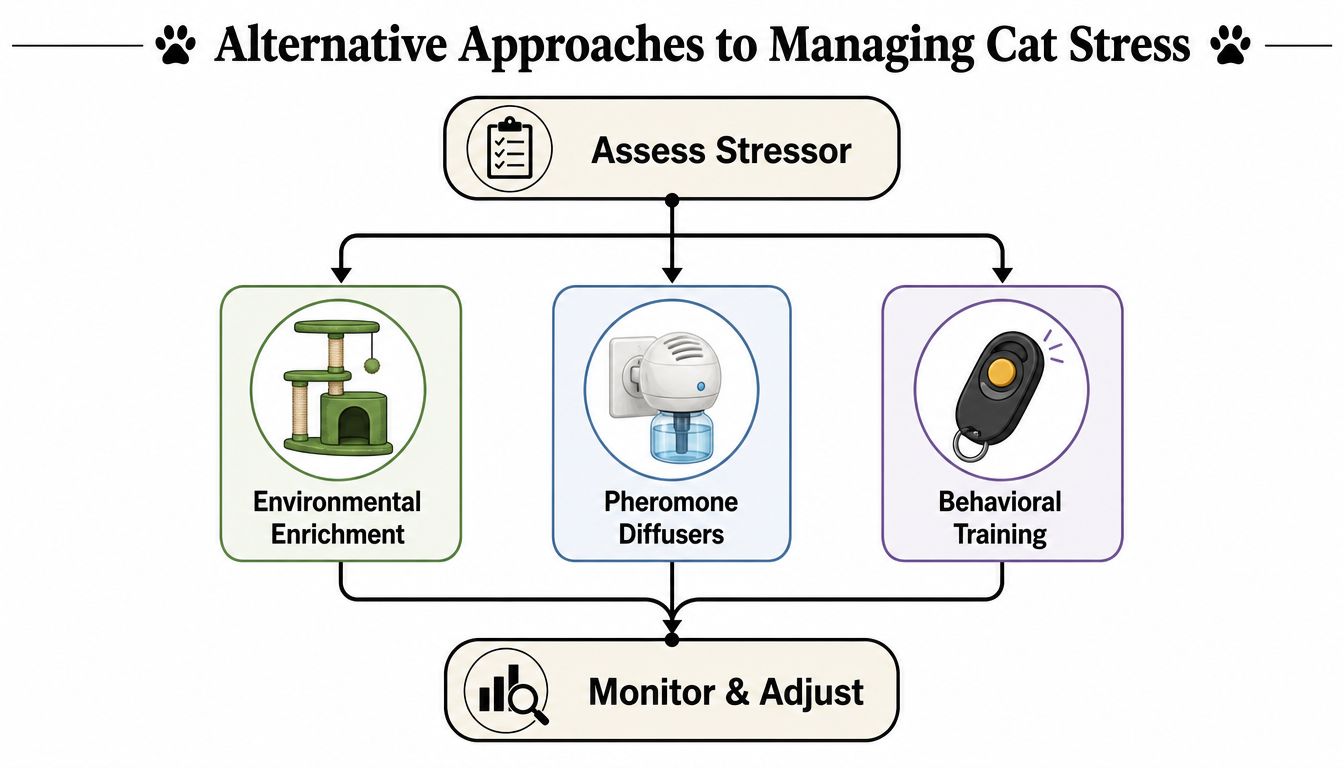
Change the setting before demanding a behavior
Give the cat a retreat with bedding, water, and a way to observe the room without being cornered. Add vertical territory, scratching options, predictable play, and food puzzles when those activities suit the individual cat. In multi-cat homes, separate resources and escape routes can reduce conflict.
Pheromone diffusers may help some cats, but they aren't a guarantee and shouldn't hide an unresolved medical or household problem. Place one where the cat spends time, follow the product directions, and monitor behavior rather than assuming the diffuser is working because it is plugged in.
Behavior modification should proceed below the cat's panic threshold. For carrier fear, leave the carrier open in a quiet room, add familiar bedding, and reward voluntary investigation. For a vacuum-sensitive cat, begin with the machine distant and switched off, pair calm observation with food, and increase exposure only while the cat remains relaxed.
The goal isn't to force bravery. It's to give the cat repeated experiences in which the trigger predicts safety, distance, and control.
If stress includes aggression, self-injury, persistent elimination changes, weight loss, or severe withdrawal, involve a veterinarian. A professional can rule out illness and recommend a behavior plan or medication when supplements and environmental changes aren't enough.
Household pests can also disturb a cat's routine and comfort. If fleas are part of the picture, use a reliable pet flea guide from FullScope Pest Control while coordinating treatment with your veterinary team.
For broader ingredient education, owners can find the best supplements for cats, but every product still needs to be matched to the cat's medical history and the specific problem.
Red Flags and Common Myths
The biggest myth is that a calming chew should make a cat visibly sleepy. Relaxation isn't the same as sedation. A cat that remains alert but recovers sooner, hides less, or tolerates handling better may be responding appropriately.
The opposite claim is just as misleading. A product promising instant, universal calm before travel or fireworks ignores the evidence. L-theanine research in stressed cats points toward improvement over days to weeks, while alpha-casozepine findings show selected and partial effects rather than broad fear elimination (feline calming ingredient review).
Marketing warnings worth taking seriously
- Instant-result promises: Be wary of claims that one serving will resolve every form of anxiety.
- Hidden quantities: Avoid blends that name several ingredients but don't disclose their individual amounts.
- Species substitution: Dog or human research may inform an idea, but it isn't direct proof for cats.
- No safety instructions: A responsible label should address administration, storage, contraindications, and what to do after overconsumption.
- Fear-based selling: Packaging that implies your cat is damaged unless you buy the product deserves skepticism.
Too much of a chew can cause vomiting, diarrhea, lethargy, or restlessness, according to independent veterinary guidance on accidental ingestion (veterinary advice after a cat eats calming chews). Kittens, seniors, cats with chronic illness, and cats taking other medicines deserve extra caution because “natural” doesn't mean interaction-free.
The same principle applies to visual marketing. If you want to find cat portrait inspiration, enjoy the art, but don't confuse a peaceful image on a package with evidence that its formula will produce that result.
Conclusion and Final Thoughts
Calming chews for cats can be useful stress-management tools, but they're not universal anti-anxiety fixes or emergency sedatives. The strongest feline evidence is ingredient-specific. L-theanine has an open-label field study showing lower stress scores over time, while alpha-casozepine has placebo-controlled data showing reduced stress-related behaviors in a defined setting. Neither result means every cat will respond to every product.
Choose a formula with transparent ingredients, clear feline dosing, and meaningful quality controls. Introduce it without creating a struggle, track behavior over days and weeks, and stop if adverse signs appear. Pair nutritional support with a safer environment, predictable routines, enrichment, and gradual behavior work.
A sudden or severe change still calls for veterinary attention. Your cat may need medical treatment, environmental changes, behavior support, or a combination of approaches. Patience helps, but careful observation helps first.
Joyfull offers veterinarian-reviewed pet wellness products, including supplements made with clearly identified ingredients and quality-focused formulation. Visit Joyfull to explore its cat supplement options and choose support that fits your cat's actual needs, not just the promise on a package.
0 comments