


Yes, dietary supplements are regulated, but mostly after they reach the market rather than through routine pre-market approval. In the United States, DSHEA, enacted in 1994, places supplements in the food category, so the FDA generally doesn't approve their safety, effectiveness, or labeling before sale.
So why can a product sit beside pet food with a polished label if nobody at the FDA has approved it first? That's the gap many shoppers miss. “Regulated” means the product is governed by legal requirements, not that a government agency has tested every formula before purchase.
For pet owners, that distinction matters even more. A supplement may have a thoughtful formula, clear dosing, and independent testing, or it may rely mainly on attractive wording and a familiar-looking package. The label alone doesn't tell you how much scrutiny happened before the product reached the shelf.
Table of Contents
- What Regulation Actually Means for Supplements
- How the FDA Oversees Human Supplements
- Why Pet Supplements Follow a Different Rulebook
- Reading Supplement Labels and Claims
- Where Oversight Falls Short
- Choosing Safe Supplements for Your Pet
- A Simple Framework for Every Purchase
What Regulation Actually Means for Supplements
Regulated doesn't mean pre-approved
People often hear that supplements are regulated and reasonably assume a government reviewer has checked the product for safety and effectiveness. That assumption fits many prescription drugs, but it doesn't fit the U.S. supplement system.
Under the Dietary Supplement Health and Education Act of 1994, supplements became a distinct category of food rather than drugs. The FDA generally doesn't approve a finished dietary supplement for safety, effectiveness, or labeling before it's sold. Instead, the manufacturer is responsible for ensuring the product is safe and properly labeled before marketing it. The FDA's consumer guidance on dietary supplements explains this structure directly.
That creates two different regulatory models:
| Model | What happens before sale | What happens after sale |
|---|---|---|
| Drug-style approval | The manufacturer submits evidence for government review before marketing | Regulators continue monitoring safety and manufacturing |
| Supplement oversight | The manufacturer carries the initial responsibility for safety and truthful labeling | The FDA can inspect, investigate, monitor reports, review imports, and act against unsafe or misbranded products |
The practical lesson is simple: a product can be legally sold without pre-market proof that it works as advertised. The rules still prohibit adulterated products and misleading labels, but enforcement often depends on problems being identified after marketing begins.
What manufacturers must do
Manufacturers are expected to control ingredient identity, product composition, labeling accuracy, and manufacturing quality. Products containing a new dietary ingredient also involve a pre-market notification process, with safety information submitted at least 75 days before marketing, according to the FDA's overview of supplement regulation.
That process isn't the same as approval. It's one part of a framework that places substantial responsibility on the company making the product.
For pet owners, this is why a separate guide to pet food regulations can be useful. Pet products don't automatically inherit the same consumer expectations people bring to medicines. The animal-supplement side involves additional layers, including feed rules and state enforcement, which can make the label harder to interpret.
How the FDA Oversees Human Supplements
Human supplements operate under a system built around post-market oversight. The FDA can inspect manufacturing establishments, review imports, examine adverse-event reports, and act against products that appear adulterated or misbranded. It can also investigate labeling and marketing claims once a product is available to consumers.
The central limitation comes first: the FDA doesn't generally review a supplement's complete safety profile, effectiveness, or label before the product reaches the market. A company must meet its legal responsibilities, but the agency isn't giving the finished bottle a routine government approval stamp.
Before sale and after sale
The distinction becomes clearer when the FDA's powers are placed side by side.
| Regulatory Power | Pre-Market (Before Sale) | Post-Market (After Sale) |
|---|---|---|
| Safety review | No general FDA approval of finished supplements for safety | FDA can investigate safety concerns and act against unsafe products |
| Effectiveness review | No routine pre-approval of effectiveness | Unsupported or misleading claims can trigger enforcement |
| Label review | Labels aren't generally approved before marketing | FDA can challenge misbranding and misleading information |
| Manufacturing oversight | Manufacturers must follow applicable quality requirements | FDA can inspect facilities and investigate manufacturing failures |
| New dietary ingredients | Safety information is submitted before marketing when the ingredient qualifies as new | FDA can examine whether marketed products comply with the law |
| Consumer harm reports | No universal pre-sale screening catches every problem | Adverse-event reports and complaints can help surface issues |
The FDA's dietary supplement questions and answers describe this primarily reactive model. The agency may inspect facilities, monitor the marketplace, review imports, and respond to adverse events, but those tools don't amount to a full pre-market review of every product.
Manufacturing controls matter
Current good manufacturing practices, commonly called CGMPs, are meant to help manufacturers maintain consistent identity, purity, strength, and composition from batch to batch. They're important because a product can have a sensible ingredient list and still fail if the manufacturing process doesn't control contamination, substitution, or inconsistent potency.
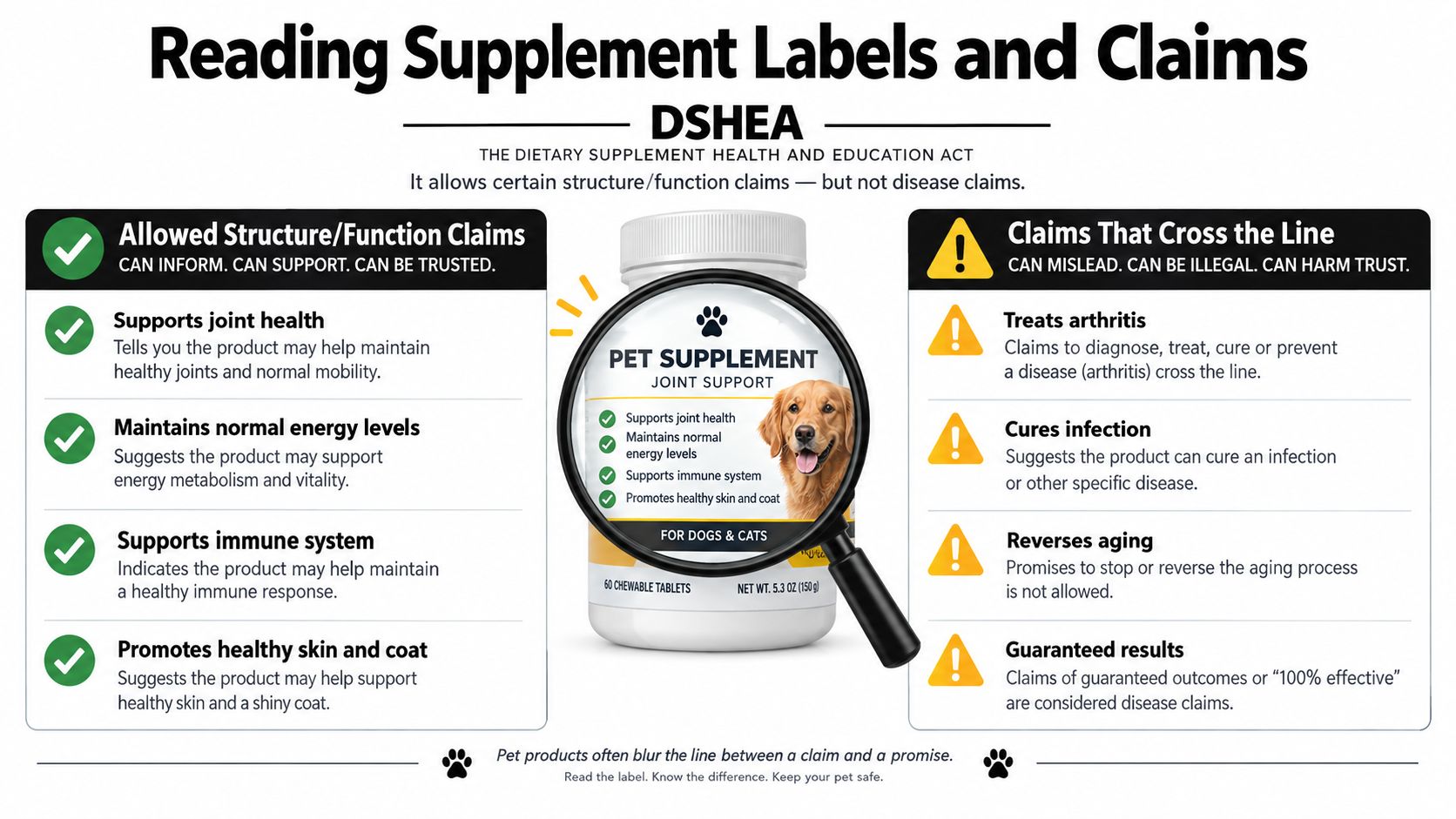
A claim also has boundaries. “Supports joint health” is a structure/function-style statement. “Treats arthritis” describes a disease treatment and crosses into drug-like territory. The wording matters because consumers may interpret both phrases as medical promises even though the legal implications differ.
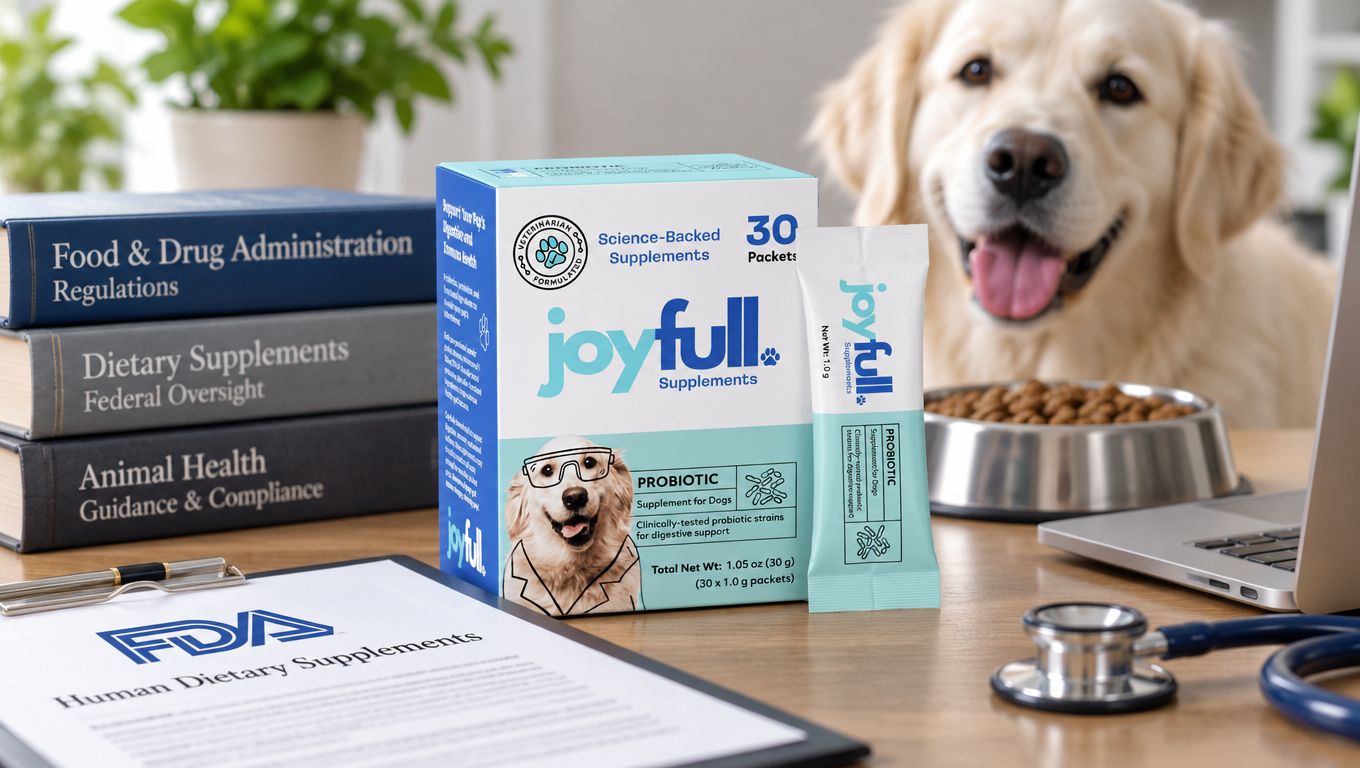
A product such as Joyfull Probiotic Supplement for Dogs - 30 Single-Serving Packets illustrates the type of information a shopper might compare on a label, including veterinarian formulation, clinically-tested probiotic strains, third-party testing for potency and purity, and a stated minimum of 1 billion CFU per serving. Those details are product information, not evidence of FDA pre-approval.
Why Pet Supplements Follow a Different Rulebook
Pet supplements sit in a less tidy space than human supplements. The FDA's Center for Veterinary Medicine has oversight responsibilities, but animal products also interact with state feed-control laws, ingredient definitions, and guidance associated with the Association of American Feed Control Officials, or AAFCO.
AAFCO isn't a federal regulator. It develops model definitions, nutrient profiles, and labeling guidance that states may adopt into their own laws. That means a statement connected with AAFCO can carry practical significance on a pet-food label, while the actual legal requirements can vary according to the state where the product is sold.
Human and animal products aren't interchangeable
A human supplement framework doesn't automatically answer questions about a dog or cat. Species, body size, metabolism, acceptable ingredients, and feeding directions all matter. A product designed for people may contain ingredients or concentrations that aren't appropriate for an animal, even if the package uses familiar wellness language.
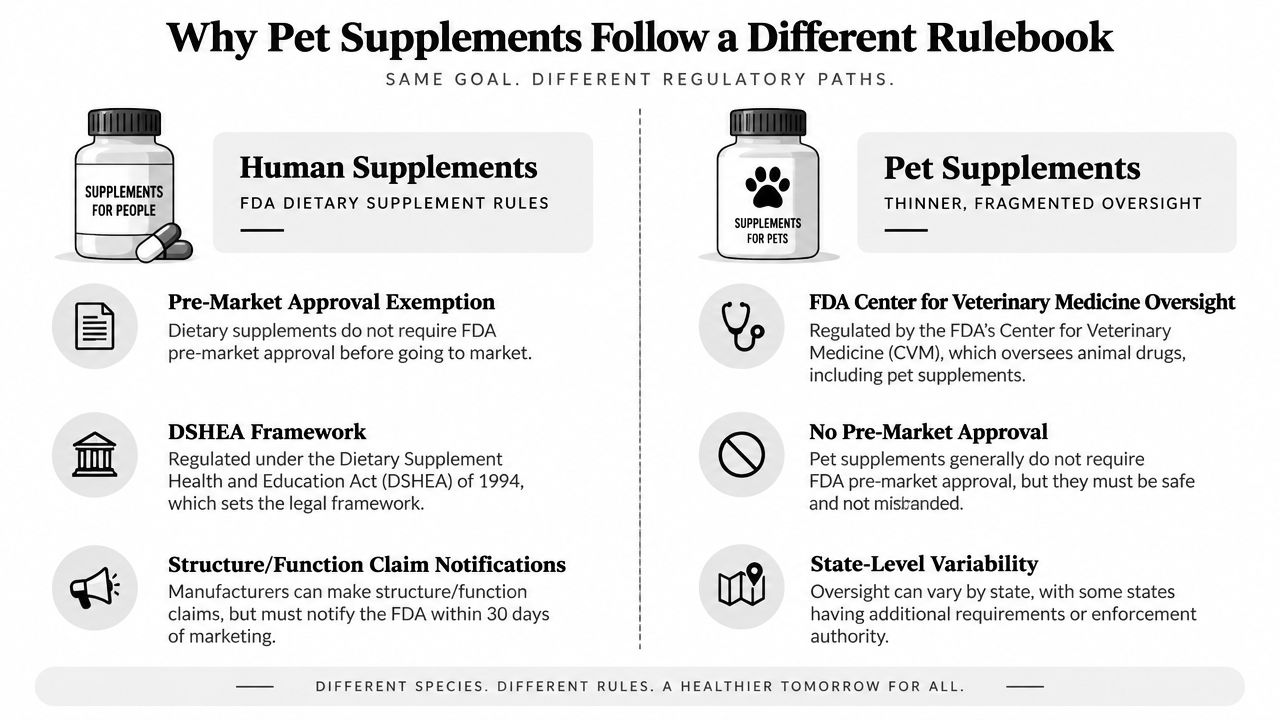
Pet owners therefore have to evaluate more than whether a label says “supplement.” They should ask:
- Who is the product for? The label should identify the intended species and provide animal-specific directions.
- What does the claim mean? “Supports digestion” is different from claiming to treat a diagnosed gastrointestinal disease.
- Which rules apply? Federal oversight, state feed laws, and voluntary industry guidance may all affect the product.
- What quality information is visible? Ingredient amounts, lot identification, expiration information, and manufacturing details help a shopper investigate.
This layered system explains why pet supplements can feel especially confusing. A package may look similar to a human wellness product, yet the legal and practical controls behind it aren't identical. The safest approach is to treat the label as a starting point for questions, not as proof that a regulator has evaluated the formula.
Reading Supplement Labels and Claims
What can a supplement label really prove? It can show what a company says the product contains and what benefits it intends to describe. It cannot, on its own, establish that every claim has clinical meaning or that the formula matches every impression created by the front panel.
Begin with the intended use. Phrases such as “supports joint health,” “helps maintain normal energy,” and “promotes calm behavior” describe a function or general benefit. “Treats arthritis,” however, presents a disease-treatment claim. That wording belongs to a different regulatory category than structure/function language.
Read the panel, not only the front
The ingredient panel should identify active ingredients and, where appropriate, state the amount per serving. A proprietary blend can obscure the quantity of each ingredient, leaving you unable to compare the label with the serving directions. Species-specific instructions matter too. “Human-grade” may describe an ingredient or handling standard, but it does not establish the right dose for a dog or cat.
For a broader primer on decoding supplement facts panels, check the serving size, active amounts, inactive ingredients, directions, and manufacturer information. Our guide to decoding pet supplement labels applies the same careful reading to animal products.
A structure/function statement may be followed by an FDA disclaimer. That disclaimer indicates the statement has not been evaluated as a disease-treatment claim in the way a drug indication would be. It does not prove the product works or replace veterinary advice.
Red flags worth pausing over
- Missing amounts: An ingredient is listed without its quantity per serving.
- No lot number: Batch identification is missing, making a product concern harder to trace.
- No expiration date: Freshness and potency may matter for oils, probiotics, and other sensitive ingredients.
- Human directions only: The label provides human serving language without clear dog- or cat-specific guidance.
- Unverifiable traceability: A QR code does not lead to useful information or meaningful batch details.
For example, the Joyfull Probiotic Supplement for Dogs - 30 Single-Serving Packets presents species-specific information, including veterinarian formulation, clinically studied probiotic strains, third-party testing for potency and purity, prebiotics, and individually sealed servings. Treat those details as information to assess alongside the complete label and your veterinarian's advice, rather than as a substitute for either.
Where Oversight Falls Short
The system's biggest weakness is timing. Because the FDA doesn't generally pre-approve finished supplements, a problem may become visible only after consumers, veterinarians, manufacturers, or regulators identify it. Reports and complaints can reveal patterns, but they depend on someone noticing the issue and reporting it with enough detail to investigate.
That gap doesn't mean every supplement is unsafe. It means regulation alone can't answer every quality question at the moment you pick up a package. A product can comply with one part of the framework while still leaving shoppers uncertain about evidence, consistency, or suitability for a particular animal.
Different bodies, different limits
| Body | Covers | Does Not Cover | Enforcement Power |
|---|---|---|---|
| FDA | Federal food, supplement, manufacturing, import, and marketplace requirements | Routine pre-market approval of every finished supplement | Inspections, investigations, marketplace action, and measures against adulterated or misbranded products |
| FDA Center for Veterinary Medicine | Federal oversight involving animal food, feed, and related products | A universal pre-sale approval pathway for all pet supplements | Federal compliance action within its authority |
| AAFCO | Model feed definitions, nutrient profiles, and labeling guidance | Direct federal approval of most pet supplements | No independent federal enforcement power |
| State feed authorities | State-specific feed and labeling requirements | A single uniform national system | State-level review and enforcement under applicable law |
Ingredients marketed for pets can also create uncertainty when their intended use is described broadly. Glucosamine, probiotics, botanical ingredients, and other wellness components may appear in products that use supportive language without offering the kind of evidence a pet owner might expect from a medicine.
A simple product such as Prebiotic Tuna Squeeze Treats for Cats still deserves the same basic questions as a capsule or powder: What species is it for? What ingredients are included? What does the product claim to do? Are the directions and quality details clear?
Choosing Safe Supplements for Your Pet
Shopping becomes easier when you separate quality signals from marketing language. No seal can promise that a supplement is right for your pet or that a wellness claim will deliver a particular outcome. Independent testing, manufacturing controls, and transparent labeling can still give you better information than a polished front panel alone.
Use a store-ready checklist
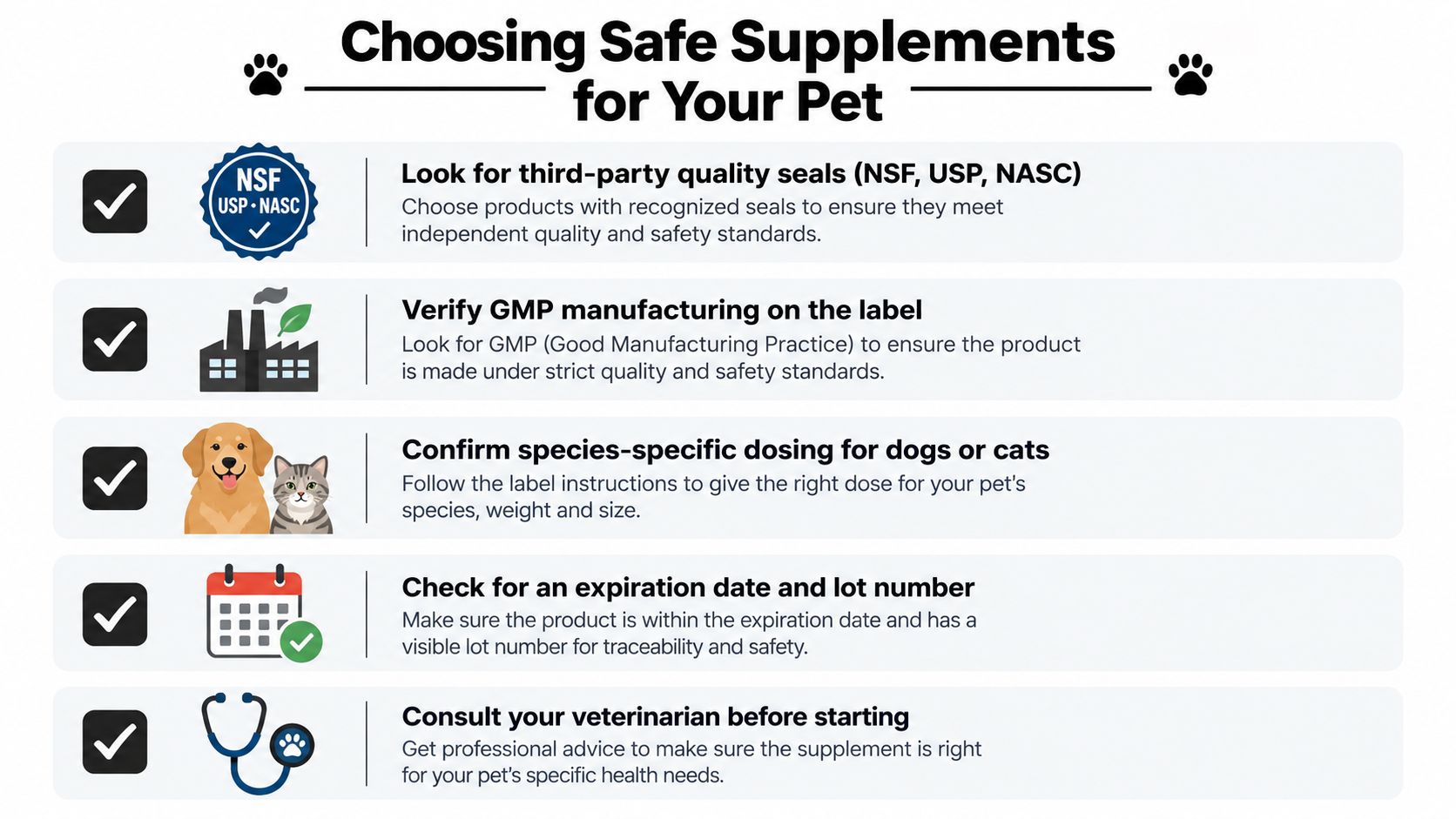
- Look for an independent quality program. The NASC Quality Seal, USP Verified, ConsumerLab, and NSF International are examples shoppers may encounter. Check what the program evaluates. A seal may relate to manufacturing, identity, purity, contaminant screening, or another defined process. Don't assume every seal guarantees effectiveness.
- Check the manufacturing language. A clear CGMP statement is more useful than a vague promise of premium quality. If a company says its facility follows current good manufacturing practices, look for enough information to understand who manufactures the product and how the claim can be verified.
- Confirm the species and dose. Avoid repurposing human multivitamins unless a veterinarian specifically directs you to do so. The label should identify dogs or cats, provide serving directions, and explain how weight affects the amount.
- Choose transparent amounts. Prefer exact active-ingredient quantities over a proprietary blend that hides individual amounts. Check the lot number and expiration date before buying.
- Ask your veterinarian first. A supplement can interact with medication, affect an underlying condition, or distract from a symptom that needs diagnosis. A veterinarian can help decide whether the product's intended use fits your pet's health situation.
Third-party testing matters most when the company explains what was tested and what the result means. “Tested” is incomplete without context. Potency, identity, purity, and contamination screening answer different questions, so look for wording that distinguishes them.
If you're comparing products such as dog probiotics, review the stated strain information, serving amount, storage or packaging details, and testing language. Then discuss the product with your veterinarian, especially if your dog has ongoing digestive symptoms or takes other products.
A Simple Framework for Every Purchase
Use four questions before you put any pet supplement in your cart.
One, is it made for this species?
A dog product isn't automatically suitable for a cat, and a human product isn't automatically suitable for either. Check the intended species, serving directions, and weight guidance.
Two, can you understand how it's made?
Look for credible CGMP information and a manufacturer willing to identify its quality practices. Manufacturing language should give you something concrete to evaluate, not just a vague promise of purity.
Three, is there independent testing?
A third-party program or test result can provide additional information about identity, potency, purity, or contaminants. Verify what the testing covers rather than treating every badge as proof of effectiveness.
Four, do the claims match the evidence and the label?
Supportive wording isn't the same as a disease-treatment claim. Ask whether the product provides clear active amounts and whether its stated benefit is appropriate for a supplement rather than a substitute for diagnosis or treatment.
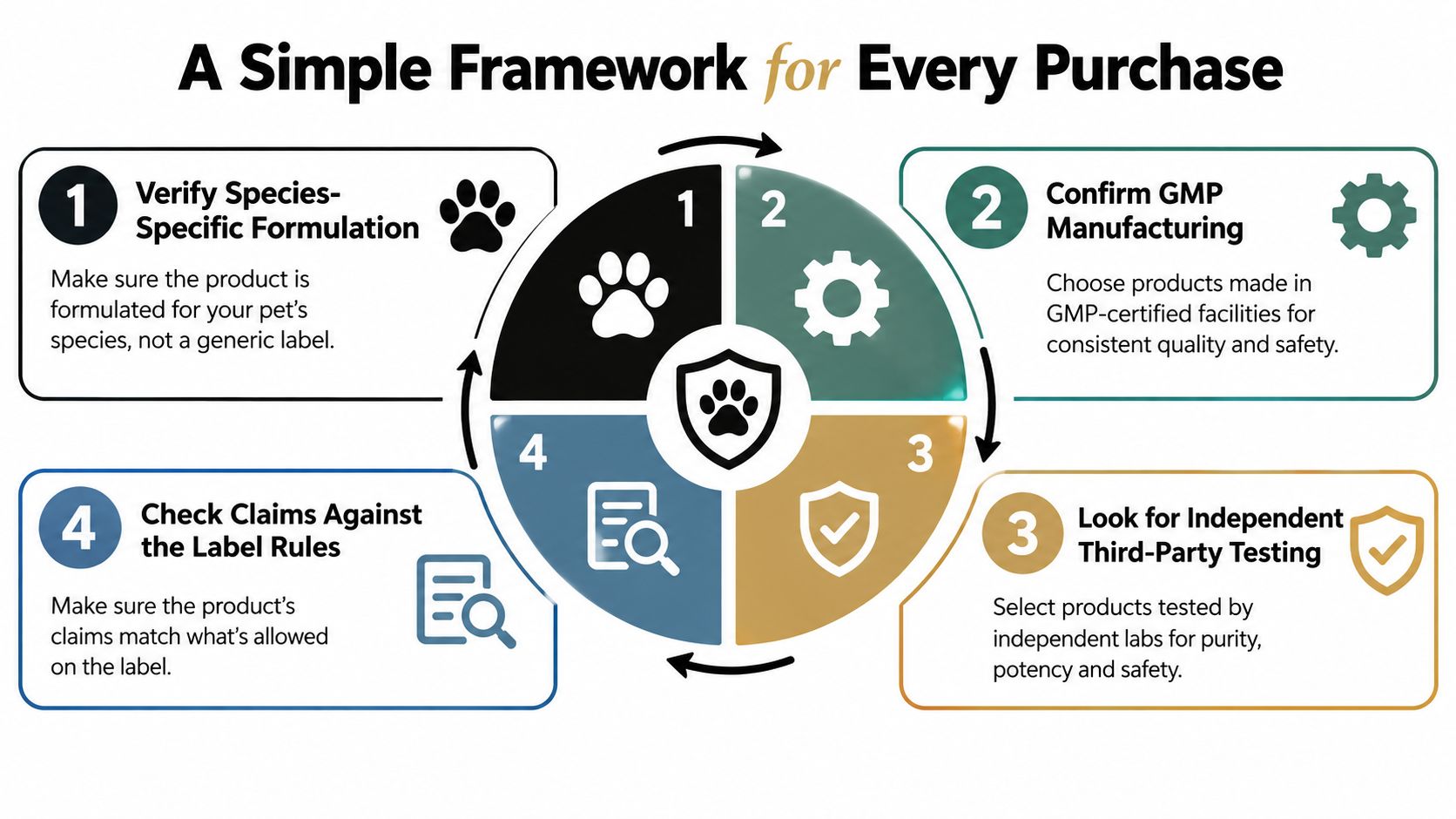
A product that passes these checks may deserve a closer look. A missing piece isn't automatic proof of a bad product, but it is a reason to pause, investigate, and ask your veterinarian before starting it.
Joyfull offers dog and cat wellness products that include veterinarian-formulated probiotic supplements, third-party testing information, species-specific options, and prebiotic treats. Visit Joyfull to review the product details and choose what to discuss with your pet's veterinarian.
0 comments