


Using a generic scoop to measure your cat’s food is like guessing the dose for a prescription. It's a risky, one-size-fits-all approach when what your cat really needs is precision to stay healthy. A proper cat feeding guide by weight is easily the best tool you have for helping your feline friend live a long, vibrant life.
Why A Scoop Is Not A Strategy For Cat Health
Tossing a scoop of kibble into the bowl is easy, but this common habit is fueling a silent epidemic in our homes. The vague instructions on pet food bags rarely account for your specific cat’s needs, which means tons of well-meaning owners are overfeeding their pets without even realizing it.
This isn't a small problem—it's a full-blown health crisis. Did you know a shocking 61% of cats in the United States are considered overweight or obese? That statistic, highlighted by pet care experts, points directly to imprecise feeding as a major cause. Learn more about the research behind feline obesity management.
Moving Beyond Guesswork
The fix is to stop thinking in scoops and start thinking in calories. Just like us, every cat has a specific daily energy requirement that depends on a few key things:
- Weight: Their current size is the baseline for everything.
- Age: Growing kittens need a ton of energy, while senior cats usually need fewer calories.
- Activity Level: A cat who naps all day needs way less fuel than an active, playful cat who's always on the move.
- Spay/Neuter Status: Altered cats tend to have slower metabolisms and often require about 25% fewer calories.
The scoop method fails because it ignores all these details. It treats every cat like they’re the same, which slowly leads to weight gain and serious health issues like diabetes, arthritis, and a shorter life. To really protect your cat's health, it’s time to get more precise, which is easier than ever with tools like smart feeders and Petkit's innovative pet care solutions.
Introducing the Body Condition Score
The number on the scale doesn't tell the whole story. That’s where the Body Condition Score (BCS) comes in—it’s a hands-on way to check if your cat is underweight, ideal, or overweight by feeling their ribs and looking at their body shape.
Think of the BCS as a more detailed physical you can do right at home. It helps you see what the scale can't, like whether your cat is just carrying a little extra fluff or is genuinely lean and muscular.
This guide will walk you through calculating exact calorie needs and using the BCS to get those portions just right. When you finally ditch the scoop, you’re doing more than just feeding your cat—you're taking charge of their health for years to come.
Figuring Out Your Cat's Daily Calorie Needs
Alright, so you've ditched the scoop. Good move. Now for the part that sounds a little intimidating but is actually pretty simple: the math. Calculating your cat's daily calories isn't about complex formulas; it's about creating a personalized energy budget. Think of it as making sure they get exactly what they need to feel great—no more, no less.
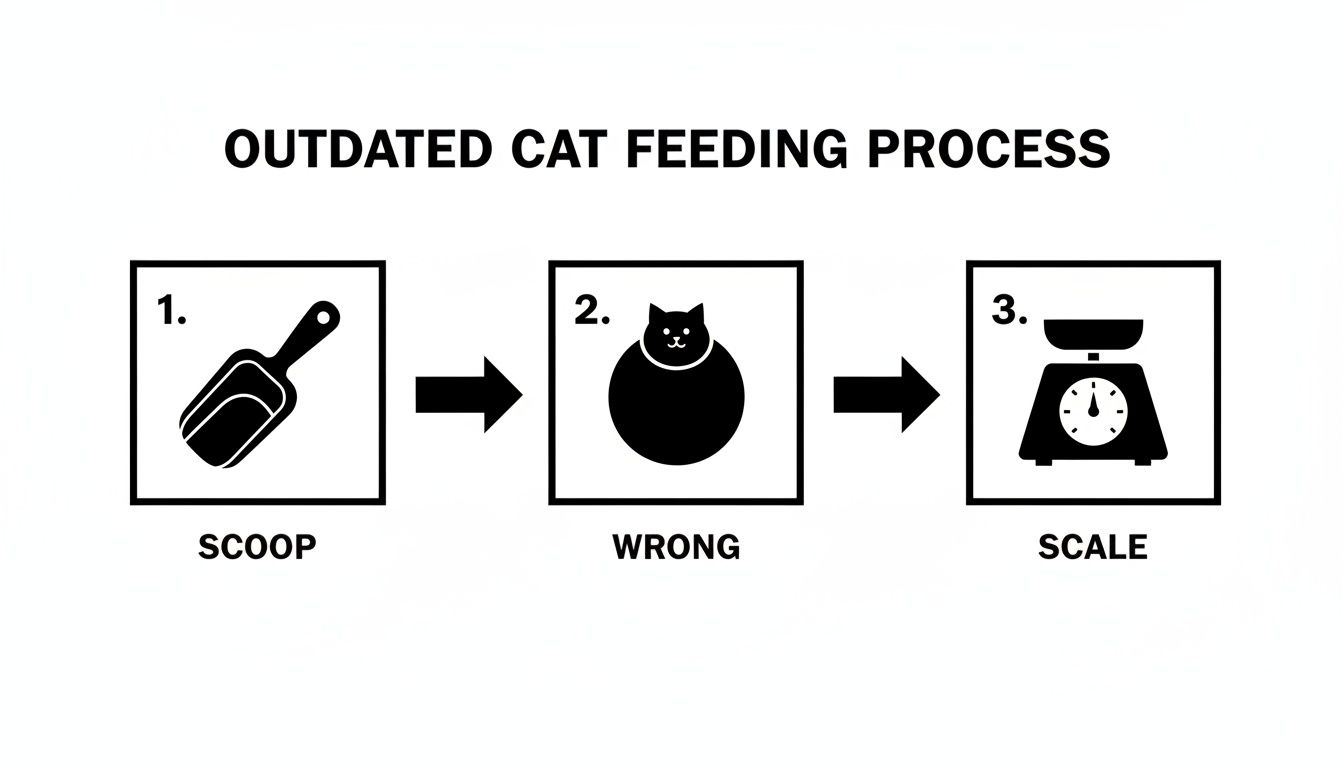
For too long, the "scoop, guess, and serve" method has been the go-to, and frankly, it's a big reason why so many cats are overweight. A little bit of precision here goes a long, long way.
Weighing food is the only way to be sure you're feeding the right amount. Guessing with a scoop, even a measuring cup, is often where the extra pounds start to creep in.
The Two-Step Formula Vets Use
To get to that magic number, we'll use the same straightforward, two-step process veterinarians use. We start by finding their baseline energy needs and then tweak that number based on their unique lifestyle.
- Resting Energy Requirement (RER): This is the base amount of energy your cat burns just to exist—breathing, digesting food, and, of course, their professional-level napping. It's the "lights on" calorie count for their body.
- Maintenance Energy Requirement (MER): This is the real number we're after. It takes the RER and adjusts it for things like activity level, age, and whether they've been spayed or neutered.
Getting this right is a game-changer for their long-term health. Nutrition experts agree that feeding has to be personalized to a cat's specific weight and lifestyle to keep obesity at bay. And while an overwhelming 90% of pet owners say they want this kind of guidance, a shockingly low 15% actually get it from their vet.
The difference can be huge. For instance, a 3 kg (6.6 lb) cat who's prone to weight gain might only need 160 kcal/day. But an active, intact cat of the exact same weight could need up to 255 kcal/day. If you want to dive deeper into the science, you can explore this detailed study on feline energy requirements.
Step 1: Find Your Cat's RER (The Baseline)
The Resting Energy Requirement (RER) is the foundation of our whole calculation. It’s the absolute minimum energy your cat needs just for their body to perform its basic, non-negotiable functions.
Think of RER as the baseline electricity bill for your cat's body. It's the energy they use just to keep the lights on, before you even factor in running, jumping, or chasing laser dots.
The formula is pretty simple and works with your cat’s weight in kilograms (kg). If you measure in pounds, just divide by 2.2 to get the weight in kg.
The Formula: RER (in kcal/day) = 70 x (Weight in kg)^0.75
Don't let the little "0.75" scare you. The calculator on your phone almost certainly has this function (look for an xʸ button). Let's walk through it.
Example Cat: A healthy, adult indoor cat who weighs 10 pounds.
- First, convert her weight to kilograms: 10 lbs ÷ 2.2 = 4.55 kg
- Next, plug that into the formula: 70 x (4.55)^0.75
- The result is: RER ≈ 217 kcal/day
So, our 10-pound cat needs around 217 calories a day just to lie on the couch. Now, let’s adjust for what she actually does all day.
Step 2: Calculate The Final Calorie Goal (MER)
This is where we fine-tune the number. We take the RER and multiply it by a factor that reflects your cat's real life to find their Maintenance Energy Requirement (MER). This is like adding an "activity surcharge" to their base energy bill.
Here are the standard multipliers to use:
- Neutered/Spayed Adult: RER x 1.2
- Intact Adult: RER x 1.4
- Inactive/Obesity-Prone: RER x 1.0
- For Weight Loss: RER x 0.8 (use their ideal weight, not current)
- Active Cat (lots of playtime): RER x 1.6
- Kitten (under 4 months): RER x 2.5
Let’s finish the calculation for our 10-pound example cat. We’ll assume she's a spayed adult who spends her days indoors.
Putting It All Together:
- Her RER is 217 kcal/day.
- Her lifestyle multiplier (Spayed Adult) is 1.2.
- MER = 217 x 1.2 = 260 kcal/day
And there you have it. Our 10-pound, spayed, indoor cat needs about 260 calories per day to stay at her healthy weight. This is your target number—the golden ticket you'll use to measure her food precisely, which we'll cover next. By doing this quick bit of math, you’re already miles ahead of the old scoop-and-hope approach.
Translating Calories To The Food Bowl
Knowing your cat's daily calorie target is a huge step, but that number doesn't mean much until you can turn it into the right amount of food in their bowl. This is where we bridge the gap between the math and the meal. Getting this right ensures every bite contributes to their health, not their waistline.
First thing's first: grab your cat’s food and look for the caloric content on the label. Every decent brand will list this, usually as "kcal/cup" for kibble or "kcal/can" for wet food. Don't let the term "kcal" throw you; it's just the scientific word for a calorie. This number is your key.
Once you find it, the math is simple. Just take your cat's total daily calorie goal and divide it by the calories per cup or can.
The Problem With Scooping
It’s so easy to grab a standard measuring cup and scoop out some kibble, but this is one of the biggest—and most common—mistakes cat owners make. Think of it like baking. If a recipe calls for a precise amount of flour, just "eyeballing" it with a random scoop can ruin the whole cake. The same principle applies to your cat's food.
Measuring cups are notoriously inaccurate. The size and shape of kibble pieces can drastically change how much actually fits in the cup, sometimes throwing off the measurement by as much as 20%. That little bit of extra food at every meal really adds up over time, often leading to unwanted weight gain.
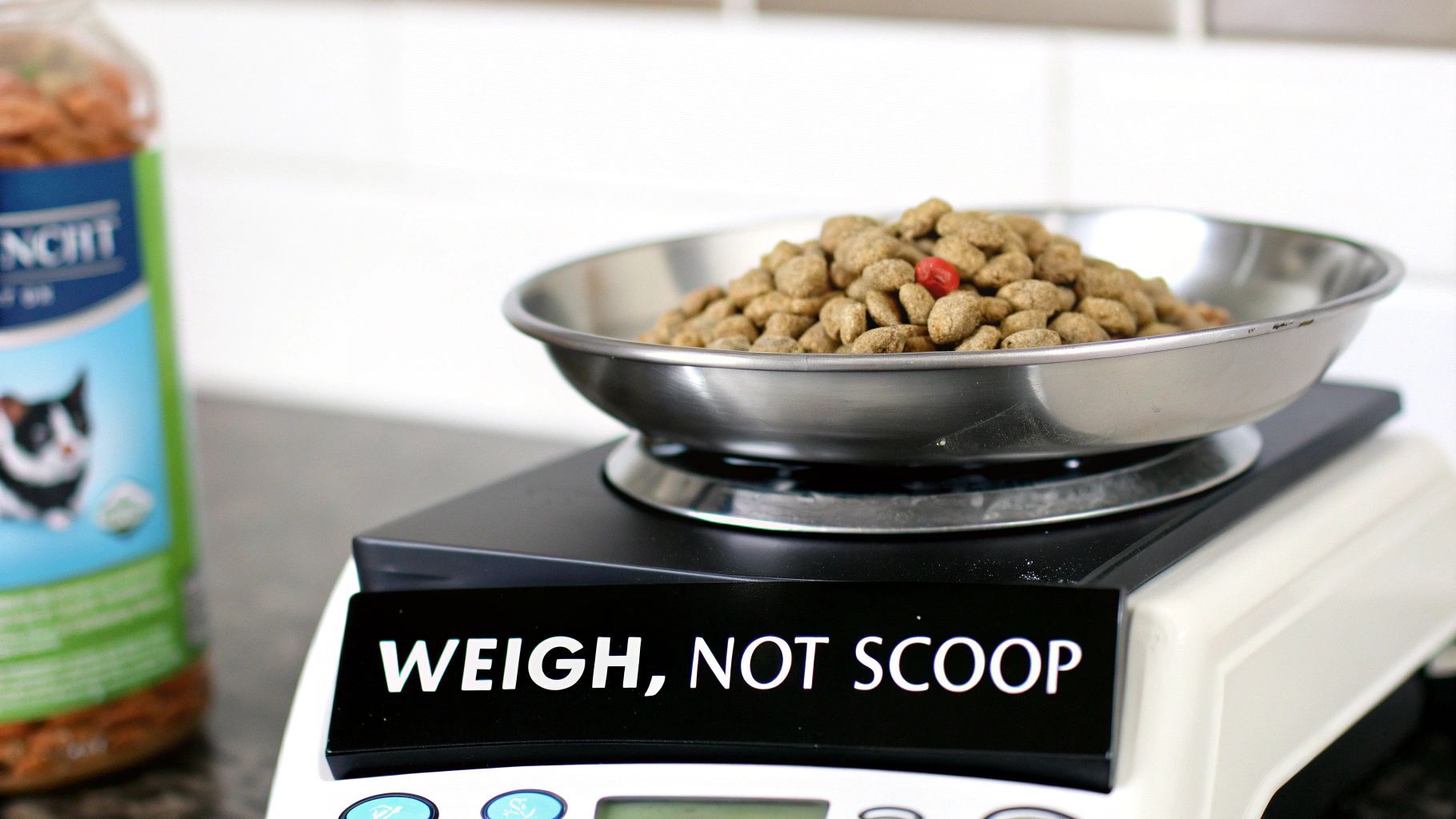
The only way to guarantee you're feeding the right amount is to use a digital kitchen scale. Weighing food in grams takes all the guesswork out of the equation. It's the simplest and most effective way to ensure your cat gets exactly what they need, every single meal.
Making this one small change—switching from a scoop to a scale—is often the single most powerful thing you can do to manage your cat’s weight.
Calculating Portions For Different Food Types
Wet and dry foods are worlds apart in calorie density. Kibble is very concentrated, while wet food is mostly water, making it far less calorie-dense by weight. Knowing how to choose cat food is the first step, as the quality and type will dictate the portion sizes. You can check out our guide on selecting the best options to learn more about reading the label.
https://joyfullpet.com/blogs/news/how-to-choose-cat-food
Let’s go back to our example 10-pound cat who needs 260 kcal per day and see how this works in the real world.
Dry Food Only Calculation
Let's say her dry food has 400 kcal/cup.
- The Math: 260 kcal (her daily need) ÷ 400 kcal/cup = 0.65 cups per day.
- The Action: Don't scoop! Look on the bag for the weight of one cup (e.g., 1 cup = 110g). Then multiply: 0.65 x 110g = 71.5 grams per day. You'd weigh out that amount on your scale and split it between her morning and evening meals.
Wet Food Only Calculation
Now, imagine her favorite wet food is a 5.5 oz can that provides 180 kcal/can.
- The Math: 260 kcal (her daily need) ÷ 180 kcal/can = 1.44 cans per day.
- The Action: You'd feed her just under one and a half cans each day, split into at least two meals to keep it fresh.
Mixed Feeding: A Popular Strategy
Many cat owners prefer a mix of wet and dry food. This approach gives your cat the dental benefits and convenience of kibble while also providing the essential hydration that comes from wet food.
Let’s plan to give our cat half her calories from each food type:
- Daily Goal: 260 kcal
- Wet Food Half: 130 kcal
- Dry Food Half: 130 kcal
Now, we just calculate each portion separately:
- Wet Portion: 130 kcal ÷ 180 kcal/can = 0.72 cans (about three-quarters of a can).
- Dry Portion: 130 kcal ÷ 400 kcal/cup = 0.325 cups (which is about 36 grams when you weigh it).
By turning abstract calories into precise, weighed portions, you take complete control of your cat's diet. This simple practice sets them up for a lifetime of healthy weight management and well-being.
Mastering The Body Condition Score

While calorie calculators give you a fantastic starting point, the number on the scale doesn't tell the whole story. A sleek, muscular cat might weigh the same as a fluffy couch potato, but their bodies are worlds apart. This is exactly why veterinarians rely on a hands-on tool called the Body Condition Score (BCS).
Think of the BCS as a more insightful physical you can do right at home. It’s a simple visual and touch-based check that helps you understand your cat's true condition, moving way beyond just pounds and ounces. This simple check lets you see what your vet sees, empowering you to make smart, proactive tweaks to your cat's diet.
Using the BCS is a powerful supplement to our cat feeding guide by weight, making sure the portions you calculate are really meeting your cat's unique needs. It helps you fine-tune your feeding plan for optimal health.
How To Assess Your Cat's BCS
The Body Condition Score is usually measured on a 9-point scale, where a score of 5 is considered the sweet spot. Anything below 5 means your cat is too thin, while scores from 6 to 9 signal they're overweight or obese. The best part? You don't need any fancy equipment—just your hands and eyes.
There are three key areas to check to figure out your cat's score.
- The Rib Check: Gently run your hands along your cat's sides. You should be able to feel their ribs easily with a light touch, kind of like they're under a thin blanket of fat.
- The Overhead View: Look down at your cat from above while they're standing. You should see a clear waistline, or an "hourglass" figure, just behind their ribs.
- The Side View: Now, look at your cat from the side. Their belly should tuck up from the rib cage toward their hind legs, not sag or bulge downwards.
This hands-on approach is far more accurate than a scale alone for spotting subtle changes in your cat’s body.
Interpreting The Results: A Simple Analogy
To make the rib check even easier, just use your own hand as a guide. It's a surprisingly perfect comparison for what you should be feeling on your cat.
- Too Thin (BCS 1-3): Make a fist and feel your knuckles. If your cat’s ribs feel sharp and bony like this, with almost no fat covering, they're likely underweight.
- Ideal (BCS 4-5): Lay your hand flat and feel the back of it. You can feel the bones, but they’re covered by a smooth layer of skin. This is exactly what your cat's ribs should feel like.
- Overweight (BCS 6-9): Now feel the palm of your hand. It’s tough to feel the bones under all that padding, right? If your cat's ribs are hard to find, they're carrying extra weight.
By using this simple comparison, you can quickly and confidently gauge where your cat falls on the Body Condition Score chart. An ideal score of 5/9 means your feeding plan is working perfectly.
A landmark 35-year study of 19 million cats found that, on average, weights creep up as cats get older. Vets agree that an ideal weight, often between 8-12 pounds for most cats, is best evaluated using this 9-point system where you can feel the ribs and see a waist. You can learn more about how vets use the BCS to determine a healthy cat weight.
Putting The BCS Into Action
Your cat’s BCS score is your cue to make adjustments. It gives you direct feedback on whether your calorie calculations are on target or need a little tweaking.
- If the score is 6/9 or higher: Your cat is overweight. It's time to dial back their daily calories. A 10-15% reduction in their current portions is a great place to start.
- If the score is 4/9 or lower: Your cat may be underweight. Try a slight increase in their daily calories, maybe by 10%, and keep a close eye on their condition.
- If the score is 5/9: Congratulations! You've nailed it. Keep their portions consistent and continue with regular BCS checks to make sure they stay in that ideal zone.
By combining your calorie math with regular Body Condition Score checks, you create a responsive, personalized feeding plan. This two-pronged approach is the single most effective way to maintain your cat's ideal weight and support a long, happy, and healthy life.
Fine-Tuning Portions for Every Life Stage
A cat’s dietary needs aren't static—they evolve right along with them, from a hyperactive kitten into a dignified senior. A cat feeding guide by weight is your best starting point, but the real secret to great care is knowing how to tweak those portions for your cat’s specific chapter in life. This way, you can be sure they’re getting the right fuel for their engine, no matter their age.
Think of it like being a personal chef for your cat. A growing kitten needs a calorie-rich diet loaded with protein, almost like a decadent cake designed to build something amazing. An adult cat, on the other hand, needs a balanced, everyday meal plan—the nutritional equivalent of a hearty, wholesome loaf of bread. Then you have seniors, who need a more specialized menu: fewer calories to keep weight in check but packed with high-quality protein to maintain muscle, much like an easy-to-digest, nutrient-fortified soup.
Fueling Energetic Kittens
Kittens are little bundles of pure, chaotic energy. To power all that rapid growth, bone development, and relentless pouncing, they can need up to three times more calories per pound than an adult cat. Their nutritional demands during this time are truly off the charts.
- Calorie Needs: Don’t be shocked if your tiny fluffball’s daily calorie requirement is similar to a full-grown cat. They are literally building an entire body from the ground up!
- Feeding Frequency: Their stomachs are tiny and can't hold much at once, so they need to refuel often. Plan on feeding them three to four small meals spaced throughout the day.
- Nutrient Focus: Always choose a food specifically made for kittens. These formulas are packed with the high levels of protein, fat, and critical nutrients like DHA they need for healthy brain development.
Maintaining Healthy Adult Cats
Once a cat reaches adulthood (usually from one to seven years old), the game changes from rapid growth to steady maintenance. This is where your calculated daily calorie target is most reliable, but it still needs a little fine-tuning based on their activity level and Body Condition Score (BCS). A lazy indoor lounger will naturally need fewer calories than an active cat who has safe access to the outdoors. Checking their BCS regularly is the best way to keep them in that perfect, healthy zone.
A common mistake is to feed an overweight cat for the weight they are, not the weight they should be. If your 14-pound cat has an ideal weight of 10 pounds, you should feed them the portion for a 9 or 10-pound cat to help them slim down safely—not the portion that keeps them overweight.
Supporting Seniors and Special Needs
As cats step into their golden years (seven and up), their metabolism tends to slow down, making them more susceptible to gaining weight. At the same time, they can start to lose muscle mass, a condition called sarcopenia.
This creates a delicate dietary balancing act. Senior cats typically need fewer calories overall, but they require high-quality, easily digestible protein to help preserve their strength and mobility. If their appetite starts to fade, some senior cats also do better with smaller, more frequent meals.
For an overweight cat of any age, a safe weight loss plan involves a gentle calorie reduction, never starvation. A good starting point is to cut their daily intake by about 15-20% and watch their progress. For any major diet change or weight management program, though, your vet is your most important partner.
Your veterinarian can help you design a plan that ensures your cat is losing fat, not muscle, while still getting all the nutrients they need to feel their best. The type of food you choose can also make a huge difference in managing their health. If you're weighing your options, you might find our detailed comparison of wet vs dry cat food helpful in understanding the benefits for different life stages.
Putting It All Together: Your Cat's Daily Meal Plan
Alright, you've done the math and sized up your cat's Body Condition Score. Now for the fun part: turning those numbers into a real-world feeding schedule that keeps your cat happy, healthy, and full of energy. A predictable routine is your best friend here.
Most cats do best when their total daily food is split into two meals, one in the morning and one in the evening. This helps keep their metabolism steady and can cut down on that "I'm starving!" drama between feedings. For tiny kittens with tiny tummies or older cats, you might even find that three or four smaller meals work better.
Making Room for Treats (Because Cats Deserve Them)
We all love giving our cats treats—it's one of the best parts of being a pet parent! But those little bites can quickly add up and throw a well-balanced diet off track. The key is to follow the "10% rule," a simple but essential guideline every cat owner should know.
The 10% rule is straightforward: treats should never make up more than 10% of your cat’s total daily calories. This ensures their main meals are still providing the core nutrition they need to thrive.
Let's go back to our 10-pound cat who needs 260 kcal per day.
- Figure out the treat budget: 260 kcal x 0.10 = 26 kcal for treats.
- Adjust the meal calories: 260 kcal (total) - 26 kcal (treats) = 234 kcal from their main food.
So, this kitty gets 234 kcal from her breakfast and dinner, with a 26-calorie buffer for a few crunchy morsels or a lickable treat. Just remember to check the package for the calorie count so you know exactly how many you can offer.
How to Switch Foods Without Upsetting Their Tummy
Changing your cat's food abruptly is a recipe for digestive chaos—think upset stomach or diarrhea. Whether you're upgrading their brand or moving from kibble to wet food, the secret is to take it slow. You need to give their system time to get used to the new ingredients.
A gradual transition over 7-10 days is the gold standard. Here’s a tried-and-true schedule:
- Days 1-3: Serve a mix of 75% old food and 25% new food.
- Days 4-6: Move to a 50/50 split of old and new.
- Days 7-9: Shift the ratio to 75% new food and 25% old.
- Day 10: Success! You can now feed 100% new food.
If you spot any tummy troubles, just pump the brakes and stick with the current ratio for a few extra days before moving on. For an even deeper dive, our guide on how to transition cat food has more pro tips to make the switch seamless.
And one last thing: always, always have fresh, clean water available. Hydration is vital for all cats, but it’s absolutely critical for those eating a mostly dry-food diet to keep their kidneys in good shape.
Common Questions About Feeding Your Cat
It's one thing to have a plan, but it's another to put it into practice. Fine-tuning your cat's diet is a process, and you're bound to run into a few questions along the way. Here are some quick answers to the most common hurdles cat owners face.
Is It Okay to Free-Feed My Cat?
Free-feeding, where you leave a bowl of kibble out 24/7, is definitely convenient for us, but it can be a real problem for your cat. Most cats simply aren't good at hitting the brakes when they've had enough, and constant access to food is a fast track to overeating and obesity.
This gets even trickier in a home with more than one cat, where you have no idea who is eating how much. A better approach is meal feeding. By giving your cat distinct meals, you have total control over their calorie intake—the foundation of any good cat feeding guide by weight. If your schedule is hectic, an automatic pet feeder can be a lifesaver, dishing out perfect portions right on time.
How Do I Handle a Picky Eater?
We all know cats are creatures of habit. Some will give you a look of pure disgust if you dare to introduce something new. If your cat is staging a hunger strike against a healthier food, the key is patience. The slow transition method is your best friend here, and sometimes you might need to stretch it out for several weeks.
Still getting the cold shoulder? Try these tricks:
- Warm It Up: Gently warming wet food for a few seconds can bring out its aroma, making it much more tempting.
- Add a Topper: A little sprinkle of something they love, like freeze-dried chicken, on top of the new food can be just the encouragement they need.
- Texture Matters: Cats can have serious texture preferences. If they won't touch a pâté, try a food with shreds or morsels instead.
What About Feeding Multiple Cats?
Juggling different diets in a multi-cat home can feel like directing a chaotic three-ring circus. You might have one cat on a weight-loss diet and another who's a growing kitten with different needs. The simplest solution? Feed them in separate rooms with the doors closed. This stops any food-stealing shenanigans and guarantees everyone gets the right meal.
Microchip-activated feeders are another fantastic option. These high-tech bowls only open for the cat with the matching microchip, so your resident food bully can't sneak extra snacks. And when you're getting ready for a trip, knowing which safe pet travel items to pack for food and water will help keep their routine consistent, even on the road.
At Joyfull, we believe pet wellness should be simple. We craft every formula with clean ingredients and high-quality proteins because a healthy life isn’t just for people—our pets deserve it, too. Explore our better-for-you options at https://joyfullpet.com.
0 comments